


You're searching for 'keywords forex trading' and getting a million generic results, right? Let's cut through the noise.
James Mitchell
Analista Trading Senior
☕ 11 min di lettura
Cosa imparerai:
You're searching for 'keywords forex trading' and getting a million generic results, right? Let's cut through the noise. In the US, trading forex isn't like anywhere else. Our rules are strict, our use is capped, and the brokers you can use are a short list. This guide isn't about buzzwords. It's about the specific terms, numbers, and regulations that will actually define your trading journey here. I've been trading under these rules for over a decade, and I'll show you what works, what doesn't, and how to build a real plan.
Forget everything you've heard about 1:1000 use and bonus wars. In the US, the Commodity Futures Trading Commission (CFTC) and the National Futures Association (NFA) set the law. This isn't a broker's choice, it's federal regulation. The first keyword you need to understand is compliance.
Your broker must be a registered Retail Foreign Exchange Dealer (RFED) or Futures Commission Merchant (FCM). If they're not, you can't legally trade with them as a US resident. The list is short: think FOREX.com, OANDA, tastyfx. That's your starting point.
The two biggest rule-based shocks for new traders are use and the FIFO rule. Major pairs like EUR/USD are capped at 1:50 use. Minors and exotics are capped at 1:20. I remember when I first started, I thought 1:50 was crippling. I was wrong. It forced me to size my positions correctly from day one. A $1,000 account with 1:50 use gives you $50,000 in buying power. That's still massive, and it prevents you from blowing up your account in two bad trades. You can learn more about managing this buying power with a good position size calculator.
Then there's FIFO – First In, First Out. If you open multiple trades on the same pair, you must close the oldest one first. This also means no hedging. You can't have a buy and a sell open on EUR/USD at the same time to 'lock in' a loss. This rule killed a lot of complex strategies I tried to import from overseas forums. It simplifies your book, but it also removes a common risk-management crutch. You have to be decisive with your stop-losses.

Warning: If a broker offers you an account without mentioning these rules, or offers higher use to US clients, run. They are either operating illegally or will restrict you later. Stick to the NFA's member list.
These regulations exist because the stats are brutal. Studies consistently show 70-90% of retail forex traders lose money. The CFTC's rules are a blunt instrument trying to lower that number. They make the game harder to get into, but , they make you a more disciplined player from the start.

💡 Consiglio di Winston
The market doesn't care about your use. A good trade is good at 1:10 or 1:100. Focus on the quality of the setup, not the size of the bet.
When brokers advertise 'low spreads,' that's just the opening act. The real cost of trading in the US comes from a combination of factors. Let's break down the numbers you'll actually see.
Spreads & Commissions: You generally have two account types. Commission-free with wider spreads (e.g., 1.3 pips on EUR/USD), or raw spread accounts with a commission. A raw account might offer 0.2 pips but charge a $5 commission per 100k lot. Which is better? It depends on your trade size. For nano or micro lots, the commission-free account is usually cheaper. For standard lots, the raw account wins. I made the mistake of using a raw account for my small, early scalps and watched commissions eat my profits. Here's a quick comparison based on typical 2026 pricing for a 1 standard lot (100k) trade on EUR/USD:
| Cost Type | Commission-Free Account | Raw Spread Account |
|---|---|---|
| Spread | 1.3 pips | 0.2 pips |
| Commission | $0 | ~$5.00 ($2.50 per side) |
| Total Cost | $13.00 (1.3 pips) | $7.00 (0.2 pips + $5) |
Note: 1 pip on EUR/USD for 1 standard lot = $10.
Overnight Financing (Swap): This is the interest paid or earned for holding a leveraged position past 5 PM ET. It's calculated on the interest rate differential between the two currencies. If you're long a currency with a higher rate than the one you're short, you might earn a small credit. Usually, you pay. For a 1-lot EUR/USD position, a nightly swap might be -$2 to -$5. It seems small, but if you're a swing trader holding for weeks, it adds up. I once held a GBP/JPY short for a month for a 120-pip gain, only to find swap fees had taken nearly 30% of the profit.
Other Fees: Watch for inactivity fees (e.g., $10/month after 12 months of no trades) and currency conversion fees on non-USD pairs (some brokers charge up to 0.5%). Always read the fee schedule. It's boring, but it's where they get you.
“In the US, trading forex isn't like anywhere else. Our rules are strict, our use is capped, and the brokers you can use are a short list.”
So, with 1:50 use and no hedging, what can you actually do? Plenty. You just need to build your strategy around the constraints, not in spite of them.
Focus on Position Sizing
This is your new best friend. With limited use, you can't just throw money at a hunch. You need a mathematical approach. The old '2% risk per trade' rule is a good start, but you have to factor in the distance to your stop-loss. A 2% risk on a $5,000 account is $100. If your stop-loss is 50 pips away on EUR/USD, your position size must be such that a 50-pip loss equals $100. That's 0.2 lots (20k). This discipline is non-negotiable. I keep my position size calculator open on every single trade.
Choose Your Timeframe Wisely
The costs we discussed make some styles harder. Ultra-low time frame scalping for 5-pip gains is tough when the spread is 1.3 pips. You're giving up 26% of your profit before you even start. It's possible, but you need razor-thin execution and a broker with consistently good fills. I found more consistency moving to higher timeframes. Swing trading over several days aligns better with the cost structure, though you must account for swap fees.
Use Technicals as a Compass, Not a Crystal Ball
Indicators help define structure, not predict the future. I use the RSI indicator to spot overbought/oversold conditions within a trend, not to call reversals. The MACD indicator helps me confirm momentum shifts on the 4-hour chart. But the core of my trade is always price action – support, resistance, and candlestick patterns. A pin bar at a key weekly level with RSI divergence? That's a setup worth watching.

Pro Tip: Backtest your strategy including estimated commissions and spreads. A strategy that looks profitable with 'zero cost' in a backtest will often be a loser in the real world. Deduct an average spread + commission from every simulated trade.
Your platform is your cockpit. In the US, you'll typically choose between a broker's proprietary platform (like OANDA's or tastyfx's) or MetaTrader 4/5. MT4 is still the king for custom indicators and automated trading (Expert Advisors), though US brokers sometimes limit EA functionality. MT5 is more powerful but less ubiquitous for forex.
Execution quality is a hidden keyword. It's not just about speed; it's about slippage. During high volatility (like news events), your order might fill at a worse price than you wanted. A good, regulated US broker will have clear policies on this and generally provide fair execution. I've had trades on EUR/USD during the NFP report slip 3-5 pips against me. You have to expect it and widen your stops around major events.
This is where tools that integrate with your platform can be a game-saver. Having advanced order types beyond the basics can simplify your risk management.

Example: Let's say you buy EUR/USD at 1.0850. You want to set a take-profit at 1.0900 and a stop-loss at 1.0820, but you'd also like to move your stop to breakeven if the price moves 20 pips in your favor. Doing this manually means watching the screen. An automated tool handles it instantly, removing emotion and hesitation.
💡 Consiglio di Winston
Your trading platform is a tool, not a strategy. Don't confuse a flashy interface with an edge. The edge is in your decision-making process.
“The low use forced patience. The FIFO rule forced clarity. I couldn't hide from losing trades.”
Here's the raw truth I learned the hard way: the US regulatory environment did more for my trading psychology than any book or mentor. The low use forced patience. The FIFO rule forced clarity. I couldn't hide from losing trades with a hedge.
My biggest early mistake was trying to 'compensate' for the low use by taking on way too many positions at once. I'd have 5 or 6 micro-lots open, thinking I was diversified. In reality, I was just correlated to the US dollar and overwhelmed. I lost track of my overall risk. A single USD surge wiped out all the positions for a loss that far exceeded my 2% rule. That was my first major margin call scare.
The lesson? Embrace the limits. Treat 1:50 use as a privilege, not a restriction. It's enough to generate serious returns if you're right, and it's low enough to save you from yourself when you're wrong. Your goal isn't to get rich next week. It's to be a consistent trader next year. That requires a mindset shift from 'hunter' to 'gardener.' You plant trades with good risk/reward, protect them, and let them grow. You weed out the bad ones quickly. The NFA, in its own bureaucratic way, is trying to make you a gardener.
One practical tip: Keep a trading journal. Not just 'bought EUR/USD, won.' Log your reasoning, your emotional state, the specific spread you paid, and the commission. Review it weekly. You'll start to see your own costly patterns emerge.
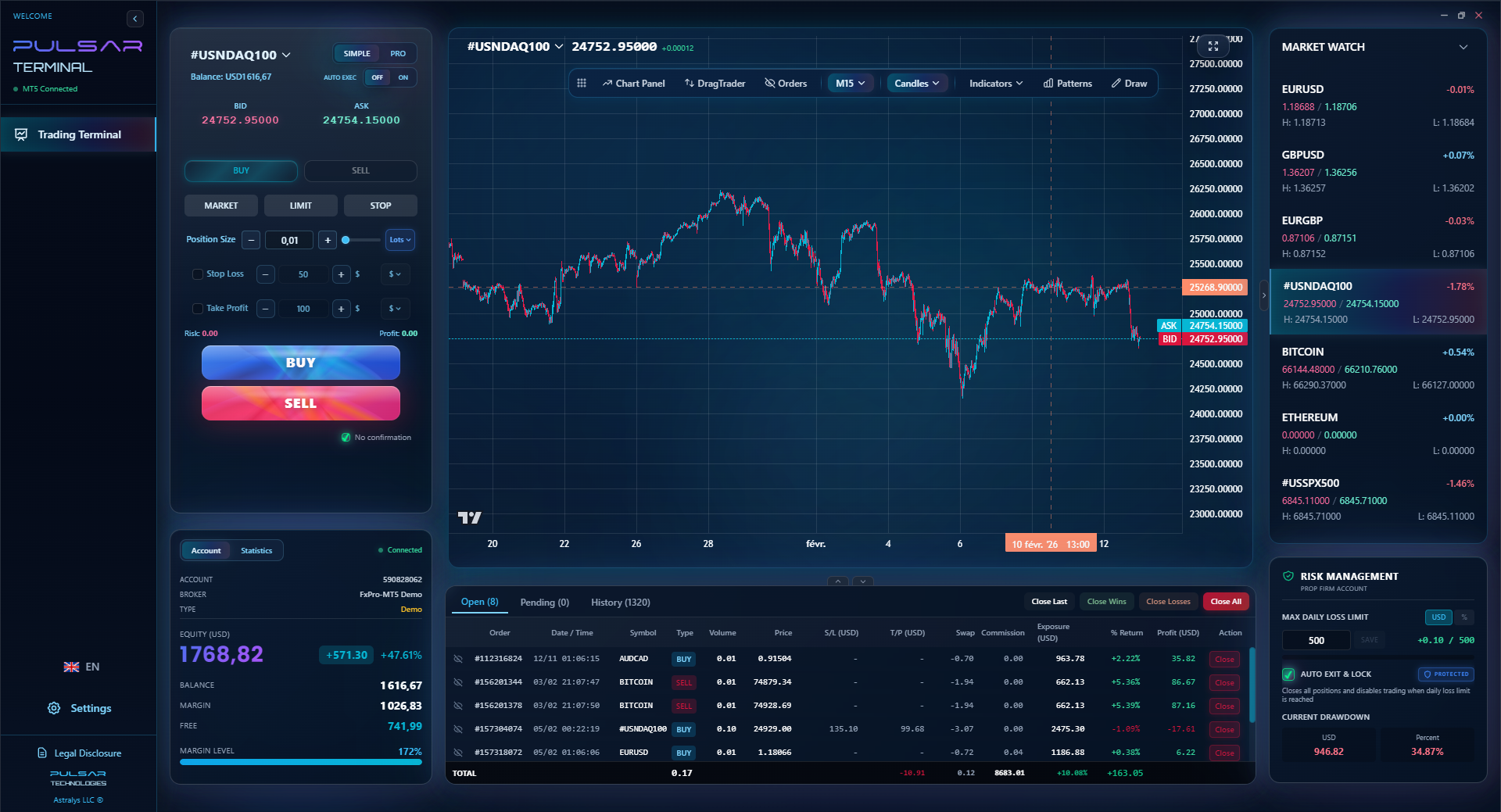
Managing multiple trades and complex exit strategies under strict US rules is easier with tools that automate risk management directly on your MT5 platform.
Pulsar Terminal
Lo strumento MT5 tutto-in-uno: ordini drag-and-drop, multi-TP/SL, trailing stop, grid trading, Volume Profile e protezione prop firm. Usato da oltre 1.000 trader ogni giorno.
Let's make this concrete. You have $1,000. Here's exactly how I'd approach it today, knowing what I know.
- Pick a Regulated Broker: Open a demo account with FOREX.com and OANDA. Test their platforms. See which one feels intuitive. Then, open a live account with your choice. Start with a micro or cent account if they offer it.
- Deposit & use Check: Deposit your $1,000. Remember, your max buying power on majors is $50,000 (1:50). Do not, under any circumstances, use all of it.
- Define Your Risk: I'd risk no more than 1% of my account per trade initially. That's $10. Not $100. $10.
- Plan a Trade: Let's use EUR/USD. You see a setup. Your stop-loss is 25 pips away. How much can you trade? $10 risk / (25 pips * $0.10 per pip on a micro lot) = 4 micro lots. So, your position size is 0.04 lots (4k).
- Execute & Manage: Enter the trade. Set your stop-loss and take-profit immediately. A good starting aim is a 1:2 risk/reward. So, a 25-pip stop and a 50-pip target. Then, walk away. Don't micromanage it.
Your goal with this first $1,000 is not to double it. Your goal is to make 20 trades following this exact process. If you can finish this exercise with $950 or more and a journal full of lessons, you're ahead of 80% of beginners. The keyword here is process, not profit.
💡 Consiglio di Winston
Journal your losses in more detail than your wins. The pattern of your mistakes is the most valuable data you will ever collect.
“Your goal with your first $1,000 is not to double it. Your goal is to make 20 trades following a strict process.”
Once you've mastered the basics, a new world of terms opens up. These aren't for beginners, but you should know they exist.
Volume Profile/Market Profile: This analyzes where trading activity actually occurred at different price levels, not just where price went. It helps identify truly significant support and resistance zones. It's a step beyond looking at simple horizontal lines on a chart.
Algorithmic/Systematic Trading: This is building a set of rules (an algorithm) that can be coded into an Expert Advisor (EA) on MT4/MT5 to execute trades automatically. In the US, ensure your broker allows EAs and understand any limitations. Backtest thoroughly.
Prop Firm Challenges: Proprietary trading firms offer evaluation challenges where you trade their capital for a share of profits. This has become huge. The key for US traders is that these firms are almost always overseas. You're not breaking US law by taking a challenge, but you must understand you're dealing with an unregulated entity. Their rules (like max daily loss limits) are strict. Passing one requires iron-clad discipline. I've passed a few, and the psychological pressure is another level entirely.
Correlation Trading: Understanding how pairs move together. For example, AUD/USD and NZD/USD often move in sync. Buying both isn't diversification; it's doubling down on a similar bet. Tools that analyze correlation can help you avoid overexposure.
The path in US forex trading is clear: master the restrictive fundamentals first. Build a rock-solid, rule-based process. Then, and only then, explore these advanced concepts. They are force multipliers for a good trader, but they are ruinous for a bad one.
FAQ
Q1Can I use a non-US forex broker to get higher use?
Technically, you can often open an account. However, it's against the terms of service of nearly all non-US brokers for a US resident to trade with them. They require you to declare your residency, and if you lie, you commit fraud. More importantly, you lose all CFTC/NFA protections. Your funds are not segregated under US law, and you have little recourse if the broker fails or acts unfairly. It's a massive risk for a bit more use.
Q2What's the minimum deposit to start forex trading in the US?
It can be as low as $0 (OANDA) or $50 (tastyfx), but I strongly recommend starting with at least $500-$1,000. Why? With a tiny account and 1:50 use, your position sizes become so small that trading costs (as a percentage) are huge. A $100 account risking 1% ($1) can barely withstand the spread on a micro lot. A larger starting amount lets you practice realistic position sizing and risk management from day one.
Q3Are there any US brokers that offer MetaTrader 5 (MT5)?
Yes, but the offering is more limited than MT4. As of 2026, OANDA and FOREX.com offer MT5 to US clients. Always check the broker's website directly, as platform availability can change. MT5 has advantages for multi-asset trading, but for pure forex, MT4's environment of indicators and EAs is still more extensive.
Q4How do I know if my broker is properly regulated?
Go directly to the NFA's website (nfa.futures.org). Use their 'Background Affiliation Status Information Center' (BASIC) search tool. Type in your broker's name (e.g., 'FOREX.com'). Look for them being listed as a 'Forex Dealer Member' (FDM) with an active status. This is the only source you should trust.
Q5Is forex trading taxable in the US?
Yes. The IRS treats forex trading as ordinary income or loss under Section 988 for most traders. You can also elect Section 1256 treatment, which taxes 60% of gains as long-term and 40% as short-term, regardless of holding period, but this comes with specific rules and is usually for more active, professional traders. Keep careful records of every trade (date, pair, P/L) and consult a tax professional familiar with forex.
Q6What's the most traded pair for US traders, and why?
EUR/USD, by a huge margin. It has the tightest spreads, the highest liquidity (meaning your orders fill quickly at the price you see), and it's active during both the European and US sessions. For a beginner, it's the best place to learn. The low spread keeps costs down while you're figuring out your strategy. You can read our full EUR/USD guide for a deeper dive.
Lezione del Prof. Winston
Punti chiave:
- ✓US use caps (1:50) protect you from yourself.
- ✓FIFO rule eliminates hedging, demanding clear stops.
- ✓Real cost includes spread, commission, and swap.
- ✓Success requires process over profit in the beginning.
Quanto è stato utile questo articolo?
Clicca su una stella
Analisi Trading Settimanali
Analisi e strategie settimanali gratuite. Nessuno spam.
Sull'autore
James Mitchell
Analista Trading Senior
Con base a New York e oltre 9 anni di esperienza nel trading. Si occupa delle principali coppie USD, sfide delle prop firm e del contesto normativo statunitense.
Commenti
Avviso di rischio
Il trading di strumenti finanziari comporta rischi significativi e potrebbe non essere adatto a tutti gli investitori. Le performance passate non garantiscono risultati futuri. Questo contenuto è fornito solo a scopo educativo e non deve essere considerato un consiglio di investimento. Conduci sempre le tue ricerche prima di fare trading.
Potrebbe interessarti anche

Cara Trading Forex Sukses: 7 Prinsip dari Trader Profesional
Cara trading forex sukses dengan 7 prinsip trader pro: manajemen modal, disiplin, journal trading, backtest. Data nyata, bukan janji profit palsu.
Jam Trading Forex Terbaik untuk Trader Indonesia: Panduan Lengkap dengan Tabel Waktu
Panduan jam trading forex untuk trader Indonesia. Tabel 4 sesi dunia, jam emas 20:00-00:00, sesi mana yang harus dihindari. Data akurat + tips dari trader berpengalaman.
Top 5 Sàn Forex Uy Tín Nhất 2026: Review Jujur dari Trader Indonesia
Top 5 sàn forex uy tín 2026 untuk trader Indonesia. Review jujur: spread, deposit, withdraw, dukungan lokal. Exness, XM, IC Markets & lebih.
Scarica Pulsar Terminal
Tutti questi calcolatori sono integrati in Pulsar Terminal con dati in tempo reale dal tuo conto MT5.
Scarica Pulsar Terminal