


Here's a number that should make you pause: over 70% of new Nigerian traders quit within six months.

Olumide Adeyemi
Pioniere del Trading in Africa Occidentale ·  Nigeria
☕ 11 min di lettura
Cosa imparerai:
Here's a number that should make you pause: over 70% of new Nigerian traders quit within six months. A huge part of that failure rate isn't just strategy; it's starting with the wrong broker. The wrong platform, impossible withdrawal rules, or crazy spreads can kill your account before you even learn what a pip is. This isn't about a shiny 'top 10' list. This is a practical, from-the-trenches guide to finding a broker that actually works for you here in Nigeria, with your Naira, and your goals.
Forget global rankings for a second. A good broker for us needs to solve Nigerian problems. The first and biggest is funding. If you can't get your money in or out reliably, nothing else matters. The CBN's restrictions on international card transactions are real, so you need a broker that accepts methods that work here: local bank transfers (in Naira), e-wallets like Neteller and Skrill, or even crypto.
Second is the Naira account. More brokers are offering this, and it's a game-saver. It means you deposit ₦50,000, and it stays as ₦50,000 in your account balance. You trade USD pairs, but the profit/loss is converted at the broker's rate. It cuts out the bank's terrible conversion fees on the way in.
Finally, there's support. When you have an issue at 9 PM on a Sunday, you don't want a call center in another hemisphere. Local or dedicated African support isn't a luxury; it's essential. I learned this the hard way early on with a broker that took 72 hours to reply to a simple ticket. During that time, a trade moved against me and I couldn't adjust my stop-loss. Cost me $120 in unnecessary losses.

Warning: A 'good' broker with terrible customer service for your region is a bad broker. Your ability to manage risk depends on them responding when you need help.
Let's be clear: Nigeria's local regulatory framework for online retail forex trading is still taking shape. The SEC requires registration, but many international brokers you'll use operate under their home-country licenses. This isn't inherently shady; it's the current reality. Your protection comes from choosing a broker regulated by a reputable international authority.
Look for brokers licensed by one of the 'Tier-1' regulators: the UK's FCA, Australia's ASIC, or Cyprus's CySEC. These bodies have strict client money protection rules. For example, under FCA rules, your funds are held in segregated accounts, separate from the broker's operating money. If the broker goes bust, your capital isn't part of their assets to pay debts.
Many brokers serving Nigeria use their offshore entities (like in Seychelles or Mauritius) for higher use offers. That's fine, but check that the parent company is still solidly regulated elsewhere. It's a balance between the safety of strict regulation and the flexibility (like higher use) that offshore entities provide.
The Tax Reality
Here's the part no one likes to talk about but everyone needs to know: you are responsible for paying a 10% Capital Gains Tax on your trading profits to the Federal Inland Revenue Service (FIRS). Your international broker won't deduct it for you. You need to keep your own clear records of all trades, deposits, and withdrawals. I use a simple spreadsheet, noting every closed trade. When tax season comes, I have the gross profit figure ready. Trying to reconstruct it a year later from broker statements is a nightmare.

💡 Consiglio di Winston
Your first broker is like your first car. It doesn't need to be a Ferrari; it needs to be reliable, get you from A to B, and not break down when you're learning to drive. Fancy features come later.
“A 'good' broker with terrible customer service for your region is a bad broker.”
This is my curated list based on years of trading, talking with other Nigerian traders, and testing platforms. These aren't in a 'ranked' order, but grouped by what they're best for.
For Low-Cost, High-use Access:
- Exness: A giant in our market for a reason. Their Standard Account has a $10 minimum, spreads from 1 pip on EUR/USD, and they offer use up to 1:2000. They have strong Naira support and multiple local deposit options. I've used them for scalping because the execution is fast. Their weakness? The very high use is a double-edged sword; it's easy to over-use and get a margin call quickly.
- OctaFX: Another popular choice with a strong local presence. Minimum deposit is around $25, spreads are tight (from 0.7 pips), and they have their own OctaTrader app alongside MT4/MT5. They accept local bank transfers directly. Their copy trading feature is decent for beginners who want to learn by following.
For Raw Trading Costs & Serious Volume:
- IC Markets: This is my primary broker for most trades. Why? Raw spreads. On their Raw Spread account, I regularly see a 0.0 pip spread on EUR/USD, with a small commission per lot. If you're trading size, those fractions of a pip add up. The minimum deposit is higher (around $200), and it's a true ECN environment. The platform choice is excellent (MT4, MT5, cTrader).
- Pepperstone: Similar to IC Markets in the 'low-cost pro' bracket. Fantastic execution, tight spreads, and regulated by top-tier authorities. Their Razor account is comparable. Their customer service has been stellar in my experience.
For User-Friendly Platforms & Education:
- XTB: Their xStation 5 platform is, in my opinion, the best proprietary platform out there. It's intuitive, clean, and has great built-in tools. They offer a $0 minimum deposit, which is perfect for absolute beginners who just want to test the environment. Their educational content is also top-notch.
- AvaTrade: They offer fixed spreads, which can be a blessing for new traders trying to calculate exact risk. No worrying about the spread widening during news events. They also have great social and copy trading integrations if that's your style.
The Local Heavyweight:
- FXTM (ForexTime): They have a massive physical presence in Nigeria. Offices, local seminars, Naira accounts – they've invested here. This translates to very easy funding and withdrawals and support that understands local issues. Their account types cater to everyone from micro traders to professionals.
Here’s a quick comparison of key specs:
| Broker | Min. Deposit (Approx.) | Avg. EUR/USD Spread | Best For |
|---|---|---|---|
| Exness | $10 | ~1.0 pip | Beginners, high use, Naira support |
| IC Markets | $200 | 0.0 - 0.1 pip | Low-cost trading, serious volume, ECN |
| XTB | $0 | ~0.9 pip | Platform ease, education, starting out |
| FXTM | $500 (lower for Naira) | ~0.8 pip | Local support, Naira accounts, community |
| OctaFX | $25 | ~0.8 pip | Local bank transfers, copy trading |

Pro Tip: Don't just open a live account. Open a demo account with 2-3 of these brokers. Test their platform speed, see the real spreads at the times you trade, and try making a dummy deposit and withdrawal request to their support. This 'test drive' is useful.
This is where your trading journey can get stuck before it starts. Let's break down the methods.
Local Bank Transfer (NGN): The holy grail if your broker offers it. You transfer Naira from your Nigerian bank to the broker's local Nigerian bank account. No CBN international limits, no conversion fees. Brokers like FXTM, OctaFX, and Exness excel here. Processing is usually within a few hours.
E-Wallets (Neteller, Skrill, PayPal): My personal go-to for brokers without local Naira accounts. You fund your e-wallet (which can be a process involving your bank card or a transfer), then move money to the broker. Withdrawals come back to the e-wallet. Fees apply, but it's reliable. I keep a Skrill balance specifically for trading movements.
Cryptocurrency: Increasingly common. You send USDT (Tether) from your crypto wallet to the broker's wallet address. It's fast and bypasses the traditional banking system entirely. The volatility of crypto itself is a risk, but using a stablecoin like USDT mitigates that. Check the broker's supported networks (e.g., TRC-20, ERC-20).
International Card: The most problematic. CBN limits and individual bank policies mean your $500 deposit might be declined, or only $100 goes through. I don't recommend this as a primary method anymore.

Example: In 2023, I deposited ₦300,000 with a broker using a Naira transfer. The broker's conversion rate to USD was 1 USD = ₦760. My trading capital was ~$394.74. If I had used my card, my bank's rate was ₦785/$1, plus a 2% fee. I would have started with only ~$381. That's a $13.74 loss before placing a single trade.
💡 Consiglio di Winston
If a broker's main marketing pitch is their bonus, not their execution or security, walk away. You're a trader, not a lottery winner.
“Low spreads reduce your cost per trade. High use is a dangerous tool that amplifies losses.”
MT4 and MT5 are the kings here, and for good reason. They're stable, ubiquitous, and every indicator or Expert Advisor (EA) you'll ever need is built for them. If you're new, start with MT4. It's simpler. If you want to trade more than just forex (stocks, futures), MT5 is the upgrade.
Your broker's version of MT4/MT5 is just a gateway to their servers. The real difference is in their server stability and execution speed. A cheap broker might have platform slippage during high volatility. I've seen a 5-pip slippage on a news trade with a sub-par broker, which turned a winning idea into a loser. That's why testing on demo during volatile periods (like London open) is crucial.
Beyond the basic platform, think about tools for analysis. Do you need advanced charting? Built-in economic calendars? Some brokers, like XTB with xStation, bake these in beautifully. Others, you'll rely on third-party tools or your own trading journal.
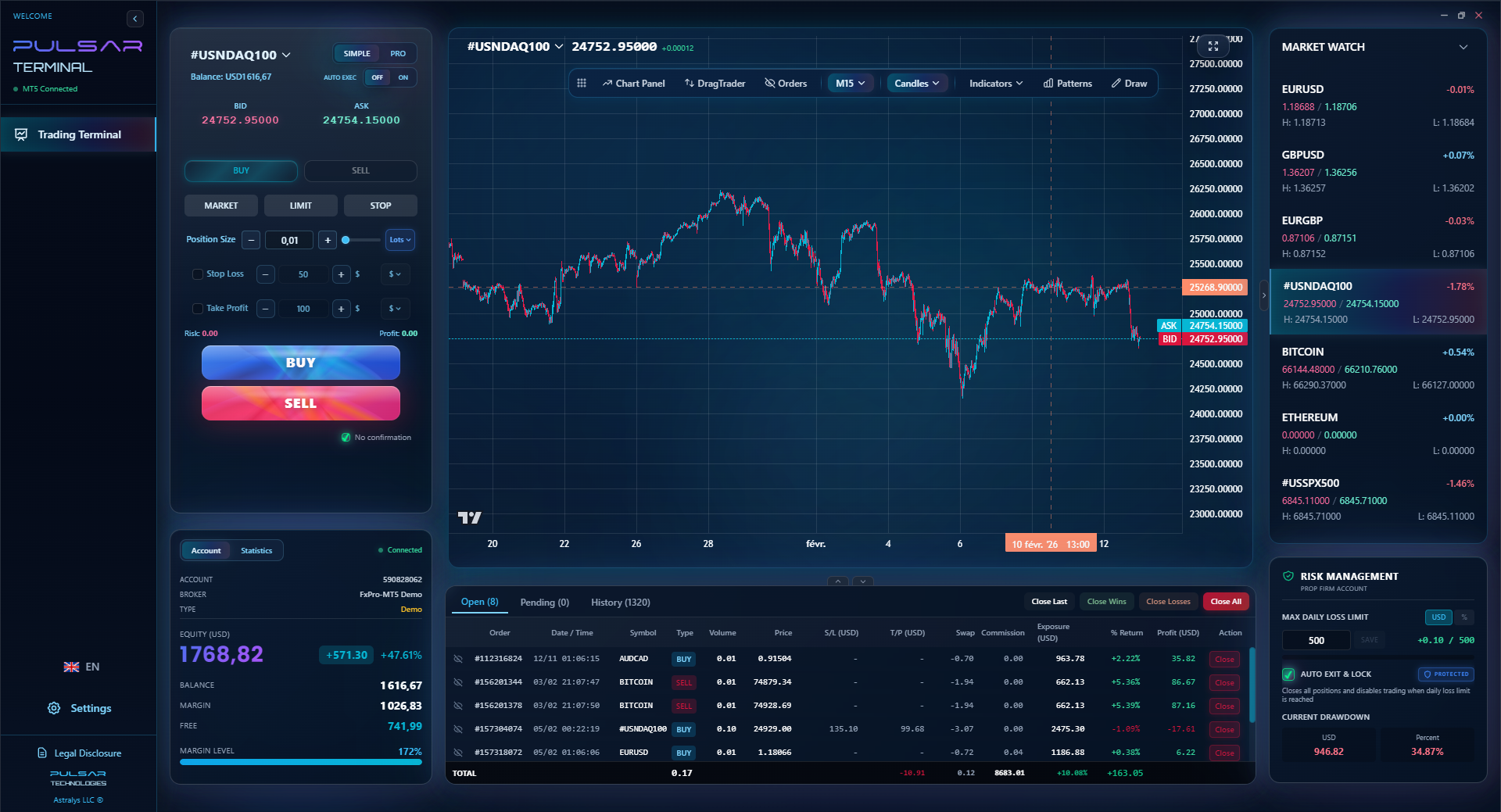
For managing trades, basic MT4 is limited. Setting multiple take-profits or moving stops to breakeven is a manual chore. This is where external tools that integrate with MT4/MT5 become powerful for managing risk and automating routine tasks.
Managing complex trades and risk manually on MT4 is slow; Pulsar Terminal automates multi-TP/SL, trailing stops, and breakeven moves directly on your charts.
Pulsar Terminal
Lo strumento MT5 tutto-in-uno: ordini drag-and-drop, multi-TP/SL, trailing stop, grid trading, Volume Profile e protezione prop firm. Usato da oltre 1.000 trader ogni giorno.
I've made these mistakes so you don't have to.
1. Chasing Bonuses: A broker offers a '100% deposit bonus!' Sounds great, right? It's often a trap. These bonuses come with insane withdrawal conditions, like trading volume requirements 50 times your bonus amount. You can easily end up locked in, forced to trade wildly to unlock your own money. I learned this early on; it took me 4 months of aggressive (and risky) trading to clear a bonus and withdraw my profit. Stick with brokers who offer transparency, not gimmicks.
2. Ignoring the Swap/Rollover Rate: If you hold a trade overnight, you pay or earn a swap fee. For some pairs, like USD/TRY, holding a sell position overnight can incur a massive daily cost that eats your profits. Always check the swap rates on your broker's website before holding a trade for multiple days, especially if you're into swing trading.
3. Not Verifying Withdrawals First: Before you deposit a large amount, do a small test withdrawal. Deposit $50, trade it a bit (or not), then request a withdrawal back to your chosen method. See how long it takes, what fees are deducted, and if there's any hassle. A broker that makes withdrawing $50 difficult will be a nightmare with $5,000.
4. Overlooking the Spread on Your Preferred Pairs: A broker might have great EUR/USD spreads but terrible spreads on GBP/AUD or exotic pairs like USD/NGN (if they offer it). If you have a specific pair in mind, check the live spreads on their demo account during your trading hours.
💡 Consiglio di Winston
Test withdrawals with a small amount before any major deposit. A broker that makes it easy to get your money out is a broker you can trust.
“Test withdrawals with a small amount before any major deposit. Trust is built on exit doors, not just entry gates.”
Here's your action plan.
Step 1: Define Your Profile. Are you a beginner with ₦50,000 testing the waters? A scalper needing ultra-low costs? A swing trader holding for days? Your style dictates your broker needs.
Step 2: Shortlist & Demo. Pick 2-3 brokers from the list above that match your profile. Open a demo account with each. Trade on them for two weeks. Get a feel. Test the MACD indicator or RSI on their charts. Practice entering and exiting trades.
Step 3: The Funding Test. Choose your top demo broker. Make a small live deposit using your intended method (maybe ₦20,000). Execute a few small trades. Then, immediately request a partial withdrawal. This verifies the entire cycle.
Step 4: Go Live, But Small. Start with capital you can afford to lose. Use a position size calculator religiously. Never risk more than 1-2% of your account on a single trade. This discipline is more important than your broker choice.
Step 5: Keep Learning & Review. Your first broker might not be your forever broker. As you grow, your needs change. Maybe you need better charting tools, or access to specific markets. It's okay to switch later. The goal is to find a partner that doesn't get in your way while you learn the real skill: trading the market itself, whether it's EUR/USD or XAU/USD.
FAQ
Q1Is forex trading legal in Nigeria?
Yes, forex trading is legal for individuals in Nigeria. The regulatory environment for online retail brokers is still developing, which is why most Nigerian traders use internationally regulated brokers. You are responsible for declaring and paying a 10% capital gains tax on your profits to the FIRS.
Q2Which broker is best for beginners in Nigeria?
For a complete beginner, I'd look at XTB (for its $0 minimum and excellent educational platform) or Exness (for its low minimum deposit, Naira support, and simplicity). Start with a demo account on both to see which interface you prefer.
Q3How can I fund my forex account with Naira?
The easiest way is to use a broker that offers local Naira bank transfers, like FXTM, OctaFX, or Exness. You send Naira directly to their Nigerian bank account. Alternatively, you can use e-wallets like Neteller or Skrill, which you fund with your Naira card/bank account, then transfer to the broker.
Q4What is the minimum amount I need to start forex trading in Nigeria?
You can start with as little as $10 (about ₦7,500-₦8,000) with brokers like Exness. However, I strongly advise starting with a larger amount you can afford to lose, like ₦50,000 - ₦100,000. This allows for proper position sizing and reduces the pressure to make huge percentage gains on tiny capital.
Q5Are there any Nigerian-regulated forex brokers?
The local regulatory framework for online retail forex brokers is still evolving. While the SEC is the relevant body, most popular brokers serving the Nigerian market are internationally regulated (e.g., by FCA, CySEC, ASIC). It's more important to choose a broker with a strong international license and a proven track record of serving Nigerian clients reliably.
Q6What's more important, low spreads or high use?
Low spreads, 100 times over. Low spreads reduce your cost per trade, which directly increases your profitability over time. High use is a dangerous tool that amplifies both gains and losses. Beginners often get attracted to 1:1000 use, but it's a fast track to a margin call. Focus on controlling your risk with proper position sizing, not on maximizing use.
Lezione del Prof. Winston
Punti chiave:
- ✓Prioritize Naira funding & local support.
- ✓Verify international regulation (FCA, ASIC, CySEC).
- ✓Test the full deposit/trade/withdrawal cycle with small money first.
- ✓Choose spreads over use for long-term success.
- ✓You are responsible for your 10% capital gains tax.
Quanto è stato utile questo articolo?
Clicca su una stella
Analisi Trading Settimanali
Analisi e strategie settimanali gratuite. Nessuno spam.
Sull'autore
Olumide Adeyemi
Pioniere del Trading in Africa Occidentale
Uno degli educatori di trading forex più attivi in Nigeria. 8 anni di esperienza di trading da Lagos. Specializzato in strategie a basso capitale e sfide prop firm per trader africani.
Commenti
Avviso di rischio
Il trading di strumenti finanziari comporta rischi significativi e potrebbe non essere adatto a tutti gli investitori. Le performance passate non garantiscono risultati futuri. Questo contenuto è fornito solo a scopo educativo e non deve essere considerato un consiglio di investimento. Conduci sempre le tue ricerche prima di fare trading.
Potrebbe interessarti anche

Cara Trading Forex Sukses: 7 Prinsip dari Trader Profesional
Cara trading forex sukses dengan 7 prinsip trader pro: manajemen modal, disiplin, journal trading, backtest. Data nyata, bukan janji profit palsu.
Jam Trading Forex Terbaik untuk Trader Indonesia: Panduan Lengkap dengan Tabel Waktu
Panduan jam trading forex untuk trader Indonesia. Tabel 4 sesi dunia, jam emas 20:00-00:00, sesi mana yang harus dihindari. Data akurat + tips dari trader berpengalaman.
Top 5 Sàn Forex Uy Tín Nhất 2026: Review Jujur dari Trader Indonesia
Top 5 sàn forex uy tín 2026 untuk trader Indonesia. Review jujur: spread, deposit, withdraw, dukungan lokal. Exness, XM, IC Markets & lebih.
Scarica Pulsar Terminal
Tutti questi calcolatori sono integrati in Pulsar Terminal con dati in tempo reale dal tuo conto MT5.
Scarica Pulsar Terminal