


I watched my screen in disbelief as the MCX Gold Mini contract I was long on hit a lower circuit.

Rajesh Sharma
Analista Forex Senior ·  India
India
☕ 12 min di lettura
Cosa imparerai:

I watched my screen in disbelief as the MCX Gold Mini contract I was long on hit a lower circuit. It was March 2026, and gold had just turned negative for the year after a record rally. My ₹25,000 position, which I'd entered based on a 'sure thing' breakout on a 15-minute chart, was locked. I couldn't exit. The ₹150,300 per kg price on my TradingView chart was just a number; my reality was a frozen position and a margin call notification from my broker. That loss, a cool ₹8,400 gone in minutes, taught me more about MCX gold trading than any winning trade ever did. It's not just about charts; it's about understanding a unique, regulated market where domestic factors and global chaos collide.
Let's cut through the jargon. MCX gold trading isn't buying physical bars. It's speculating on the future price of gold in Indian rupees, on India's Multi Commodity Exchange. Think of it like stock futures, but for gold. The key difference? It's hyper-local. The price you see on your MCX gold trading view isn't just the international spot price converted. It's that price, plus or minus the USD/INR rate, plus local demand, import duties, and pure market sentiment.
SEBI regulates this whole show. They took over from the Forward Markets Commission back in 2015, and their rules are what keep the market from turning into a casino (though it can feel like one sometimes). They set position limits, mandate margins, and require full transparency. This structure is why you can trade with confidence, but also why you get hit with things like circuit filters that can lock you in a trade.
The contracts themselves come in sizes for every wallet. You've got the big one: Gold Standard at 1 kg. Then there's the retail favorite, Gold Mini at 100 grams. For smaller accounts, there's Gold Guinea (8g) and Gold Petal (1g). Most traders I know, myself included, stick with the Mini. It gives you enough exposure to matter without requiring a mortgage for the margin.

Warning: Don't confuse MCX futures with trading gold CFDs with international brokers. They are fundamentally different. MCX is a regulated Indian exchange with physical delivery as the ultimate settlement mechanism (even if you square off before). The rules, taxes, and trading hours are all specific to India. For a deep dive on the global spot version, check our XAU/USD guide.

“MCX gold trading isn't about charts; it's about understanding a unique, regulated market where domestic factors and global chaos collide.”
This is where most new traders get blindsided. They see the price move and think about profit, not the cost of doing business. Ignore this section, and you'll be profitable on paper but broke in reality.
The Margin Trap
Margins aren't a suggestion; they're a requirement. Your broker will ask for an Initial Margin (typically 6-10% of contract value, or higher based on volatility) and an Extreme Loss Margin (another 1%). In February 2026, MCX removed an additional 3% margin on gold futures, which was a relief. But don't get complacent.
Let's use real numbers from early 2026. Say Gold Mini (100g) is at ₹150,300 per kg. That's ₹15,030 per 100g contract. Your initial margin could be around ₹1,200 to ₹1,800. That's the deposit. But if the price moves against you, you'll get a "margin call" to top it up. If you don't, they'll close your position at a loss. I learned this the hard way early on. I had ₹20,000 in my account and thought three Mini lots was safe. A 1% move against me triggered the call, and I didn't have spare cash. Game over.
The Silent Fee Killers
Your brokerage fee is just the tip of the iceberg. Here’s what really eats returns:
| Fee Type | What It Is | Approximate Cost |
|---|---|---|
| Commodity Transaction Tax (CTT) | Government tax on sell-side trades. | 0.01% (Futures), 0.05% (Options) |
| Exchange Transaction Charge | Fee paid to MCX. | ~0.0021% of turnover |
| GST | Tax on brokerage + exchange charges. | 18% on top of those fees |
| SEBI Turnover Fee | Regulator's fee. | 0.0001% of turnover |
| Stamp Duty | State government tax. | 0.002% (Futures, buy side) |
Add it all up. On a ₹1.5 lakh trade, your total costs could easily be ₹80-120. That means your trade needs to move enough to cover that just to break even. This makes scalping strategy on small timeframes incredibly difficult on MCX. The math often doesn't work.

Example: You buy 1 lot of Gold Mini at ₹15,030 and sell at ₹15,100. Your gross profit is ₹70. After all fees (say ₹85), you've actually lost ₹15. You won on price, but lost money.

💡 Consiglio di Winston
The market doesn't reward complexity. It rewards patience and discipline. Your best MCX gold trade this month might be the one you didn't take.
“Ignoring the rupee is the #1 mistake traders make. You're trading an Indian price, not the international spot.”
TradingView is the go-to for charting, and for good reason. Its tools are excellent. But setting it up for MCX isn't always straightforward.
First, you need the right symbol. Don't just search "GOLD." You need the specific MCX contract. It's usually something like MCX:GOLD1! for the front-month continuous contract, or MCX:GOLDMINI1! for the mini. The ! denotes a continuous contract, which automatically rolls to the next expiry. This is crucial for your analysis - you want a smooth chart, not one with giant gaps every expiry.
I made a classic mistake here. I once built a beautiful support and resistance structure on an expiring contract. The chart looked perfect. I entered the trade, and the very next day, the chart switched to the new contract, which opened at a completely different price. My support line was now in the middle of nowhere. I was trading a ghost.
Key Settings for Your Charts
- Time Zone: Set your TradingView chart to IST (GMT+5:30). If you're analyzing patterns based on market open (9:00 AM) or global session overlaps, having the wrong time zone will misalign everything.
- Trading Hours: Remember, MCX gold trades from 9 AM to 11:30/55 PM. Your volume profile and candle patterns during off-hours (when international markets are moving but MCX is closed) mean something different. That gap at 9:00 AM open? That's the global move you missed.
- Indicators: Keep it simple. I use a Volume Profile to see where most trading happened (value area). A simple MACD indicator for momentum divergence works well on the 1-hour and 4-hour charts. Overloading the chart with 10 indicators just creates noise and conflicting signals.

Pro Tip: Use TradingView's "Compare" function. Pull up MCX:GOLD1! and compare it with FX:USDINR. You'll often see an inverse relationship. A falling rupee (USDINR up) can push MCX gold higher even if international gold is flat. This context is everything.

“Ignoring the rupee is the #1 mistake traders make. You're trading an Indian price, not the international spot.”
Forget the guru strategies promising 90% wins. Here’s a boring, evidence-based framework that keeps you in the game.
Step 1: The Context is King Before you even look at a 5-minute chart, know the context. Is the USD/INR screaming higher? Are global equity markets in a panic (bullish for gold)? What's the trend on the daily chart? I only take trades in the direction of the higher timeframe trend. If the daily chart is in a clear uptrend, I'm only looking for buy setups on lower timeframes. It sounds simple, but fighting the trend is the quickest path to a blown account.
Step 2: Find the Value Area This is where the MCX gold trading view on TradingView becomes powerful. I use the Volume Profile tool on the previous day's range. Where did most of the trading happen? That zone becomes my potential support or resistance. I look for price to return to that value area and show a reaction - a pin bar, a bullish engulfing pattern, a divergence on the RSI indicator. My best trades come from buying in the lower value area in an uptrend, not chasing breakouts.
Step 3: The Entry & The Safety Net Let me give you a real example from last week. Daily trend: up. Price pulled back into the previous day's value area around ₹150,800/kg. On the 1-hour chart, I saw a bullish divergence on the RSI (price made a lower low, RSI made a higher low). I entered a Gold Mini long at ₹150,850.
Here's the critical part: my stop loss. I didn't place it just below the recent low. I used the position size calculator and my risk rule: never risk more than 1% of my account on a single trade. My account was ₹200,000, so my max risk was ₹2,000. With my entry at ₹150,850, I calculated that a stop at ₹150,600 (a 0.16% move) would mean a loss of about ₹250 per lot. I could trade 8 lots. But I didn't. I traded 2. Why? Because volatility was high, and I wanted to give the trade room to breathe. I set a wider stop at ₹150,500 and traded fewer lots. This is the art of position sizing.
Step 4: The Exit I set a target at the previous swing high, around ₹151,500. The trade worked, netting about ₹650 per lot, or ₹1,300 total. Not a home run, but a solid single. This is swing trading MCX gold. You won't get rich overnight, but you can build consistency.
💡 Consiglio di Winston
Always know your 'rupee risk.' A 0.5% move in USD/INR can completely offset a 1% move in international gold. Trade the Indian price, not the global headline.
“Your beautiful setup on TradingView means nothing if you can't get a good fill. Execution is where profits are made or destroyed.”
I've fallen into every one of these. Consider this a list of my most expensive lessons.
Pitfall 1: Trading Around Expiry. MCX gold contracts expire. The delivery period is staggered. If you hold a position into the expiry week, you risk being forced into physical delivery (which most retail brokers like Zerodha don't even allow) or having your position squared off at a terrible price due to low liquidity. Always check the expiry date and roll over or close your position at least a week before.
Pitfall 2: Ignoring the Rupee. This is the #1 mistake traders coming from international platforms make. You might have a perfect bearish view on gold. But if the Indian rupee collapses, MCX gold can rally while international gold falls. You need to watch USD/INR like a hawk. A strong dollar (USD/INR up) is a tailwind for MCX gold prices.
Pitfall 3: Chasing the News. Geopolitical tension spikes, gold rockets. You see the price flying on your MCX gold trading view and FOMO in. By the time your order fills, the move is often over, and you're buying the top. The March 2026 surge to ₹163,142 was a classic example. The smart money was already in. The retail crowd piled in at the highs, just in time for the sharp correction. If you're not already positioned before the headline hits, the risk/reward is usually terrible.
Pitfall 4: Misunderstanding Liquidity. The Gold Mini is liquid. Gold Petal (1g) is not. A wide spread definition and slippage can kill a small trade. Stick to the main contracts.
Warning: The market's extended hours are a double-edged sword. Yes, you can trade when London and New York are active. But liquidity can be thin, and moves can be exaggerated. A small international move can trigger a large, gap-like move on MCX with few participants, leading to nasty slippage.
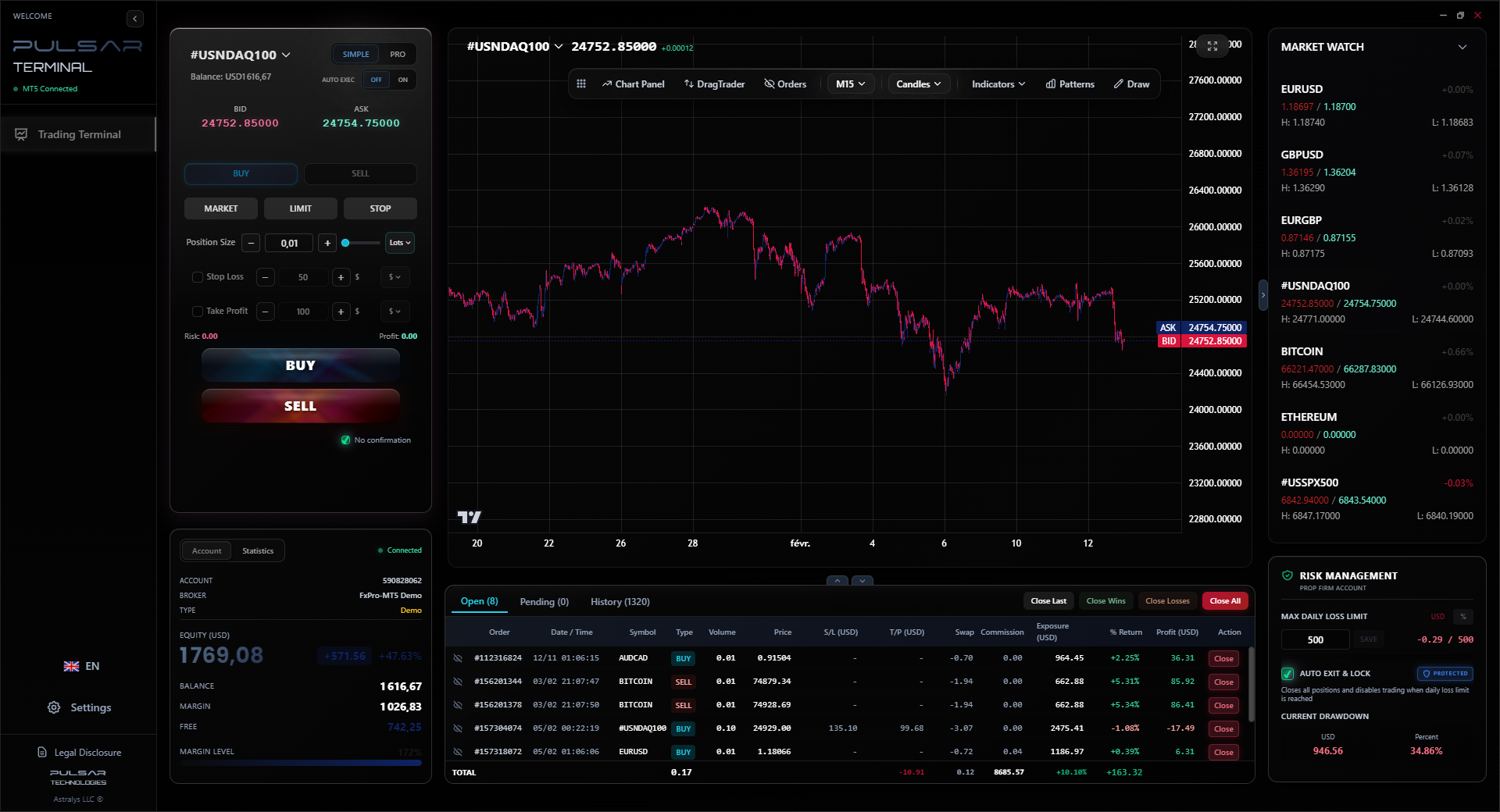
Managing multiple targets and a trailing stop on a volatile MCX gold trade is stressful, but tools like Pulsar Terminal automate this directly on your MT5 platform.
Pulsar Terminal
Lo strumento MT5 tutto-in-uno: ordini drag-and-drop, multi-TP/SL, trailing stop, grid trading, Volume Profile e protezione prop firm. Usato da oltre 1.000 trader ogni giorno.
“Your beautiful setup on TradingView means nothing if you can't get a good fill. Execution is where profits are made or destroyed.”
Your broker is your gateway. You'll use their platform to execute trades, even if your analysis happens on TradingView.
The Broker Decision: You need a SEBI-registered broker that offers MCX trading. Look beyond just brokerage fees. Consider:
- Platform Stability: Does it crash during high volatility? (This happens more than you think).
- Margin Policies: Are they conservative? Do they levy extra margins without much notice?
- Customer Support: Can you get someone on the phone when you have a position issue?
Many popular discount brokers like Zerodha, Upstox, and Angel One offer MCX. Upstox's flat ₹20 per trade is attractive for active traders. But test their commodity trading platform separately from their equity platform. They can feel like different worlds.
Execution is Everything: Here's a reality check. Your beautiful setup on TradingView means nothing if you can't get a good fill. Use limit orders, not market orders, especially around market open (9:00 AM) or during major news. I've seen market orders slip by 5-10 pips definition in a flash crash, turning a good idea into an instant loser.
Your trading plan must include your entry order type. "Buy if price breaks above resistance" is not a plan. "Place a BUY STOP LIMIT order at ₹151,010 (just above resistance) with a limit of ₹151,030" is a plan. It defines your maximum entry price.
This gap between analysis and execution is where tools like Pulsar Terminal bridge a massive hole for MT5 users, but for MCX, you're typically tied to your broker's native platform. Learn its order types inside out. Practice on a demo account until it's muscle memory. Panicking and clicking the wrong button is a rite of passage you can skip.
💡 Consiglio di Winston
Your trading platform's 'Market Depth' or 'Order Book' for MCX Gold is often a ghost town. Relying on it for execution is a sure way to get poor fills. Use limit orders.
“In MCX gold, where volatility can shake out the unprepared, being boring is your greatest edge.”
Trading isn't about one brilliant insight. It's about a boring, repeatable process. Here's mine.
Every Sunday Night:
- Macro Check: What's the trend in US yields? What's the USD/INR weekly close? Any major geopolitical events this week?
- MCX Gold Weekly Chart: Draw key support/resistance. What's the trend?
Before Market Open (8:45 AM):
- Overnight Action: What did gold do in London/NY? Where did it close? Where is USD/INR?
- Gap Analysis: Is MCX likely to open with a gap? If so, where is that gap relative to my weekly levels?
- Plan the Day: Based on context, am I looking for long or short setups today? What is the key level that would invalidate my bias?
During the Session:
- Wait for Your Setup: Don't trade for the sake of trading. Let price come to your pre-defined value area.
- Execute the Plan: Use your predetermined order types, stop loss, and position size. Once the order is placed, walk away for a bit. Micro-managing causes overtrading.
- Journal the Trade: Win or lose, write it down. Entry, exit, reasoning, P&L, emotional state. This is your most valuable tool for improvement.
Stick to this. It removes emotion. It turns trading from a thrilling gamble into a professional, albeit often dull, business. And in the world of MCX gold, where volatility can shake out the unprepared, being boring is your greatest edge.

FAQ
Q1What is the minimum amount needed to start trading MCX Gold?
There's no fixed minimum, but you need enough to cover the margin for at least one contract plus a buffer for losses. For the Gold Mini (100g), with a notional value of around ₹15,000, the initial margin could be ₹1,200-₹2,000. However, starting with just the margin is suicidal. You need capital to withstand moves against you. Realistically, don't start with less than ₹50,000 in your trading account if you're serious about trading the Mini contract.
Q2Can I avoid physical delivery of gold?
Absolutely, and you must. Almost all retail traders square off their futures positions before the contract's expiry date. If you hold until expiry, you enter the delivery period, which can lead to compulsory physical delivery - a logistical and financial nightmare for a retail trader. Most brokers (like Zerodha) don't even allow retail clients to take delivery. Always check your contract's expiry and close or roll over your position at least 3-5 days in advance.
Q3Why is the price on MCX different from international gold prices?
MCX gold is priced in Indian Rupees per 10 grams/kg. The international spot price is in US Dollars per ounce. The MCX price is a function of: (International Gold Price in USD) x (USD/INR exchange rate) + local premiums (like import duty, GST, local supply/demand). A falling rupee (USD/INR going up) can make MCX gold rise even if international gold is flat or falling.
Q4What are the trading hours for MCX Gold?
From 9:00 AM to 11:30 PM (April to October) and from 9:00 AM to 11:55 PM (November to March), Monday to Friday. This includes sessions that overlap with major global markets like London and New York.
Q5Is TradingView free for MCX Gold charts?
You can view basic MCX gold charts on a free TradingView account, but there will be a delay. For real-time data, you need a paid TradingView data subscription for "MCX" feeds. Alternatively, many Indian brokers provide their own charting platforms with real-time data, though they are usually not as feature-rich as TradingView.
Q6What is Commodity Transaction Tax (CTT) and how does it work?
CTT is a tax levied by the Indian government on the sale side of commodity futures and options contracts. For gold futures, it's 0.01% of the sell value. If you sell a Gold Mini contract worth ₹1,50,000, you'll pay ₹15 as CTT. For options, it's 0.05% on the sell side. This is a direct cost that reduces your net profit or increases your net loss.
Q7How do I find the correct MCX Gold symbol on TradingView?
Search for symbols like MCX:GOLD1! for the continuous front-month contract of standard gold (1kg), or MCX:GOLDMINI1! for the continuous Mini contract. The 1! denotes the most liquid contract that automatically rolls. You can also search for specific expiry contracts, like MCX:GOLDM26JUNFUT, but for technical analysis, the continuous contract is best.
Lezione del Prof. Winston
Punti chiave:
- ✓Margin is a requirement, not a suggestion. Under-capitalization is the fastest path to a margin call.
- ✓Total costs (CTT, GST, fees) can turn a winning price move into a losing trade.
- ✓Always use the continuous contract symbol (`GOLD1!`) on TradingView to avoid expiry gaps.
- ✓Never risk more than 1% of your account on any single MCX gold trade.
Quanto è stato utile questo articolo?
Clicca su una stella
Analisi Trading Settimanali
Analisi e strategie settimanali gratuite. Nessuno spam.
Sull'autore
Rajesh Sharma
Analista Forex Senior
Oltre 10 anni di trading sui mercati indiani e del Sud-Est asiatico. Ha iniziato con i derivati valutari del NSE prima di passare al forex internazionale. Specializzato in USD/INR e coppie dei mercati emergenti.
Commenti
Avviso di rischio
Il trading di strumenti finanziari comporta rischi significativi e potrebbe non essere adatto a tutti gli investitori. Le performance passate non garantiscono risultati futuri. Questo contenuto è fornito solo a scopo educativo e non deve essere considerato un consiglio di investimento. Conduci sempre le tue ricerche prima di fare trading.
Potrebbe interessarti anche

Cara Trading Forex Sukses: 7 Prinsip dari Trader Profesional
Cara trading forex sukses dengan 7 prinsip trader pro: manajemen modal, disiplin, journal trading, backtest. Data nyata, bukan janji profit palsu.
Jam Trading Forex Terbaik untuk Trader Indonesia: Panduan Lengkap dengan Tabel Waktu
Panduan jam trading forex untuk trader Indonesia. Tabel 4 sesi dunia, jam emas 20:00-00:00, sesi mana yang harus dihindari. Data akurat + tips dari trader berpengalaman.
Top 5 Sàn Forex Uy Tín Nhất 2026: Review Jujur dari Trader Indonesia
Top 5 sàn forex uy tín 2026 untuk trader Indonesia. Review jujur: spread, deposit, withdraw, dukungan lokal. Exness, XM, IC Markets & lebih.
Scarica Pulsar Terminal
Tutti questi calcolatori sono integrati in Pulsar Terminal con dati in tempo reale dal tuo conto MT5.
Scarica Pulsar Terminal