


You're probably thinking liquidity is just some boring term for 'how easy it is to buy and sell.' You're half right, but that's the dangerous part.

Olumide Adeyemi
Pioniere del Trading in Africa Occidentale ·  Nigeria
☕ 10 min di lettura
Cosa imparerai:

You're probably thinking liquidity is just some boring term for 'how easy it is to buy and sell.' You're half right, but that's the dangerous part. The other half is where your money gets made or lost. For a trader in Lagos trying to catch a move on GBP/NGN or EUR/USD, understanding liquidity isn't academic. It's the difference between your stop-loss getting filled at the price you see and getting absolutely wrecked by a 50-pip slippage because the market just vanished. I've been on both sides of that trade. Let's break down what it really means for you.
Most new traders confuse liquidity with trading volume. Volume tells you how much has been traded. Liquidity tells you how easily you can trade it right now, at a stable price. Think of it like selling a car. In a busy market (high liquidity), you can sell your Toyota Camry fast and get a fair price close to what you asked. In a village market at 2 AM (low liquidity), good luck finding a buyer without slashing the price.
In forex, liquidity comes from a constant tug-of-war. The big players are central banks, commercial banks, hedge funds, and multinational corporations moving billions. Your retail order is a drop in that ocean. The key pools of liquidity are the major currency pairs: EUR/USD, USD/JPY, GBP/USD. These are the 'deep' markets. Exotic pairs, like USD/NGN or EUR/TRY, are the 'shallow' end. The spread is your first clue about liquidity. A tight 0.8-pip spread on EUR/USD? Deep pool. A 50-pip spread on USD/NGN? You're wading in a puddle.

Warning: A common mistake is seeing high volume on a chart and assuming you're safe. Volume is historical. Liquidity is real-time. That high volume from the London session is useless if you're trading during the dead Tokyo session and news hits.
Here’s a personal screw-up. Early on, I got fancy and tried trading USD/ZAR (US Dollar/South African Rand). The charts looked great, the setup was perfect. I entered a sell order. The moment I clicked, the price jumped 15 pips against me before my order filled. That wasn't bad luck. That was low liquidity. My modest order was big enough to eat through all the available buy orders at my price, and I had to go hunting for the next seller, who charged me a premium. I lost on the entry before the market even moved.

💡 Consiglio di Winston
Liquidity is a coward. It runs and hides the moment real news hits. If you wouldn't swim in a lagoon at midnight, don't trade the market 5 minutes before a central bank announcement.

“Price doesn't move because of news. It moves because of orders hitting the market, guided by liquidity.”
Price doesn't move because of news. It moves because of orders hitting the market, and those orders are guided by liquidity. Think of the market as a stack of orders at different prices - the order book. A thick stack at a price level means high liquidity there. A thin stack means low liquidity.
The Stop-Hunt Phenomenon
This is where it gets real. Major support and resistance levels are often where retail traders cluster their stop-loss orders. The big banks and algos can see these clusters (not your specific stop, but the liquidity pool). They have the firepower to push price into that zone, trigger a cascade of stops, and then reverse. Why? To collect that liquidity. Your stopped-out loss is their profitable fill. I've been hunted more times than I care to admit. The lesson? Don't place your stop-loss at the obvious round number where everyone else does. Place it beyond where the liquidity pool likely ends.
Slippage: Liquidity's Bite
Slippage is when your order fills at a worse price than you requested. It happens almost exclusively in low-liquidity conditions or during high volatility (like news events). The market literally runs out of orders at your price. If you're buying, you have to pay up. If you're selling, you have to accept less. Using a market order during the NFP (Non-Farm Payrolls) report is asking for catastrophic slippage. A limit order protects you, but it might not get filled at all. It's a choice between certainty of execution and certainty of price. You rarely get both.

Example: You want to buy 2 lots of USD/NGN at 1600.00. The liquidity is thin. Your broker's system finds:
- 0.5 lots at 1600.00
- 0.7 lots at 1600.05
- 0.8 lots at 1600.10 Your average fill price becomes roughly 1600.05. That's 5 pips of slippage on a pair where the spread might already be 20 pips. Your trade is in the red before it even starts. This is why a position size calculator is non-negotiable. You must account for this potential cost.
“Your retail order is a drop in an ocean of institutional money. You don't move the market, you surf its waves.”
Liquidity isn't static. It ebbs and flows with the global trading sessions. If you're trading from Abuja or Port Harcourt, you need to know this schedule like you know your own name.
| Session | Time (WAT) | Key Pairs | Liquidity Vibe |
|---|---|---|---|
| Tokyo | 12 AM - 9 AM | USD/JPY, AUD pairs | Moderate. Can be quiet, prone to false breaks. |
| London | 8 AM - 5 PM | EUR/USD, GBP/USD, USD/CHF | HIGH. The main event. Most volume, tightest spreads. |
| New York | 1 PM - 10 PM | EUR/USD, USD/CAD, USD/JPY | HIGH. Overlaps with London for 4 hours (1 PM - 5 PM WAT). This is peak liquidity. |
| Pacific/Sydney | 10 PM - 7 AM | AUD, NZD pairs | Low. The wild west. Wide spreads, easy to get slippage. |
The golden hours are the London-New York overlap (1 PM - 5 PM WAT). This is when the meaning of liquidity in forex is most evident: spreads are razor-thin, moves are decisive, and your orders get filled fast. Trying to scalp during the Sydney session is a recipe for frustration and losses. The market is thin, and a single decent-sized order can cause a spike that ruins your setup.
I learned this the hard way. I used to try trading GBP/USD late at night. I'd see a pin bar form and jump in. More often than not, the price would just grind sideways or get jerked around by an algo. The moves lacked conviction because the liquidity wasn't there to support a real trend. I was fighting the tide. Now, I structure my day around the London open. My profitability changed overnight.

“A tight spread is liquidity smiling at you. A widening spread is it baring its teeth.”
You don't trade directly with the interbank market. Your broker is your gateway. How they connect to liquidity providers (LPs) directly impacts your trading. There are two main models, and you need to know which one you're in.
Market Makers (MM) vs. ECN/STP Brokers
- Market Makers: They often act as the counterparty to your trade. They may hedge your order in the real market, or they may take the other side. In low-liquidity times, they can widen spreads dramatically or even reject orders. Your conflict of interest is higher.
- ECN/STP Brokers: These brokers (like IC Markets or Pepperstone) route your order directly to a network of banks and LPs. You get access to deeper, aggregated liquidity. Spreads are usually tighter, especially during high-volume times, but you pay a small commission. Slippage can be positive or negative here.
Your choice of broker dictates your liquidity access. A broker with poor LP connections will give you worse fills, especially on larger orders. Always check if your broker offers depth of market (DOM) data. It's a visual representation of the order book, showing you the liquidity at different price levels in real-time. It's one of the most honest views of the market you can get.

Pro Tip: Before you fund a live account, test a broker's execution during a high-impact news event on a demo. Place a market order on EUR/USD 10 seconds after NFP drops. Note the slippage. If it's consistently horrific (like 10+ pips on a major), their liquidity connections are weak. I did this with three brokers before settling on my current one. The difference in fills was staggering.
💡 Consiglio di Winston
Your broker's liquidity is their report card. Consistently terrible slippage and wide spreads on majors? They've failed the test. Fire them.

“A tight spread is liquidity smiling at you. A widening spread is it baring its teeth.”
Okay, so liquidity is important. How do you actually use this? You trade with the liquidity flow, not against it.
1. Follow the Session Money: Align your trades with the active session. If London is open, focus on EUR, GBP, and CHF pairs. Your signals will be cleaner. Save your swing trading analysis for the daily charts, which smooth out session noise.
2. Respect the News Blackout: Major economic news (CPI, Interest Rates, NFP) creates a temporary but massive evaporation of liquidity. Market makers pull their orders, spreads blow out, and price can gap. Do not have open market orders during these times. If you're in a trade, consider tightening your stop or closing it before the announcement. Protecting your capital is more important than catching a volatile spike.
3. Use Limit Orders in Thin Markets: If you must trade an exotic pair or during off-hours, use limit orders to define your exact entry price. You sacrifice the guarantee of a fill for price certainty. This saved me countless times trading Gold (XAU/USD) in Asian hours.
4. Watch for Liquidity Pools on Charts: Key technical levels (previous day high/low, weekly opens, major round numbers) often hold liquidity. A price approach to these levels with increasing volume can signal a potential reversal or breakout as those orders get taken. Combine this with an indicator like the RSI indicator for confluence.
5. Size Matters: Your lot size should be proportional to the liquidity of the pair. Trading 5 standard lots on USD/NGN is insane. Trading 5 lots on EUR/USD during the London overlap? That's what the market is built for. Always, always use a position size calculator linked to the volatility of the specific pair and time of day.

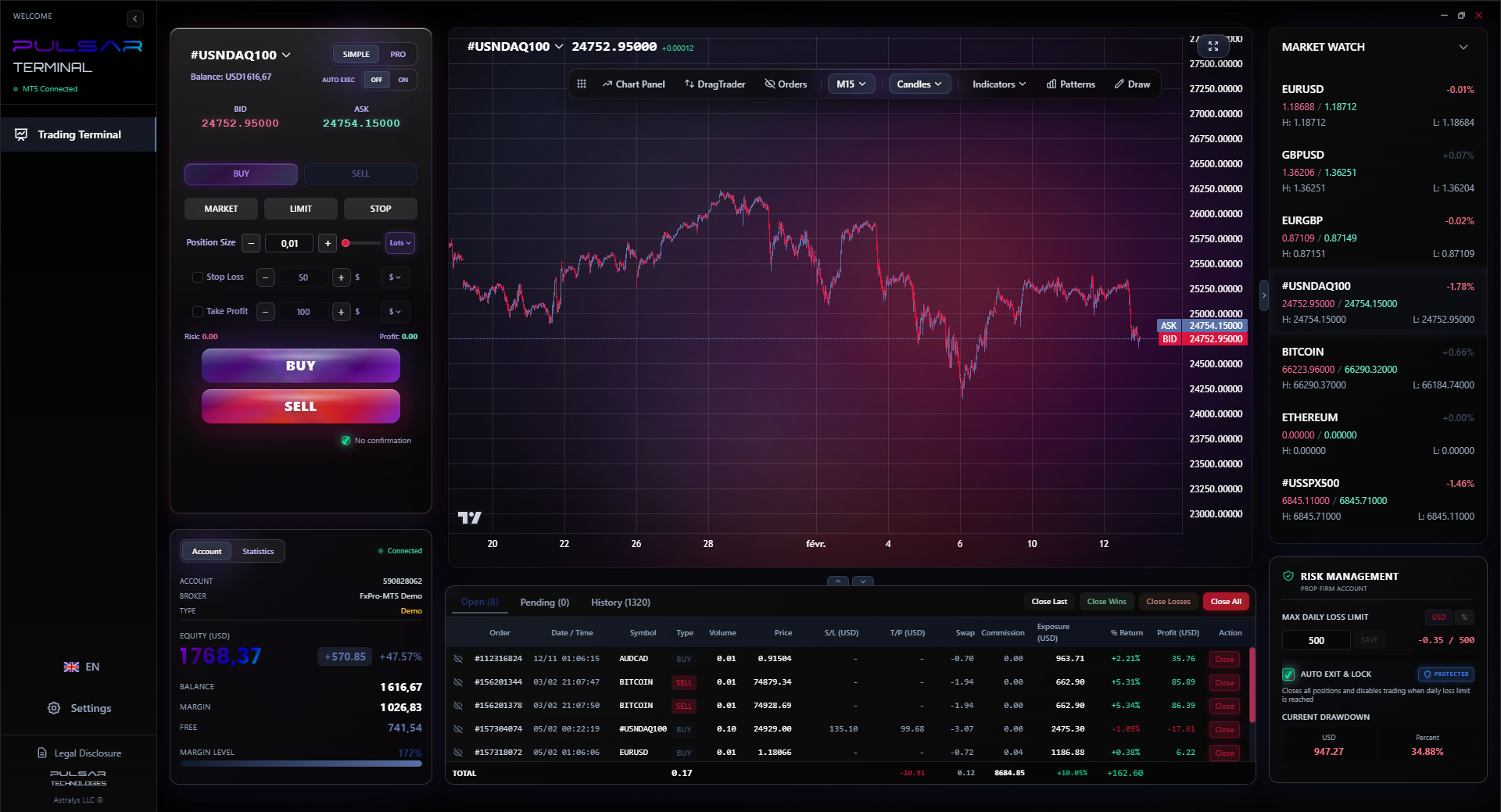
Managing multiple trades and setting precise stops in volatile, liquid markets is where a tool like Pulsar Terminal shines, letting you drag and drop orders directly on your MT5 chart.
Pulsar Terminal
Lo strumento MT5 tutto-in-uno: ordini drag-and-drop, multi-TP/SL, trailing stop, grid trading, Volume Profile e protezione prop firm. Usato da oltre 1.000 trader ogni giorno.
“In low liquidity, your modest order can be the biggest fish in a very small, very expensive pond.”
Let's be blunt. Trading from Nigeria adds extra layers to the liquidity challenge. It's not just about the forex market; it's about your connection to it.
Internet Stability: A flickering connection during a volatile period is a nightmare. Your order might be sent but not confirmed, leaving you in limbo. Or worse, a requote happens (your broker can't fill at your price due to changing liquidity), and your slow connection means you miss the new price entirely. Invest in the most reliable internet you can afford. It's a business cost.
NGN Pairs & Limited Access: Direct trading of the Naira on international forex platforms is heavily restricted. You're mostly trading USD/NGN via CFDs, which are derivatives. The liquidity for these contracts is not the same as the interbank Naira market. It's often synthetic, provided by your broker. This means wider spreads and a higher risk of manipulation. Be extra cautious. I stick to major pairs for my core trading and treat Naira pairs as a speculative side bet with very small size.
Deposits & Withdrawals: This is off-topic but critical. Liquidity in your trading account is useless if you can't fund it or withdraw profits reliably. Use brokers with a strong track record of processing Naira withdrawals for Nigerian clients, like Exness or XM. Delays here can tie up your capital and force you to miss opportunities.
The bottom line? As a Nigerian trader, you're already playing on a slightly uneven field. Don't make it worse by ignoring the meaning of liquidity in forex. It's the one market force that treats everyone equally - it will swallow your money just as fast as it will a trader in New York if you're careless.
💡 Consiglio di Winston
The best indicator of liquidity isn't on your chart. It's the clock. Master the session overlaps, and you've mastered half the game.

FAQ
Q1What is the simplest definition of liquidity in forex?
It's how easily you can buy or sell a currency pair without causing a big change in its price. High liquidity = easy to trade at stable prices (like EUR/USD). Low liquidity = hard to trade, with big spreads and slippage (like some exotic pairs).
Q2Does high liquidity mean less volatility?
Not necessarily. High-liquidity pairs like EUR/USD can be very volatile during news events. The key difference is that during high liquidity, the volatility is driven by a flood of real orders, so price moves are often smoother and more tradable. In low liquidity, volatility can be chaotic and spiky from just a few large orders.
Q3What time of day has the lowest forex liquidity?
The lowest liquidity is typically in the late New York session (after 10 PM WAT) and through the early Sydney/Pacific session until Tokyo opens. This is the 'dead zone' where spreads widen and price action can be erratic.
Q4How can I check the liquidity of a currency pair?
Look at the spread (the difference between bid and ask). A consistently tight spread indicates high liquidity. Also, observe the price movement: does it move in smooth increments, or does it jump in chunks? Choppy jumps suggest low liquidity. Some brokers provide Depth of Market (DOM) tools which show the order book directly.
Q5Is slippage always bad?
No, slippage can be positive! In a fast-moving market, if you have a buy limit order waiting below the price and the market drops sharply, your order might get filled at an even better (lower) price than you set. This is more common with ECN brokers during high volatility.
Q6Why does liquidity matter for my stop-loss order?
In low liquidity, your stop-loss (a market order that triggers when hit) is vulnerable to major slippage. Price can blow straight past your stop level, and your order gets filled much worse, turning a small planned loss into a large one. This is a major component of a margin call scenario.
Q7As a Nigerian, should I avoid trading during the London session because of time difference?
Absolutely not. The London session (8 AM - 5 PM WAT) is one of the best times to trade. It's highly liquid. If you have a day job, the London open (8 AM) is a perfect time to check the market before or during your work day. The overlap with New York (1 PM - 5 PM WAT) is the absolute peak.
Lezione del Prof. Winston
Punti chiave:
- ✓Trade major pairs during London/NY overlap for best fills.
- ✓Use limit orders in thin markets to control price.
- ✓Avoid market orders 5 mins before/after major news.
- ✓Test broker execution with demo during high volatility.
- ✓Your stop-loss is a target in low-liquidity zones.
Quanto è stato utile questo articolo?
Clicca su una stella
Analisi Trading Settimanali
Analisi e strategie settimanali gratuite. Nessuno spam.
Sull'autore
Olumide Adeyemi
Pioniere del Trading in Africa Occidentale
Uno degli educatori di trading forex più attivi in Nigeria. 8 anni di esperienza di trading da Lagos. Specializzato in strategie a basso capitale e sfide prop firm per trader africani.
Commenti
Avviso di rischio
Il trading di strumenti finanziari comporta rischi significativi e potrebbe non essere adatto a tutti gli investitori. Le performance passate non garantiscono risultati futuri. Questo contenuto è fornito solo a scopo educativo e non deve essere considerato un consiglio di investimento. Conduci sempre le tue ricerche prima di fare trading.
Potrebbe interessarti anche

Cara Trading Forex Sukses: 7 Prinsip dari Trader Profesional
Cara trading forex sukses dengan 7 prinsip trader pro: manajemen modal, disiplin, journal trading, backtest. Data nyata, bukan janji profit palsu.
Jam Trading Forex Terbaik untuk Trader Indonesia: Panduan Lengkap dengan Tabel Waktu
Panduan jam trading forex untuk trader Indonesia. Tabel 4 sesi dunia, jam emas 20:00-00:00, sesi mana yang harus dihindari. Data akurat + tips dari trader berpengalaman.
Top 5 Sàn Forex Uy Tín Nhất 2026: Review Jujur dari Trader Indonesia
Top 5 sàn forex uy tín 2026 untuk trader Indonesia. Review jujur: spread, deposit, withdraw, dukungan lokal. Exness, XM, IC Markets & lebih.
Scarica Pulsar Terminal
Tutti questi calcolatori sono integrati in Pulsar Terminal con dati in tempo reale dal tuo conto MT5.
Scarica Pulsar Terminal