


Everyone's selling you a dream.
James Mitchell
Analista Trading Senior
☕ 11 min di lettura
Cosa imparerai:
Everyone's selling you a dream. 'Trade our capital, keep 90% of the profits!' Sounds like a no-brainer, right? Wrong. The brutal truth about options prop trading firms is that they're a business designed to make money from you, the hopeful trader, first and foremost. I've seen guys blow five figures on 'evaluation fees' before they ever saw a funded account. Let's cut through the marketing fluff. I'll show you how these firms really work, the numbers they don't advertise, and whether this path is a legitimate career launchpad or just an expensive lesson.
At its core, a proprietary trading firm gives you access to their capital. You trade it, you make profits, and you split those profits with them. If you lose, you're (usually) not on the hook for the losses - that's the big selling point. But here's the catch: you have to prove you can trade profitably and consistently by passing their evaluation, often called a 'challenge.' This is where 90% of hopefuls fail and where the firm makes its real money.
For options specifically, these firms provide the infrastructure: the brokerage connection, the trading platform (like ThinkorSwim or TradeStation), and crucially, the ability to trade at professional rates. Retail traders get killed on per-contract fees. A prop desk can get commissions down to $0.20-$0.60 per contract, which is a massive edge when you're trading hundreds of contracts a day.

Warning: Don't confuse these modern evaluation-based prop firms with the old-school floor trader model. The old way involved you bringing your own capital to the firm's desk. The new model is almost entirely about selling you a test.
The regulatory landscape is shifting. Thanks to recent SEC rule changes, more of these firms are being forced to register as broker-dealers and join FINRA. That's good for you - it means more oversight. A firm like T3 Trading Group, which is a registered broker-dealer and SIPC member, operates under a much stricter set of rules than some offshore 'funded account' shop.

💡 Consiglio di Winston
Before you pay for a challenge, paper trade their exact rules for a full month. The trailing drawdown will mess with your head if you're not ready for it.
“The average trader spends $4,270 on evaluations before becoming profitable. That's not trading capital; that's cash paid for the privilege of trying.”
The advertised 'challenge fee' is just the tip of the iceberg. Let me break down where your money actually goes, because I learned this the expensive way.
The Upfront Fleecing (Sorry, 'Fees') You'll see fees from $15 for a tiny account to over $1,000 for a serious capital allocation. The average joe spends about $4,270 on evaluations before becoming profitable. Let that sink in. That's not trading capital lost in the market; that's cash paid to firms for the privilege of trying. I personally burned through about $2,800 in various challenges over 18 months before I finally passed one. My mistake? Chasing the biggest account size instead of proving my strategy on a smaller, cheaper challenge first.
The Hidden, Relentless Fees Once you're funded, the costs don't stop. This is what crushes new prop traders who aren't prepared.
| Fee Type | Typical Cost | What It Is |
|---|---|---|
| Professional Data Fees | $150 - $400/month | OPRA options data and Level 2 quotes. Retail prices don't apply. |
| Platform Fees | $100 - $400/month | For platforms like Sterling Trader Pro or Lightspeed. |
| Per-Contract Fees | ~$0.20 - $0.60 + exchange fees | Your base commission. Adds up fast on multi-leg orders. |

Example: Let's say you're moderately active. $250/month for data + $200 for platform = $450 in fixed costs. You need to make that back in net profit before you see a single dollar of your split. If your profit split is 80%, you need to generate $562.50 in gross profit just to break even on fees. Trade 500 contracts in a month at $0.40 commission? That's another $200 gone. Your break-even point is now $762.50. This changes your entire position size calculator math.
The Profit Split Illusion They advertise 'up to 90% or even 100%!' What they don't say is that the top splits often require hitting insane profit targets for months on end. A realistic starting split for a freshly funded trader is 70-80%. And that's split of the net profit, after all those fees I just listed are taken out.
“A realistic starting split for a freshly funded trader is 70-80%. And that's split of the net profit, after all those hidden fees are taken out.”
The pass rate is 5-10%. It's designed to be hard. Your goal isn't to get rich quick in the challenge; it's to prove you're a boring, consistent risk manager.
The Rules Are Everything
You will have three main constraints: a profit target, a daily loss limit, and a maximum trailing drawdown. The drawdown is the silent killer. It's usually a trailing peak-to-trough limit from your highest equity point. If you hit it, you're out. Game over. Fee gone.
My first three failures were all because of the trailing drawdown. I'd make $800, get excited, take a slightly bigger position on a 'sure thing,' lose $600, and suddenly I'm within a hair of my max drawdown from that $800 peak. The psychological pressure is immense. You're not just losing money; you're losing your chance.
The Only Strategy That Works
Forget hero trades. You need a grinding, high-probability approach. For options, this often means selling premium (credit spreads, iron condors) rather than buying lottery-ticket calls. You're playing for a high win rate, not a home run. Your scalping strategy needs to be airtight. Use the RSI indicator or MACD indicator not for magic signals, but to identify overbought/oversold conditions for your mean-reversion plays.

Pro Tip: Treat the daily loss limit as your hard stop for the DAY. If you lose 3% by 10:30 AM, you walk away. Live to trade tomorrow. The number one reason people fail is they try to 'make it back' in the same session and blow through the daily limit, triggering a violation.
Platform Choice Matters
If the firm offers a choice, pick the platform you know best. Don't try to learn ThinkorSwim's complex option chains during a high-pressure evaluation. This is another area where a tool like Pulsar Terminal can be a lifesaver if you're on MT5, as it simplifies order management on a platform not originally built for complex options trading.

“A realistic starting split for a freshly funded trader is 70-80%. And that's split of the net profit, after all those hidden fees are taken out.”
The industry is in flux. Over 80 firms shut down in 2024. You want one with stability, good tech, and clear rules. Here's my take on the current players.
The Regulated Broker-Dealers These are the 'safest' in terms of oversight. T3 Trading Group is the classic example. You're actually on their desk (physically or remotely), they're SEC/FINRA registered, and you get direct market access. The barrier to entry is higher, and the profit split might be less sexy (often starting at 70/30), but you're not a customer buying a challenge; you're a trader affiliated with a real brokerage. It's a career path.
The Major Evaluation-Funded Firms These dominate online ads. Topstep is the giant, especially for futures, but their TopstepX platform supports options. They're established, which counts for a lot. Funded Trading Plus and Lux Trading Firm push the boundaries on account size, offering scaling plans up to $5.5M and even $10M. Sounds great, but remember the scaling rules are another hurdle.
The Agile Newcomers Firms like Goat Funded Trader (launched 2022) have gained traction by offering simpler rules, lower fees, and faster payouts. They often embrace crypto payments. The risk with newer firms is longevity - will they be here in two years?
Key Questions to Ask Any Firm:
- What is the exact profit split on the first payout?
- List every single monthly fee (data, platform, admin).
- How often are payouts? (Weekly is best, monthly is standard).
- What is the drawdown model? Is it trailing from initial balance or from peak equity? (Peak is harder).
- Can I trade the strategy I'm comfortable with, or are there style restrictions?
Do your own due diligence. Check reviews on sites like Forex Peace Army (but take them with a grain of salt - most reviews are from people who failed).
💡 Consiglio di Winston
Your first goal in a funded account isn't a Lamborghini. It's three consecutive months of payouts that cover your fees and leave a little extra. Consistency unlocks everything.
“The pass rate is 5-10%. It's designed to be hard. Your goal isn't to get rich quick; it's to prove you're a boring, consistent risk manager.”
You passed. Congratulations. Now the real work begins. You're no longer trading to pass a test; you're trading to earn a living while covering your nut (those monthly fees).
The psychology shifts. Suddenly, that virtual money in your dashboard is attached to real payouts. It can make you gun-shy. I remember my first funded month. I was so terrified of hitting a margin call or breaching my drawdown that I traded a quarter of my usual size and barely covered my data fees. It took me three months to find the balance between caution and aggression.
Payouts & Taxes Most firms pay weekly or bi-weekly. You'll get a profit share statement. Crucially, in the U.S., you are almost always considered an independent contractor. The firm will not withhold taxes. You get a 1099-MISC or 1099-NEC at year-end, and you're responsible for paying estimated quarterly taxes. Set aside 30-40% of every payout immediately. I learned this the hard way with a painful tax bill my first year.
Risk Management is Your Job The firm's risk team is watching. If you start taking insane, outsized positions relative to your account, they'll call you. If you consistently breach your risk parameters, they'll pull your funding. Your tools become critical. You need to automate your swing trading exits. A trailing stop isn't a nice-to-have; it's mandatory. This is where having strong trade management software isn't a luxury; it's professional-grade equipment.
Speaking of tools, managing multiple option legs with individual profit targets and stops is a nightmare on a basic platform. The ability to set multi-TP/SL orders and partial closures on a complex position is what separates the hobbyist from the professional. It's the difference between scrambling to manage 10 contracts manually and having the platform execute your plan precisely.
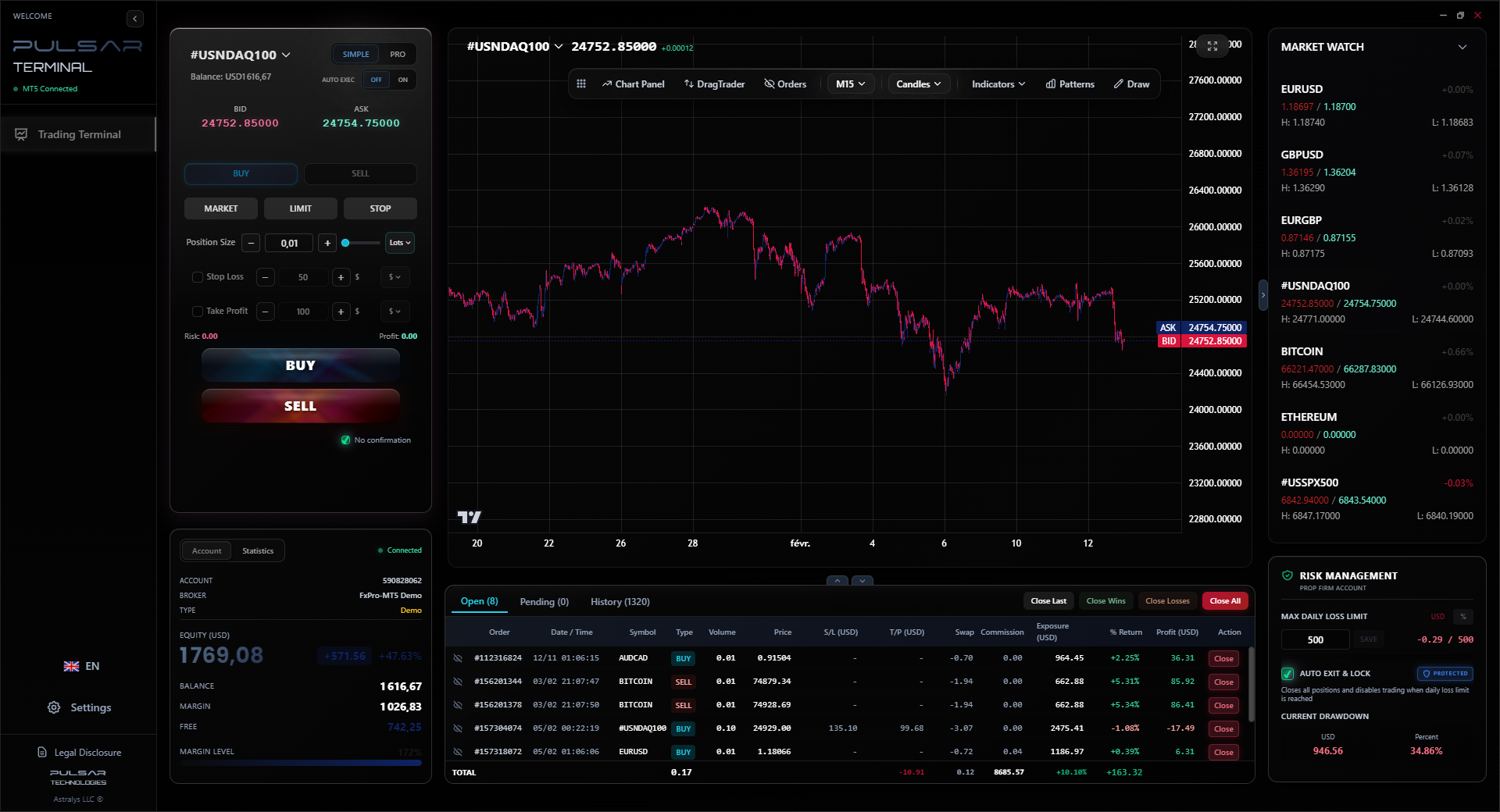
Managing complex options positions with multiple legs and precise exits is a nightmare without the right tools; Pulsar Terminal's drag-and-drop order system and multi-TP/SL with partial closures automate this directly on your MT5 platform.
Pulsar Terminal
Lo strumento MT5 tutto-in-uno: ordini drag-and-drop, multi-TP/SL, trailing stop, grid trading, Volume Profile e protezione prop firm. Usato da oltre 1.000 trader ogni giorno.
“The pass rate is 5-10%. It's designed to be hard. Your goal isn't to get rich quick; it's to prove you're a boring, consistent risk manager.”
Throwing hundreds of dollars at challenge fees isn't the only path. Let's be honest: if you have a truly profitable strategy, there are other ways to scale it.
1. Trade Your Own Account, But Get a Professional Broker. Once you have $25k to meet Pattern Day Trader rules, you can open an account with a serious broker like Interactive Brokers. Your per-contract fees will be higher than a prop desk, but you keep 100% of the profits. No drawdown rules, no profit splits, no one looking over your shoulder. This is the ultimate goal, but it requires significant personal capital to generate meaningful income.
2. Find a Mentor or Join a Trading Room (The Right Way). Instead of paying a prop firm for capital, pay a proven trader for education and trade ideas. The key is verification. Anyone can claim returns. You need to see a verified track record. This path builds your skill, not just your ability to pass a test.
3. Specialize in a Lower-Capital Strategy. Not all trading requires $100k. You can build a bankroll selling premium on /ES or SPY options with a $15k account. It's slower, but it's yours. Focus on mastering a specific setup, like trading XAU/USD volatility around Fed announcements, or playing the ranges in EUR/USD.
The prop firm path is a use tool. It's for the trader who has the skill and discipline but lacks the capital. If you don't have the skill and discipline yet, a prop firm challenge is just a very expensive way to find out.
💡 Consiglio di Winston
If a firm's website is all Lambos and cash stacks, but vague on fee breakdowns, run. Professional businesses don't market like a rap video.

“The prop firm path is a use tool. It's for the trader who has the skill and discipline but lacks the capital.”
Here's my blunt assessment after 12 years and watching hundreds try.
A prop firm is RIGHT for you if:
- You have a documented, back-tested, and live-traded strategy with a positive expectancy.
- You have rock-solid discipline and have traded your own account profitably (but it's too small to live on).
- You understand the fees and have the upfront cash to risk on 2-3 evaluation attempts without it affecting your life.
- You treat it like a business application, not a lottery ticket.
A prop firm is WRONG for you if:
- You're still 'figuring out' your strategy. (Do that with paper trading).
- You think this is a way to get rich quick with no risk.
- The evaluation fee is a significant portion of your savings.
- You have a history of revenge trading or blowing up accounts.
The modern options prop trading firm model is a legitimate, if flawed, environment. It provides access and opportunity. But it's a gatekeeper, not a golden ticket. Your edge was, is, and always will be your own skill and psychology. The firm just provides the ammunition. Don't give them a dime until you are absolutely certain you know how to use it.
Start small. Pick one firm with a low-cost evaluation. Treat it like the most serious job interview of your life. If you pass, you've validated your edge. If you fail, you've bought a (hopefully) cheap education. Just don't keep buying the same lesson over and over.
FAQ
Q1What's the biggest mistake traders make with prop firm challenges?
Over-trading to hit the profit target fast. They ignore the daily loss limit and trailing drawdown, which are far more important. The goal isn't speed; it's consistency without breaking the risk rules. Blowing the daily limit in one bad trade is the most common failure point.
Q2Are prop firm payouts guaranteed?
No. You are paid a share of the profits you generate. If you don't make a profit in a payout period, you get nothing. You still owe any monthly platform or data fees, which will be deducted from future profits or, in some cases, require you to cover them.
Q3Can I trade any options strategy with a prop firm?
Not always. Some firms restrict high-risk strategies like naked options selling (selling calls or puts without defined risk) due to the unlimited loss potential. Always check the firm's allowed strategies before buying a challenge. Most allow defined-risk spreads (credit/debit spreads, iron condors).
Q4How are taxes handled on prop firm earnings?
In the U.S., you are typically treated as an independent contractor. The firm will send you a 1099 form at year-end for your profit shares. They do not withhold taxes. You are responsible for paying estimated quarterly income and self-employment taxes (Social Security & Medicare). Set aside 35-40% of every payout.
Q5What happens if I lose money in a funded account?
You hit your maximum drawdown limit and your funded account is closed. You do not owe the firm the lost money (this is the standard model - always verify). However, you may have to start over by purchasing a new evaluation challenge if you want another shot.
Q6Is there a minimum trading activity requirement?
Sometimes. Firms want to see you are actively using their capital. Many have a minimum number of trading days per month (e.g., 5-10 days). If you don't trade, they may deem the account inactive and close it. Check the specific rules.
Q7Can I use automated trading or algorithms?
This is firm-specific. Many prohibit fully automated trading (bots) during the evaluation phase to prevent gaming the system. In a funded account, some firms allow it with prior approval, while others still prohibit it. Always get this in writing before you start.
Lezione del Prof. Winston
Punti chiave:
- ✓Treat challenge fees as tuition, not tickets.
- ✓Know all fees: data, platform, commissions.
- ✓Daily loss limit is more critical than profit target.
- ✓Set aside 40% of every payout for taxes.
Quanto è stato utile questo articolo?
Clicca su una stella
Analisi Trading Settimanali
Analisi e strategie settimanali gratuite. Nessuno spam.
Sull'autore
James Mitchell
Analista Trading Senior
Con base a New York e oltre 9 anni di esperienza nel trading. Si occupa delle principali coppie USD, sfide delle prop firm e del contesto normativo statunitense.
Commenti
Avviso di rischio
Il trading di strumenti finanziari comporta rischi significativi e potrebbe non essere adatto a tutti gli investitori. Le performance passate non garantiscono risultati futuri. Questo contenuto è fornito solo a scopo educativo e non deve essere considerato un consiglio di investimento. Conduci sempre le tue ricerche prima di fare trading.
Potrebbe interessarti anche

Cara Trading Forex Sukses: 7 Prinsip dari Trader Profesional
Cara trading forex sukses dengan 7 prinsip trader pro: manajemen modal, disiplin, journal trading, backtest. Data nyata, bukan janji profit palsu.
Jam Trading Forex Terbaik untuk Trader Indonesia: Panduan Lengkap dengan Tabel Waktu
Panduan jam trading forex untuk trader Indonesia. Tabel 4 sesi dunia, jam emas 20:00-00:00, sesi mana yang harus dihindari. Data akurat + tips dari trader berpengalaman.
Top 5 Sàn Forex Uy Tín Nhất 2026: Review Jujur dari Trader Indonesia
Top 5 sàn forex uy tín 2026 untuk trader Indonesia. Review jujur: spread, deposit, withdraw, dukungan lokal. Exness, XM, IC Markets & lebih.
Scarica Pulsar Terminal
Tutti questi calcolatori sono integrati in Pulsar Terminal con dati in tempo reale dal tuo conto MT5.
Scarica Pulsar Terminal