


Everyone shows you the picture-perfect version of forex trading: luxury cars, beachside laptops, endless profits.

Olumide Adeyemi
Pioniere del Trading in Africa Occidentale ·  Nigeria
☕ 11 min di lettura
Cosa imparerai:
Everyone shows you the picture-perfect version of forex trading: luxury cars, beachside laptops, endless profits. Let me show you the real pictures. The ones with margin calls, sleepless nights watching USD/NGN, and the 10% taxman waiting for his cut. I've traded through Nigeria's regulatory shifts, funding freezes, and market chaos since 2012. This isn't another motivational post. This is what actually happens when you press that buy button from Lagos, Abuja, or Port Harcourt.
You've seen the first picture. It's all over Instagram. A guy in sunglasses, three monitors, a Lamborghini key fob casually on the desk. The caption says 'Another 500-pip win on GBP/JPY!' It's designed to sell you a dream, a course, a signal service.
The second picture, the real one, looks different. It's 2:17 AM. You're in your boxers at a desk in Surulere, sweating because your USD/NGN analysis was wrong and the CBN just made an unexpected announcement. Your phone shows three declined card transactions trying to fund your Exness review account. One monitor shows your losing position, another has a Nairaland forum thread open titled 'Broker Withdrawal Issues.'
I fell for the first picture early on. In 2015, I blew a $1,000 account chasing the 'perfect setup' I saw online. The reality was a 0.9 pip spread on EUR/USD, a surprise swap fee, and my own greed combining into a 100% loss in two weeks. The glamour picture never shows the position size calculator you should have used, or the feeling when you get a margin call.

Warning: If a 'trader' only shows profits, luxury, and ease, they're selling something, not trading. Real trading journals have losses, mistakes, and corrections.
The true picture of forex trading is 90% risk management, psychology, and admin (like calculating that 10% capital gains tax). The other 10% is actually placing trades. Anyone who tells you otherwise is painting the wrong picture.
Let's get specific about what's on your screen and in your bank account. The numbers matter more than the hype.
The Funding Headache
Your first real picture is the funding struggle. Despite trading being legal, getting money to your broker is the first boss level. Most Nigerian bank cards have international spending limits that make funding a $500 account a multi-day operation. Some banks outright block transactions to known broker entities. This pushes many toward crypto deposits or specialized payment processors, which add their own fees (around 1-2%) to the mix.
I remember in 2021, I spent three days trying to deposit $200 into my IC Markets review account. Card declines, calls to customer service, the whole drama. By the time the money arrived, the setup I wanted was long gone.
The Cost Breakdown
Here’s what eats your profit, in real Naira and Kobo:
| Cost Factor | Typical Range (2026) | What It Means For You |
|---|---|---|
| Spread (EUR/USD) | 0.6 - 0.9 pips | Your trade starts down this amount. A 0.8 pip spread on a standard lot is $8 gone before you move. |
| Commission (ECN) | ~$6 per round lot | Paid on open AND close. On a $10,000 (mini lot) trade, that's $1.20 round turn. |
| Overnight Swap | Variable, can be +/- | Holding positions past 5 PM EST costs or earns interest. For a swing trading style, this adds up. |
| Capital Gains Tax | 10% of GROSS profit | The big one. On a $1,000 profit, you owe FIRS ₦140,000 (at 560 Naira/$). This comes from you, not your broker. |

Example: You make a 50-pip profit on EUR/USD with a standard lot ($10 per pip). That's $500. Subtract a 0.8 pip spread ($8) and commission ($12). Your net is $480. Then, you owe 10% tax: $48. Your real take-home? $432. The picture just changed.
The use Double-Edged Sword
Brokers offer insane use here - 1:1000, even 1:2000. It looks like a superpower on the glamour picture. The reality picture? It's a quick way to amplify a mistake into an account explosion. With 1:1000 use, a 10-pip move against you on a standard lot can wipe out 10% of your margin. I learned this the hard way early on. use is a tool, not a strategy. Using a proper position size calculator is non-negotiable, especially with these numbers.

💡 Consiglio di Winston
The market's only job is to prove you wrong. Your only job is to have a plan for when it does. A stop-loss isn't a suggestion, it's your lifeline.
“A mental stop loss is no stop loss. It's a recipe for turning a small loss into an account-ending disaster.”
Charts are the core pictures of forex trading. But most traders are reading them wrong. They're looking for magic patterns, while the real story is in price action and momentum.
The Useless Picture: Overloaded Indicators
My first charts were a mess. I had a MACD indicator, an RSI, Bollinger Bands, and three moving averages all on one screen. It looked professional, like the movies. It was also completely paralyzing. The indicators would conflict: MACD says buy, RSI is overbought, price is at the upper Bollinger Band. I'd just stare, frozen, until the move passed.
The breakthrough came when I stripped it all back. Now, my main chart has just three things: clean candlesticks, a volume profile to see key price levels, and maybe one exponential moving average for context. The noise disappeared, and the actual price story became clear.
The Useful Picture: Structure & Momentum
Forget the fancy names. Look for these two things:
- Market Structure: Is price making higher highs and higher lows (uptrend)? Or lower highs and lower lows (downtrend)? Or is it bouncing between two clear levels (range)? Drawing these simple lines gives you the battlefield map.
- Momentum Shifts: This is where an oscillator like the RSI indicator can help, but only in a specific way. I don't use it for overbought/oversold signals. I use it to spot divergence - when price makes a new high but the RSI makes a lower high. That's a picture of weakening momentum, a potential reversal warning. It saved me on a Gold (XAU/USD) trade last year, signaling a top before a $80 drop.

Pro Tip: Spend a week just looking at clean price charts. No indicators, no lines. Just watch how price moves, how it reacts at round numbers ($1.0800 on EUR/USD, $2350 on Gold). You'll learn more than any indicator can teach you.
The best trade I ever took on XAU/USD guide came from a simple picture: a strong uptrend, a pullback to a previous resistance-turned-support level, and a bullish engulfing candlestick pattern. No other confirmation needed. Entry at $1824, exit at $1887. Simple, clear, effective. You can read more about trading Gold specifically in our XAU/USD guide.
This is the picture that's changing the fastest. For years, it was the wild west. You could open an account with an offshore broker in minutes. The new Investments and Securities Act (ISA) 2025 aims to change that, making it illegal for platforms to operate here without SEC registration.
What does this mean for you right now?
1. Your International Broker is Still Your Best Bet (For Now). Most Nigerian traders use brokers regulated abroad, like Pepperstone review (ASIC) or XM review (CySEC). These brokers aren't registered with the Nigerian SEC. The law targets the platforms offering services, not you the individual trader. So, your existing account is likely safe. However, the long-term picture is uncertain. Pressure on payment channels could increase.
2. The Taxman is Very Real. This part of the picture is crystal clear and enforced. The 10% Capital Gains Tax on your gross forex profits isn't a future maybe. It's law. You are responsible for declaring and paying this. I set aside 10% of every successful withdrawal immediately. It hurts to see it go, but it hurts more to get a penalty notice from FIRS.
3. Withdrawals are the True Test. Anyone can take your deposit. The real picture of a broker's reliability is how smoothly you get your money back to your Nigerian bank account or wallet. Some brokers are seamless with crypto withdrawals. Others using traditional bank transfers can take 5-7 business days and might hit snags with intermediary banks. Always test a small withdrawal first.
My advice? Keep operating with reputable international brokers, but stay informed. Follow financial news. And for heaven's sake, keep your own records for tax purposes. The regulatory picture is developing, but your responsibility for your trades and taxes is already here.
💡 Consiglio di Winston
If you can't explain your trade in one simple sentence ('I'm buying here because it's bouncing off support in an uptrend'), you don't have a trade. You have a hope.
“Your trading journal is the true picture of you as a trader. Your weaknesses will stare right back at you, and that's how you fix them.”
So how do you create a good picture? One that ends with more money than you started with? It's a system, not a single trade.
Start with the Right Canvas: Your Account Size
Forget the $1 minimum deposit accounts. Technically, you can start there. But practically, you'll blow up. The spreads and commissions will eat you alive. You can't manage risk properly. My firm recommendation? Start with at least $500. Better yet, $1,000. This gives you room to breathe, to make small trades, to survive a few losses while you learn. It forces you to be serious.
Use the Right Brushes: Strategy & Timeframe
Are you a quick painter or a detailed one? Match your personality.
- The Quick Sketch (Scalping strategy): In and out in minutes, aiming for 5-10 pips. It's intense, requires total focus, and you're fighting the spread definition on every trade. You need a broker with razor-thin spreads (think 0.0 pips raw). It's stressful, and most people fail at it.
- The Detailed Portrait (Swing trading): This is my home. Holding trades for days or weeks, aiming for 100-300 pip moves. You're catching the bigger market waves. It's less stressful, gives you time to think, and the spread becomes a tiny fraction of your target profit. This style works with most broker types.
I tried scalping early on. My heart rate was through the roof, I was glued to the screen, and after a month I was down 3% despite a 55% win rate. The spreads and slippage killed me. Switching to swing trading changed everything. The EUR/USD guide is a great place to start learning this approach, as it's a perfect pair for swing trades.
The Final Varnish: Psychology & Journaling
This is the most important part of the picture, and no one talks about it. You will feel fear, greed, hope, and regret. The only antidote is a trading journal. Not just 'bought EUR/USD, sold for profit.' I mean a real journal.
- 'Tuesday: Felt rushed because I missed the morning move. Entered GBP/USD chase trade. Ignored my rule about waiting for London close. Lost 2%. Lesson: No trade is better than a forced trade.'
- 'Friday: Stuck to plan. Waited for pullback to 1.0650 support on EUR/USD. Got filled. Took half profit at 1.0720, moved stop to breakeven. Feeling disciplined.'
Your journal is the true picture of you as a trader. Review it weekly. Your weaknesses will stare right back at you, and that's how you fix them.
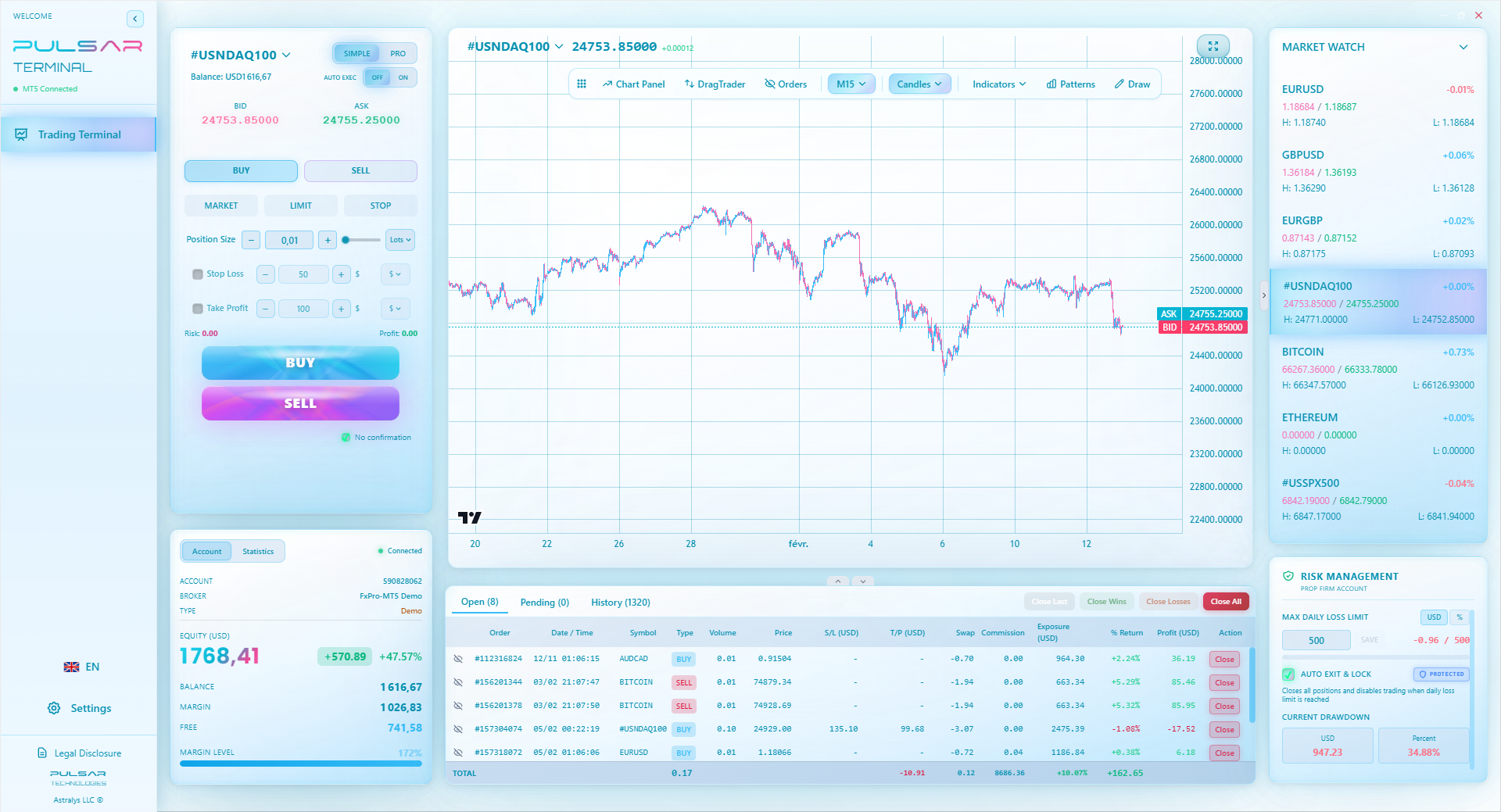
Managing multiple take-profit levels and moving stops to breakeven manually is stressful and error-prone; Pulsar Terminal automates this directly on your MT5 chart with drag-and-drop ease.
Pulsar Terminal
Lo strumento MT5 tutto-in-uno: ordini drag-and-drop, multi-TP/SL, trailing stop, grid trading, Volume Profile e protezione prop firm. Usato da oltre 1.000 trader ogni giorno.
I'll show you my ugliest picture. March 2023. The USD/NGN was a mess in the parallel market, rumors were flying about a CBN devaluation. I was convinced the Naira would plunge further. I didn't trade USD/NGN directly, but I figured a strong USD against everything was a sure thing.
I went all in on a short EUR/USD position. I mean, I used use like an idiot. I put on a position size that was 8% of my account risk on a single trade (my rule was 1%). The entry was around 1.0720. I didn't have a clear stop loss, just a 'mental stop' (which is code for no stop).
The ECB came out with unexpectedly hawkish comments. EUR/USD ripped higher. 50 pips against me. Then 100 pips. My pride wouldn't let me close. 'It'll come back,' I thought. At 150 pips down, the margin call was imminent. I finally closed at 1.0875. A 155 pip loss.
On my oversized position, that was a 22% loss of my entire account in one trade. One stupid, arrogant, rule-breaking trade.
The picture after that wasn't pretty. I felt sick. I had to shut down the charts for two weeks. But it was the best lesson I ever got. It burned the rules into me:
- Never, ever risk more than 1-2% of your account on a single trade. Use a calculator.
- A mental stop is NO STOP. Always have a physical stop-loss order in the market.
- No trade is a 'sure thing.' The market doesn't care about your conviction.
I had to rebuild from that picture. Slowly, strictly, with humility. That loss taught me more than 100 wins ever could. It's the picture I keep on my desk to remind me what happens when you think you know it all.
💡 Consiglio di Winston
Your first profit target should always be to move your stop-loss to breakeven. Protecting your capital is rule number one. Profits come after survival.
FAQ
Q1Is forex trading legal in Nigeria?
Yes, trading forex as an individual is legal. However, the regulatory environment is evolving. The new Investments and Securities Act (ISA) 2025 requires platforms offering services to be registered with the SEC. Most Nigerian traders use internationally regulated brokers, which is currently the standard practice.
Q2How much tax do I pay on forex profits in Nigeria?
You pay a 10% Capital Gains Tax on your gross trading profits. This is your responsibility to declare and pay to the Federal Inland Revenue Service (FIRS). Your international broker will not deduct or manage this for you.
Q3What is a realistic starting amount for forex trading in Nigeria?
While you can technically start with $1 or $10, it's not practical for learning or proper risk management. A realistic minimum to seriously learn and apply strategies is between $500 and $1,000. This allows for sensible position sizing and the ability to withstand a few losses without blowing your account.
Q4Which broker is best for Nigerian traders?
There's no single 'best' broker. It depends on your style. For low spreads (good for scalping), look at ECN brokers like IC Markets or Pepperstone. For ease of use and lower minimum deposits, brokers like XM or Exness are popular. Always prioritize brokers with strong international regulation and test their withdrawal process with a small amount first. You can compare detailed reviews in our brokers section.
Q5What is the biggest mistake new Nigerian traders make?
Using excessive use. Brokers offer 1:1000 or more, and new traders see it as free money to control huge positions. This amplifies losses just as fast as profits. The second biggest mistake is not accounting for all costs: spreads, commissions, swap fees, and especially the 10% tax.
Q6Can I fund my forex account with my Nigerian debit card?
It's increasingly difficult. Many Nigerian banks have low international transaction limits (e.g., $100/day) and some block transactions to known forex brokers. This has made cryptocurrency (USDT) deposits and specialized payment processors the most common funding methods for Nigerian traders in 2026.
Q7What time should I trade forex in Nigeria?
The most active and liquid sessions overlap from 9 AM to 12 PM Nigerian Time (when London opens) and again from 2 PM to 5 PM Nigerian Time (when London is still open and New York comes in). This is when spreads are tightest and you get the cleanest price action. Trading in the dead of night (Asian session) is often slower and more unpredictable.
Lezione del Prof. Winston
Punti chiave:
- ✓Risk a maximum of 1-2% of your capital per trade, no exceptions.
- ✓The 10% Capital Gains Tax on gross profits is non-negotiable. Plan for it.
- ✓Start with at least $500. Trading with $10 teaches you nothing but frustration.
- ✓Swing trading (100-300 pip targets) is more sustainable than scalping for most.
- ✓Your biggest loss will be your best teacher if you're humble enough to listen.
Quanto è stato utile questo articolo?
Clicca su una stella
Analisi Trading Settimanali
Analisi e strategie settimanali gratuite. Nessuno spam.
Sull'autore
Olumide Adeyemi
Pioniere del Trading in Africa Occidentale
Uno degli educatori di trading forex più attivi in Nigeria. 8 anni di esperienza di trading da Lagos. Specializzato in strategie a basso capitale e sfide prop firm per trader africani.
Commenti
Avviso di rischio
Il trading di strumenti finanziari comporta rischi significativi e potrebbe non essere adatto a tutti gli investitori. Le performance passate non garantiscono risultati futuri. Questo contenuto è fornito solo a scopo educativo e non deve essere considerato un consiglio di investimento. Conduci sempre le tue ricerche prima di fare trading.
Potrebbe interessarti anche

Cara Trading Forex Sukses: 7 Prinsip dari Trader Profesional
Cara trading forex sukses dengan 7 prinsip trader pro: manajemen modal, disiplin, journal trading, backtest. Data nyata, bukan janji profit palsu.
Jam Trading Forex Terbaik untuk Trader Indonesia: Panduan Lengkap dengan Tabel Waktu
Panduan jam trading forex untuk trader Indonesia. Tabel 4 sesi dunia, jam emas 20:00-00:00, sesi mana yang harus dihindari. Data akurat + tips dari trader berpengalaman.
Top 5 Sàn Forex Uy Tín Nhất 2026: Review Jujur dari Trader Indonesia
Top 5 sàn forex uy tín 2026 untuk trader Indonesia. Review jujur: spread, deposit, withdraw, dukungan lokal. Exness, XM, IC Markets & lebih.
Scarica Pulsar Terminal
Tutti questi calcolatori sono integrati in Pulsar Terminal con dati in tempo reale dal tuo conto MT5.
Scarica Pulsar Terminal