


Here's a fact most trading gurus in Lagos won't tell you: over 80% of Nigerian retail forex traders blow their first account within six months.

Olumide Adeyemi
Pioniere del Trading in Africa Occidentale ·  Nigeria
☕ 12 min di lettura
Cosa imparerai:
- 1What Price Action Trading Really Is (And Isn't)
- 2The Core Concepts You Need to Internalize
- 3Applying Price Action to Nigerian Market Realities
- 4Two High-Probability Price Action Setups to Trade Now
- 5Risk Management: Protecting Your Naira Capital
- 6Common Mistakes Nigerian Traders Make (And How to Avoid Them)
- 7Building Your Personal Price Action Trading Plan
- 8Your Next Steps and Local Resources
Here's a fact most trading gurus in Lagos won't tell you: over 80% of Nigerian retail forex traders blow their first account within six months. They're chasing signals, loading charts with every indicator under the sun, and getting wrecked by spread spikes and platform freezes. The real edge for a trader here isn't a secret indicator; it's learning to read what the price is telling you directly. Price action trading forex cuts through the noise, works on a spotty internet connection, and doesn't require you to pay for expensive data plans just to update lagging tools. I've taught this for years, and the students who survive are the ones who master this.
Let's clear the air first. Price action trading isn't some mystical art. It's simply the practice of making all your trading decisions based on the raw price movements on your chart - the candles or bars themselves - without the clutter of predictive indicators like MACD or RSI. You're reading the story the market is writing in real-time.
In Nigeria, this is more than a preference; it's a practical necessity. When your data is slow or your broker's server is acting up (we've all been there), a lagging Moving Average can give you a signal that's 15 minutes old. The price candle from 2 minutes ago? That's current. It's the most reliable data point you have.

Warning: Don't confuse this with "naked trading." You still need structure. I use horizontal support/resistance lines, trendlines, and occasionally a simple moving average to define the market's context. The key is that the trade trigger - the reason you click buy or sell - comes purely from the price pattern and its interaction with these levels.
I made this shift years ago after a costly lesson. I was short on GBP/NGN, relying on a stochastic oscillator that was stuck. The price had already reversed, but my indicator hadn't caught up. By the time it did, I was down a significant chunk of my capital. That was the day I uninstalled half the junk on my charts.
Support and Resistance: Your Market Roadmap
These aren't magic lines. Think of them as price levels where a lot of buying (support) or selling (resistance) has happened before. In Lagos, we say "market don remember this price." You draw these horizontally at swing highs and lows. The more times price touches and reverses from a level, the stronger it becomes. Your entire price action trading forex plan revolves around these zones.
Candlestick Patterns: The Market's Vocabulary
Single candles and small groups of them tell you about market sentiment. A long bullish candle after a downtrend shows buying pressure. A Doji (where open and close are nearly equal) at a resistance level shows indecision - traders are unsure. The Pin Bar (a candle with a long wick and small body) is a classic rejection signal. I look for these patterns forming at my pre-drawn support or resistance levels. That's where the high-probability setups are.
Market Structure: Are We Going Up or Down?
This is about identifying the trend. Higher highs and higher lows? That's an uptrend. Lower highs and lower lows? Downtrend. It sounds simple, but most new traders fight the trend. In a strong uptrend, your only job is to look for price action buy signals on pullbacks. Trying to pick the top is a sure way to lose money. A tool like a basic trendline or even observing the sequence of swings is enough. For a deeper dive on structuring trades within trends, our guide on swing trading builds on these principles.

Example: If USD/NGN makes a high at 1600, pulls back to 1550, then rallies to 1620 (a higher high), and pulls back to 1570 (a higher low), the structure is bullish. You'd ignore sell signals until that structure breaks.

💡 Consiglio di Winston
The most important support and resistance level is the one price is reacting to right now. Yesterday's famous level means nothing if price is ignoring it today.
“Price action trading cuts through the noise and works on a spotty internet connection.”
Trading from Nigeria adds unique layers. You're not just trading currencies; you're navigating local infrastructure challenges.
1. Currency Pairs & Liquidity: Stick to the major and minor pairs (EUR/USD, GBP/USD, USD/JPY, etc.). They have the tightest spreads and most clean price action. Avoid exotic pairs that include the Naira on international brokers unless you have a specific hedge - the spreads are often monstrous, and the price action is jumpy and unreliable. For understanding the most traded pair, see our EUR/USD guide.
2. Internet & Power Stability: This is where price action shines. You don't need a constant, high-speed stream for indicators to calculate. You can open a 1-hour or 4-hour chart, analyze the structure, place your orders with stop loss and take profit, and walk away. No need to babysit a screen waiting for a cross on a lagging indicator. If the lights go out, your plan is already in the market.
3. Broker Selection is Critical: You need a broker with reliable execution and low spreads. Slippage during CBN announcements or local liquidity crunches can ruin a good price action setup. I've had positive experiences with brokers known for their raw spreads and good MT4/MT5 integration, which is essential for clean charting. Always do your own research on current regulations. You can start with our reviews of IC Markets, Pepperstone, or XM to understand what to look for.
4. The Naira Factor: Your capital and psychology are in Naira. A 50-pip loss on EUR/USD feels different when the Naira is at 1500/$ vs. 1300/$. You must factor potential Naira volatility into your position size calculator. A 2% risk rule is useless if the Naira devalues 10% in a month. I keep a portion of my profits in USD for this reason.
Let's get specific. These are two patterns I've traded for years.
1. The Pin Bar Rejection at Key Level: This is my bread and butter. I wait for price to approach a clear support or resistance zone. Then, I look for a Pin Bar to form. The long wick shows the market tried to move in one direction (e.g., above resistance) and got forcefully rejected, closing near the opposite end of the candle.
- My Trade: In January, on GBP/USD 4-hour chart. Resistance was clear at 1.2780. Price rallied up, formed a perfect Pin Bar with a long upper wick poking above 1.2780, and closed near its low. I entered short on a break of the Pin Bar's low. Entry: 1.2755. Stop loss: placed above the Pin Bar's high at 1.2795 (40 pips risk). Take profit: at next support, 1.2670 (85 pips reward). Risk/Reward was over 1:2. It worked.
2. The Inside Bar Breakout (in a Trend): An Inside Bar is a candle completely contained within the range of the previous candle (the "mother bar"). It shows consolidation and compression. In a strong trend, this often precedes a continuation.
- How I Trade It: In a clear uptrend, I look for an Inside Bar to form. I place a buy stop order a few pips above the high of the mother bar. My stop loss goes a few pips below the low of the Inside Bar. This is a lower-risk way to catch a trend continuation. The opposite for downtrends. This pattern is fantastic for a scalping strategy on lower timeframes when the trend is strong.

Pro Tip: Don't trade every Pin Bar or Inside Bar you see. The context is everything. The setup must occur at a significant level (support/resistance, trendline) or in the direction of the broader market structure. A random Pin Bar in the middle of nowhere is noise, not a signal.
“Your stop loss is not a suggestion; it's the cost of being wrong. Pay it gracefully and move on.”
All the price action skill in the world is worthless without iron-clad risk management. This is non-negotiable.
- Risk Per Trade: Never, ever risk more than 1-2% of your total trading capital on a single trade. If your account is ₦500,000, your max loss per trade should be ₦5,000-₦10,000. Use a position size calculator every single time. I don't care if you're "sure" this is the trade.
- Stop Loss Placement: Your stop loss is part of your trade setup. In price action, it's logical. For a Pin Bar sell, your stop goes above the Pin Bar's high. For a breakout buy, it goes below the consolidation low. It's not a random number. If the distance to your logical stop loss means you're risking 3% of your account, the trade is invalid. Walk away.
- Beware of the Margin Call: Nigerian brokers, especially international ones serving this market, can have aggressive margin policies. A few bad trades in a row can trigger a margin call faster than you think. Keeping your risk at 1% ensures you can survive a losing streak without being wiped out.
- Emotional Control: When you're trading with money that feels real (because it is), the psychology is intense. A solid, rules-based price action plan removes emotion. You're not "hoping" the trade works; you're executing a plan where the outcome of any single trade is irrelevant to your long-term survival.
💡 Consiglio di Winston
If you can't immediately see where to place your stop loss on a chart, you don't have a valid trade. The stop defines the trade, not the entry.
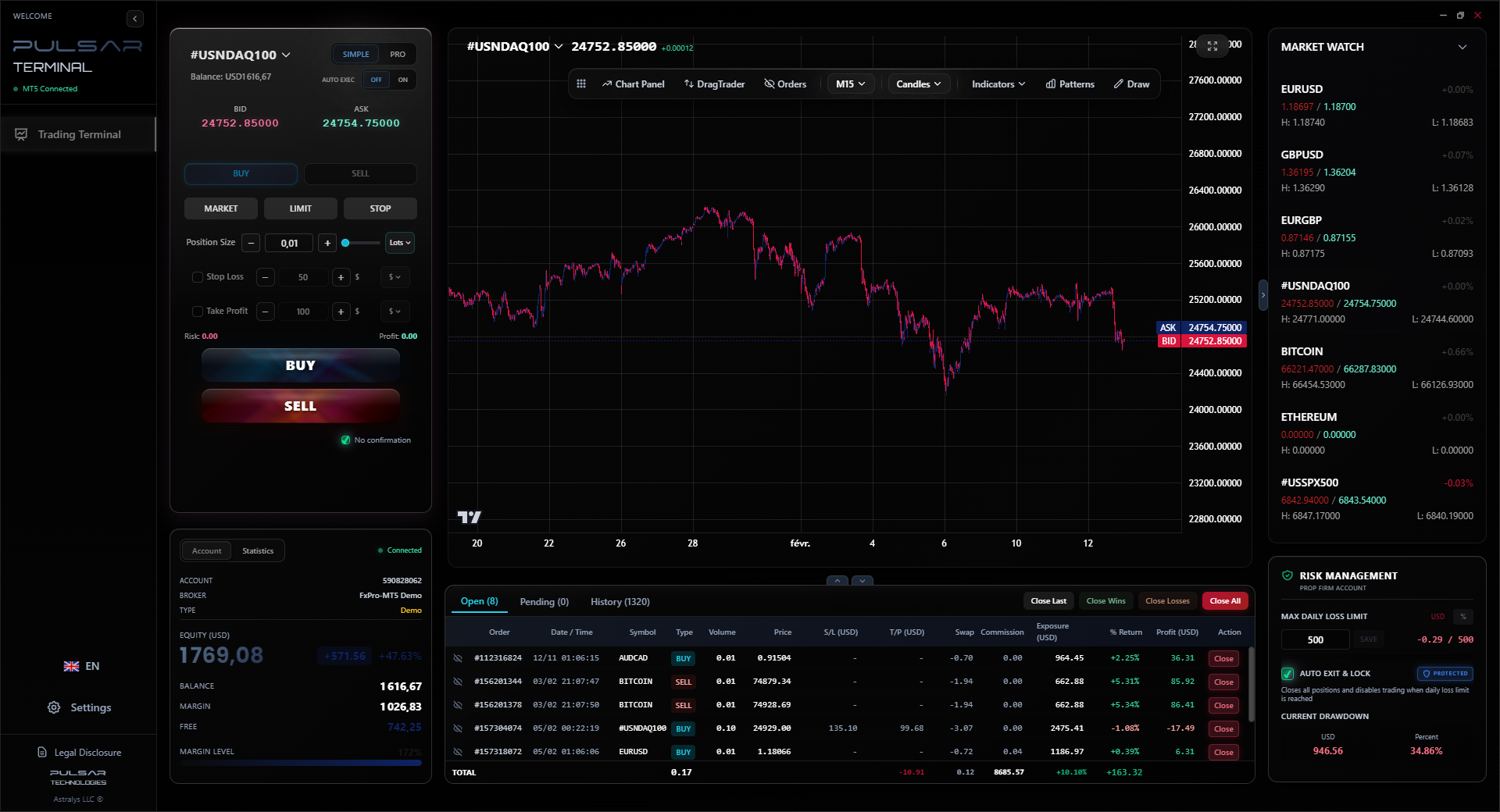
Manually moving stop losses to breakeven is a chore; Pulsar Terminal automates breakeven and trailing stop functions directly on your MT5 charts, enforcing your price action risk rules without emotion.
Pulsar Terminal
Lo strumento MT5 tutto-in-uno: ordini drag-and-drop, multi-TP/SL, trailing stop, grid trading, Volume Profile e protezione prop firm. Usato da oltre 1.000 trader ogni giorno.
I've seen these destroy accounts. Let's fix them.
Mistake 1: Over-trading. Price action requires patience. You might only see 1-2 high-quality setups per day on a 4-hour chart. New traders see 10. They take mediocre setups out of boredom, eroding their capital with spreads and losses. Fix: Have a written checklist for your setup (e.g., "1. Strong S/R level? 2. Clear Pin Bar? 3. In line with trend?"). If all boxes aren't ticked, don't trade.
Mistake 2: Moving Stop Losses. You place a stop, the trade goes slightly against you, and you "widen the stop just a little" to avoid the loss. This is suicide. It turns a small, controlled loss into a catastrophic one. Fix: Set your stop loss logically when you enter, and do not touch it unless you're moving it to breakeven after price has moved favorably.
Mistake 3: Chasing Price. You see EUR/USD rocket up 80 pips. FOMO kicks in, and you buy at the top, right into a resistance level. Fix: If you miss the entry, you miss it. The market will always give you another opportunity. Wait for the next pullback to support in the new uptrend.
Mistake 4: Ignoring the Higher Timeframe. You see a perfect buy signal on the 15-minute chart, but you're selling against a clear daily chart downtrend. You're fighting the tide. Fix: Always start your analysis on the 4-hour or daily chart to determine the main trend. Only take signals on lower timeframes that align with it. Understanding tools like the MACD indicator on a higher timeframe can help confirm trend direction, even in a price-action framework.
“In Nigeria, your greatest trading asset isn't a secret indicator - it's self-reliance.”
Your plan is your business blueprint. It must be in writing.
| Component | What to Define | Nigerian Consideration |
|---|---|---|
| Timeframes | What chart do you analyze on (e.g., Daily for trend), and what chart do you execute on (e.g., 4H/1H for entry)? | Stick to 1H+ if your internet is unreliable. Avoid tick charts. |
| Markets | Which 3-5 currency pairs will you focus on? | Majors only (EUR/USD, GBP/USD, USD/JPY, AUD/USD). Add XAU/USD (Gold) if you want a commodity. |
| Setups | List the exact patterns you will trade (e.g., Pin Bar at S/R, Inside Bar breakout in trend). | Be specific. Draw examples. |
| Risk Rules | What % risk per trade? Max daily/weekly loss limit? | 1% per trade max. Stop trading for the week if you lose 5%. |
| Entry/Exit Rules | Precisely how do you enter (market order, pending order)? Where do you place SL/TP? | Use pending orders to avoid emotional entries. SL/TP based on chart structure, not arbitrary pips. |
| Journaling | How will you review every trade? | Screenshot charts, note reason for entry/exit, emotional state. This is how you improve. |
Start by trading this plan on a demo account for at least two months. Then, move to a live account with the smallest possible capital. The goal in the first year is not to get rich; it's to survive and consistently execute your plan.
You don't need to pay a "mentor" in Lekki ₦500k to learn this. The resources are out there.
-
Education First: Use free content from reputable international traders (not the flashy Lamborghini guys). Focus on material about support/resistance, candlestick patterns, and market structure. Our glossary on key terms like pip and spread is a free starting point.
-
Find a Reliable Broker: This is crucial. You need fast execution, low spreads, and a stable MT4/MT5 platform. Read detailed, unbiased reviews that discuss deposit/withdrawal methods for Nigeria. Check our analysis of Exness as an example of what to look for in terms of local payment processing.
-
Join a Community (Carefully): Find a serious trading group focused on education, not signal sharing. The best ones dissect charts and talk about psychology. Avoid groups where everyone is just posting their latest profit screenshot - it's usually fake.
-
Start Small and Simple: Pick one pair (EUR/USD), one timeframe (4-hour), and one setup (Pin Bar at S/R). Master that before you add anything else. I spent my first six months only trading that. It built my discipline.
Price action trading forex is the great equalizer. It doesn't require the fastest internet or the most expensive software. It requires your eyes, your brain, and the discipline to follow a plan. In the volatile Nigerian financial environment, that self-reliance is your greatest asset.
FAQ
Q1Is price action trading suitable for beginners in Nigeria?
Absolutely, and in many ways, it's the best place to start. It teaches you to read the market itself, not rely on tools that might lag on slow internet. It builds foundational skills that are timeless. Start on higher timeframes (like 4-hour charts) where the noise is reduced, and be patient.
Q2Can I use price action on exotic pairs like USD/NGN?
I strongly advise against it for your core strategy. The spreads are often very wide, and the price action can be erratic due to lower liquidity and direct CBN intervention. This makes clean technical analysis difficult. Use major pairs for your price action analysis and execution.
Q3How many indicators should I use with price action?
Ideally, none for your entry signal. You can use one or two for context, like a single moving average to help define the trend or the RSI indicator to spot potential divergences at key levels. But the trigger to buy or sell should come from the price pattern (candle close, breakout) itself.
Q4What is the best timeframe for price action trading in Nigeria?
It depends on your schedule and internet. If you have a day job and intermittent connectivity, the 4-hour and daily charts are perfect. You can analyze once or twice a day. If you're a full-time trader with stable data, you can incorporate the 1-hour chart for finer entries. Avoid timeframes below 15 minutes if your connection isn't rock solid.
Q5How long does it take to become profitable with price action?
There's no fixed timeline, but expect a minimum of 12-18 months of dedicated practice. The first 6 months should be on a demo account, the next 6 on a very small live account. Profitability comes from consistency, not a few lucky trades. Your goal in year one is to not lose money.
Q6Do I need a special type of broker account for price action?
No, but you need a broker with a reliable trading platform (MT4/MT5 are standard), tight spreads (to keep transaction costs low), and fast execution (so your stop and limit orders are filled at the price you see). A raw spread account can be beneficial as it shows the cleanest price.
Lezione del Prof. Winston
Punti chiave:
- ✓Trade only at clear support/resistance levels.
- ✓Never risk more than 1% of your capital per trade.
- ✓The higher timeframe trend is your boss.
- ✓Master one setup on one pair before adding more.
Quanto è stato utile questo articolo?
Clicca su una stella
Analisi Trading Settimanali
Analisi e strategie settimanali gratuite. Nessuno spam.
Sull'autore
Olumide Adeyemi
Pioniere del Trading in Africa Occidentale
Uno degli educatori di trading forex più attivi in Nigeria. 8 anni di esperienza di trading da Lagos. Specializzato in strategie a basso capitale e sfide prop firm per trader africani.
Commenti
Avviso di rischio
Il trading di strumenti finanziari comporta rischi significativi e potrebbe non essere adatto a tutti gli investitori. Le performance passate non garantiscono risultati futuri. Questo contenuto è fornito solo a scopo educativo e non deve essere considerato un consiglio di investimento. Conduci sempre le tue ricerche prima di fare trading.
Potrebbe interessarti anche

Cara Trading Forex Sukses: 7 Prinsip dari Trader Profesional
Cara trading forex sukses dengan 7 prinsip trader pro: manajemen modal, disiplin, journal trading, backtest. Data nyata, bukan janji profit palsu.
Jam Trading Forex Terbaik untuk Trader Indonesia: Panduan Lengkap dengan Tabel Waktu
Panduan jam trading forex untuk trader Indonesia. Tabel 4 sesi dunia, jam emas 20:00-00:00, sesi mana yang harus dihindari. Data akurat + tips dari trader berpengalaman.
Top 5 Sàn Forex Uy Tín Nhất 2026: Review Jujur dari Trader Indonesia
Top 5 sàn forex uy tín 2026 untuk trader Indonesia. Review jujur: spread, deposit, withdraw, dukungan lokal. Exness, XM, IC Markets & lebih.
Scarica Pulsar Terminal
Tutti questi calcolatori sono integrati in Pulsar Terminal con dati in tempo reale dal tuo conto MT5.
Scarica Pulsar Terminal