


I blew up my first prop firm challenge in 72 hours.

James Mitchell
Analista Trading Senior
☕ 10 min di lettura
Cosa imparerai:
I blew up my first prop firm challenge in 72 hours. I was trading SPY options, convinced a volatility spike was coming. I put on a short strangle, collecting a juicy $1,200 in premium. The market didn't spike, it just drifted. Slowly. My short delta grew, and my unrealized loss hit the $2,500 daily limit. The account was locked. I lost my $299 evaluation fee and learned the hard way that prop firms for options trading aren't about big bets, they're about survival. Most traders get this backwards.
Let's cut through the marketing. A proprietary trading firm (prop firm) for options gives you a simulated account that behaves like real money. If you pass their rules - which are designed to make you fail - they give you a live account with their capital. You keep most of the profits (say, 80%), they take the rest.
It sounds like a free lottery ticket. It's not. It's a sophisticated filter. The firm's primary income isn't from your trading profits. It's from the hundreds of thousands of dollars in evaluation fees paid by hopeful traders who blow up. Industry estimates put the failure rate north of 90%. You're not a client, you're a statistic until you prove otherwise.
The key difference from trading your own account is the rulebook. Your personal brokerage might let you ride a losing position into oblivion. A prop firm will shut you down at a predefined daily or total loss limit. This forces a discipline most retail traders lack, which is the entire point.

Warning: Don't confuse these retail prop firms with traditional Wall Street prop desks. The old-school firms hired you, trained you, and paid you a salary. These modern online firms are a pay-to-play audition model. You're the product until you're profitable.

💡 Consiglio di Winston
The evaluation fee is the cost of a lesson. If you can't afford to light that money on fire, you're not ready for the psychological pressure of trading someone else's capital.
This is where dreams go to die. The rules aren't suggestions, they are binary triggers. Violate one, and your challenge fails or your funded account is closed.
Daily Loss Limits: The Silent Killer
This is the most common account assassin. Let's say you get a $100,000 account with a 5% max daily loss. That's $5,000. It seems huge. You think, "I'd never lose $5,000 in a day." But you're not thinking in net liquidation value (NLV).
Here's my mistake: I had a portfolio of iron condors on QQQ. My net position was delta-neutral. I was up $800 on the day. Then, I decided to 'add a little directional bias' with a few call debit spreads. An hour later, the market sold off hard. My iron condors were now fine, but my new call spreads were down $2,200. My total daily P&L was -$1,400. No problem, right? Wrong. The firm's rule was based on trailing daily loss. My peak equity for the day was +$800. From that peak, I drew down $2,200. I violated the $2,000 daily trailing drawdown. Account locked. I never even saw the total loss limit.
Maximum Position Size & Greeks
Prop firms for options trading hate unlimited risk. You'll face hard limits on:
- Delta: You can't be too directional. A common limit might be a net delta of +/- 200 on a $100k account.
- Vega: Your exposure to implied volatility is capped. This stops you from loading up on cheap, far-dated options before earnings.
- Gamma: They limit how much your delta can swing with price movement. This prevents you from holding too many short-dated, at-the-money options.
- Naked Short Options: Many firms outright ban them. You'll likely be restricted to defined-risk spreads (iron condors, butterflies, verticals) for overnight positions. This is a good thing, but it cramps the style of traders who love selling premium.

Example: A firm's rule might state: "Max portfolio Vega: $5,000. Max net Delta: +/- 150. No naked short options overnight." If you're long $6,000 of Vega from buying straddles, you've broken the rule, even if the trade is currently profitable.
“The advertised 90% profit split is a headline, not the full story.”
Let's talk numbers. The advertised 90% profit split is a headline, not the full story.
Upfront Costs:
- Evaluation Fee: This is your audition ticket. For a $100,000 options account, this can range from $250 to $600. It's usually non-refundable.
- Monthly Data/Platform Fees: If they provide a professional platform like ThinkorSwim, you might pay $100-$150/month for live data (CBOE, OPRA feeds). This comes out of your pocket, or from your trading profits.
- Activation Fee: A nasty trend. Some firms charge a one-time fee (e.g., $150) to 'activate' your funded account after you pass the challenge. It's a pure margin grab.
The Profit Split (The Truth): You see "Up to 90%" everywhere. The reality is tiered. A common structure:
- First $10,000 in profits: You keep 80%.
- Next $15,000: You keep 85%.
- Beyond $25,000: You keep 90%.
They also pay you monthly, not instantly. You make $5,000 in week one? You request a payout, they process it, and you might see the money in 5-10 business days. This gives them a float.
How They Really Profit: From the failure fees. If 1,000 people pay a $400 challenge fee, that's $400,000 in revenue. If only 80 pass (an 8% pass rate, which is generous), the firm pays out only those 80. The other 920 paid for a learning experience. The firm's risk is minimal, especially if they're using simulated accounts for the challenge phase. I've seen the math from a firm owner: the evaluation phase is the business; the funded traders are the marketing cost.

Pro Tip: Always read the payout fine print. Some firms have a 'minimum profit threshold' before you can withdraw. Others charge a withdrawal fee. Factor all this into your position size calculator. A 90% split on paper can become a 70% effective split after fees and hurdles.
Forget making money. Your sole goal in the evaluation phase is to not break the rules. Period. Profit is a secondary benefit.
- Trade Small, Stupid Small. On a $100k account, your max position size might be 10 lots. Start with 1. Your goal is to generate a string of small, boring wins to build a "cushion" between your equity and the trailing drawdown line. I passed my first real challenge by doing nothing but 1-lot iron condors 30 days out, closing them at 25% max profit. It was mind-numbing, but it worked.
- Use Defined-Risk Spreads Exclusively. This is non-negotiable. Trade iron condors, butterflies, vertical spreads. Your max loss is defined at entry. This makes calculating your risk relative to your daily limit trivial. If your max loss on a trade is $300, and your daily limit is $2,000, you know you can't put on 8 of those at once.
- Manage Trades Early. The worst thing you can do is let a defined-risk spread expire. Close it for a small loss well before expiration to avoid pin risk or a sudden gamma move. A $150 loss is better than a $500 loss that triggers your limit.
- Track Your Greeks Religiously. You need a dashboard. Before you enter any trade, calculate the new portfolio Delta, Vega, and Gamma. Will it push you over the limit? If there's any doubt, don't take the trade. This is where a tool like Pulsar Terminal can be a lifesaver, letting you visualize exposure before you click.
- Have a Daily Loss Cut-Off. If you're down 1-2% on the day, stop. Turn off the screens. The urge to "revenge trade" back to breakeven is what triggers the massive, rule-breaking loss. Your job is to live to trade tomorrow.
This approach is the opposite of sexy. It's grinding. But the prop firm model rewards consistency, not brilliance. A swing trading mindset applied to options is often more successful than hyper-active scalping in this environment.
💡 Consiglio di Winston
Your first goal in a challenge isn't to make $10,000. It's to make $1,000 ten times without a single rule breach. Consistency is the only metric that matters to the algorithm.
“Forget making money. Your sole goal in the evaluation phase is to not break the rules.”
Not all firms are created equal. Some are outright scams. Here’s a breakdown of reputable models. (Note: Structures change fast, verify directly).
| Firm Model | Key Focus | Typical Profit Split | Good For | The Catch |
|---|---|---|---|---|
| Traditional Payout (e.g., Maverick Trading) | Equities & Options | 70-80% | Experienced traders who want coaching & community. | Higher evaluation fee ($1,000+), often requires a formal interview. |
| Online Challenge (e.g., Topstep, Earn2Trade) | Futures (but some allow options on futures) | 80-90% | Traders comfortable with futures options (/ES, /NQ). | Rules are extremely strict. Data fees for CME can be $130/month. |
| Retail-Focused Funded Accounts (e.g., Apex Trader Funding) | Primarily Futures | Up to 100% (with scaling) | Traders wanting the highest possible split. | The '100%' split often only applies after hitting huge profit targets. Activation fees are common. |
A Critical Note on Regulation: Most of these retail prop firms operate in a gray area. They're not broker-dealers. They often register as "educational companies" selling trading simulations. Your challenge fee is for "education," and your funded account is often a simulated account where they just mirror your trades in their own master account. This is why they aren't regulated by the SEC or FINRA in the traditional sense. It's crucial you understand you don't have an individual brokerage account in your name. Your legal recourse if they don't pay is limited. Stick with firms that have a long, verifiable track record of paying.
Your choice of broker matters too. Some prop firms have partnerships, while others let you use your own. If you're using your own, ensure it's a reputable one with strong options tools. You can read our deep dives on brokers like TradeStation or Interactive Brokers to see if their platforms fit an options workflow.
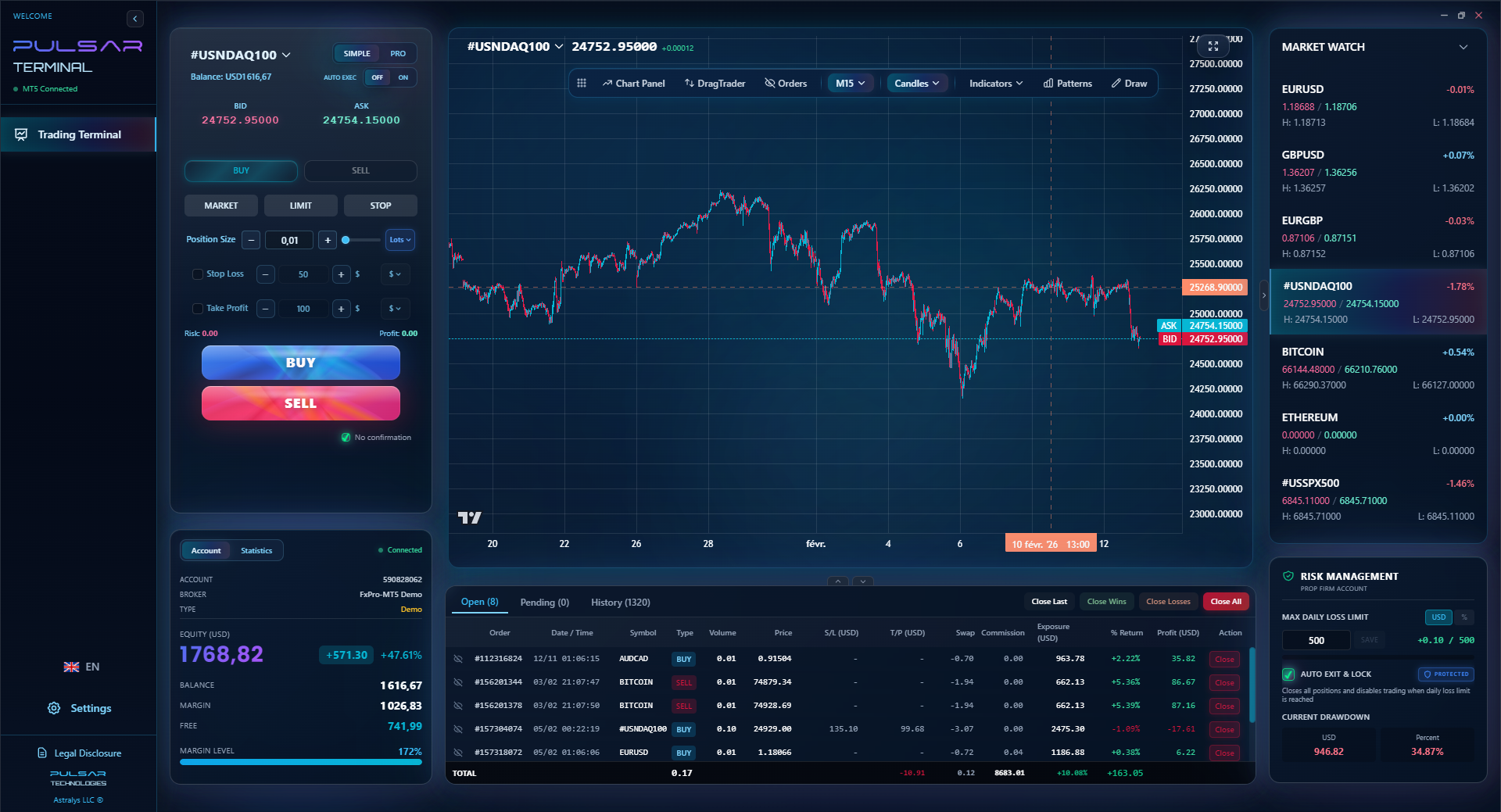
Managing complex options portfolios against strict Greek limits is nearly impossible on a basic platform; Pulsar Terminal gives you the real-time exposure dashboard you need to stay within a prop firm's rules.
Pulsar Terminal
Lo strumento MT5 tutto-in-uno: ordini drag-and-drop, multi-TP/SL, trailing stop, grid trading, Volume Profile e protezione prop firm. Usato da oltre 1.000 trader ogni giorno.
Prop firms for options trading are a tool, not a destination. They're good for one thing: forcing robotic discipline on traders who are skilled but emotionally erratic.
You might be a good candidate if:
- You have a proven, written options strategy with a positive expectancy over 100+ trades.
- You consistently lose money due to overtrading or breaking your own rules, not due to a bad strategy.
- You have the spare cash to lose the evaluation fee (twice) without it affecting your life.
- You understand that the first goal is survival, not getting rich.
You will almost certainly fail if:
- You think this is 'free use' to make a killing.
- You haven't traded options consistently with your own money for at least a year.
- You can't explain the Greeks or calculate your max loss on a spread in under 10 seconds.
- You're looking for a quick fix to financial problems.
The psychological toll is real. The pressure of the trailing drawdown creates a type of performance anxiety that can distort even a solid strategy. I've seen traders become so afraid of a loss that they take profits far too early, ensuring they'll never hit their profit targets.
My final advice? Paper trade their rules first. Take your own $50,000 sim account and impose a 5% daily loss limit and a 3-lot max position size. Do it for two months. If you can be profitable and not break the rules once, then consider paying for a challenge. If you can't, you just saved yourself hundreds of dollars and a heap of frustration. The real value of prop firms for options trading isn't the capital, it's the mirror they hold up to your own discipline.
FAQ
Q1Can I trade any stock option with a prop firm?
No. Most firms restrict you to highly liquid ETFs (like SPY, QQQ, IWM) and index options. They often ban single-name stock options due to the higher risk of gap moves and lower liquidity. Always check their approved symbols list.
Q2What's the difference between a daily loss and a trailing drawdown?
A daily loss is calculated from your starting equity each day. A trailing drawdown is the maximum allowed drop from your highest ever equity in the account. If you start at $100k, hit $103k, then drop to $100,500, your trailing drawdown is $2,500 from your peak. This is much harder to manage and is the most common rule type.
Q3Do prop firms report my profits to the IRS?
Yes. When you get a payout, they will issue you a 1099-MISC or 1099-NEC form for the income. You are responsible for paying income tax (typically as self-employment income) on your share of the profits. The evaluation fee may be tax-deductible as a business expense (consult a tax professional).
Q4How long does it take to get funded?
The fastest challenges can be passed in a minimum period (often 7-30 trading days) if you hit the profit target quickly without breaking rules. However, rushing is the #1 cause of failure. Plan for 1-2 months to pass a challenge cautiously, plus another week for account activation and first payout.
Q5What happens if I have a winning trade but violate a Greek limit?
You fail. The rules are absolute. A winning trade that breaks your max Vega or Delta exposure is still a rule violation. They are testing process adherence, not just profitability. You must manage your book within the limits at all times.
Q6Are there prop firms that trade only cash-settled index options (SPX, NDX)?
Yes, but they are less common in the retail space. Trading cash-settled indices is attractive (no assignment risk, 60/40 tax treatment), but the notional size is large. Firms that allow it typically have higher capital requirements and are more selective. You'll find this more in traditional prop shop models.
Lezione del Prof. Winston
Punti chiave:
- ✓Over 90% of funded challenge attempts fail.
- ✓Trailing drawdowns, not total loss, kill most accounts.
- ✓Trade 1/10th of your allowed size to build a cushion.
- ✓Defined-risk spreads are your only friend overnight.
Quanto è stato utile questo articolo?
Clicca su una stella
Analisi Trading Settimanali
Analisi e strategie settimanali gratuite. Nessuno spam.
Sull'autore
James Mitchell
Analista Trading Senior
Con base a New York e oltre 9 anni di esperienza nel trading. Si occupa delle principali coppie USD, sfide delle prop firm e del contesto normativo statunitense.
Commenti
Avviso di rischio
Il trading di strumenti finanziari comporta rischi significativi e potrebbe non essere adatto a tutti gli investitori. Le performance passate non garantiscono risultati futuri. Questo contenuto è fornito solo a scopo educativo e non deve essere considerato un consiglio di investimento. Conduci sempre le tue ricerche prima di fare trading.
Potrebbe interessarti anche

Cara Trading Forex Sukses: 7 Prinsip dari Trader Profesional
Cara trading forex sukses dengan 7 prinsip trader pro: manajemen modal, disiplin, journal trading, backtest. Data nyata, bukan janji profit palsu.
Jam Trading Forex Terbaik untuk Trader Indonesia: Panduan Lengkap dengan Tabel Waktu
Panduan jam trading forex untuk trader Indonesia. Tabel 4 sesi dunia, jam emas 20:00-00:00, sesi mana yang harus dihindari. Data akurat + tips dari trader berpengalaman.
Top 5 Sàn Forex Uy Tín Nhất 2026: Review Jujur dari Trader Indonesia
Top 5 sàn forex uy tín 2026 untuk trader Indonesia. Review jujur: spread, deposit, withdraw, dukungan lokal. Exness, XM, IC Markets & lebih.
Scarica Pulsar Terminal
Tutti questi calcolatori sono integrati in Pulsar Terminal con dati in tempo reale dal tuo conto MT5.
Scarica Pulsar Terminal