


Over 200,000 South Africans trade forex.

David van der Merwe
Trader dei Mercati Emergenti ·  South Africa
☕ 11 min di lettura
Cosa imparerai:
Over 200,000 South Africans trade forex. Statistically, a huge chunk of them are with brokers that are either outright scams or so poorly regulated they might as well be. The daily volume here is over $21 billion, but that money attracts sharks. A 'real' broker isn't just a website that takes your deposit. It's a licensed entity that follows the rules, protects your cash, and won't vanish when you try to withdraw. Let's strip away the marketing and look at what actually matters.
Forget fancy platforms and bonus offers for a second. In South Africa, a real forex broker boils down to one thing: a valid FSP license from the Financial Sector Conduct Authority (FSCA). It's not a suggestion, it's the law. The FSCA is our local watchdog, and their license means the broker has met specific capital requirements, agrees to keep your money in segregated accounts (so they can't use it to pay their office rent), and follows a rulebook designed to protect you.
Trading with an unregulated offshore broker is like leaving your car unlocked in Hillbrow. Sure, it might be fine, but when it's gone, you've got no recourse. I learned this the hard way early on. I deposited $500 with a 'broker' offering 1000:1 use and insane bonuses. Made a decent R8,000 profit on a few gold trades. The withdrawal request? Ignored. Emails? Bounced. Website? Gone a week later. That $500 tuition taught me more than any course.

Warning: Any broker offering you use above 30:1 is breaking FSCA rules for retail clients. If they're willing to ignore that major regulation, what other corners are they cutting?
The FSCA also enforces the 30:1 use cap. This isn't the broker being stingy, it's them following the law to prevent you from blowing up your account in two seconds. A real broker here will enforce this limit without question.
Let's get specific about what that FSCA license actually does for you. It's not just a logo on a website.
Client Money Protection
This is the big one. FSCA-regulated brokers must keep all client funds in separate, trust accounts at major banks. This money is legally distinct from the broker's operating funds. If the broker goes bankrupt (it happens), your trading capital should be safe and returned to you. This alone is worth choosing a regulated broker.
Dispute Resolution
Got a problem with a withdrawal, a disputed trade, or hidden fees? With a real FSCA broker, you have a formal path. Start with their internal complaints process. If that fails, you can escalate to the FSCA's Office of the Ombud for Financial Services Providers (FAIS Ombud). They have legal power to make binding rulings. Try that with an offshore outfit in Cyprus or the Seychelles.
Transparency on Costs
They have to disclose all fees, commissions, spreads, and financing charges clearly. No more 'zero spread' accounts that hit you with R400 in hidden commissions per lot. You can see the real cost upfront.
Verifying a license is simple. Go to the FSCA's website, find their Financial Service Provider Register, and type in the broker's name or FSP number. If they're not there, walk away. Don't just trust the broker's 'regulated internationally' line. We need local regulation for local protection.

Pro Tip: When checking a broker's FSCA status, also note their license category. They should be authorized for 'Discretionary and Non-Discretionary Forex and CFD Investments'. If it just says 'Advice Intermediary', they might not be fully licensed to hold your money.

💡 Consiglio di Winston
A broker's regulation is your first and last line of defense. If you skip that check, you're volunteering to be a victim.
“A 'real' broker isn't just a website that takes your deposit. It's a licensed entity that follows the rules, protects your cash, and won't vanish when you try to withdraw.”
Brokers make money. Real ones are just more transparent about how. Let's break down where your Rands go.
Spreads vs. Commissions: This is the core choice. A 'spread-only' broker might quote USD/ZAR with a 2-pip spread. On a standard lot (100,000 units), that's R200 gone the second you click buy. A 'commission-based' broker might offer a razor-thin 0.5-pip spread (R50) but charge a $5 (approx. R100) commission per lot, per side. Your total cost on entry is R150.
Here’s the kicker: for scalpers doing 20 trades a day, the commission model is usually cheaper. For a swing trader holding for weeks, the spread-only might work out better. You need to do the math based on your scalping strategy or swing trading style.
Overnight Financing (Swap): Holding a position past 10 PM SAST? You'll pay or earn a swap rate. On a long EUR/USD position, you might pay -0.3% annually. On a 1-lot trade, that's a few dollars a night. It adds up. Always check the swap rates on your broker's platform before holding a trade over Wednesday night (when triple swaps are charged).
Inactivity Fees: Some real brokers charge these if you don't trade for 3-6 months. It's annoying, but they tell you about it in their terms. The shady ones just quietly drain your account.
The Tax Man: This isn't a broker fee, but it's a real cost. Your net trading profits are taxable income. The capital gains tax rate is 5%. Keep a detailed log of all your trades. When you make that big withdrawal, SARS will want their share.
Let's look at some actual FSCA-licensed brokers with real numbers. This isn't a 'top 10' list. It's a breakdown of what different types of real brokers offer.
| Broker | FSCA License | Min. Deposit (ZAR Approx.) | Key Feature for SA Traders | Best For... |
|---|---|---|---|---|
| IG Markets | Yes (FSP 41393) | R4,000+ | Massive global firm, strong proprietary platform. | Experienced traders who want depth and don't mind a higher entry. |
| Tickmill | Yes (FSP 49464) | R1,800 ($100) | Exceptionally low raw spreads (EUR/USD from 0.11 pips). | Active traders, scalpers who need tight pricing. |
| XM | Yes (FSP 49146) | R90 ($5) | Ultra-low minimum deposit, good educational content. | Beginners wanting to test with very little capital. |
| Khwezi Trade | Yes | R500 | Local South African broker, ZAR-based accounts. | Traders who want direct local support and banking. |
I have personal experience with two of these. I ran a scalping strategy on Tickmill's raw account for 6 months. The average effective spread on EUR/USD was 0.71 pips (0.11 spread + $3 commission). On 100 trades a month, that low cost saved me hundreds compared to a spread-only broker. My position size calculator was critical here to manage risk with their 30:1 use.
Conversely, I used XM when first teaching a friend. The $5 minimum let him get a real feel for the platform and pip definition without risk. Their spreads on majors are wider (1.6-1.7 pips), but for a tiny account just learning, it's a fair trade-off. Just don't try serious volume trading there; the costs will eat you alive.

Example: On a R20,000 account, with 30:1 use, your maximum exposure is R600,000. That's 6 standard lots. A 2-pip spread on USD/ZAR across 6 lots would cost you R1,200 on entry. This is why understanding spread definition and costs is non-negotiable.
“Trading with an unregulated offshore broker is like leaving your car unlocked in Hillbrow. Sure, it might be fine, but when it's gone, you've got no recourse.”
Trading in SA isn't just about the broker. You're operating within a national financial system. Get these three things wrong, and you'll have problems bigger than a losing trade.
1. The 30:1 use Cap: I've said it, but it needs its own section. The FSCA imposed this in 2021. It's for your protection. Yes, it limits your potential buying power, but it drastically reduces your chance of a catastrophic margin call. A real broker will not offer you more as a retail client. If you're a professional client (meeting specific asset and experience tests), you can apply for higher limits, but that's a different ball game.
2. Tax on Profits: The South African Revenue Service (SARS) views forex trading as income generation. You must declare your net profit (total profits minus total losses and allowable expenses) on your annual tax return. The capital gains tax rate is 5%. Keep every statement, every trade confirmation. Use a spreadsheet or journal. When you withdraw R50,000 in profits, remember R2,500 of that isn't yours, it's SARS's. Plan for it.
3. SARB Foreign Exchange Allowances: This catches many people off guard. You can't just wire millions to an international broker. The South African Reserve Bank (SARB) controls cross-border money flow.
- You have a Single Discretionary Allowance of R1 million per calendar year for foreign investments (like funding an offshore broker account).
- For amounts over R1 million, you need to use your Foreign Investment Allowance (up to R10 million per year), which requires a Tax Clearance Certificate from SARS and more paperwork.
- Funding a local FSCA broker (where your ZAR stays in SA) avoids these limits entirely. This is a major advantage of brokers like Khwezi or the local entities of IG and Tickmill.
Ignoring SARB rules can lead to your bank freezing the transaction and potential penalties. A real broker's compliance team will often guide you on the required documentation for larger deposits.
💡 Consiglio di Winston
Your first withdrawal is more important than your first profitable trade. It's the only real test of a broker's legitimacy.
After 12 years, the scams all smell the same. Here’s what to run from.
1. 'Guaranteed' Profits or Daily Signals: No one can guarantee profits. If they could, they'd be on a private island, not spamming you on WhatsApp. Any broker pushing this is a scam.
2. Pressure to Deposit More After a Loss: This is the 'recovery' scam. You lose R10,000. A 'senior account manager' calls, saying you need to deposit R20,000 to follow a special trade that will win it all back. It's a trap to suck you deeper.
3. Withdrawal Problems: The biggest sign. Excuses like 'payroll issues', 'processing delays', or demands to pay a 'tax' or 'fee' to release your funds. With a real FSCA broker, withdrawals are routine and happen within a few business days.
4. No Clear Company Details: Can't find a physical address? The 'About Us' page is full of generic stock photos and buzzwords? The website's registration is hidden? Get out.
5. Copy-Paste Reviews: Go to Trustpilot or similar. If 50 reviews all say 'Amazing broker! I made $5000 in a day with Mr. John's signals!' and are posted on the same date, they're fake.
I once investigated a 'broker' targeting South Africans. Their FSCA number was fake (one digit off from a real company). Their listed address was a vacant plot in Sandton. They spent more on Facebook ads than on their legal setup. People still deposited. Don't be those people.
Stick to the established, verifiable names. Your first stop for checking any international broker should be our detailed reviews, like our Exness review, IC Markets review, or Pepperstone review, to see how they operate for South Africans specifically.
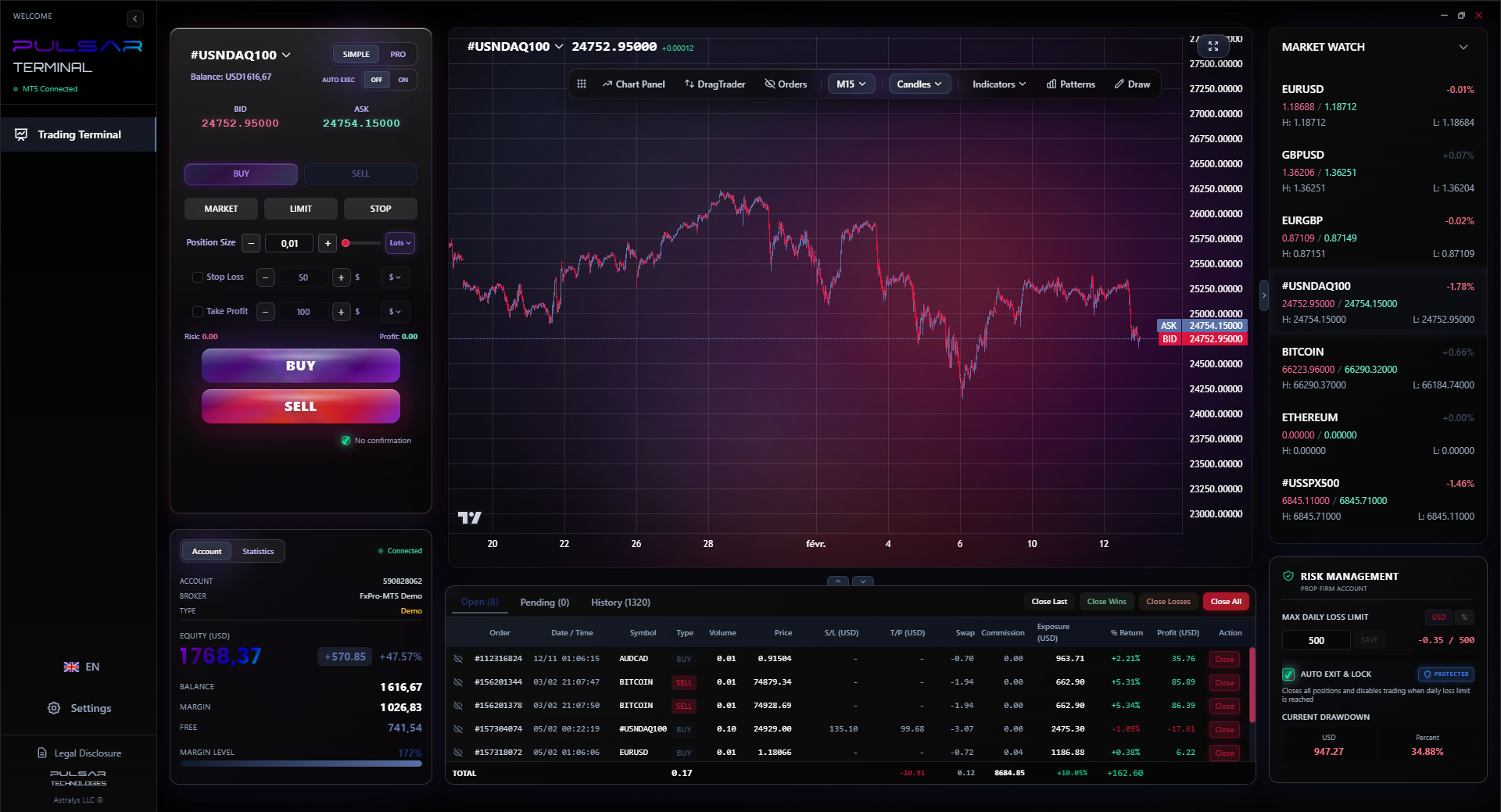
Managing risk with proper stop-losses and take-profits is critical with FSCA's 30:1 leverage, and Pulsar Terminal lets you set multi-level orders and trailing stops directly on your MT5 charts.
Pulsar Terminal
Lo strumento MT5 tutto-in-uno: ordini drag-and-drop, multi-TP/SL, trailing stop, grid trading, Volume Profile e protezione prop firm. Usato da oltre 1.000 trader ogni giorno.
“Your first goal is not to make money. Your first goal is to test the deposit and withdrawal process.”
Okay, you're convinced. Here's how to open an account without screwing up.
Step 1: Choose Your Broker Type. Decide: Do you want a low-cost, raw spread account for active trading (look at Tickmill, IC Markets)? Or a user-friendly platform with a low minimum to learn (XM)? Or the security of a massive global firm (IG)? Use the table above as a starting point.
Step 2: Verify the FSCA License. Do it yourself. Right now. Before you even click 'Open Account'.
Step 3: Open a Demo Account. Trade on it for at least a month. Test everything: order execution, platform stability, how their MACD indicator or RSI indicator looks on their charts. Get a feel for the spreads at different times of day.
Step 4: Start Small with Real Money. When you fund your live account, start with the minimum or just above it. Your first goal is not to make money. Your first goal is to test the deposit and withdrawal process. Deposit R500 or R1000. Trade it carefully for a week. Then, try to withdraw R400. If that process is smooth and fast, you've passed the most important test.
Step 5: Develop a REAL Strategy. Now you can focus on trading. Use your demo to test strategies on different instruments. Maybe you like the volatility of XAU/USD (Gold), or the liquidity of the EUR/USD. Learn how to use your position size calculator religiously with the 30:1 use.
This process is boring. It's not sexy. But it's what separates the traders who last from the ones who become statistics. You're building a business, not buying a lottery ticket. Act like it.
FAQ
Q1Can I legally trade with international brokers like Exness or Pepperstone?
Yes, but you need to be careful. Many international brokers are not directly licensed by the FSCA. This means you lose the direct protection of the FAIS Ombud and the guarantee of segregated funds under South African law. You are dealing with their offshore entity (e.g., in Cyprus or the Seychelles). Always check if they have a local presence or FSCA license. We review their offshore operations in our Exness review and Pepperstone review.
Q2What is the minimum deposit for forex trading in South Africa?
It varies wildly. Some brokers like XM offer accounts from $5 (about R90). Most serious brokers have a minimum of $100-$200 (R1,800-R3,600). Local broker Khwezi Trade starts at R500. The minimum deposit is less important than the trading conditions (spreads, commissions) that apply once you've funded.
Q3How do I pay tax on my forex trading profits?
Forex trading profits are considered taxable income. You must calculate your net profit (total gains minus total losses and any allowable expenses like data subscriptions) for the tax year (March to February). Include this amount in your annual income tax return (ITR12). The capital gains inclusion rate is 5%. It is highly recommended to consult with a tax practitioner familiar with trading.
Q4Why is use limited to 30:1 in South Africa?
The FSCA imposed the 30:1 use cap for retail traders in 2021 as a consumer protection measure. Excessive use (like 500:1 or 1000:1) allows traders to take positions far too large for their account size, leading to rapid, total losses. The limit is designed to promote more sustainable trading and reduce the risk of a margin call wiping out your account from a normal market move.
Q5What happens if my FSCA-regulated broker goes out of business?
This is where regulation matters most. Because client funds must be held in segregated trust accounts, your money should not be part of the broker's assets in a bankruptcy. In theory, the appointed liquidator would identify client claims and return the segregated funds. This process is far more structured and protective than with an unregulated broker, where your money is often simply gone.
Q6Can I use SARB allowances to fund an international broker?
Yes, you can use your Single Discretionary Allowance (up to R1 million per year) or Foreign Investment Allowance (up to R10 million per year, with a Tax Clearance Certificate) to transfer funds to an overseas broker for investment purposes. Your local bank will require you to complete a declaration form (e.g., a Form A for amounts over R1 million) to authorize the transfer. Always keep records for SARS.
Lezione del Prof. Winston
Punti chiave:
- ✓Verify the FSCA license yourself, every time.
- ✓The 30:1 use cap is law, not a suggestion.
- ✓Plan for a 5% tax on your net trading profits.
- ✓Test withdrawals before making large deposits.
- ✓SARB limits apply to international transfers over R1 million.
Quanto è stato utile questo articolo?
Clicca su una stella
Analisi Trading Settimanali
Analisi e strategie settimanali gratuite. Nessuno spam.
Sull'autore
David van der Merwe
Trader dei Mercati Emergenti
Trader con base a Johannesburg con 11 anni di esperienza nelle valute dei mercati emergenti. Specializzato in coppie ZAR, trading regolamentato dalla FSCA e analisi del mercato sudafricano.
Commenti
Avviso di rischio
Il trading di strumenti finanziari comporta rischi significativi e potrebbe non essere adatto a tutti gli investitori. Le performance passate non garantiscono risultati futuri. Questo contenuto è fornito solo a scopo educativo e non deve essere considerato un consiglio di investimento. Conduci sempre le tue ricerche prima di fare trading.
Potrebbe interessarti anche

Cara Trading Forex Sukses: 7 Prinsip dari Trader Profesional
Cara trading forex sukses dengan 7 prinsip trader pro: manajemen modal, disiplin, journal trading, backtest. Data nyata, bukan janji profit palsu.
Jam Trading Forex Terbaik untuk Trader Indonesia: Panduan Lengkap dengan Tabel Waktu
Panduan jam trading forex untuk trader Indonesia. Tabel 4 sesi dunia, jam emas 20:00-00:00, sesi mana yang harus dihindari. Data akurat + tips dari trader berpengalaman.
Top 5 Sàn Forex Uy Tín Nhất 2026: Review Jujur dari Trader Indonesia
Top 5 sàn forex uy tín 2026 untuk trader Indonesia. Review jujur: spread, deposit, withdraw, dukungan lokal. Exness, XM, IC Markets & lebih.
Scarica Pulsar Terminal
Tutti questi calcolatori sono integrati in Pulsar Terminal con dati in tempo reale dal tuo conto MT5.
Scarica Pulsar Terminal