


I blew up my first account trying to be a scalper.

James Mitchell
Analista Trading Senior
☕ 13 min di lettura
Cosa imparerai:
- 1More Than Just Timeframes: The Core Philosophies
- 2The $25,000 Gorilla in the Room: PDT and Other Rules
- 3Profit Targets, Costs, and the Math That Actually Matters
- 4Which One Will Make You Miserable? A Personality Test
- 5Setting Up Your Shop: Platforms, Brokers, and Tech
- 6How Much Money Do You Really Need to Start?
- 7Classic Mistakes I've Made (So You Don't Have To)
- 8So, Which One Is For You? A Practical Action Plan
I blew up my first account trying to be a scalper. It was 2012, and I had $3,000. I thought I could outsmart the market, grabbing 5-pip moves on EUR/USD all day. I made 47 trades in one session. My total profit, before commissions and spreads, was about $180. My total costs? Over $210. I ended the day down, exhausted, and completely demoralized. That painful lesson cost me real money but taught me the fundamental truth: you don't choose a strategy; it chooses you based on your capital, psychology, and the regulatory sandbox you're playing in. Let's break down the real differences between scalping and swing trading in the US market, far beyond the textbook definitions.
Everyone says scalping is fast and swing trading is slower. That's like saying a fighter jet and a cargo plane are both vehicles. The difference is in the mission.
Scalping is a game of probability and precision. You're a sniper, not a soldier. Your edge comes from executing a high-probability setup perfectly, over and over, before market noise erases the opportunity. You're not trying to catch a trend; you're trying to skim the spread and capitalize on tiny, predictable inefficiencies in liquidity. I've had days scalping the E-mini S&P 500 where my average trade duration was 90 seconds. The mental toll is immense.
Swing trading, on the other hand, is about patience and conviction. You're a hunter waiting for the right prey. You analyze the broader EUR/USD guide trend on a daily chart, identify a potential pullback, and place your trade with the expectation that the main trend will resume over days or weeks. The noise that kills a scalper's trade is just background static to you. Your battle isn't against latency; it's against your own impulse to close a trade too early.

Warning: Don't romanticize either style. Scalping isn't 'action-packed glory.' It's often monotonous and stressful. Swing trading isn't 'relaxed and easy.' It's filled with anxiety watching open profits evaporate overnight. Choose based on your tolerance for these specific pains.
This is where theory meets American regulatory reality. You can't talk about scalping vs swing trading here without understanding the Pattern Day Trader (PDT) rule. It's the single biggest factor that dictates what's possible for most retail traders.
The PDT Rule (For Now): If you execute four or more day trades (open and close a position in the same stock or option in a margin account on the same day) within five business days, and those trades are more than 6% of your total activity, you're flagged. This mandates a minimum account equity of $25,000. Fall below that, and your account gets restricted. This rule makes traditional stock scalping with less than $25k nearly impossible in a margin account. You're forced into a cash account, which has its own settlement delays (T+2).
The Big News: Pay attention. As of early 2026, FINRA has proposed a rule change to eliminate the PDT designation and the $25,000 minimum. It's not final yet, but it's on the table. This would be a seismic shift, opening the doors for smaller-account stock scalpers. But until it's ratified, the old rule stands.
Other Key Rules:
- use: Max 2:1 for stocks. This limits the size you can trade, affecting both styles but hitting the scalper's need for volume harder.
- Short Sale Rule (Rule 201): If a stock drops more than 10% in a day, you can only short it on an uptick. This can completely derail a scalper's short strategy on a crashing stock.
Swing traders largely sidestep the PDT rule because they hold positions overnight. Their regulatory hassle is different, often dealing with overnight margin requirements and, in forex, swap fees.

💡 Consiglio di Winston
Your first $10,000 in trading should be spent on education and controlled losses, not dreams of profits. Consider it tuition.
“The PDT rule makes traditional stock scalping with less than $25k nearly impossible. This is the single biggest factor for US traders.”
Let's get specific. Vague promises don't pay bills.
Scalping: The Volume Game
A scalper's profit per trade is tiny. We're talking:
- Forex: 5-10 pips on major pairs. On a standard lot, that's $50-$100. On a mini lot, $5-$10.
- Stocks: $0.10 to $0.50 per share.
- Futures: 1-4 ticks on the Micro E-mini S&P 500 (MES).
The killer is cost. Your broker and the market take their cut every single time. In 2023, costs could eat 8% of a scalper's gross profits. By 2025, that had dropped by 34% thanks to better tech and competition, but it's still the primary enemy.

Example: Scalping Micro E-mini (MES) futures. Say your all-in round-trip cost (commission + fees) is $1.20. You scalp for 2 ticks (0.25 points x $5 per point = $1.25 per tick x 2 = $2.50). Your gross profit is $2.50. Subtract the $1.20 in costs, and your net is $1.30. You need a 92% win rate just to break even if your stop-loss is also 2 ticks. This is why scalpers need tight spreads and low commissions from brokers like Pepperstone or IC Markets for forex, or dedicated futures brokers.
A successful scalper might do 50-200+ trades a day. The profit isn't in the home run; it's in a relentless series of singles.
Swing Trading: The Risk-Reward Game
A swing trader aims for larger moves: 100-300 pips in forex, or 5-15% moves in stocks. Your profit per trade is larger, but you do far fewer trades - maybe 2-10 per month.
Costs are a smaller percentage of your profit, but they're replaced by other 'costs': overnight risk (gap openings), swap fees, and the opportunity cost of tied-up capital and margin. You need a smaller win rate (40-60% can be profitable) but much better risk/reward ratios (think 1:3 or higher). Your main tool isn't speed; it's a solid swing trading plan and the discipline to follow it.
| Factor | Scalping | Swing Trading |
|---|---|---|
| Trades/Day | 50-200+ | 2-10 per month |
| Hold Time | Seconds to Minutes | Days to Weeks |
| Profit/Trade | Very Small (0.01%-0.1%) | Large (1%-5%+) |
| Cost Impact | Extremely High (Can be >30% of gross) | Low (Usually <1% of gross) |
| Key Metric | Win Rate & Cost Control | Risk/Reward Ratio |
| Primary Risk | Slippage, Spreads, Tech Failures | Overnight Gaps, Trend Reversals |
This is the most important section. You can learn charts and rules, but you can't easily change your wiring.
You Might Be a Scalper If:
- You have intense focus for short bursts and can instantly let go of a losing trade.
- You're comfortable with a 60-70% win rate where many wins are small and losses are quick.
- You're technologically adept and paranoid about internet latency and platform stability.
- You get bored watching paint dry. Waiting for days for a trade to play out feels like torture.
- You're okay with the fact that your P&L will be a flat line with tiny, frequent zigs and zags.
You Might Be a Swing Trader If:
- You're patient and analytical. You can do the homework, place the trade, and walk away.
- You can tolerate watching a 2% unrealized profit turn into a 1% loss without panicking.
- You understand that being right on direction but wrong on timing is a common outcome.
- You have a life outside trading and don't want to be glued to screens from 9:30 to 4:00 ET.
- You're comfortable with larger individual losses (in dollar terms) because your position size is calibrated for a wider stop.
I learned I'm a hybrid. I swing trade my core account but keep a small 'scalp account' to satisfy the itch for action. It keeps me engaged without risking my serious capital. Most people fail because they pick a style that conflicts with their innate temperament.
“Your starting capital should be money you can afford to lose completely without affecting your rent or groceries.”
Your tools determine your ceiling.
For the Scalper:
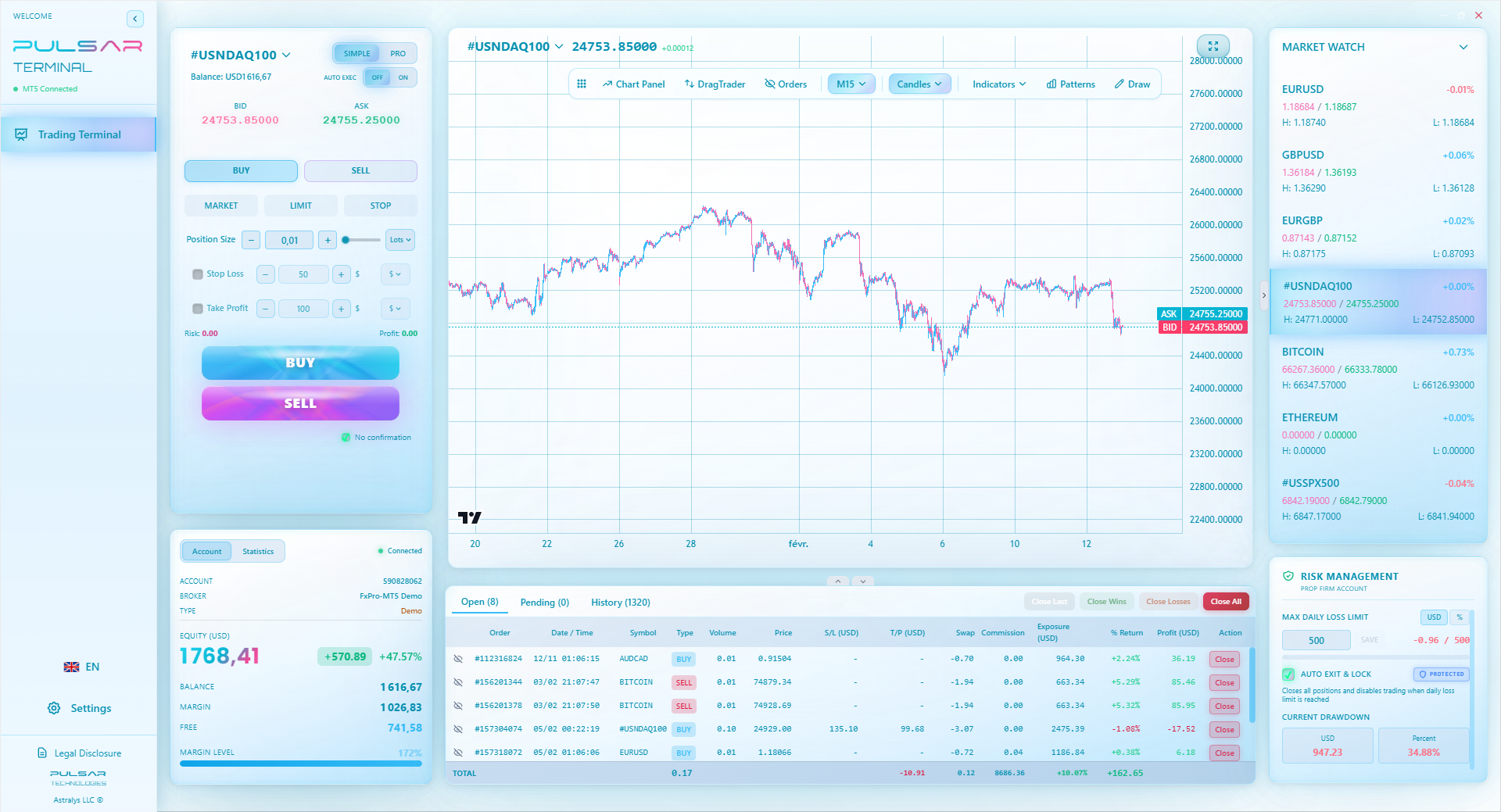
- Platform: You need direct market access (DMA), rock-solid stability, and hotkeys. Thinkorswim (from Charles Schwab), Interactive Brokers' TWS, or dedicated platforms like Sierra Chart. You need a tool that lets you manage risk instantly. For MT5 users, a companion app like Pulsar Terminal that offers one-click orders, trailing stops, and partial closures is non-negotiable.
- Broker: Lowest possible commissions and tightest spreads. Every penny counts. For forex, international brokers like Exness or XM cater to this, but US traders are often limited to domestic brokers like Forex.com or IG for direct access. For futures, look at brokers with tiered pricing.
- Tech: A powerful PC, a fiber internet connection, and a backup connection (like your phone's hotspot). A multi-monitor setup is standard.
For the Swing Trader:
- Platform: You need great charting and research. Thinkorswim, TradingView, and MetaTrader are excellent. The speed of order execution is less critical than the depth of analysis.
- Broker: Reliability and good margin rates are key. Commission costs matter less per trade. Fidelity, Schwab, and Interactive Brokers are all strong contenders.
- Tech: A reliable laptop will do. Your biggest tool is your trading journal and your checklist for evaluating setups.

Pro Tip: Never use a swing trading platform for scalping or vice-versa. I tried analyzing a weekly chart on a platform built for scalping, and it was agonizing. The tool must fit the task. Before you fund an account, test the platform's demo with the specific order types and speed you need.
💡 Consiglio di Winston
If you feel a strong urge to override your stop-loss, stand up and walk away for 15 minutes. The market will still be there. Your account might not be if you stay.
For scalpers, managing multiple trades and risk in seconds is critical, which is why tools like Pulsar Terminal that offer one-click orders, trailing stops, and partial closures directly on MT5 are game-changers.
Pulsar Terminal
Lo strumento MT5 tutto-in-uno: ordini drag-and-drop, multi-TP/SL, trailing stop, grid trading, Volume Profile e protezione prop firm. Usato da oltre 1.000 trader ogni giorno.
Let's be brutally honest about money.
Scalping Capital: The PDT rule makes this the big barrier. If you're day trading stocks/options in a margin account, you need $25,000 minimum, full stop. And that's just to be allowed to play. To actually survive the volatility and costs, you need more. I'd never recommend starting with less than $30k, and even that is tight.
If you're scalping forex or futures, the PDT rule doesn't apply, but the math is just as harsh. Because your profit per trade is so small, you need enough capital to trade a size that makes the effort worthwhile after costs. Trying to scalp with a $500 account is a joke. The spreads and commissions will devour you. A realistic minimum for forex scalping is $2,000-$5,000 to trade mini lots effectively. For micro futures, maybe $1,500. Use a position size calculator religiously. Your risk per trade should be 0.1%-0.25% of your account. On a $2,000 account, that's $2-$5 per trade. Let that sink in.
Swing Trading Capital: You can start smaller. $500 can get you started in forex swing trading with a nano lot. For stocks, $2,000 is a bare minimum, but $10,000 lets you breathe and diversify. The key is that your position size lets you place a logical stop-loss without risking more than 1-2% of your account. A common mistake is having a $1,000 account and taking a $50 risk because 'the setup is perfect.' That's a 5% risk. Do that twice, and you're down 10%. It's a fast track to a margin call.
My rule: Your starting capital should be money you can afford to lose completely without affecting your rent or groceries. The pressure of trading with 'rent money' will corrupt every decision you make.
“Don't decide today. Experiment. Open two demo accounts and commit to one month each.”
Let me save you some money and heartache.
Scalping Pitfalls:
- Chasing Losses: You lose $20 on a bad trade. You immediately jump back in to 'make it back,' doubling your size. You lose $40. Rinse, repeat. Account dead by lunch. This is the #1 scalper killer.
- Ignoring Slippage: You place a market order during news. Your fill is 5 pips worse than you expected. Your entire profit target was 6 pips. You just lost money on a 'winning' trade.
- Overtrading: The market is dead, but you're bored. You take marginal setups just to be in the game. This is how you give back all your morning profits in the afternoon chop.
Swing Trading Pitfalls:
- Turning a Swing Trade into a Long-Term Investment: Your trade goes against you. 'It'll come back,' you say, moving your stop-loss further out. You've just abandoned your plan. You're now a hopeful bag-holder, not a trader.
- Taking Profits Too Early: You get a 2% gain in two days. You close it, feeling smart. The stock then runs another 8% over the next week. You traded fear, not your plan.
- Misusing use: Because you hold trades for days, you think you can use higher use. A 2% overnight gap against you on 10:1 use wipes out 20% of your account. use is a double-edged sword that cuts deeper the longer you hold it.
The antidote to all of this is a written trading plan for each style. For scalping, it's a set of entry/exit rules and a daily loss limit. For swing trading, it's a checklist for trade selection and unwavering rules for stop-loss and take-profit placement. Indicators like the RSI indicator or MACD indicator can be part of your plan, but they are not the plan itself.
💡 Consiglio di Winston
The best indicator for your chosen style is your own trade journal. It tells you what you actually do, not what you think you do.
Don't decide today. Experiment.
- Open Two Demo Accounts. Seriously. Fund them with a realistic amount of virtual capital ($25k for a PDT-style account, $5k for a swing account).
- Commit to One Month Each. For one month, only scalp on your demo. Follow the rules: tight stops, small targets, high volume. Journal how it feels. Are you stressed? Bored? Engaged? Then, for the next month, only swing trade. Do the analysis at night, place trades, and check them once a day. Which month felt more sustainable?
- Audit Your Results. It's not about which made more fake money. It's about which had better risk-adjusted returns and which you could execute without emotional meltdowns. Look at your biggest losing trade in each style. Which one was easier to accept and move on from?
- Start Small with Real Money. Once you choose, fund a live account with the minimum capital we discussed. Your goal for the first 6 months is not to get rich. It's to not blow up. It's to prove you can follow your plan with real money on the line. This is the hardest step.
Remember, this isn't a lifetime sentence. I know traders who scalp in trending markets and swing trade in ranging markets. The ultimate skill is knowing which environment you're in and which tool from your toolbox to use. But you must master one style first before you try to blend them. Trying to learn both at once is a surefire way to master neither.
Final thought: The market doesn't care what you prefer. It will do what it does. Your job is to align your method with your personality and the regulatory framework, so you can survive long enough to learn. Most of the money in trading is made by the survivors, not the geniuses.
FAQ
Q1Can I start scalping in the US with less than $25,000?
Yes, but with major caveats. The $25,000 PDT rule only applies to day trading stocks and options in a margin account. You can scalp forex or futures without that minimum. You can also use a cash account for stocks, but you're limited by settlement times (T+2). However, even without the PDT rule, you need enough capital to cover costs and trade a meaningful size. Starting with less than $2,000 for serious scalping is very difficult.
Q2Is scalping more profitable than swing trading?
Not inherently. Profitability is about your edge and discipline, not the speed of your trades. A disciplined swing trader with a 2:1 risk/reward ratio and a 40% win rate can be highly profitable. A sloppy scalper with a 55% win rate and high costs will blow up. Scalping offers more frequent feedback, which can accelerate learning or accelerate ruin. Swing trading profits are less frequent but can be larger per trade.
Q3What's the biggest mistake new swing traders make?
Moving their stop-loss further away when a trade goes against them. They confuse 'being patient' with 'being wrong.' A stop-loss is part of your trade plan. If you move it, you no longer have a plan; you have a hope. The second biggest mistake is using too much use on overnight positions, exposing themselves to gap risk.
Q4Do I need expensive software to be a scalper?
You need reliable and fast software, which isn't always expensive. Many good brokers provide strong platforms for free (Thinkorswim, TWS). However, you may pay for data feeds or advanced order types. The real expense is often in your hardware and internet connection. A slow home computer and Wi-Fi will cost you more in slippage than any software fee.
Q5How many hours a day does each style require?
Active scalping requires you to be focused and in front of the screen during market hours you trade - potentially 6.5 hours for US stocks. It's intense. Swing trading requires concentrated analysis time (1-2 hours) for research and planning, often in the evening or pre-market, but then only brief check-ins during the day. The time commitment is deeper but less constant.
Q6Can I use the same broker for both styles?
Often, yes, but it might not be optimal. A broker like Interactive Brokers can handle both, offering good execution for scalping and strong fundamentals data for swing trading. However, you might find a broker with ultra-low costs better for scalping (like a futures-specific broker) and a different broker with better research for swing trading. Don't force one broker to do everything if it compromises your primary strategy.
Lezione del Prof. Winston
Punti chiave:
- ✓The PDT rule mandates $25k for stock day trading; it's the law, not a suggestion.
- ✓Scalping costs can eat 30%+ of gross profits; control them or fail.
- ✓Swing trading's enemy is emotion, not latency; master your psychology.
- ✓Start with a demo for one full month per style before risking a single real dollar.
Quanto è stato utile questo articolo?
Clicca su una stella
Analisi Trading Settimanali
Analisi e strategie settimanali gratuite. Nessuno spam.
Sull'autore
James Mitchell
Analista Trading Senior
Con base a New York e oltre 9 anni di esperienza nel trading. Si occupa delle principali coppie USD, sfide delle prop firm e del contesto normativo statunitense.
Commenti
Avviso di rischio
Il trading di strumenti finanziari comporta rischi significativi e potrebbe non essere adatto a tutti gli investitori. Le performance passate non garantiscono risultati futuri. Questo contenuto è fornito solo a scopo educativo e non deve essere considerato un consiglio di investimento. Conduci sempre le tue ricerche prima di fare trading.
Potrebbe interessarti anche

Cara Trading Forex Sukses: 7 Prinsip dari Trader Profesional
Cara trading forex sukses dengan 7 prinsip trader pro: manajemen modal, disiplin, journal trading, backtest. Data nyata, bukan janji profit palsu.
Jam Trading Forex Terbaik untuk Trader Indonesia: Panduan Lengkap dengan Tabel Waktu
Panduan jam trading forex untuk trader Indonesia. Tabel 4 sesi dunia, jam emas 20:00-00:00, sesi mana yang harus dihindari. Data akurat + tips dari trader berpengalaman.
Top 5 Sàn Forex Uy Tín Nhất 2026: Review Jujur dari Trader Indonesia
Top 5 sàn forex uy tín 2026 untuk trader Indonesia. Review jujur: spread, deposit, withdraw, dukungan lokal. Exness, XM, IC Markets & lebih.
Scarica Pulsar Terminal
Tutti questi calcolatori sono integrati in Pulsar Terminal con dati in tempo reale dal tuo conto MT5.
Scarica Pulsar Terminal