


I made S$18,500 in a single month back in 2021, trading USD/SGD and EUR/USD like it was my job.

Daniel Harrington
Responsabile Editoriale
☕ 12 min di lettura
Cosa imparerai:
- 1The Big Question: Is Forex Taxable in Singapore?
- 2How MAS Regulations Impact Your Trading (And Taxes)
- 3Calculating Your Potential Tax Bill: Real Numbers
- 4Trading as a Business vs. Personal Investment
- 5Brokers, Platforms, and Your Local Setup
- 6Recent Changes (2024-2026) and What They Mean for You
- 7Your Actionable Steps for Compliance
I made S$18,500 in a single month back in 2021, trading USD/SGD and EUR/USD like it was my job. I was already planning what to do with the cash. Then tax season rolled around, and I got a letter from IRAS. They wanted to know if my forex profits were taxable income. I had no idea. That confusion cost me months of stress and a hefty accountant's bill to sort it out. The truth is, Singapore's tax rules for forex aren't black and white. They're a grey area that depends entirely on how you trade. Let me save you that headache and walk you through exactly how the Singapore forex trading tax works, what IRAS looks for, and how to structure your trading so you keep more of your hard-earned money.
This is where everyone gets tripped up. Singapore doesn't have a capital gains tax. So, if you buy a stock, hold it for years, and sell it for a profit, that's generally not taxed. Many traders wrongly assume the same applies to forex. It doesn't, necessarily.
The Inland Revenue Authority of Singapore (IRAS) uses a concept called the 'Badges of Trade' to figure out if your trading activity is a hobby or a business. If it looks like a business, your profits are considered taxable income. It's not about how much you make, but how you make it.
Think of it this way: If you're a doctor who buys and sells a few lots of EUR/USD a year based on holiday plans, IRAS probably won't care. But if you're sitting at your screens for hours each day, executing dozens of trades, using complex analysis, and relying on that income? That starts to look a lot like a business. I learned this the hard way after my big month. My trading frequency and the size of my account relative to my other income were huge red flags.

Warning: Don't assume you're tax-free just because there's no capital gains tax. IRAS assesses each case individually based on your activity. Ignorance isn't a defense.
The 'Badges of Trade' Checklist
IRAS looks at several factors. The more you tick, the more likely your forex profits are taxable:
- Profit-seeking motive: Are you trading to make a living or for speculative gain? (Spoiler: we all are).
- Frequency and number of transactions: A few trades a month vs. 50 trades a day makes a big difference.
- Holding period: Are you holding positions for weeks (more 'investment-like') or are you scalping for minutes?
- Financing: Are you using significant use? This points to speculation.
- Expertise: Do you have a professional background in finance or spend serious time on market analysis?
- Organization: Do you keep trading records, have a dedicated office space, or use automated systems?
My own situation? High frequency, high use, detailed journals. After reviewing it, my accountant said, 'Yeah, they're going to call this a business.' And he was right.

💡 Consiglio di Winston
The first rule of tax club is to keep a journal. Your trade log isn't just for strategy review; it's your primary defense in a tax discussion. Note the rationale for every trade. 'Felt lucky' is not a business rationale.
“Singapore's forex tax isn't about how much you make, but how you make it.”
The Monetary Authority of Singapore (MAS) doesn't set tax policy, but its rules shape your trading environment, which indirectly affects your tax profile. MAS is one of the toughest regulators globally, and that's mostly good for you.
First, use is capped. For retail traders like you and me, it's 50:1 for major pairs (like EUR/USD) and 20:1 for others. This is a global best practice to prevent you from blowing up your account in seconds. It also means your potential profits (and losses) per trade are limited compared to unregulated brokers offering 500:1. This can influence the 'Badges of Trade' assessment - extreme use screams 'speculation'.
Second, every legit broker here must be MAS-licensed, hold a Capital Markets Services (CMS) license, and keep your money in segregated accounts. This is non-negotiable. I only use brokers like IC Markets or Pepperstone that hold these licenses for their Singapore entities. It means your funds are safe if the broker goes under.
Finally, MAS banned the marketing of copy-trading to retail investors a few years back. If you're copy-trading, that's another data point for IRAS. It shows you might be systematically following a strategy to generate income, which leans toward a business activity.

Pro Tip: Always verify your broker's MAS license on the MAS Financial Institutions Directory. It's free and takes two minutes. Trading with an unregulated broker is asking for trouble, both with your money and your tax records.
“A good trade isn't just a winning entry; it's knowing how much profit you'll actually keep.”
Let's get down to brass tacks. If IRAS decides your forex trading is a business, your net profit (after deducting allowable expenses) is added to your other income and taxed at Singapore's progressive personal income tax rates.
Here are the resident tax rates for Year of Assessment 2026 (which taxes income you earn in 2025):
| Chargeable Income (S$) | Tax Rate (%) | Tax Payable (S$) |
|---|---|---|
| First 20,000 | 0 | 0 |
| Next 10,000 | 2 | 200 |
| Next 10,000 | 3.5 | 350 |
| Next 40,000 | 7 | 2,800 |
| Next 40,000 | 11.5 | 4,600 |
| Next 40,000 | 15 | 6,000 |
| Next 40,000 | 18 | 7,200 |
| Next 40,000 | 19 | 7,600 |
| Next 40,000 | 19.5 | 7,800 |
| Next 40,000 | 20 | 8,000 |
| Above 320,000 | 22 | ... |
Here's a real example from my own planning: Let's say you have a salary of S$70,000. You also make a net profit of S$30,000 from forex trading that IRAS deems taxable.
- Your total chargeable income: S$100,000.
- Tax on S$100,000 = S$21,950 (from the progressive scale).
- For YA 2026, you get a Personal Income Tax Rebate of 60%, capped at S$200.
- So your final tax bill: S$21,950 - S$200 = S$21,750.
Without the forex income, your tax on S$70,000 would be about S$4,350. So that S$30,000 in trading profit added roughly S$17,400 to your tax bill. Your effective tax rate on the trading profit alone is about 58% in this bracket! This is why you must factor tax into your profit targets. Always use a position size calculator that considers your net, after-tax returns, not just gross pips.

Example: If your trading strategy needs a 10% annual return to be worthwhile, and you're in a 15% average tax bracket on that income, you actually need to gross about 11.76% just to break even on that 10% net goal. Taxes eat into your edge.
“A good trade isn't just a winning entry; it's knowing how much profit you'll actually keep.”
This is the core strategic decision. You can't just 'choose' one, but your actions will push IRAS toward one conclusion.
The 'Personal Investment' Path: This is the goal if you want to avoid the Singapore forex trading tax. You're treating forex as part of your wealth portfolio. How it looks:
- Low frequency (maybe a handful of swing trades per month).
- Longer holding periods (days to weeks).
- Not your primary source of income. You have a full-time job.
- Minimal use of use (staying well under MAS limits).
- No formal business structure, marketing, or clientele.
The 'Business' Path: You're all in. You might even consider registering a sole proprietorship or a private limited company. Why would you do this? Because you can claim expenses.
Allowable Expenses for a Trading Business:
- Platform & Data Fees: Subscriptions to TradingView, premium MT4/MT5 indicators, news feeds.
- Hardware & Software: A portion of your computer, monitors, internet bills.
- Education: Trading courses, books, seminar fees.
- Professional Fees: Accountant and legal costs.
- Home Office Deduction: If you have a dedicated space.
Let me give you a real, vulnerable number. In 2023, I treated my trading as a business. My gross profit was S$42,000. But I claimed S$8,500 in legitimate expenses (new laptop, software subscriptions, part of my rent, accountant fees). My taxable income became S$33,500. That saved me over S$1,500 in taxes. The key is keeping every single receipt and having a clear ledger.
If you go the company route, you pay corporate tax rates (currently 17%) instead of personal rates. With the new Corporate Income Tax Rebate of 40% capped at S$30,000 for YA 2026, this can be very attractive for larger, consistent profits. But it comes with compliance costs. Don't incorporate for a S$5,000 profit.
💡 Consiglio di Winston
If you're trading actively, assume you'll be taxed. Set aside 15-20% of your net profits in a separate savings account immediately. A large tax bill you can't pay can trigger a [margin call](/en/glossary/margin-call) on your entire life.
“Mixing trading funds with grocery money is a bookkeeping nightmare. Use a separate bank account.”
Your choice of broker and how you fund your account matters more than you think, both for practicality and tax records.
Brokers in Singapore: You want a broker that is not just 'available' in Singapore, but has a local entity regulated by MAS. This ensures they report correctly (if required) and you have local recourse. I've had good experiences with the Singapore arms of global brokers. For instance, Exness and XM have strong regional presence, but always check their specific MAS status. Many offer raw spreads on EUR/USD below 0.2 pips.
Minimum Deposits & Spreads: These vary wildly. Some like CMC Markets have no minimum, while Saxo might ask for S$2,000. For active trading, spreads are crucial. On a major like EUR/USD, you should be looking at under 1.0 pip on a standard account. Half a pip or less on a raw account is common. That difference is pure profit or loss over hundreds of trades.
Payment Methods: This is where Singapore shines. Funding is a breeze.
- Local Bank Transfer (FAST): Instant, usually fee-free. This is my go-to. Keep all these transaction records for your accounts.
- PayNow: Even faster. Linked to your phone or NRIC.
- Cards & E-Wallets: Credit/debit cards, GrabPay, Apple Pay. Convenient but sometimes have deposit fees or lower limits.
Platforms: MT4 and MT5 are the kings here for a reason. They're stable, support automated trading, and every broker offers them. For tax purposes, they generate detailed trade reports you can export for your accountant. If you're on MT5, using a tool that enhances order management can be a legitimate business expense if it improves your profitability. Managing multiple take-profit and stop-loss levels manually is a pain.
Pro Tip: Open a separate bank account just for trading. Feed it from your main account, and withdraw profits back to main. This creates a clean audit trail. Mixing trading funds with grocery money is a bookkeeping nightmare.
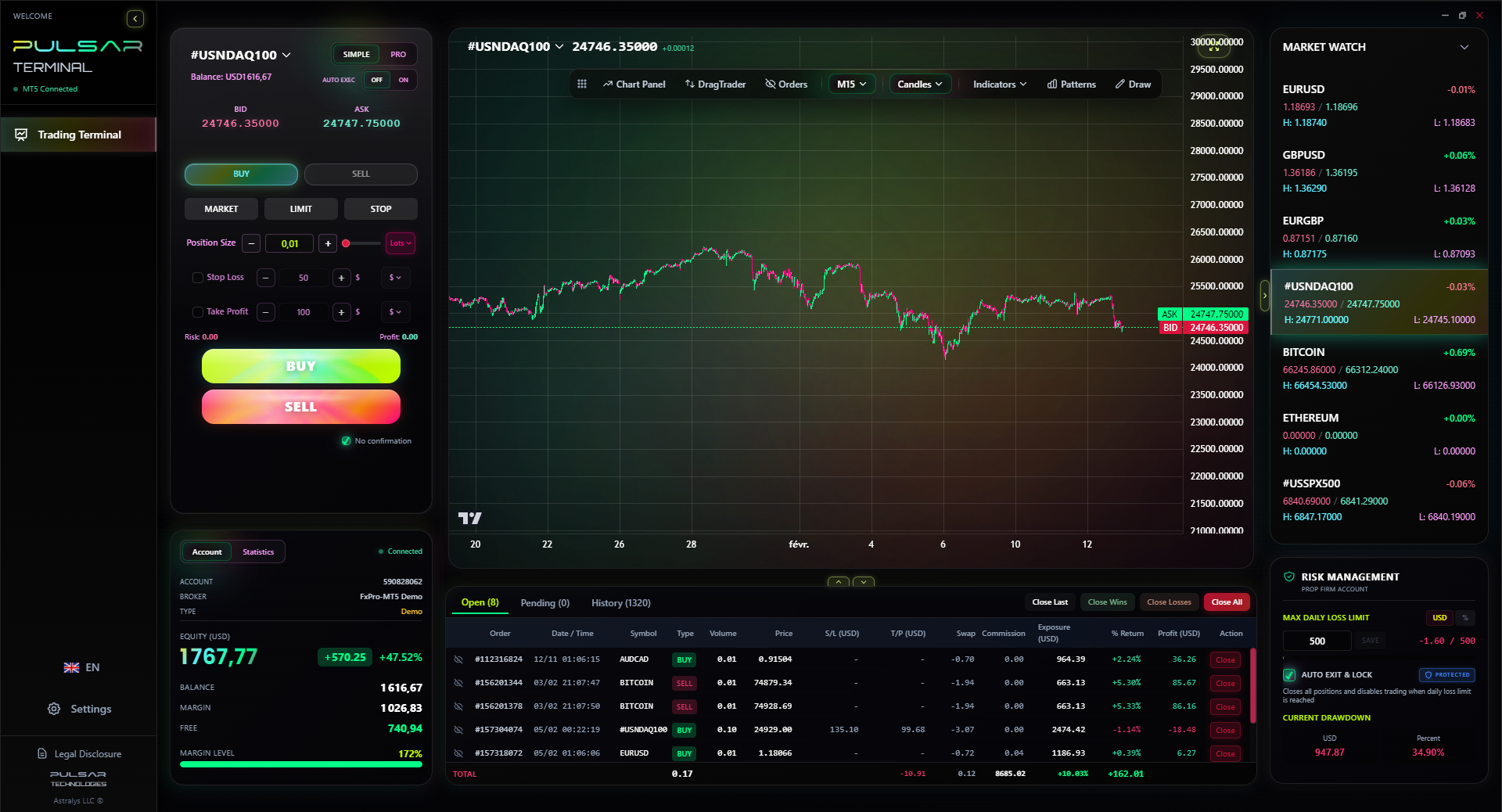
Managing complex trades and keeping a clear journal for tax purposes is easier when your platform automates order management and provides detailed, exportable analytics, like Pulsar Terminal does on MT5.
Pulsar Terminal
Lo strumento MT5 tutto-in-uno: ordini drag-and-drop, multi-TP/SL, trailing stop, grid trading, Volume Profile e protezione prop firm. Usato da oltre 1.000 trader ogni giorno.
“Mixing trading funds with grocery money is a bookkeeping nightmare. Use a separate bank account.”
The landscape isn't static. Here are the updates you need to know about.
- Withholding Tax Exemptions Extended (Budget 2026): Big news. Exemptions on payments for things like OTC derivatives and margin interest, which were due to expire end-2026, are now extended to Dec 31, 2031. This keeps Singapore competitive as a forex hub. For you, it means lower costs on certain transactions if you're trading complex products or with large margin.
- MAS E-Trading Push: MAS is working with banks to beef up Singapore's electronic trading infrastructure. The goal? Better pricing, faster execution, and more liquidity. In the next few years, you should see even tighter spreads and more reliable fills, especially on Asian pairs and USD/SGD. This is good for all trading styles.
- Personal & Corporate Tax Rebates (YA 2026): As mentioned, the personal rebate (60%, cap S$200) and corporate rebate (40%, cap S$30,000) for income earned in 2025 are a nice little boost. It's not life-changing for individuals, but for a trading company, that S$30,000 cap is significant.
- Prop Firm Scene: While MAS banned retail copy-trading marketing, the proprietary trading firm model is alive. If you pass a challenge with a firm, you trade their capital for a split. The key tax question: Is the profit share income? Usually, yes. It's likely considered business income or employment income. Keep those payouts documented.
The trend is clear: Singapore is building a professional, institutional-grade environment. The days of wild west forex are over here. Regulation is tightening, but the infrastructure is getting better for serious traders.
💡 Consiglio di Winston
Your broker's profit/loss statement is in USD. For IRAS, you must convert every single trade to SGD using the spot rate at the time of the trade's opening and closing. This is tedious but crucial. Find an accountant who can automate this.
“The 'Badges of Trade' test means your trading frequency can be more important than your profit size.”
Don't wait for an IRAS letter. Get organized now.
- Keep Impeccable Records: This is non-negotiable. Use a spreadsheet or journal. For every trade, log: Date, Pair, Entry/Exit Price, Size (lots), Profit/Loss (in SGD), and any commission. Your broker's statement is a start, but your own log is better.
- Decide Your Path: Honestly assess your trading. Are you a casual investor or running a business? Your frequency, size, and reliance on the income will tell you. If in doubt, assume it's business and keep expense receipts.
- Use Separate Accounts: One bank account for trading. One broker account. Don't co-mingle funds.
- Consult a Professional (Before You Need To): Once you have a year of consistent profits, spend S$500-S$1,000 on a consultation with a tax advisor who understands financial trading. It's cheaper than a tax dispute. They can advise if you should incorporate.
- File Accurately: If you have other employment income (IR8A), and you have taxable trading profits, you must declare the trading income under 'Trade, Business, Profession or Vocation' in your personal tax return. Don't omit it.
- Understand Losses: If you're a business, trading losses can be carried forward to offset future trading profits, or sometimes deducted against other income. This is a complex area - get advice.
My biggest mistake was waiting until I had a problem. I now have a simple Google Sheet that auto-calculates my monthly P&L and a folder where I snap a photo of every related receipt. An hour a month of admin saves weeks of stress.
Remember, the goal isn't to evade tax. It's to understand your liability, plan for it, and ensure you're compliant so you can focus on what matters: trading well. A good trade isn't just a winning entry; it's a winning entry where you know exactly how much of that profit you'll actually get to keep.
FAQ
Q1Do I need to pay tax on forex profits in Singapore?
Not automatically. Singapore has no capital gains tax. However, if the Inland Revenue Authority of Singapore (IRAS) determines your trading is frequent, organized, and profit-seeking enough to constitute a business (using the 'Badges of Trade' test), then your net profits are considered taxable income and added to your other income for personal income tax.
Q2What is the 'Badges of Trade' test?
It's a set of criteria IRAS uses to distinguish between a personal investment (non-taxable) and a trade or business (taxable). Key factors include your profit motive, the frequency and number of your trades, how long you hold positions, your use of use, your financial expertise, and how organized your trading activity is. The more boxes you tick, the more likely your profits are taxable.
Q3Can I claim expenses against my forex trading profits?
Yes, but only if your trading is deemed a business by IRAS. Allowable expenses can include trading platform fees, market data subscriptions, a portion of hardware/internet costs, educational materials, and professional fees for accountants or lawyers related to the trading activity. You must keep all receipts and records.
Q4Should I set up a company for forex trading in Singapore?
Consider it only if you have large, consistent profits. A private limited company pays corporate tax (17%) instead of personal income tax (up to 24%). For YA 2026, companies also get a 40% tax rebate (capped at S$30,000). However, incorporation involves registration costs, annual filing fees, and more complex accounting. It's overkill for most individual traders.
Q5How do I report forex trading income to IRAS?
If your trading is a taxable business, you declare your net profit (gross profit minus allowable expenses) under the section 'Trade, Business, Profession or Vocation' in your annual Individual Income Tax Return (Form B1). You must maintain detailed records to support your figures in case of an inquiry.
Q6Are losses from forex trading tax deductible?
If your trading is considered a business, net trading losses can typically be carried forward indefinitely to offset against future profits from the same business. In some cases, they may be deducted against other income in the same year. This is a complex area where professional tax advice is highly recommended.
Q7What's the best way to keep records for tax purposes?
- Export monthly trade reports from your broker (e.g., MT4/MT5). 2) Maintain your own trading journal logging every trade. 3) Use a separate bank account for all trading deposits and withdrawals. 4) Keep a digital folder of receipts for all trading-related expenses. This creates a clear, auditable trail.
Lezione del Prof. Winston
Punti chiave:
- ✓No capital gains tax doesn't mean no tax on forex.
- ✓IRAS uses the 'Badges of Trade' test to assess your activity.
- ✓High-frequency trading almost always looks like a business.
- ✓Keep every receipt; expenses can save you 15%+ on your tax bill.
- ✓Convert all trade P&L to SGD using the correct historical rates.
Quanto è stato utile questo articolo?
Clicca su una stella
Analisi Trading Settimanali
Analisi e strategie settimanali gratuite. Nessuno spam.
Sull'autore
Daniel Harrington
Responsabile Editoriale
Responsabile dei contenuti di The Trading Mentor. Trader veterano appassionato nel rendere accessibili concetti di trading complessi. Copre argomenti globali, strategie e guide alle piattaforme.
Commenti
Avviso di rischio
Il trading di strumenti finanziari comporta rischi significativi e potrebbe non essere adatto a tutti gli investitori. Le performance passate non garantiscono risultati futuri. Questo contenuto è fornito solo a scopo educativo e non deve essere considerato un consiglio di investimento. Conduci sempre le tue ricerche prima di fare trading.
Potrebbe interessarti anche

Cara Trading Forex Sukses: 7 Prinsip dari Trader Profesional
Cara trading forex sukses dengan 7 prinsip trader pro: manajemen modal, disiplin, journal trading, backtest. Data nyata, bukan janji profit palsu.
Jam Trading Forex Terbaik untuk Trader Indonesia: Panduan Lengkap dengan Tabel Waktu
Panduan jam trading forex untuk trader Indonesia. Tabel 4 sesi dunia, jam emas 20:00-00:00, sesi mana yang harus dihindari. Data akurat + tips dari trader berpengalaman.
Top 5 Sàn Forex Uy Tín Nhất 2026: Review Jujur dari Trader Indonesia
Top 5 sàn forex uy tín 2026 untuk trader Indonesia. Review jujur: spread, deposit, withdraw, dukungan lokal. Exness, XM, IC Markets & lebih.
Scarica Pulsar Terminal
Tutti questi calcolatori sono integrati in Pulsar Terminal con dati in tempo reale dal tuo conto MT5.
Scarica Pulsar Terminal