


Here's a fact that will annoy every chart guru in Lagos: over 70% of the time, a price will bounce off a support level not because of some magical line, but because enough people believe the line is there.

Olumide Adeyemi
Pioniere del Trading in Africa Occidentale ·  Nigeria
☕ 12 min di lettura
Cosa imparerai:
- 1What is Support in Forex? (It's Not a Magic Forcefield)
- 2How to Identify Strong Support Levels (Look for the Clusters)
- 3Trading Strategies Using Support (The Bounce and The Break)
- 4Common Mistakes Nigerian Traders Make (I've Made Them All)
- 5Tools and Indicators to Confirm Support (Beyond the Line)
- 6Managing Risk with Support Levels (This is Where You Survive)
- 7Applying It to Naira Pairs (USD/NGN, GBP/NGN)
Here's a fact that will annoy every chart guru in Lagos: over 70% of the time, a price will bounce off a support level not because of some magical line, but because enough people believe the line is there. That's the dirty secret of support in forex. It's a self-fulfilling prophecy, and your job isn't to find some holy grail, it's to spot where the herd is about to change its mind. In a market like ours, where the Naira can swing 5% in a week on CBN whispers, knowing where the floor might be isn't just helpful, it's survival.
Let's cut through the nonsense. Support in forex is simply a price level where buying interest is strong enough to overcome selling pressure, causing a downtrend to pause or reverse. Think of it as a price floor, but one made of trader psychology, not concrete.
It forms because traders remember. If the price of GBP/NGN dropped to ₦1,800 last month and then rocketed up, everyone watching will see that ₦1,800 level as a bargain zone next time price approaches. They'll start buying again, hoping for a repeat. That collective memory creates the support.
It's not a guaranteed bounce. Price can slice right through it like a hot knife through butter if the selling pressure is overwhelming (more on that later, it's called a breakout). The key is that at support, the odds of a bounce increase. That's all trading is, playing the odds.

Warning: Never, ever think of support as a guaranteed "buy here" signal. I've lost more money assuming a level would hold than I care to admit. It's a zone of probability, not a promise.
The Two Main Flavors of Support
You'll encounter two types: horizontal and dynamic.
Horizontal Support is the classic. It's a static price level, often a previous low. You draw a flat line across the chart. For example, if USD/NGN has bounced off ₦1,450 three times in the past two months, that's a strong horizontal support zone.
Dynamic Support moves. It's usually a rising trendline you draw underneath a series of higher lows in an uptrend, or a moving average like the 50 or 200-period EMA that price tends to respect. In a strong bull run for EUR/USD, the price might keep bouncing off the rising 20-period EMA. That's dynamic support in action.
“Support isn't a magic line; it's a zone where enough traders remember the last time price was a bargain.”
Anyone can draw a line. The skill is knowing which line matters. A weak support level will break and leave you holding a bag. A strong one gives you a high-probability entry. Here’s how I separate the wheat from the chaff.
1. Prior Swing Lows: This is the most basic method. Look back on your chart and mark the lowest points price reached before moving higher. The more times price has touched and reversed from a specific area, the stronger that support zone becomes. Three touches are better than one.
2. Confluence is King: This is the pro move. A support level becomes much more significant when multiple technical factors agree on the same zone. For instance:
- A horizontal support level at ₦1,420 on USD/NGN.
- The 200-day Exponential Moving Average sitting at ₦1,421.
- A 61.8% Fibonacci retracement level from the last major swing at ₦1,419. When you get a cluster like that, the market is screaming for attention. I once took a long position on Gold (XAU/USD) at a zone where a horizontal support, the 100-day SMA, and a round number ($1800) all converged. The bounce was clean and netted a 35-pip move for a scalping strategy.
3. Round Numbers & Psychological Levels: Never underestimate these. Price reacts around big, round numbers like $1.00 on EUR/USD or ₦1,500 on USD/NGN. Traders place orders there because they're easy to remember.
4. Volume Profile: This is an advanced but powerful tool. It shows you the price levels where the most trading activity (volume) has occurred over a set period. A high-volume node (a thick area on the profile) often acts as strong support or resistance. Tools that offer Volume Profile, like some advanced charting software, can give you a massive edge.

Pro Tip: Zoom out. A support level on a 15-minute chart is a minor speed bump. A support level on a weekly chart that has held for years is a brick wall. Always check the higher timeframes to see if your level aligns with the bigger picture trend.

💡 Consiglio di Winston
The market's memory is about 3 touches long. After that, a support level becomes a public trap. Be extra cautious trading the 4th or 5th touch of a well-known level.
“In Lagos, the biggest support level for the Naira isn't on your chart - it's in the CBN governor's speech.”
You've found a level. Now what? You generally have two plays: trade the bounce or trade the break. I use both, depending on market mood.
Strategy 1: Trading the Bounce (The Reversal Play)
This is the classic buy-at-support move. You're betting the level will hold.
- Entry: Don't buy at the support line. Buy on a confirmation that the bounce is happening. Wait for a bullish candlestick pattern (like a hammer or bullish engulfing) to form after price touches the support zone. Or, wait for a small break above a minor resistance level that formed during the pullback.
- Stop Loss: Place your stop loss just below the support zone. If the level breaks, your thesis is wrong. Get out. Using a position size calculator here is non-negotiable to ensure this stop doesn't blow up your account.
- Take Profit: Aim for the next area of resistance. You can use a fixed risk-reward ratio (like 1:2) or trail your stop up as price moves in your favor.
My Experience: I got greedy on a EUR/GBP bounce trade. The support was solid, the bounce came. Instead of taking profit at the obvious previous high, I held for "just a bit more." Price reversed and took me out at breakeven. Lesson learned: take the money when the market offers it.
Strategy 2: Trading the Break (The Momentum Play)
Sometimes, support breaks. This isn't a failure, it's a new opportunity. A strong break below a major support level can signal a new downtrend.
- Entry: Again, don't sell the initial spike down. It could be a false break (a "stop hunt"). Wait for price to break below support and then retest it from below. If price comes back up to that old support level (now turned resistance) and gets rejected, that's your sell signal. It's the market confirming the break.
- Stop Loss: Place your stop just above the old support-turned-resistance level.
- Take Profit: The measured move is often the height of the range that just broke. If price consolidated in a 100-pip range before breaking down, a 100-pip drop is a common initial target.
These strategies apply whether you're swing trading over days or scalping minute charts. The principles are the same; just the timeframes change.
“In Lagos, the biggest support level for the Naira isn't on your chart - it's in the CBN governor's speech.”
Let's talk about how we get it wrong here in Naija. Our unique market conditions breed specific errors.
1. Ignoring CBN Policy as the Ultimate Support/Resistance. The biggest support or resistance level for the Naira pairs isn't on your chart; it's in CBN's monetary policy statements. A surprise interest rate hike can create a support level out of thin air. A change in the I&E window rules can smash through what looked like iron-clad technical support. Always have a calendar for MPC meeting dates.
2. Chasing "Sure Bounce" Signals on Naira Pairs During Illiquidity. The USD/NGN market can get thin, especially during local holidays or after hours. A support level that looks solid on the 1H chart might vanish because one corporate order hits the market. The spread can widen massively, turning your perfect bounce trade into an instant loser. I learned this the hard way trying to trade USD/NGN on a Saturday evening. The chart was there, but the market wasn't.
3. Using Crazy use on Support Trades. So your broker, maybe Exness or OctaFX, offers you 1:500 use. You see a beautiful support bounce on GBP/USD and go all in with maximum use. What happens? A tiny, normal wiggle (a 5-pip retracement) triggers a margin call before the bounce even has a chance to play out. use kills good trades. Use it like pepper - a little goes a long way.
4. Not Accounting for Swap Fees on Overnight Holds. You buy USD/NGN at support, planning to hold for a few days. You don't check the swap rate. For Naira pairs, holding a long USD position overnight often incurs a heavy negative swap (you pay). Your profitable trade can slowly bleed out from fees. Always check the swap/rollover rates in your platform before taking a multi-day position.
“Greed doesn't turn profits into losses; it turns winners into breakevens, which is somehow worse.”
Don't rely on a single drawn line. Use other tools to stack the odds in your favor.
Oscillators for Momentum Shifts: These are great for spotting loss of selling momentum at a support zone.
- RSI (Relative Strength Index): Look for bullish divergence. Price makes a new low near support, but the RSI makes a higher low. This indicates weakening downward momentum and often precedes a bounce. You can learn more about setting this up in our RSI indicator guide.
- MACD (Moving Average Convergence Divergence): Watch for the histogram to start rising while price is still at or near support, or for a bullish crossover to occur in the zone.
Volume: This is critical. A bounce off support on high volume is a strong, confirmed move. It shows big money is participating. A bounce on low volume is suspicious and more likely to fail.
Candlestick Patterns: Your best friends for entry timing. A Hammer or Bullish Engulfing pattern right at a support zone is a strong buy signal. It shows the sellers tried to push lower but were aggressively rejected by buyers.
The Order Book (If You Can See It): On some ECN brokers like IC Markets or Pepperstone, you might have access to Depth of Market. A large cluster of buy orders sitting at a specific price level is the literal, real-time manifestation of support.
Remember, these are confirming tools. They tell you "the bounce is likely happening now," not "a bounce will happen here someday."
💡 Consiglio di Winston
On Naira pairs, the most reliable support is often 100 pips above where the CBN last intervened. It's not on the chart, but every local trader knows it's there.
“Greed doesn't turn profits into losses; it turns winners into breakevens, which is somehow worse.”
This is the most important section. Identifying support is analysis. Managing risk around it is trading.
1. Stop Loss Placement: Your stop loss must be placed where your trade idea is invalidated. For a bounce trade, that's below the support zone. But how far below?
- Give it enough room to breathe. If the support zone is between ₦1,450-₦1,455, don't put your stop at ₦1,449.5. That's just asking to get stopped out by market noise. Place it below the low of the support zone, maybe at ₦1,448 or lower, depending on the pair's volatility.
- Consider using the ATR (Average True Range) indicator. Place your stop 1.5x the current 14-period ATR below the support low. This is a volatility-adjusted stop.
2. Position Sizing: This is your life raft. The distance between your entry and your stop loss defines your risk per pip definition. You should never risk more than 1-2% of your account on a single trade. If your stop is 50 pips away, you must calculate your lot size so that 50 pips lost equals 1% of your account. Do not guess this. Use a calculator.
3. The False Break (The Stop Hunt): This happens all the time. Price spikes just below a major support level, triggers all the stops sitting there, and then rockets back up. It feels personal. To avoid this:
- Use wider stops as mentioned above.
- Consider not having a stop right at the level. Instead, use a mental stop and manually exit if price closes (e.g., a 4-hour candle closes) below the support zone. This requires discipline.
- Better yet, use a trading tool that can automate a stop loss based on a candle close, not just an intra-candle spike.
4. Have an Exit Plan for the Break: If you're in a bounce trade and support breaks decisively, what's your plan? Do you reverse and go short? Or just get out and wait? Decide this before you enter the trade. Emotional decisions during a breakdown are always bad decisions.
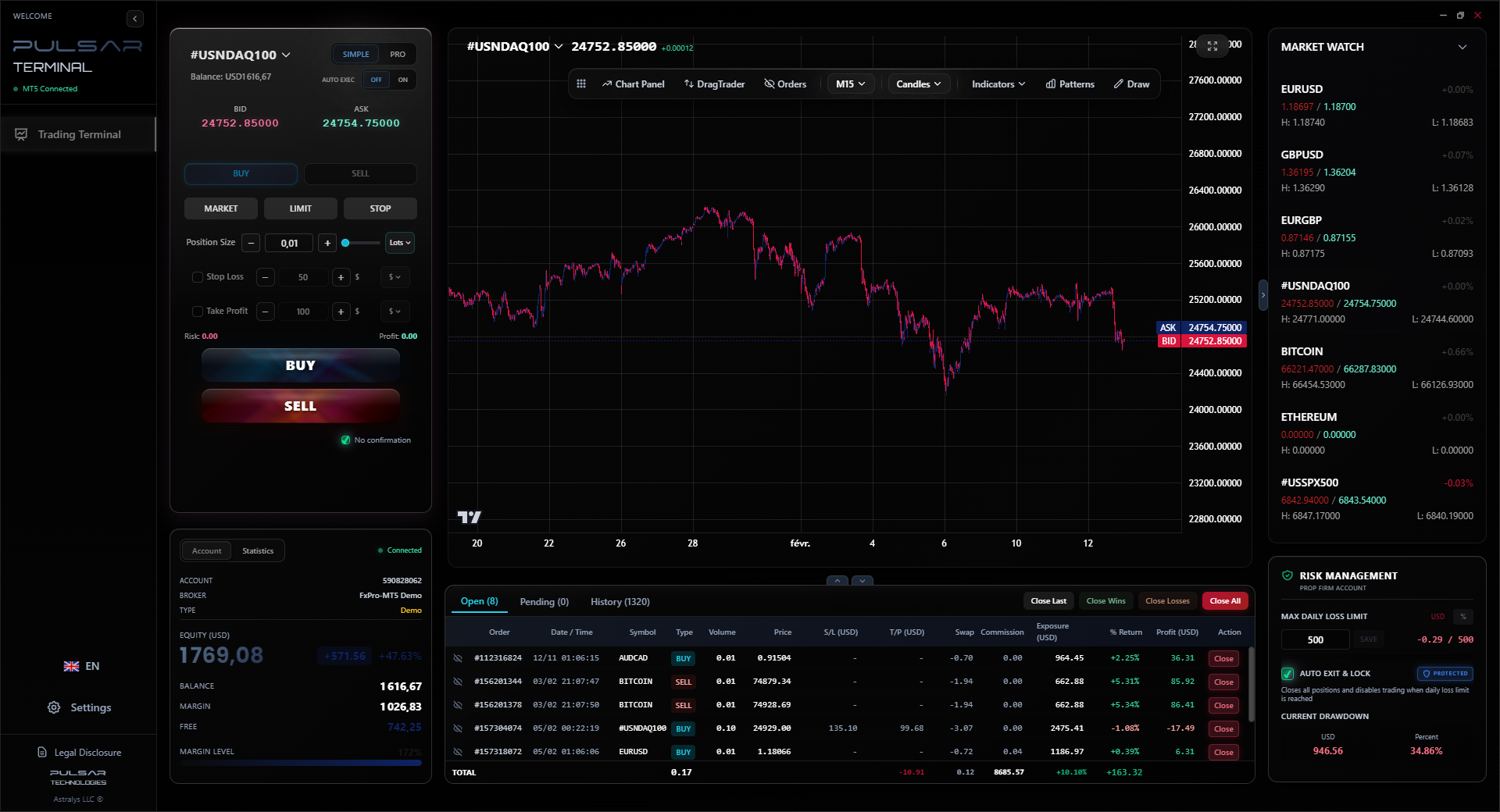
Managing multiple trades and setting precise stops at volatile support zones is a headache, which is why a tool like Pulsar Terminal that lets you drag-and-drop orders and set multi-level take-profits directly on your MT5 chart is a game-saver.
Pulsar Terminal
Lo strumento MT5 tutto-in-uno: ordini drag-and-drop, multi-TP/SL, trailing stop, grid trading, Volume Profile e protezione prop firm. Usato da oltre 1.000 trader ogni giorno.
“A false break isn't the market cheating you. It's the market clearing out the weak hands before the real move.”
Trading support on Naira pairs is a different beast from EUR/USD. You're trading a currency with direct, heavy central bank intervention and unique local flows.
USD/NGN is a Policy Pair: Its primary drivers are CBN policy, oil prices, and foreign investor flows. Technical support levels do exist, but they are more fragile.
- Key Levels: Watch major round numbers (₦1,300, ₦1,400, ₦1,500) and the yearly lows/highs. The spread definition can be much wider than on majors, so factor that into your risk.
- The "CBN Put": There's often an invisible support level where the market believes the CBN will step in to defend the Naira. This isn't on the chart, but you can sense it when price approaches historic lows and volatility suddenly drops - traders are afraid to bet against the central bank.
- Liquidity Times: Trade is most liquid during Lagos and London overlap hours (8 AM - 12 PM WAT). Trying to trade a support bounce at 2 AM WAT is asking for trouble with slippage.
A Real Trade Example (The Good and The Bad): In early 2025, USD/NGN had formed a clear support zone around ₦1,480-₦1,485 on the daily chart. It had bounced twice. On the third touch, I saw a bullish hammer form on the 4-hour chart with RSI showing divergence. I went long at ₦1,482.
- The Good: I placed my stop at ₦1,475, risking about 0.8% of my account. Price bounced perfectly to ₦1,510 over the next three days.
- The Bad: I got cocky. I didn't take profit. I watched it fall back to my entry and then, fearing a loss, closed the trade for a measly 5-pip profit. The lesson? Have a profit target and stick to it. Greed turns winners into breakevens.
For pairs like GBP/NGN or EUR/NGN, you're trading GBP/USD or EUR/USD with a Naira overlay. Focus your technical analysis on the major currency pair first, then consider the Naira side as an extra volatility factor. A strong support on EUR/USD will likely translate to support on EUR/NGN, unless there's a massive, Naira-specific event.
💡 Consiglio di Winston
If you're unsure whether to trade a bounce, don't. The best trade you'll ever make is the one you skip because the setup wasn't perfect.
FAQ
Q1Is support in forex a guaranteed level where price will bounce?
Absolutely not. It's a zone of increased probability, not a guarantee. Price can and will break through support levels. Thinking of them as guarantees is the fastest way to blow up your trading account. Always use a stop loss.
Q2What's the difference between support and resistance?
Support is a floor where buying interest tends to emerge, halting a decline. Resistance is a ceiling where selling interest tends to emerge, halting a rally. They are flip sides of the same coin. In fact, when a support level breaks, it often becomes a new resistance level.
Q3How many times should price touch a level for it to be considered strong support?
There's no magic number, but generally, the more touches and reactions a level has, the stronger it's considered. Two or three clear bounces are a good sign. A level that has been tested 5+ times over many months is considered very strong. However, be wary of a level that's been tested too many times - it can eventually wear out and break.
Q4Can I use support levels for scalping?
Yes, absolutely. The principles are identical, just on a smaller timeframe. Look for support on a 5-minute or 15-minute chart, wait for a confirming candlestick pattern or momentum shift (using an indicator like the MACD indicator on a fast setting), and take a quick profit. Risk management is even more critical due to the speed of trades.
Q5Why does my support level keep breaking on USD/NGN?
This is common with Naira pairs. Technical levels are secondary to fundamental drivers for USD/NGN. A sudden change in CBN policy, a shift in oil prices, or a large corporate dollar demand can easily overpower any technical support on the chart. Always be aware of the economic calendar and news flow when trading Naira pairs.
Q6Should I buy exactly at the support line?
No. This is a common mistake. Buying at the exact line is called "catching a falling knife." You have no confirmation the bounce will happen. Instead, wait for price to reach the support zone and then show a sign of reversal - like a bullish candlestick pattern or a break of a minor downtrend line. This confirmation saves you from many false breaks.
Q7How do I know if a support break is real or a false break?
Look for confirmation. A real break is usually accompanied by strong momentum (big bearish candles) and high volume. It will also see price stay below the level, not just spike below and snap back. The best confirmation is a retest: price breaks below support, then rallies back up to that same level (now resistance), and gets rejected. That failed retest is a strong signal the break is real.
Lezione del Prof. Winston
Punti chiave:
- ✓Support is a probability zone, not a price promise.
- ✓Always wait for price action confirmation before entering.
- ✓Place stops logically, not arbitrarily close to the level.
- ✓For Naira pairs, policy trumps technicals every time.
Quanto è stato utile questo articolo?
Clicca su una stella
Analisi Trading Settimanali
Analisi e strategie settimanali gratuite. Nessuno spam.
Sull'autore
Olumide Adeyemi
Pioniere del Trading in Africa Occidentale
Uno degli educatori di trading forex più attivi in Nigeria. 8 anni di esperienza di trading da Lagos. Specializzato in strategie a basso capitale e sfide prop firm per trader africani.
Commenti
Avviso di rischio
Il trading di strumenti finanziari comporta rischi significativi e potrebbe non essere adatto a tutti gli investitori. Le performance passate non garantiscono risultati futuri. Questo contenuto è fornito solo a scopo educativo e non deve essere considerato un consiglio di investimento. Conduci sempre le tue ricerche prima di fare trading.
Potrebbe interessarti anche

Cara Trading Forex Sukses: 7 Prinsip dari Trader Profesional
Cara trading forex sukses dengan 7 prinsip trader pro: manajemen modal, disiplin, journal trading, backtest. Data nyata, bukan janji profit palsu.
Jam Trading Forex Terbaik untuk Trader Indonesia: Panduan Lengkap dengan Tabel Waktu
Panduan jam trading forex untuk trader Indonesia. Tabel 4 sesi dunia, jam emas 20:00-00:00, sesi mana yang harus dihindari. Data akurat + tips dari trader berpengalaman.
Top 5 Sàn Forex Uy Tín Nhất 2026: Review Jujur dari Trader Indonesia
Top 5 sàn forex uy tín 2026 untuk trader Indonesia. Review jujur: spread, deposit, withdraw, dukungan lokal. Exness, XM, IC Markets & lebih.
Scarica Pulsar Terminal
Tutti questi calcolatori sono integrati in Pulsar Terminal con dati in tempo reale dal tuo conto MT5.
Scarica Pulsar Terminal