


I remember watching the NGN/USD chart in late 2024, my cursor hovering over the sell button as the CBN's new guidelines hit the wires.

Olumide Adeyemi
Pioniere del Trading in Africa Occidentale ·  Nigeria
☕ 10 min di lettura
Cosa imparerai:
I remember watching the NGN/USD chart in late 2024, my cursor hovering over the sell button as the CBN's new guidelines hit the wires. The market didn't just move, it convulsed. In that moment, your broker isn't just a platform; it's your lifeline. Did your order get filled at the price you saw, or did it slip 50 pips? Could you withdraw your profit that week, or did you get stuck in 'processing' for a month? Choosing from the top 5 forex brokers in Nigeria isn't about fancy ads; it's about survival in a market where the rules are still being written. Let's cut through the noise.
Before we talk brokers, we need to talk about the ground you're standing on. Forex trading is legal here, but the local regulatory framework for online retail trading is, frankly, underdeveloped. The SEC Nigeria doesn't license retail forex brokers. Let that sink in. Any broker claiming SEC Nigeria regulation for spot forex is selling you a dream.
This means you, as a Nigerian trader, are almost certainly going with an internationally regulated entity. That's not inherently bad - it often means better technology and tighter spreads - but it changes the game. Your primary protection comes from bodies like the UK's FCA or Cyprus's CySEC, not from an office in Abuja. Your tax obligations, however, are 100% local. The FIRS expects its 10% cut on your capital gains, and you need to figure that out yourself.
The recent CBN moves, like the 2024 NFEM guidelines and the 2025 FX Code, are aimed at the institutional and BDC wholesale market. For the retail trader staring at a MetaTrader screen, the direct impact is on liquidity and sometimes wild volatility when new policies drop. Your broker's stability during these events is the first real test.

Warning: The single biggest risk isn't a bad trade; it's using an unregulated or poorly regulated offshore broker. If they vanish with your money, you have virtually no local recourse. International regulation is your non-negotiable first filter.
This list isn't based on who spends the most on Instagram influencers. It's based on what actually matters when you're trading from Lagos, Port Harcourt, or Abuja. I've blown up an account before by ignoring these basics, so learn from my expensive mistake.
1. International Regulation (The Safety Net): This is the gatekeeper. No top-tier regulation (FCA, ASIC, CySEC, FSCA), no entry. It's that simple.
2. Deposit & Withdrawal Pain Points: Can you fund your account in Naira? How long do withdrawals to your Nigerian bank account really take? Are there hidden conversion fees? I once waited 11 business days for a withdrawal from a "reputable" broker - it felt like a lifetime.
3. Cost Structure for the Nigerian Reality: We're talking spreads on major pairs like EUR/USD, overnight swap rates (which can kill a long-term position), and commission structures. A "low minimum deposit" is a marketing trick if the spreads are 3 pips wide. You need to run the numbers through a position size calculator with their actual costs.
4. Platform Stability & Tools: Does it offer MT4/MT5? Good. Does it offer local server access for lower latency? Even better. During high volatility, a platform that freezes is a portfolio killer.
5. Local Support: When you have a problem at 9 PM on a Tuesday, can you get help? A local phone number or office isn't a luxury; it's a critical support line.
Using this checklist, here are the top 5 forex brokers in Nigeria that consistently meet the mark.

💡 Consiglio di Winston
A broker's withdrawal policy tells you everything about their integrity. If they make it difficult to get your money out, they've failed the only test that matters.
“A low minimum deposit is a marketing trap if the spreads are wide enough to eat your account before the trend even starts.”
1. Exness
Exness is a powerhouse in the Nigerian market for concrete reasons. Regulated by CySEC and the FSCA, they've built a system that works seamlessly here. Their minimum deposit can be as low as $1, which is great for testing, but the real magic is in their raw costs. Their Zero Account offers spreads from 0.0 pips with a small commission. More importantly, they've mastered the local payment environment. Withdrawals are often instant, which is a game-changer for active traders. Their use is high (even unlimited for verified experienced clients), which is a double-edged sword - it can amplify gains but is the fastest route to a margin call.
Why it's on the list: Unbeatable withdrawal speed and integration with Nigerian banks. Low, transparent costs.
Watch out for: Extremely high use requires insane discipline. It's a tool, not a strategy.
2. HF Markets (HFM)
HFM has a strong physical presence in Nigeria, which matters. Regulated by the FCA, DFSA, and FSCA, they offer serious credibility. They provide Naira-denominated accounts, which removes the currency conversion guesswork from your profit/loss calculations. Their minimum deposit can be as low as ₦4,000 depending on the payment method. They offer a wide range of account types and solid educational resources. Their spreads are competitive, and they support both MT4 and MT5.
Why it's on the list: Local office and Naira accounts. Strong, multi-jurisdictional regulation.
Watch out for: The sheer number of account types can be confusing. Make sure you pick one that matches your scalping strategy or swing trading style.
3. AvaTrade
AvaTrade is the "set-and-forget" institutional-grade option. Licensed by ASIC and the FSCA, among others, they are one of the most regulated brokers on this list. They offer a fixed spread account, which is rare and valuable for traders who hate variable spreads. This means your commission is built into the spread, so you know your exact cost upon entry. Their platform suite is vast, including MT4, MT5, and their own AvaTradeGo. They are a fantastic choice for beginners due to their extensive educational content and automated trading options like ZuluTrade.
Why it's on the list: Fixed spreads provide cost certainty. Exceptional for beginners and automated traders.
Watch out for: Fixed spreads are typically wider than the raw variable spreads of an ECN broker. You're paying for predictability.
4. XM
XM has cultivated a massive global following, and Nigeria is a key part of that. Regulated by CySEC and the FSCA, they are known for their client-friendly offers. This includes a low $5 minimum deposit and a $30 no-deposit bonus for Nigerian traders (check current terms). This allows you to test their platform and execution with real money risk-free. They offer Naira payment options and have a strong local support team. Their spreads are low, and they don't charge withdrawal fees, which is a big plus.
Why it's on the list: The no-deposit bonus is a legitimate way to test them. Strong local support and fee-free withdrawals.
Watch out for: Bonuses come with trading volume conditions. Read the terms carefully - it's not free money, it's a marketing tool.
5. IC Markets
IC Markets is the choice for the raw, technical trader. Regulated by ASIC and CySEC, they are a true ECN broker. This means you get direct access to interbank liquidity with spreads starting from 0.0 pips on the EUR/USD. Their commissions are clear and low. For traders who rely on pure price action and need the tightest possible spreads (think high-volume scalping strategy), IC Markets is often the benchmark. They offer MT4, MT5, and cTrader.
Why it's on the list: the rawest, lowest-cost ECN execution available to Nigerian traders. A favorite for professional strategies.
Watch out for: The environment is bare-bones. You won't get many hand-holding features or bonuses. It's for traders who know what they're doing. You can read our full deep dive in the IC Markets review.

Example: Let's compare costs on a standard 1-lot (100,000 units) trade on EUR/USD:
| Broker | Typical Spread | Commission (if any) | Total Cost per 1 Lot |
|---|---|---|---|
| Exness Zero | 0.1 pips | $3.50 per side | ~$4.50 (0.1 pip = $1 + $3.50) |
| IC Markets Raw | 0.0 pips | $3.50 per side | $7.00 |
| AvaTrade (Fixed) | 0.9 pips | $0 (included) | $9.00 |
| Cost = (Spread in pips x $10 per pip per micro lot for 1 lot) + Commission. This is why you must calculate! |
Brokers advertise minimum deposits and use. They don't advertise the silent killers. I learned this the hard way in 2021 on a long-term XAU/USD guide position.
Swap Rates (Overnight Financing): This is the cost to hold a position past 5 PM EST. For a buy position on USD/NGN with Nigeria's high-interest rates, you might PAY a huge daily swap. My gold trade bled $12 per lot, per night. Over 30 days, that's $360 gone before the price even moved. Always check the swap long/short rates on your broker's website before holding for more than a day.
Payment Processing Fees: Funding your account in Naira often involves a conversion to USD. Your broker might offer "zero fees," but the payment processor or your bank might charge 2-5%. On a ₦500,000 deposit, that's ₦10,000-₦25,000 gone before you place a single trade. Use local payment partners like Flutterwave or direct broker Naira accounts where possible.
Slippage: This is the difference between your requested price and your filled price. During CBN announcements or major news, slippage can be catastrophic. A 20-pip slippage on a 2-lot EUR/USD trade is a $400 instant loss. A broker with poor liquidity providers will have worse slippage.

Pro Tip: Before going live, open a demo account and trade during major news events (like U.S. Non-Farm Payrolls at 1:30 PM GMT on a Friday). Watch the execution quality and slippage. That's your true test.
💡 Consiglio di Winston
The 'no-deposit bonus' is the most expensive 'free' money you'll ever encounter. The trading volume requirements are designed so that 95% of traders lose it all before they can withdraw a penny.
“Your first real-money deposit has one purpose: to teach you how it feels to lose. If you can't handle that lesson with $10, you'll never handle it with $10,000.”
- Pick ONE Broker from the List: Don't spread yourself thin. Pick the one that best fits your style (e.g., IC Markets for scalping, AvaTrade for beginners).
- Open a Demo Account: Not for a day, for at least a month. Trade your strategy. Test deposits and withdrawals with fake money. Get a feel for the platform. I spent 3 months on demo before my first real trade, and it was the best education I got.
- Start with a Micro Account: When you go live, start with the smallest possible real money account. For Exness or XM, that's $5-$10. The goal is not to get rich. The goal is to feel the psychological weight of real money on your decisions. Did your hand shake clicking the button? Good. That's the lesson.
- Document Everything: Keep a journal. Entry price, exit price, spread at entry, reason for the trade, emotional state. After 20 trades, you'll see your real patterns.
- Plan Your Exit Before Entry: This is non-negotiable. Know your stop-loss and take-profit levels before you click buy or sell. Use tools that help you manage this mechanically. If you're trading with a prop firm, managing your daily loss limit is everything.
Your broker is just the vehicle. You are the driver. A great car won't save you from driving off a cliff.
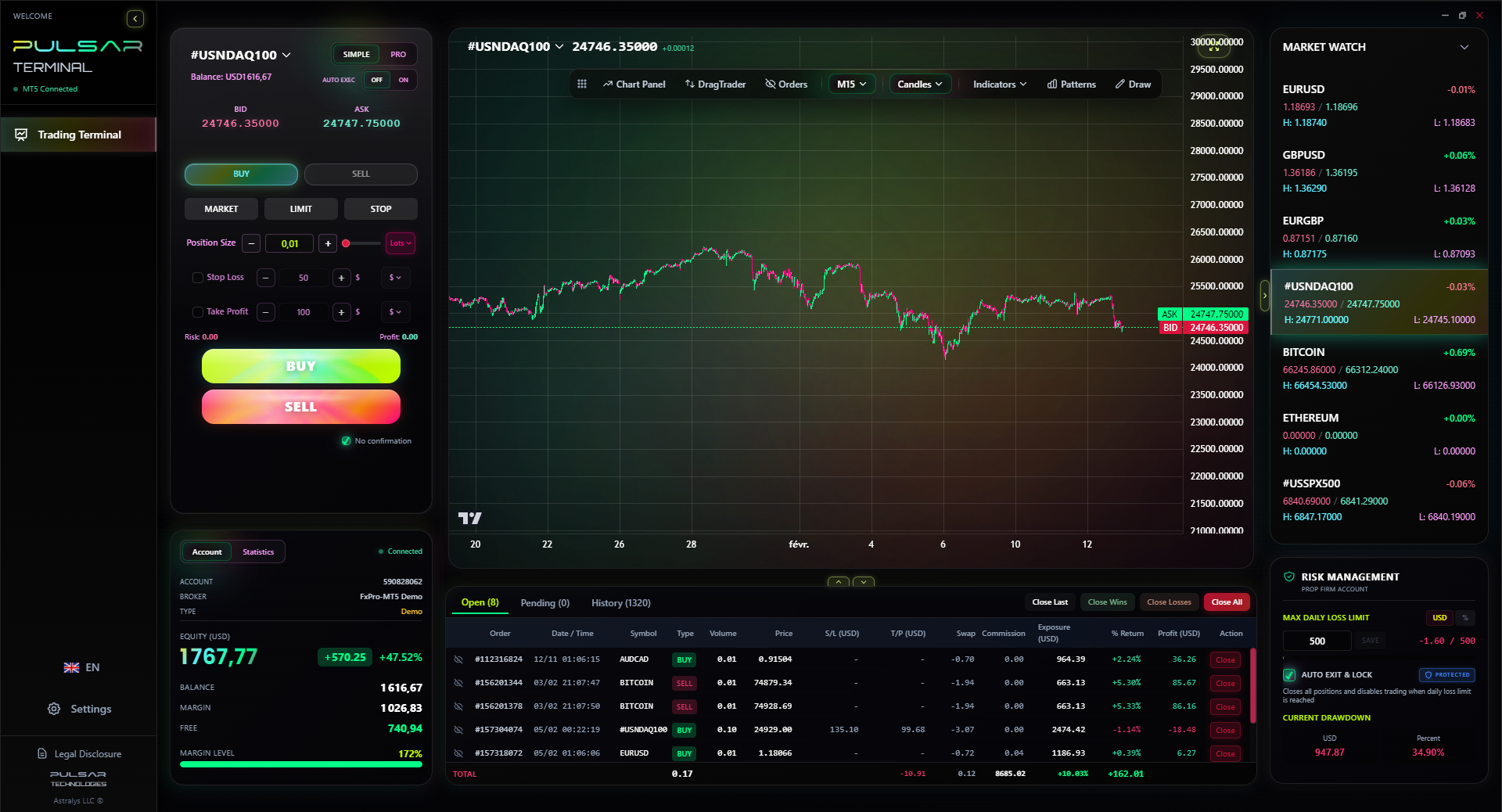
Planning your exit before entry is critical, and tools like Pulsar Terminal automate complex order management with multi-TP/SL and trailing stops directly on your MT5 platform.
Pulsar Terminal
Lo strumento MT5 tutto-in-uno: ordini drag-and-drop, multi-TP/SL, trailing stop, grid trading, Volume Profile e protezione prop firm. Usato da oltre 1.000 trader ogni giorno.
The top 5 forex brokers in Nigeria for 2026 - Exness, HFM, AvaTrade, XM, and IC Markets - are here because they provide a combination of safety, cost-effectiveness, and local relevance you can actually use. But the broker is only 20% of the equation.
The other 80% is you. Your risk management, your discipline, your ability to not chase losses when the market turns against you. The Nigerian trading scene is vibrant and growing, but it's also full of get-rich-quick schemes and "mentors" selling hope. Anchor yourself to a reputable, regulated broker from this list. Then, focus on the hard work of becoming a consistent trader.
Remember, the CBN's projected rate of ~₦1,400/$ for 2026 suggests they expect more stability. But the forex market feeds on the unexpected. Your job isn't to predict the unpredictable; it's to survive it long enough to catch the right trends. Choose your broker wisely, trade small, and live to fight another day. For more on analyzing those trends, understanding tools like the RSI indicator or MACD indicator is essential.
FAQ
Q1Is forex trading legal and taxable in Nigeria?
Yes, it is legal for individuals to trade forex with international brokers. Any profit you make is considered capital gains and is subject to a 10% tax, which you are responsible for declaring and paying to the Federal Inland Revenue Service (FIRS).
Q2Why aren't there any Nigerian-regulated brokers on the top 5 list?
As of 2026, the Securities and Exchange Commission (SEC) of Nigeria does not license or regulate retail spot forex brokers. Therefore, to get proper investor protection (like compensation funds and regular audits), Nigerian traders must use brokers regulated by top-tier international authorities like the UK's FCA or Cyprus's CySEC.
Q3What is the best payment method for funding my trading account in Nigeria?
The best methods are those that minimize fees and processing time. Look for brokers that offer direct Naira deposits or partner with local payment gateways like Flutterwave. Direct local bank transfers to a broker's Nigerian bank account (if offered) are often the most cost-effective. Avoid methods that involve multiple currency conversions.
Q4What is a safe minimum deposit to start trading forex in Nigeria?
A safe minimum is an amount you are 100% willing to lose completely. Practically, many brokers allow starts from $5-$10 (₦7,000-₦14,000). Use this tiny amount to experience real-market psychology and execution for at least 3-6 months before considering adding more capital. The goal of your first deposit is education, not income.
Q5Can I use use of 1:1000 or more?
Brokers like Exness and HFM may offer it, but you absolutely should not use it as a beginner. High use magnifies both profits and losses. A 1% price move against you with 1:1000 use wipes out your entire account. Most professional traders use use below 1:30. Treat high use as a dangerous tool, not a benefit.
Q6How do I verify if a broker is truly regulated?
Do not rely on logos on their website. Go directly to the regulator's website (e.g., register.fca.org.uk for the FCA, www.cysec.gov.cy for CySEC). Use the official register search function and look up the broker's exact legal entity name and their license number. Check what activities the license permits.
Lezione del Prof. Winston
Punti chiave:
- ✓Prioritize FCA, ASIC, or CySEC regulation above all else.
- ✓Test withdrawal speed before making a large deposit.
- ✓Calculate total cost (spread + commission + swap), not just the advertised spread.
- ✓Use use under 1:30 until you have 3 years of consistent profits.
Quanto è stato utile questo articolo?
Clicca su una stella
Analisi Trading Settimanali
Analisi e strategie settimanali gratuite. Nessuno spam.
Sull'autore
Olumide Adeyemi
Pioniere del Trading in Africa Occidentale
Uno degli educatori di trading forex più attivi in Nigeria. 8 anni di esperienza di trading da Lagos. Specializzato in strategie a basso capitale e sfide prop firm per trader africani.
Commenti
Avviso di rischio
Il trading di strumenti finanziari comporta rischi significativi e potrebbe non essere adatto a tutti gli investitori. Le performance passate non garantiscono risultati futuri. Questo contenuto è fornito solo a scopo educativo e non deve essere considerato un consiglio di investimento. Conduci sempre le tue ricerche prima di fare trading.
Potrebbe interessarti anche

Cara Trading Forex Sukses: 7 Prinsip dari Trader Profesional
Cara trading forex sukses dengan 7 prinsip trader pro: manajemen modal, disiplin, journal trading, backtest. Data nyata, bukan janji profit palsu.
Jam Trading Forex Terbaik untuk Trader Indonesia: Panduan Lengkap dengan Tabel Waktu
Panduan jam trading forex untuk trader Indonesia. Tabel 4 sesi dunia, jam emas 20:00-00:00, sesi mana yang harus dihindari. Data akurat + tips dari trader berpengalaman.
Top 5 Sàn Forex Uy Tín Nhất 2026: Review Jujur dari Trader Indonesia
Top 5 sàn forex uy tín 2026 untuk trader Indonesia. Review jujur: spread, deposit, withdraw, dukungan lokal. Exness, XM, IC Markets & lebih.
Scarica Pulsar Terminal
Tutti questi calcolatori sono integrati in Pulsar Terminal con dati in tempo reale dal tuo conto MT5.
Scarica Pulsar Terminal