


Let's cut through the noise.

David van der Merwe
Trader dei Mercati Emergenti ·  South Africa
☕ 9 min di lettura
Cosa imparerai:
- 1What Exactly Is Triangular Arbitrage? (The Simple Version)
- 2The Cold, Hard Reasons It Doesn't Work For You
- 3The SA Rulebook: FSCA, SARS, and Your R1 Million Allowance
- 4The Silent Profit Killers: Spreads, Commissions & Bank Fees
- 5The Technical Setup (For the Obsessive Few)
- 6Forget Arbitrage. Here's What Actually Works in SA
- 7My Final Take: A Lesson in Market Reality
Let's cut through the noise. You've probably seen YouTube videos promising 'risk-free profits' from triangular arbitrage forex. The theory says you can exploit tiny price differences between three currencies for guaranteed money. Here's the brutal truth from someone who's tried: for 99.9% of South African retail traders, it's a fantasy. The fleeting opportunities are snapped up in milliseconds by institutional algorithms. But understanding why it doesn't work for us is one of the most valuable lessons you'll learn about how the real market operates.
Forget the complex formulas for a second. Imagine you're at a currency exchange booth. You see they'll give you 19 ZAR for 1 USD. At another booth, they give 0.92 EUR for 1 USD. At a third, they give 20 ZAR for 1 EUR. If you start with R1,000, you could theoretically buy USD, then EUR, then back to ZAR and end up with more Rand than you started with. That's the core idea.
In forex, it's the same dance with three currency pairs that form a closed loop, like EUR/USD, GBP/EUR, and GBP/USD. The math must be perfect: (EUR/USD rate) x (GBP/EUR rate) must equal the (GBP/USD rate). If it doesn't, an arbitrage opportunity exists. The key word is 'theoretically.'

Warning: This isn't a trading strategy. It's a market efficiency mechanism. By the time your retail platform refreshes, the discrepancy is almost always gone. I once spent two weeks coding a script to look for these setups on a demo account with IC Markets. It flagged 47 'opportunities' in a day. I manually tried to execute on 10. I was too slow on 9, and on the 10th, the slippage turned the theoretical 0.02% profit into a loss after the spread.
Let's get real about the barriers. This isn't about skill; it's about physics and infrastructure.
The Speed Wall
Banks and hedge funds have their trading servers physically located next to the exchange's servers (co-location). Their trades execute in microseconds. Your order from Cape Town or Joburg has to travel to a broker's server, often in London or Cyprus, then to the liquidity provider. You're running a marathon against sprinters on rocket skates.
The Cost Problem
Every leg of the trade costs you. The spread, the commission, the potential slippage. For triangular arbitrage forex to be profitable, the pricing inefficiency must be larger than the total cost of three transactions. Let's break it down with a real example from a few years back.
I spotted a potential loop with USD/ZAR, EUR/USD, and EUR/ZAR. The math showed a 0.05% potential gain. Sounds tiny, but on a R100,000 position, that's R50. Here's what killed it:
- USD/ZAR spread: 45 pips (common for an exotic)
- EUR/USD spread: 1.2 pips
- EUR/ZAR spread: 50 pips
- Commission on 3 standard lots: ~$30 By the time I calculated all that, the 'opportunity' was a guaranteed loss of over R200. The spreads alone devoured any potential profit. This is why you need a broker with the tightest possible spreads, like those offered by Pepperstone or Exness on their raw accounts, and even then, it's a long shot.
Liquidity and Execution
To make the numbers meaningful, you need large position sizes. That means tying up significant margin on three simultaneous trades. If one leg fails to fill at the expected price - which happens all the time - your 'risk-free' arbitrage turns into two open directional positions you never wanted. I've been there, left holding a long EUR/USD and short USD/ZAR position in a panic. It wasn't pretty.

💡 Consiglio di Winston
If a strategy promises 'risk-free' profits, the only thing risk-free is the seller's commission. They already got paid.
“For 99.9% of South African retail traders, triangular arbitrage is a fantasy.”
Even if you could pull this off, you need to know the local rules. The Financial Sector Conduct Authority (FSCA) is your watchdog. Trading forex, including attempting arbitrage, is legal, but you must use an FSCA-regulated broker. This protects you from outright scams.
The South African Reserve Bank (SARB) controls the flow of money overseas. Here's the critical bit for funding your account: you have a single discretionary allowance of R1 million per calendar year. You can send this abroad to an international broker without needing special tax clearance. Need more? You can apply for an additional R10 million foreign investment allowance. Keep all your FNB or Standard Bank transfer records.
Now, for SARS. Arbitrage profits are not some magical tax-free income. They're added to your total taxable income for the year. You must declare every cent. I learned this the hard way after a good year of swing trading. Keep a careful log of every trade - entry, exit, profit/loss in ZAR. If you're using an international broker, you're responsible for converting profits to Rand at the correct exchange rate on the day you made them. Get an accountant who understands trading.
This is where dreams of triangular arbitrage forex go to die. Let's talk real numbers from the SA landscape.
Spreads: On a major pair like EUR/USD, you might get 0.0 pips with a commission, or 1-2 pips on a standard account. But the moment you involve the ZAR, everything changes. USD/ZAR can have a spread of 40-100 pips during normal hours. That's a massive hurdle before you even start.
Commissions: A typical raw spread account charges $3-$5 per standard lot per side. Three trades mean three commissions. On a R100,000 position size, that can be over R500 in fees alone.
Bank Fees: Funding your account isn't free. While many brokers offer free deposits, your local bank will charge you. For example, Capitec charges R250 for a foreign currency outgoing payment. Standard Bank charges for incoming telegraphic transfers. These fees eat into your capital before you place a single trade.

Example: The Arithmetic of Failure Let's assume a miraculous 0.1% pricing discrepancy.
- Potential profit on R500,000 position: R500
- Total Spread Cost (USD/ZAR, EUR/USD, EUR/ZAR): ~R1,200
- Total Commission: ~R750
- Bank Fees (Deposit & eventual withdrawal): ~R500 Net Result: A loss of approximately R1,950. The numbers simply don't add up for manual trading.
💡 Consiglio di Winston
Your single discretionary allowance of R1 million is for sensible investing. Don't blow it all chasing a trading phantom. Start small.
“You're running a marathon against sprinters on rocket skates.”
Alright, you're stubborn. I get it. Here's what you'd theoretically need, knowing the odds are stacked against you.
Platform & Tools: You need a platform that allows for lightning-fast execution. MetaTrader 5 (MT5) is more common than MT4 for this because it has better multithreading. You'll need to write or buy an Expert Advisor (EA) that can monitor three correlated pairs in real-time and execute all three orders simultaneously. This isn't a simple MACD indicator crossover script.
Broker Choice: You need a broker with:
- FSCA regulation (non-negotiable).
- True ECN/STP execution with ultra-low latency.
- Raw spreads, especially on USD/ZAR.
- A platform that supports algorithmic trading. IC Markets and FP Markets are often cited for their tech.
The Strategy Logic: Your EA must constantly calculate the cross rate. For a EUR/USD, GBP/USD, EUR/GBP triangle, the formula is: (EUR/USD bid) x (GBP/USD ask)⁻¹. If the result is not equal to the EUR/GBP ask price (within your cost threshold), it triggers. The EA must then send three market orders instantly.
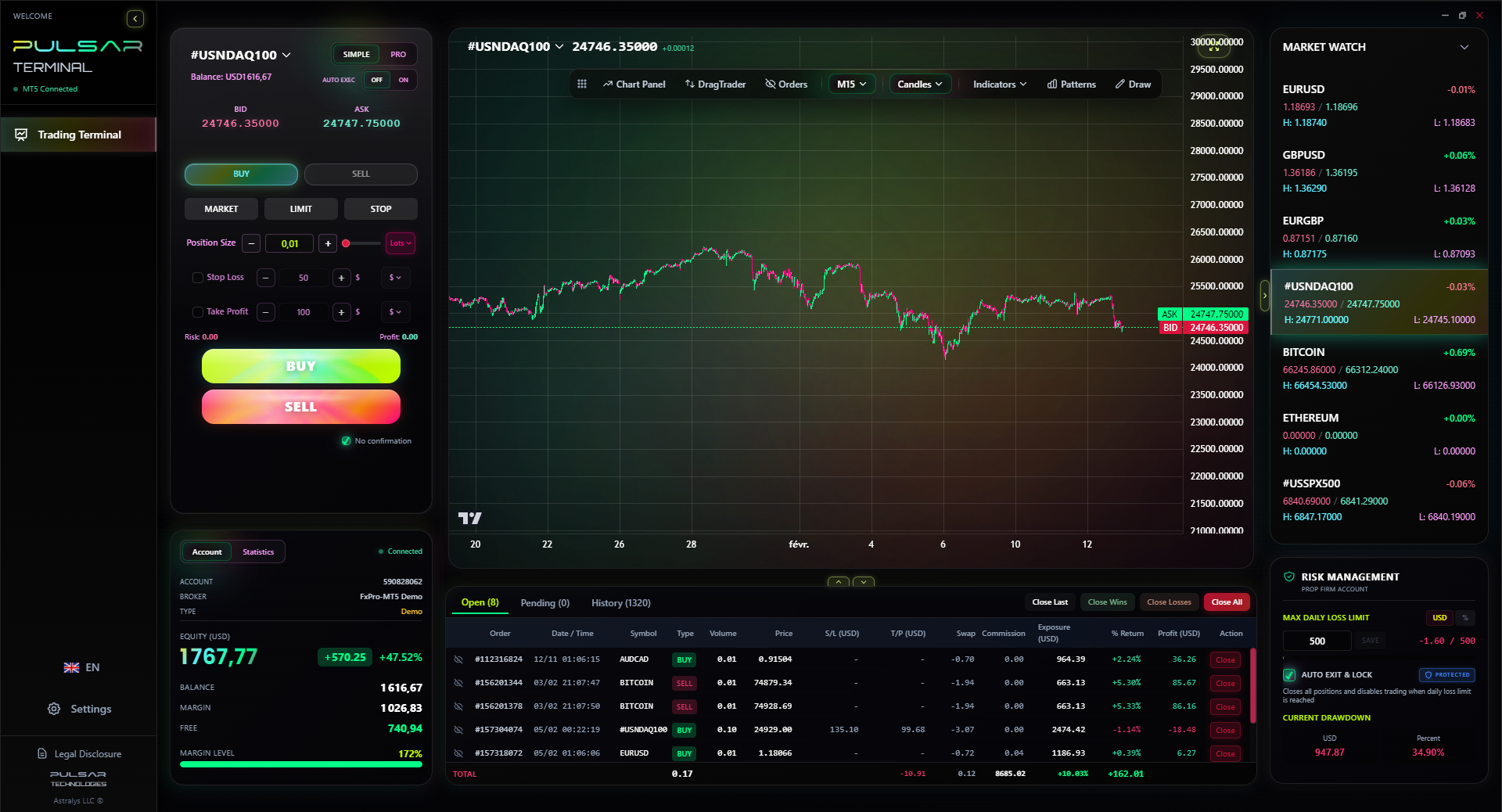
Risk Management: You must have immediate, automatic cancellation for the other two legs if one fails. Without this, you're just taking random, unplanned directional risk. This level of automated risk management is where a tool like Pulsar Terminal, which works on top of MT5, could theoretically help manage complex order scenarios, but it doesn't find the arbitrage for you.
Managing complex, multi-leg orders manually is a recipe for disaster; Pulsar Terminal's drag-and-drop order system and one-click multi-TP/SL features are built for precise, rapid trade management on MT5.
Pulsar Terminal
Lo strumento MT5 tutto-in-uno: ordini drag-and-drop, multi-TP/SL, trailing stop, grid trading, Volume Profile e protezione prop firm. Usato da oltre 1.000 trader ogni giorno.
Instead of chasing a ghost, focus on strategies where you have a real edge. Your edge as a retail trader isn't speed or volume. It's patience, discipline, and good risk management.
1. Volatility Trading on USD/ZAR: Our home currency is wonderfully volatile. Use that. Look for key support and resistance levels on the daily chart. Trade the reactions. A 50-pip move on USD/ZAR is 0.3%, which is a meaningful move. Learn to read the impact of SARB announcements and commodity price swings (gold, platinum).
2. Carry Trade Adjustments: This involves buying a high-yielding currency and selling a low-yielding one to earn the swap difference. With ZAR interest rates historically high, pairs like USD/ZAR often have a negative swap for longs (you pay). But you can structure trades around central bank meeting dates. I once held a short USD/ZAR position for three weeks just for the positive swap, netting a few hundred Rand extra even though the spot price barely moved.
3. Master One Simple Strategy: Pick one major pair like EUR/USD or XAU/USD (gold). Learn its personality. Use a combination of price action and one or two indicators like the RSI indicator for confluence. Become an expert in that, rather than a novice in ten strategies.
4. Risk Management is Your Real Job: This is where you make money. Use a position size calculator religiously. Never risk more than 1-2% of your account on a single trade. Understand what a margin call really is and avoid it. This boring discipline will do more for your account than any 'secret' arbitrage scheme.
💡 Consiglio di Winston
The most profitable 'arbitrage' in South Africa is the gap between what you know and what you don't. Close that gap first.
“The most profitable 'arbitrage' is the gap between disciplined and emotional traders.”
I wasted about six months and a significant amount of coding time trying to make triangular arbitrage forex work on a retail level. My biggest 'profit' from the entire endeavor was the lesson itself: understanding market efficiency.
The fact that these opportunities are so rare and vanish so quickly proves that the forex market is overwhelmingly efficient. That's actually good news for you as a regular trader. It means prices reflect available information quickly, and you can focus on analyzing that information rather than trying to beat supercomputers to a punch.
Your goal shouldn't be to find a glitch in the Matrix. Your goal should be to become a consistently good trader who understands probabilities. Focus on getting a positive risk-reward ratio on your trades, managing your losses, and keeping your psychology in check. That's the real 'arbitrage' - exploiting the gap between disciplined and emotional traders.
Put your energy into learning a solid scalping strategy if you like action, or swing trading if you're more patient. Learn what a pip truly costs you and how the spread impacts your bottom line. That knowledge will pay dividends long after the fantasy of risk-free profits has faded.
FAQ
Q1Is triangular arbitrage illegal in South Africa?
No, it's not illegal. The act of trying to profit from pricing discrepancies is a normal market function. However, you must execute your trades through an FSCA-regulated broker and declare any profits to SARS as taxable income. The illegality would come from market manipulation, not from arbitrage itself.
Q2Can I use a trading bot for triangular arbitrage?
You can try, but you're competing in an arms race you're destined to lose. Retail-grade bots running on your home PC or a VPS are orders of magnitude slower than institutional systems. The bot also needs direct market access (DMA) and near-zero latency, which is expensive and complex to set up. Most 'arbitrage bots' sold online are scams that will lose your money.
Q3What's a realistic profit percentage from forex arbitrage for a retail trader?
Realistic? Zero. Or more likely, negative once you factor in costs. Academic studies show opportunities may exist less than 1% of the time and last milliseconds. The theoretical profit per opportunity is often less than 0.05%, which is instantly wiped out by spreads and commissions for a retail trader.
Q4Do any South African brokers offer conditions good for arbitrage?
Some, like Khwezi Trade or international brokers with FSCA licenses like IG or AvaTrade, offer competitive conditions. However, 'good for arbitrage' is relative. They offer tight spreads by retail standards, but not the co-located, sub-millisecond execution you need for true triangular arbitrage. They are good brokers for normal trading strategies.
Q5How does the USD/ZAR pair affect arbitrage opportunities?
It makes them virtually impossible for a retail trader. USD/ZAR is an exotic pair with wide spreads (often 40+ pips) and lower liquidity than majors. Any arbitrage loop involving ZAR immediately incurs that huge spread cost, which is almost always larger than any temporary pricing discrepancy you might find.
Q6What should I do if I see an obvious arbitrage opportunity on my platform?
It's almost certainly a display error or latency issue (stale price). If you try to trade it, you'll either get a 'requote' message, massive slippage, or only one leg will fill, leaving you with an unwanted directional position. The best thing to do is ignore it. It's a mirage.
Lezione del Prof. Winston
Punti chiave:
- ✓Arbitrage opportunities last milliseconds, not minutes.
- ✓Spreads on USD/ZAR alone can exceed 40 pips.
- ✓Your R1 million discretionary allowance is for smart capital use.
- ✓Real profits come from risk management, not market glitches.
Quanto è stato utile questo articolo?
Clicca su una stella
Analisi Trading Settimanali
Analisi e strategie settimanali gratuite. Nessuno spam.
Sull'autore
David van der Merwe
Trader dei Mercati Emergenti
Trader con base a Johannesburg con 11 anni di esperienza nelle valute dei mercati emergenti. Specializzato in coppie ZAR, trading regolamentato dalla FSCA e analisi del mercato sudafricano.
Commenti
Avviso di rischio
Il trading di strumenti finanziari comporta rischi significativi e potrebbe non essere adatto a tutti gli investitori. Le performance passate non garantiscono risultati futuri. Questo contenuto è fornito solo a scopo educativo e non deve essere considerato un consiglio di investimento. Conduci sempre le tue ricerche prima di fare trading.
Potrebbe interessarti anche

Cara Trading Forex Sukses: 7 Prinsip dari Trader Profesional
Cara trading forex sukses dengan 7 prinsip trader pro: manajemen modal, disiplin, journal trading, backtest. Data nyata, bukan janji profit palsu.
Jam Trading Forex Terbaik untuk Trader Indonesia: Panduan Lengkap dengan Tabel Waktu
Panduan jam trading forex untuk trader Indonesia. Tabel 4 sesi dunia, jam emas 20:00-00:00, sesi mana yang harus dihindari. Data akurat + tips dari trader berpengalaman.
Top 5 Sàn Forex Uy Tín Nhất 2026: Review Jujur dari Trader Indonesia
Top 5 sàn forex uy tín 2026 untuk trader Indonesia. Review jujur: spread, deposit, withdraw, dukungan lokal. Exness, XM, IC Markets & lebih.
Scarica Pulsar Terminal
Tutti questi calcolatori sono integrati in Pulsar Terminal con dati in tempo reale dal tuo conto MT5.
Scarica Pulsar Terminal