


I lost ₹47,000 in two weeks trying to run a Turtle system on Nifty futures.

Rajesh Sharma
Analista Forex Senior ·  India
India
☕ 12 min di lettura
Cosa imparerai:

I lost ₹47,000 in two weeks trying to run a Turtle system on Nifty futures. Not from bad trades, but from sheer ignorance. I'd coded the rules, backtested a decent equity curve, and hit 'deploy' on my cloud server. What I hadn't factored in was the new SEBI algo tax - the ₹20 per order brokerage, the ₹500/month API fee, the ₹2,800 AWS bill. The strategy was technically profitable, but my account was slowly bled dry by overhead. That's the real story of systematic trading in India now. It's not just about the rules; it's about whether the math works after the regulator, the broker, and the cloud provider have all taken their cut.
Forget the romantic myth. The Turtle Trading strategy wasn't about genius. It was about rigid, emotionless process. In the 1980s, traders Richard Dennis and William Eckhardt famously bet whether trading could be taught. They recruited novices, the 'Turtles,' and drilled a mechanical trend-following system into them.
The core is simple: Buy when price breaks above the highest high of the last 20 days. Sell short when it breaks below the lowest low of the last 20 days. That's your entry signal. The magic, and the pain, is in the position sizing and risk management. They used a concept called 'N' (average true range) to measure volatility. Your position size was calculated so that a 1 'N' move against you would lose a fixed percentage of your capital, usually 1-2%.

Example: Let's say you're trading Reliance shares. The 20-day ATR ('N') is ₹25. Your capital is ₹500,000, and your risk per trade is 1% (₹5,000). The Turtle formula for units to trade is: (1% of Account) / (N * value per point). If one Reliance share at ₹2,800 represents one point, you'd trade: ₹5,000 / (₹25 * 1) = 200 shares. This volatility-adjusted sizing is the engine.
Exits were the other half. You'd hold a winning trade until price reversed and broke a 10-day low (for long trades) or a 10-day high (for shorts). No taking profits early. No guessing. The goal was to catch a few massive trends a year and sit through long periods of small losses. It's a brutal psychological game. I know, because I've sat through seven consecutive losing trades on Bank Nifty futures using this method, watching my paper losses mount, trusting the system. The seventh trade ran for 3 months and netted +18R, wiping out all the previous losses and then some. That's the Turtle promise - and it demands iron discipline.
You can apply the logic to any trending instrument, from USD/INR futures to gold (XAU/USD guide). The question for us in India isn't about the theory; it's about the modern practicality, especially with our unique market structure and, crucially, SEBI's 2026 regulatory overhaul.

💡 Consiglio di Winston
Your backtest is a fairy tale until you subtract all real costs - brokerage, slippage, data fees, and that AWS bill. The market doesn't care about your gross P&L.
If you want to trade like a Turtle in India today, you're an algorithmic trader. Full stop. Manually tracking 20-day breakouts and calculating ATR-based position sizing for multiple stocks is a full-time job. The only feasible way is to automate it. And as of April 1, 2026, that game has completely new rules.
SEBI's framework isn't meant to stop you; it's meant to cage every algo in a transparent, auditable box. Here’s what you absolutely must know:
The Broker Is Now Your Keeper
Gone are the days of casually connecting your Python script to a broker's open API. SEBI has made the stockbroker the 'principal' legally responsible for every order your algo spits out. This means they have to know, approve, and monitor everything. You can't just host your strategy on your laptop anymore. It must be deployed through your broker's own infrastructure or a whitelisted, static IP. Direct connections? Banned.
The Algo ID & The Kill Switch
Every single order from your strategy will carry a unique Algo ID tag provided by the exchange (NSE/BSE). This is for audit trails. More importantly, your broker is now required to have a 'kill switch' - a big red button they (and ideally you) can press to instantly halt a runaway algorithm. This is a good thing. I once had a bug in a Turtle variant that sent 78 orders in 2 seconds before I could stop it. A kill switch would have saved me a lot of panic and a call from the broker.
What This Means for You, the Retail Trader
You can still run your Turtle algo. But you must do it through a broker that offers an approved algo platform and get your specific strategy approved. This isn't a quick process. You'll also be subject to the 10 Orders Per Second (OPS) threshold. A classic Turtle system won't hit that, but you still need a 'Generic Algo ID'. The barrier to entry is no longer just coding skill; it's compliance.
Brokers like Zerodha (Zerodha review) and Upstox have built entire ecosystems for this. The freedom of the wild west is over. You're now trading in a regulated lab.
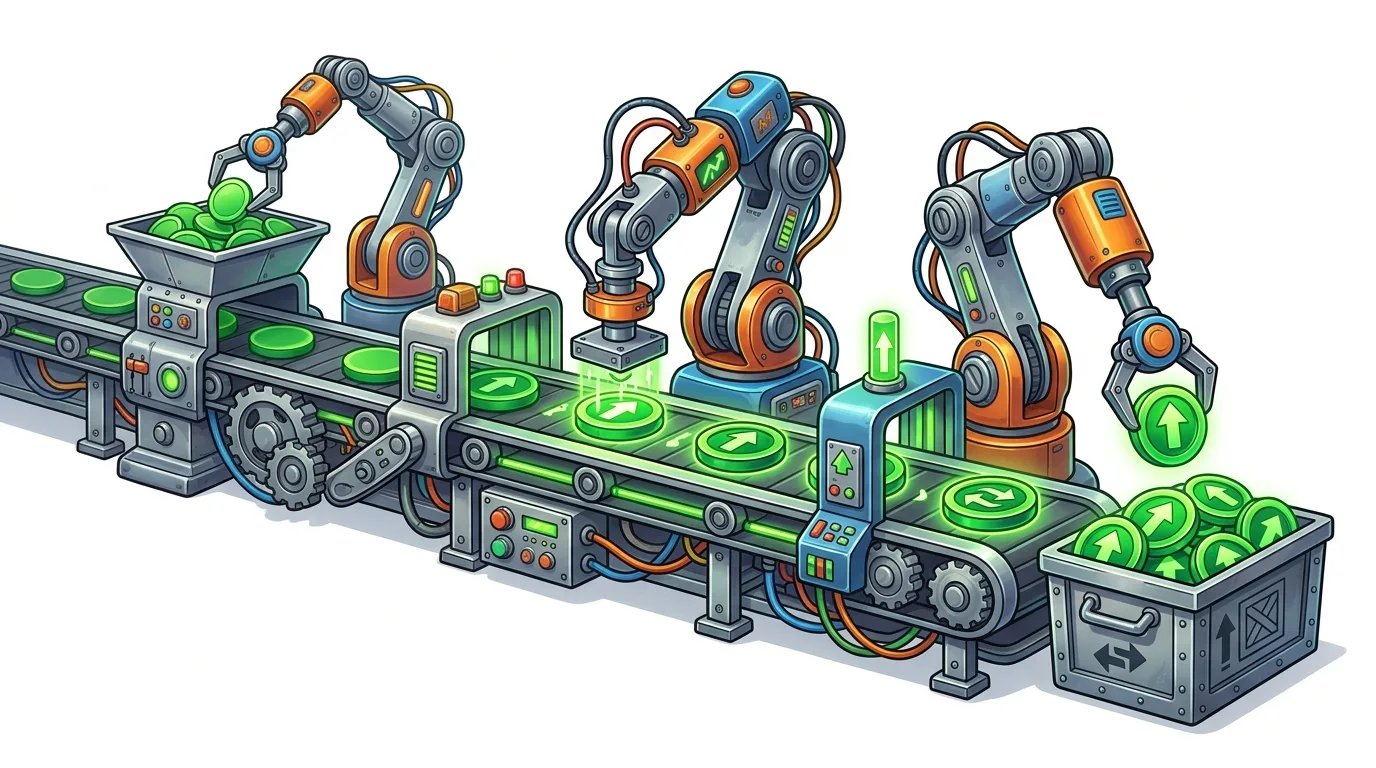
“Your profit & loss statement isn't just (Exit Price - Entry Price). It's that minus a pile of fixed costs that don't care if you're in a trending or choppy market.”
Let's talk numbers. This is where most backtests lie and where my initial ₹47,000 lesson was learned. Your profit & loss statement isn't just (Exit Price - Entry Price). It's that minus a pile of fixed costs that don't care if you're in a trending or choppy market.
Here’s a breakdown of the monthly overhead for running one automated Turtle strategy on a single NSE futures segment:
| Cost Component | Example Provider | Approx. Monthly Cost (₹) | Notes |
|---|---|---|---|
| Brokerage per Order | Most Major Brokers | ₹20/order | Your biggest variable cost. 100 trades/month = ₹2,000. |
| API Access | Zerodha Kite Connect | ₹500 | Some, like Angel One (Angel One review), offer it free. |
| Algo Platform | Tradetron / uTradeAlgos | ₹1,000 - ₹2,500 | If you don't code yourself. |
| Cloud Server (AWS) | EC2 t3.medium | ₹2,800 | Mandatory for 24/7 hosting with static IP. |
| Market Data Feed | ₹1,500 | For reliable, low-latency data. | |
| Total Monthly Overhead | ₹7,800 - ₹10,300 | Before your first trade is even placed. |

Warning: That ₹8k-₹10k is a hard monthly fee. Your strategy's edge must be large enough to first cover this, then produce actual profit. In a sideways market where the Turtle system produces small losses or breakeven results, you are still down the overhead. This is the silent account killer.
I learned this the hard way. My backtest showed a 14% annual return. Looks great. But the backtest didn't include ₹20 per trade. It didn't include AWS costs. When I added real-world friction, that 14% shrunk to 3%. And that's before accounting for slippage - the difference between your backtest's perfect entry and the price you actually get filled at in the live market. On a 20-day breakout, you're buying when everyone else sees the breakout too, often at a worse price.
You must use a position size calculator that factors in all these costs. If your system risks 1% per trade but your monthly overhead is 2% of your capital, you start every month in a hole.
💡 Consiglio di Winston
SEBI's 2026 rules aren't a barrier; they're a filter. They separate the serious system traders from the hobbyists. Your compliance is now part of your edge.
The financial markets of the 2020s are not the markets of the 1980s. Algorithms dominate, information is instant, and trends can be both sharper and shorter-lived. The core Turtle logic - follow volatility-adjusted breakouts - still has merit, but you can't use it straight out of the 1983 playbook.
The Good: It Forces Discipline
In a country where 'tips' and emotional trading are rampant, the Turtle system's greatest gift is its rigidity. It tells you exactly when to enter, how much to buy, and when to admit you're wrong. It eliminates the self-sabotage that blows up most Indian trading accounts. For learning strict risk management, it's a fantastic framework.
The Bad: Choppiness and Costs
Indian equity indices and stocks can spend long periods in consolidation. The Nifty can chop sideways for months. During these phases, a Turtle system will get 'whipsawed' - you'll buy a breakout, it'll reverse, you'll get stopped out, then it'll break out again. Each whipsaw costs you the 1% risk plus brokerage. This attrition can be brutal. It's why pure trend-following often works better on more consistently trending instruments like forex majors (check the EUR/USD guide for context) or commodities.
The Adaptation
You likely need to filter the signals. Some modern Turtles use a longer-term moving average to gauge the overall trend. For example, only take 20-day breakout long signals if the price is above a 100 or 200-day moving average. This keeps you on the right side of the major trend and filters out some false breakouts in bear markets. Others combine it with momentum oscillators like the RSI indicator to avoid buying overbought breakouts.
I modified my own approach after those initial losses. I kept the Turtle's volatility-based position sizing (the single best part) and its trailing exit logic. But I made my entries more selective, which reduced trade frequency and thus brokerage costs. It's about taking the timeless principles - risk management, trend-following - and adapting them to today's transaction-cost reality.
“The freedom of the wild west algo trading is over. You're now trading in a regulated lab.”
Let's walk through setting this up legally and practically today.
Step 1: Choose Your Instrument & Timeframe Start simple. Don't try to run Turtles on 50 stocks at once. Pick one liquid instrument with a history of strong trends. Nifty 50 Futures (NIFTY-FUT) is a prime candidate. Use daily closing prices for the classic system. This isn't for scalping strategy; it's for swing trading and beyond.
Step 2: Code or Choose Your Platform
- If you code: Python with pandas and a broker API library (like
kiteconnect) is the standard. Your code must: calculate the 20-day high/low, calculate the ATR (N), compute position size, and place orders with the correct Algo ID tag. - If you don't code: Use a SEBI-compliant algo marketplace like Tradetron or AlgoTest. You'll build your logic using their visual builders or pre-defined blocks. This is easier but less flexible and adds the platform subscription cost.
Step 3: Backtest WITH FRICTION Use at least 10 years of data. Your backtest report is useless unless it includes:
- Brokerage per trade (₹20)
- Slippage (assume 0.05% per trade)
- The monthly platform/data/hosting costs prorated per trade Only if the equity curve is solid after these deductions should you proceed.
Step 4: Broker Onboarding & Deployment
- Open an account with a broker supporting retail algo trading (Zerodha, Upstox, etc.).
- Apply for API access and get your static IP whitelisted.
- Submit your strategy for exchange approval through your broker. This is the new mandatory step. Provide your logic, expected order frequency, and risk controls.
- Once approved and assigned an Algo ID, deploy your code to a cloud server (AWS/Azure) with that static IP.
- Connect it to your broker's API using the secure, authenticated method.
Step 5: Monitor & Manage Your job now is not to override trades. Your job is to monitor the system's health: Is it connected? Is it placing orders correctly? Is the cloud server running? And most importantly, you must know how to trigger the kill switch if something goes wrong. Set aside the capital you're trading with and the overhead for at least 6 months. The first few months might be all drawdown.
💡 Consiglio di Winston
If you find yourself constantly wanting to tweak the Turtle's 20-day parameter after a few losses, you don't trust the system. And if you don't trust it, you won't follow it through the inevitable 30% drawdown. Pick a different method.
I've made most of these. Learn from my losses.
1. Ignoring Total Cost of Ownership. We covered this. It's the #1 killer. Your strategy isn't viable if it makes ₹8,000 a month but costs ₹9,000 to run.
2. Over-leveraging with 'N'. The Turtle's position sizing formula (Units = (1% of Account) / (N * Point Value)) is powerful. But if you're trading a highly volatile instrument, 'N' can be huge, leading the formula to suggest a tiny position. The mistake is to think, 'That's too small,' and override it. Don't. That formula is your life raft. Overriding it is how you take a 5% loss instead of a 1% loss. Respect the volatility.
3. Curve-Fitting the Rules. You backtest and see that a 22-day breakout works better than 20-days on Nifty. So you switch to 22. Then you see a 15-day exit works better than 10. You're now optimizing for past noise, not a strong principle. Stick to the original parameters for at least a full market cycle (2-3 years) before tweaking. The original rules survived because they were simple and general.
4. Not Planning for Drawdowns. A true trend-following system can have drawdowns of 20-30% over a year or more. Your account will be in the red for long stretches. If you haven't prepared mentally and financially for this, you will abandon the system at the worst possible time - right before it catches its next big trend. You need the psychological capital to match your financial capital.
5. Neglecting the Exit. Newbies obsess over the entry signal (the breakout). Professionals know the exit is far more important. The Turtle's 10-day trailing exit is what lets profits run. Do not be tempted to take profits early because you're scared of giving some back. That's how you turn a system designed to catch 10R winners into one that only catches 2R winners. You need those home runs to pay for all the strikeouts.
Using tools that help you manage these exits mechanically, like automated trailing stops, can remove the emotion. Some platforms can help enforce this discipline without you having to watch the screen every second.

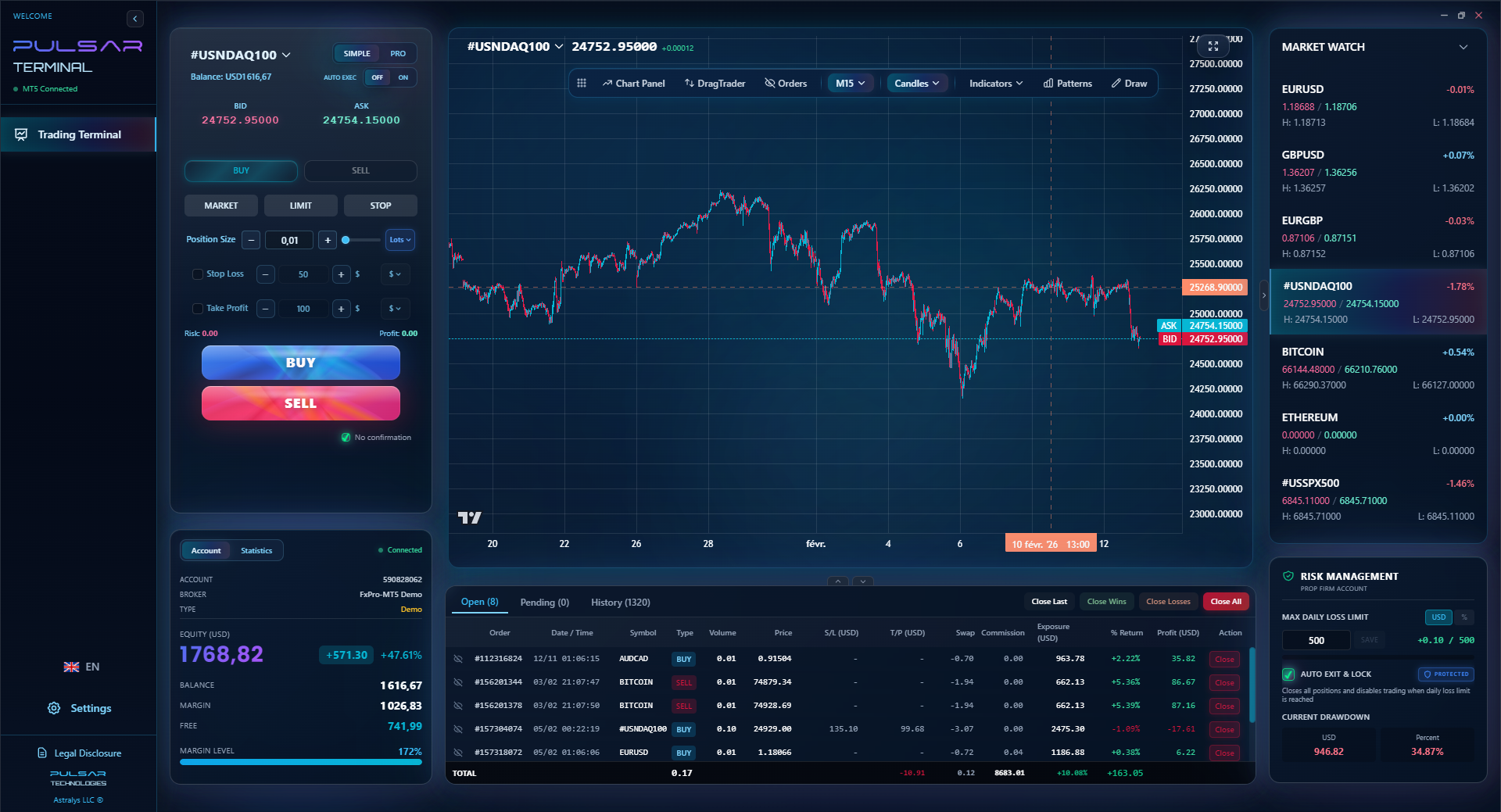
Managing multiple Turtle positions and their complex trailing exits is far simpler with a trading terminal that lets you automate those rules directly on your chart.
Pulsar Terminal
Lo strumento MT5 tutto-in-uno: ordini drag-and-drop, multi-TP/SL, trailing stop, grid trading, Volume Profile e protezione prop firm. Usato da oltre 1.000 trader ogni giorno.
FAQ
Q1Can I run the Turtle Trading strategy manually without an algorithm in India?
Technically, yes. Practically, it's incredibly difficult and prone to error. You'd need to manually track the 20-day high/low and 10-day exit levels for every stock you follow, calculate the ATR-based position size for each trade, and execute without emotion. One missed calculation or moment of fear/greed breaks the system. For any serious capital, automation is the only reliable way.
Q2What is the minimum capital required to run a Turtle algo profitably in India?
Given the ₹8,000-₹10,000 monthly overhead, you need enough capital so these costs are a small percentage of your expected returns. If your system aims for 15-20% annual returns, you'd want at least ₹10-15 Lakhs in trading capital. With ₹2 Lakhs, a 10% monthly overhead (₹10k/₹100k) would require a 120% annual return just to break even on costs - an impossible hurdle.
Q3Which Indian brokers are best for implementing algorithmic Turtle trading?
Look for brokers with strong, SEBI-compliant API platforms and clear algo onboarding processes. Zerodha (Kite Connect) is the industry leader with extensive documentation. Upstox (Pro API), Angel One (SmartAPI), and Dhan (DhanHQ) are also strong contenders. Compare their API costs, brokerage per order, and the level of support they offer for strategy approval. Always read the latest broker reviews as offerings change.
Q4How does SEBI's 10 Orders Per Second (OPS) rule affect a Turtle strategy?
It doesn't, really. A classic daily breakout Turtle system might place 1-2 orders per day per instrument. You're orders per day, not per second. You'll fall well under the 10 OPS threshold. However, you still need to register your strategy and get a Generic Algo ID from the exchange through your broker. The rule is aimed at high-frequency trading (HFT) firms, not retail trend-followers.
Q5Can I use the Turtle rules for trading options in India?
You can apply the trend-following philosophy, but the mechanics change completely. Options have expiry, decaying time value (theta), and non-linear pricing. Using a simple 20-day breakout on the option price itself is dangerous. A more common approach is to use the Turtle signals on the underlying (like Nifty) to determine direction, and then buy plain vanilla call or put options. Your position sizing must account for the option premium's volatility, which is different from the ATR of the underlying. It's an advanced adaptation.
Q6What's a good alternative if the Turtle system's drawdowns are too stressful?
Consider a hybrid approach. Use the Turtle's volatility-based position sizing (the 'N' formula) to always risk 1% of your capital - this is non-negotiable for survival. But for entries, use a less sensitive method that generates fewer trades. This could be buying pullbacks to a moving average in a longer-term uptrend, or using weekly chart breakouts instead of daily. You'll reduce whipsaws and brokerage costs, but you may also enter trends later. The core takeaway should be the risk management, not just the entry signal.
Lezione del Prof. Winston
Punti chiave:
- ✓Monthly overhead kills more algos than bad signals.
- ✓SEBI's 2026 rules make your broker your algo's legal guardian.
- ✓The 'N' formula for position sizing is non-negotiable.
- ✓You need ₹10L+ capital for the math to work after costs.
Quanto è stato utile questo articolo?
Clicca su una stella
Analisi Trading Settimanali
Analisi e strategie settimanali gratuite. Nessuno spam.
Sull'autore
Rajesh Sharma
Analista Forex Senior
Oltre 10 anni di trading sui mercati indiani e del Sud-Est asiatico. Ha iniziato con i derivati valutari del NSE prima di passare al forex internazionale. Specializzato in USD/INR e coppie dei mercati emergenti.
Commenti
Avviso di rischio
Il trading di strumenti finanziari comporta rischi significativi e potrebbe non essere adatto a tutti gli investitori. Le performance passate non garantiscono risultati futuri. Questo contenuto è fornito solo a scopo educativo e non deve essere considerato un consiglio di investimento. Conduci sempre le tue ricerche prima di fare trading.
Potrebbe interessarti anche

Cara Trading Forex Sukses: 7 Prinsip dari Trader Profesional
Cara trading forex sukses dengan 7 prinsip trader pro: manajemen modal, disiplin, journal trading, backtest. Data nyata, bukan janji profit palsu.
Jam Trading Forex Terbaik untuk Trader Indonesia: Panduan Lengkap dengan Tabel Waktu
Panduan jam trading forex untuk trader Indonesia. Tabel 4 sesi dunia, jam emas 20:00-00:00, sesi mana yang harus dihindari. Data akurat + tips dari trader berpengalaman.
Top 5 Sàn Forex Uy Tín Nhất 2026: Review Jujur dari Trader Indonesia
Top 5 sàn forex uy tín 2026 untuk trader Indonesia. Review jujur: spread, deposit, withdraw, dukungan lokal. Exness, XM, IC Markets & lebih.
Scarica Pulsar Terminal
Tutti questi calcolatori sono integrati in Pulsar Terminal con dati in tempo reale dal tuo conto MT5.
Scarica Pulsar Terminal