


I remember my first proper losing streak back in 2015.

Olumide Adeyemi
Pioniere del Trading in Africa Occidentale ·  Nigeria
☕ 12 min di lettura
Cosa imparerai:
- 1Why Your Trader Type Matters More Than You Think
- 2The Scalper: Minute-by-Minute Pressure
- 3The Day Trader: No Overnight Baggage
- 4The Swing Trader: Catching the Wave
- 5The Position Trader: Big Picture Only
- 6The Mechanical Trader: Robot Master
- 7Choosing Your Type: Practical Steps
- 8Hybrid Approaches: Mixing Styles
I remember my first proper losing streak back in 2015. I was trying to be everything at once. I'd scalp EUR/USD for 5-pip gains in the morning, then hold GBP/JPY for days hoping for a big swing. The result? I made NGN 12,000 on Tuesday, lost NGN 18,000 on Wednesday, and ended the week completely confused. I was mixing styles without understanding what each type of forex trader actually needs. That's when I realized: you can't win if you don't know what game you're playing. Finding your trader type isn't just theory - it's the difference between consistent profits and constant frustration.
Here's the truth most Nigerian traders learn the hard way: your personality, your schedule, and your bank account determine your success more than any indicator. I've seen guys with full-time jobs try to scalp during lunch breaks and fail miserably. I've watched students with small accounts try position trading and get wiped out by a single swing.
Your trader type dictates everything:
- How much time you need daily
- The minimum capital that makes sense
- Your emotional tolerance for drawdowns
- The tools and platforms you'll need
For example, a scalper needs lightning-fast execution and tight spreads. A position trader needs patience and doesn't care about overnight swaps. Get this wrong, and you're fighting your own nature.

Warning: Don't choose a style because it sounds cool or promises quick money. I tried scalping because I heard stories of 100-pip days. With my 9-5 job, I missed most setups and took desperate trades just to participate. Lost NGN 45,000 in two weeks trying to be something I wasn't.
The global forex market turns over $9.6 trillion daily. There's room for every type of forex trader. Your job is to find where you fit.

💡 Consiglio di Winston
Your first year should be about finding your rhythm, not making money. Try each style on demo for a month. The one that feels least like 'work' is probably your fit.
What Scalping Really Feels Like
Scalping isn't trading - it's a sport. You're in and out in minutes, sometimes seconds. Your profit target might be just 5-10 pips. I scalped EUR/USD seriously for six months in 2019. My best day? 47 trades, 38 winners, net +127 pips. My worst? 52 trades, 44 losers, net -89 pips. The emotional whiplash is real.
The Nigerian Scalper's Reality
You need specific conditions to make this work:
- A broker with execution under 50ms and spreads under 0.5 pips on majors
- A stable internet connection (no 'network provider' excuses)
- At least 2-3 uninterrupted hours during London or New York sessions
- Starting capital of at least $500 (NGN 700k+) to make those small gains meaningful
Tools of the Trade
Scalpers live on the 1-minute and 5-minute charts. You'll need:
- VWAP (Volume Weighted Average Price)
- Order flow tools
- A direct market access (DMA) or ECN account
Brokers like Pepperstone review with their Razor account or IC Markets review are popular among serious scalpers for their raw spreads.

Pro Tip: Never scalp during Nigerian public holidays when internet is shaky, or during low-volume Asian sessions. The spreads widen enough to eat your profits. I learned this after losing 11 pips to spread on a USD/JPY trade that only moved 9 pips total.
Is This You?
You might be a scalper if:
- You have intense focus for hours
- You handle losing 5 trades in a row without tilting
- You can make decisions in under 3 seconds
- You're okay with small, frequent wins instead of home runs
If that sounds exhausting, maybe check out our scalping strategy guide first before committing.
“With NGN 100k, you're not choosing a style - the style chooses you based on what's mathematically possible.”
Day trading is what most Nigerians picture when they think of forex. You open and close all positions before midnight Lagos time. No overnight swaps, no weekend gap risk.
A Typical Day Trader's Session
My day trading routine from 2020-2022 looked like this:
- 7:30 AM WAT: Check economic calendar
- 8:00 AM: London open analysis
- 9:00 AM - 12:00 PM: Active trading (3-5 trades max)
- 12:00 PM: Review, close all positions
- Profit target: 15-40 pips per trade
Capital & Psychology
You need enough capital to withstand normal volatility without getting margin call anxiety. I recommend at least $1,000 (NGN 1.4M) for comfortable day trading. Why? Because with proper 1% risk per trade, that's $10 risked - enough to set sensible stops on 15-minute charts.
Day traders use 15-minute to 1-hour charts. Key indicators include the MACD indicator for momentum and support/resistance levels. You're catching intraday trends, not micro-movements.
The Nigerian Advantage
Our timezone is perfect for day trading. London session (8 AM - 5 PM WAT) overlaps with our workday. Many traders I know wake up early, trade the London open, then go to their jobs.

Example: Trading EUR/USD with a 30-pip target. With a standard lot ($100,000 position), that's $300 profit. With 1:100 use, you need $1,000 margin. After Nigeria's 10% capital gains tax, you keep $270.
Common Mistake
New day traders overtrade. They see sideways action from 2-4 PM WAT and force trades. I did this in 2018 - took 4 unnecessary trades during low volatility, lost 62 pips total. Sometimes the best trade is no trade.
Day trading fits Nigerians with day jobs who can check charts occasionally. It's less intense than scalping but still requires daily attention.
Swing trading changed my life. After burning out from day trading, I switched to swings in 2021. Held GBP/USD for 8 days, caught a 280-pip move. Made more on that one trade than I had in the previous month of day trading.
The Swing Trader's Mindset
You're holding positions for days to weeks. You're not worried about intraday noise. You're waiting for the market to make its move, then riding it.
Time commitment? Maybe 1-2 hours every other day. Perfect for Nigerians with busy schedules. Check charts in the evening, adjust stops if needed, carry on with life.
Chart Timeframes & Tools
Swing traders live on 4-hour and daily charts. The RSI indicator becomes more reliable here than on lower timeframes. You're combining technical patterns with broader market sentiment.
Capital requirements are similar to day trading, but your stops are wider. A typical swing stop might be 50-100 pips. That means with 1% risk on a $1,000 account, you're trading smaller position sizes.
The Overnight Reality
Yes, you pay swap fees. On that 8-day GBP/USD trade, I paid $4.20 in swaps. But the 280-pip profit was $2,800 on a standard lot. The swap was noise.
Pro Tip: Always calculate swaps before entering multi-day trades. Some pairs have heavy negative swaps that eat profits. I once held AUD/JPY for 12 days - made 190 pips but paid $18 in swaps. Still profitable, but annoying.
Is This You?
You might be a swing trader if:
- You're patient (Nigerian traffic has trained you well)
- You can watch a trade go against you 40 pips before turning
- You prefer analyzing markets weekly, not hourly
- You have a day job and can't monitor charts constantly
Many successful Nigerian traders I mentor are swing traders. It balances profit potential with lifestyle. Learn more in our swing trading guide.
💡 Consiglio di Winston
Nigerian traders often underestimate time requirements. If you can't dedicate the hours a style needs, you'll fail no matter how good your strategy is.
“Most profitable EAs are never sold - their creators keep them. Remember that before buying the next 'guaranteed' robot.”
Position trading is forex on easy mode, time-wise. But it's hard mode psychologically. You're holding trades for months based on economic fundamentals.
What You're Actually Doing
You're making maybe 2-5 trades per year. You're analyzing interest rate cycles, GDP trends, geopolitical shifts. In 2022, I entered a short EUR/USD position at 1.0950 based on ECB vs Fed policy divergence. Held it for 11 months. Exited at 1.0450. 500 pips.
Sounds easy? The trade went against me 200 pips first. I watched it for weeks, believing my analysis. Most Nigerians can't handle that.
Capital Requirements
You need significant capital. Not because of use, but because your stops are massive - 200-300 pips minimum. With a $500 account, a 300-pip stop at 1% risk means trading nano lots. The profit in dollar terms becomes trivial after Nigeria's 10% tax.
I recommend at least $5,000 (NGN 7M+) for serious position trading. This lets you set wide stops while still making meaningful money.
The Nigerian Context
Our economic reality makes position trading tricky. With Naira volatility, having $5,000 sitting in a forex account is a big deal. Plus, you need unwavering confidence in your fundamental analysis.
Tools? Economic calendars, central bank statements, COT reports. You might check charts once a week. Perfect if you're a professional with zero time for daily analysis.
Warning: Position trading requires ignoring 90% of market noise. If you're the type checking Bitcoin prices every hour, this isn't for you. I know a Lagos-based trader who put on a long-term USD/CAD trade, then panicked and closed it after a bad NFP report. Missed a 400-pip move that developed over the next month.
Position traders are rare in Nigeria for good reason. But if you have the capital and temperament, it's the closest thing to 'passive' income in forex.
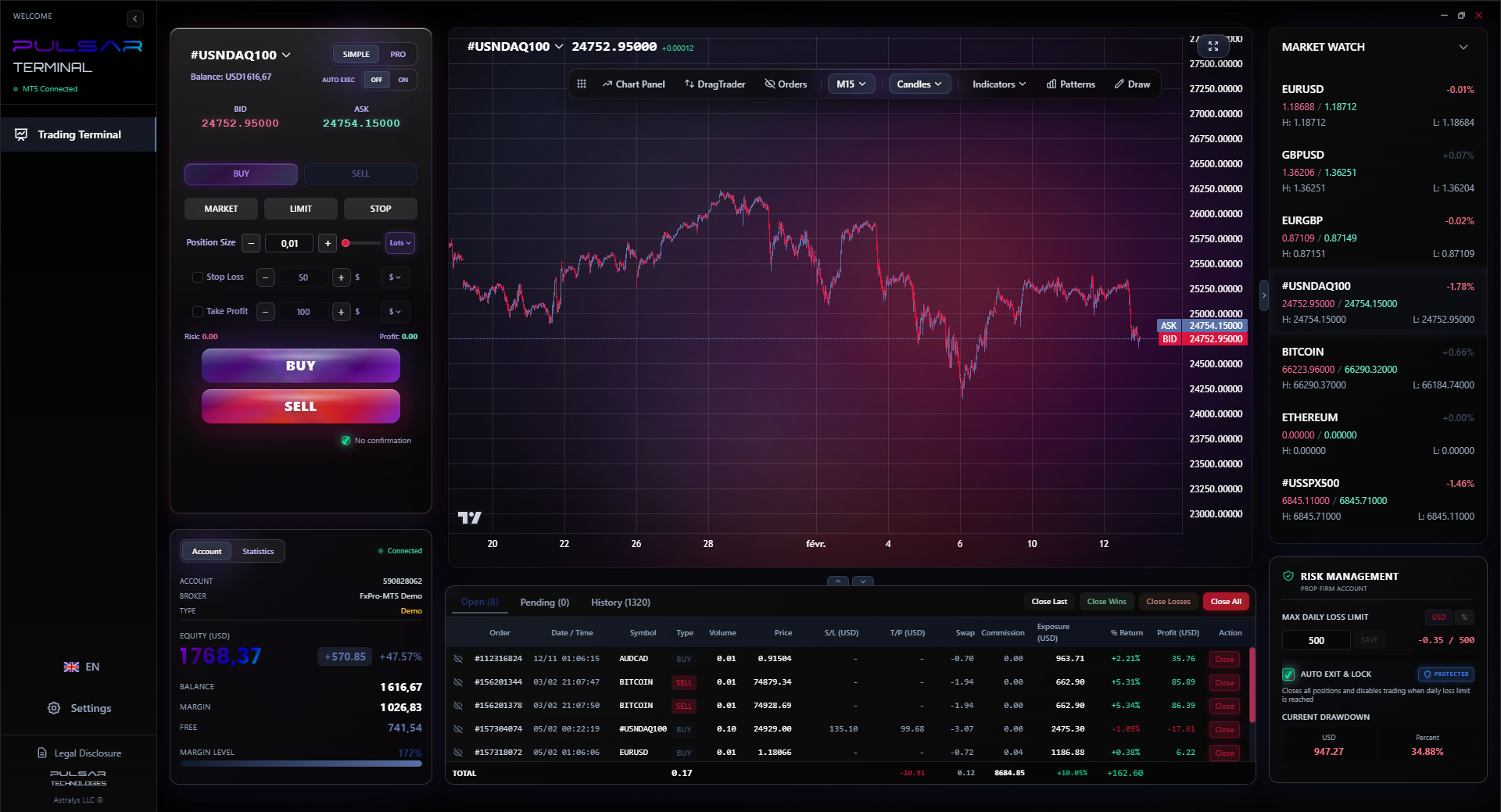
Managing multiple trades across different timeframes is complex, but tools like Pulsar Terminal let you set different take-profit levels and trailing stops for each position directly on MT5.
Pulsar Terminal
Lo strumento MT5 tutto-in-uno: ordini drag-and-drop, multi-TP/SL, trailing stop, grid trading, Volume Profile e protezione prop firm. Usato da oltre 1.000 trader ogni giorno.
Mechanical trading means rules, algorithms, Expert Advisors (EAs). You're not trading - you're managing a system.
Two Approaches
- Your Own Rules: You create strict entry/exit conditions, then follow them religiously
- Full Automation: You buy or code an EA that trades for you
I tried both. In 2020, I coded a simple moving average crossover EA for XAU/USD guide. Ran it on a VPS. Made $1,200 in three months, then gave back $900 in one bad week when gold went sideways.
The Allure & Danger for Nigerians
Mechanical trading seems perfect: set it and forget it. But here's what nobody tells you:
- You need programming knowledge or money to hire developers
- EAs need constant monitoring and adjustment
- Most profitable EAs are never sold - their creators keep them
Brokers like Exness review and XM review are popular for EA trading because they allow hedging and have good MT4/MT5 support.
Realistic Expectations
A good mechanical system might make 10-20% per year with 30% max drawdown. Not the 100% monthly returns YouTube gurus promise.
You still need to understand the rules. I know an Abuja trader who bought a 'guaranteed' EA for $500. It opened 87 trades in one day during low volatility, blew his $2,000 account. The EA was just a martingale system disguised as AI.
Is This You?
You might be a mechanical trader if:
- You're more programmer than psychologist
- You trust data over gut feelings
- You're okay with your system losing for weeks if the rules say it should
- You have capital to withstand drawdowns without interfering
Mechanical trading removes emotion, which is huge. But it introduces technical complexity and requires different skills.
“Your personality is fixed. Your trading style should bend to fit it, not the other way around.”
Don't guess. Follow this process:
Step 1: The 30-Day Test
Pick one style for one month. Start with day trading if you're new - it's the best learning ground. Use a demo account but treat it like real money. Track everything:
- How many hours did you actually spend?
- How did you feel during losses?
- Did you miss important setups because of your schedule?
Step 2: Match Your Capital
Here's a blunt Nigerian reality check:
| Trader Type | Minimum Realistic Capital | Why |
|---|---|---|
| Scalper | $500 (NGN 700k) | Small gains need decent size |
| Day Trader | $300 (NGN 420k) | Can start smaller with micro lots |
| Swing Trader | $500 (NGN 700k) | Wider stops require smaller position sizes |
| Position Trader | $5,000 (NGN 7M) | Massive stops need big account |
| Mechanical | $1,000 (NGN 1.4M) | Need buffer for system drawdowns |
These aren't broker minimums - these are amounts where the style actually makes sense after spreads, commissions, and our 10% tax.
Step 3: Lifestyle Audit
Be honest:
- Do you have 3 uninterrupted hours daily? (Scalping)
- Can you check charts 2-3 times daily? (Day trading)
- Can you analyze markets weekly? (Swing)
- Do you understand macroeconomics? (Position)
- Do you enjoy coding/testing? (Mechanical)
Step 4: Broker Alignment
Each style needs different broker features:
- Scalpers: Lowest spreads, fastest execution
- Day traders: Good spreads, reliable platform
- Swing traders: Low swaps, good charting tools
- Position traders: High use for smaller margin use
- Mechanical: MT4/MT5 API, VPS hosting
Use our position size calculator to test different scenarios with your capital.
My Journey
I started as a day trader (2014-2016), switched to swing trading (2017-present), dabbled in mechanical (2020-2021). Swing trading fits my personality and Lagos business schedule. I check charts after work, place trades that last days. No stress during market hours.
Your path will be different. The key is recognizing when something isn't working and having the courage to switch.
💡 Consiglio di Winston
Your personality is fixed. Your trading style should bend to fit it, not the other way around. An impatient person will never succeed at position trading, no matter how hard they try.
Once you master one style, you might blend elements. I know successful Nigerian traders who do this.
Common Hybrids
Swing + Day Trading: Use swing analysis for direction, take day trades in that direction. Example: You're bullish EUR/USD on weekly chart (swing view). You look for intraday pullbacks to buy (day trades).
Mechanical + Discretionary: Use an EA for entry signals, but manually manage exits. Or vice versa.
The Danger Zone
Mixing styles too early is the #1 reason Nigerians fail. You need discipline in one approach first. I tried hybrid trading in 2018 - had a swing position on USD/CHF, then tried to scalp it intraday. Ended up closing the swing trade early for 15 pips when it would have made 120.
When to Consider Hybrid
- After 2+ years profitable in one style
- When you have enough capital to allocate to different strategies
- When you understand why each trade belongs to which style
Most traders should master one type of forex trader identity before experimenting. It's like learning to drive - master one car before trying to race different models.
FAQ
Q1Which type of forex trader makes the most money in Nigeria?
There's no 'most money' style - only what fits you. I've seen scalpers make NGN 500k in a good month and swing traders make NGN 2M in a good trade. The position trader with the right analysis can make the most per trade, but they trade rarely. Focus on consistency, not comparisons. A disciplined day trader with NGN 1M capital making 5% monthly beats an inconsistent scalper with NGN 5M capital losing 10%.
Q2Can I start forex trading in Nigeria with less than NGN 100,000?
Yes, but your options shrink. With NGN 100k (~$70), you're looking at micro or nano lots. Day trading or swing trading on higher timeframes (like 4-hour charts) becomes more realistic than scalping. The key is proper position sizing - risk no more than 1-2% per trade. That's NGN 1,000-2,000 risked. Use a position size calculator religiously. Many brokers like XM offer accounts from $5, but I'd recommend saving at least NGN 300k for meaningful trading after considering Nigeria's 10% capital gains tax.
Q3How do I know if I'm a scalper or day trader?
Time yourself. Try scalping for a week: can you sit for 2 hours straight, intensely focused? Do you get anxious if a trade isn't closed within 10 minutes? Then try day trading: can you set a trade and leave it for hours? Do you check it constantly? Your natural behavior tells you. Most Nigerians with day jobs find day trading fits better - they can set trades before work, check at lunch, close before bed.
Q4Do I need different brokers for different trading styles?
Sometimes. Scalpers need the tightest spreads and fastest execution - look at Pepperstone or IC Markets. Swing traders care more about swap rates and charting tools - XM or Exness work well. Position traders need high use for smaller margin use - HFM offers up to 1:2000. Check our broker reviews for specifics: Exness review, IC Markets review, XM review.
Q5How does Nigeria's 10% capital gains tax affect my trading style choice?
It makes high-frequency trading harder. If you scalp making 5 pips per trade, after spread and commission, that 10% tax bites deeper. Swing and position traders with larger per-trade profits feel the tax less proportionally. Always calculate your profit after estimated tax - it might make that 'profitable' scalping system actually break even.
Q6Can I change my trader type later?
Absolutely. I changed from day to swing trader after 3 years. Many traders evolve as their life, capital, and skills change. The mistake is changing weekly out of frustration. Give any style at least 3-6 months of serious practice before deciding it's not for you. And always go back to demo when switching to learn the new rhythm.
Q7Which trading style is best for someone with a full-time job in Nigeria?
Swing trading, hands down. You analyze in the evenings on daily or 4-hour charts, place trades that last days to weeks. No need to monitor during work hours. Day trading can work if you have flexible hours or long breaks. Scalping requires uninterrupted focus - nearly impossible with a typical 9-5. Position trading works if you're fundamentally inclined and can analyze on weekends.
Lezione del Prof. Winston
Punti chiave:
- ✓Start with day trading to learn market rhythms
- ✓Need at least NGN 300k for realistic trading
- ✓Swing trading fits most Nigerian lifestyles
- ✓10% tax affects scalpers disproportionately
- ✓Master one style before experimenting
Quanto è stato utile questo articolo?
Clicca su una stella
Analisi Trading Settimanali
Analisi e strategie settimanali gratuite. Nessuno spam.
Sull'autore
Olumide Adeyemi
Pioniere del Trading in Africa Occidentale
Uno degli educatori di trading forex più attivi in Nigeria. 8 anni di esperienza di trading da Lagos. Specializzato in strategie a basso capitale e sfide prop firm per trader africani.
Commenti
Avviso di rischio
Il trading di strumenti finanziari comporta rischi significativi e potrebbe non essere adatto a tutti gli investitori. Le performance passate non garantiscono risultati futuri. Questo contenuto è fornito solo a scopo educativo e non deve essere considerato un consiglio di investimento. Conduci sempre le tue ricerche prima di fare trading.
Potrebbe interessarti anche

Cara Trading Forex Sukses: 7 Prinsip dari Trader Profesional
Cara trading forex sukses dengan 7 prinsip trader pro: manajemen modal, disiplin, journal trading, backtest. Data nyata, bukan janji profit palsu.
Jam Trading Forex Terbaik untuk Trader Indonesia: Panduan Lengkap dengan Tabel Waktu
Panduan jam trading forex untuk trader Indonesia. Tabel 4 sesi dunia, jam emas 20:00-00:00, sesi mana yang harus dihindari. Data akurat + tips dari trader berpengalaman.
Top 5 Sàn Forex Uy Tín Nhất 2026: Review Jujur dari Trader Indonesia
Top 5 sàn forex uy tín 2026 untuk trader Indonesia. Review jujur: spread, deposit, withdraw, dukungan lokal. Exness, XM, IC Markets & lebih.
Scarica Pulsar Terminal
Tutti questi calcolatori sono integrati in Pulsar Terminal con dati in tempo reale dal tuo conto MT5.
Scarica Pulsar Terminal