


Most traders think volume is just a number at the bottom of the chart.

Rajesh Sharma
Analista Forex Senior ·  India
India
☕ 13 min di lettura
Cosa imparerai:
- 1What Volume Actually Means in the Indian Market
- 2How SEBI's 2026 Rules Change Everything for Volume Traders
- 3Reading Volume Signals Correctly (Not Just the Indicator)
- 4Practical Volume Setups for Indian Stocks & Indices
- 5Tools & Indicators That Actually Work (And Which to Avoid)
- 6Managing Risk with Volume (Your New Best Friend)
- 7Common Volume Trading Mistakes (I've Made Them All)
- 8Putting It All Together: Your Volume Trading Checklist
Most traders think volume is just a number at the bottom of the chart. They'll slap on an indicator and call it a day. I used to do that too, until I lost ₹47,000 in a week trying to trade Nifty breakouts with 'high volume' that turned out to be meaningless. The truth is, volume without context is just noise. In India's market, with SEBI's new 2026 rules changing how we can even use algorithms, understanding real volume trading strategy has never been more important - or more different from what YouTube gurus teach.
Let's clear this up first: volume isn't how many shares traded. It's how much money changed hands at a specific price. That distinction matters because ₹10 crore trading in Reliance at ₹2,800 tells a completely different story than the same amount at ₹2,750.
In our markets, you're seeing two types of volume:
Exchange-Reported Volume: This is what your broker shows you - the total trades on NSE or BSE. It's delayed by 15 minutes for equity and real-time for F&O. Useful, but incomplete.
Order Flow Volume: This is what moves prices. It's the actual buy and sell orders hitting the market. Most retail traders never see this, but it's where the real money is made. I learned this the hard way when I bought YES Bank at ₹18.50 because 'volume was increasing,' only to watch it drop to ₹16.20. The exchange volume looked good, but the order flow showed massive selling at every uptick.

Warning: SEBI's new F&O rules mean you can't just scale into losing positions anymore. The intraday position monitoring (four random snapshots daily starting April 2025) and removed calendar spread benefits on expiry days make understanding volume critical for managing risk before the exchange catches you overexposed.
Why Indian Volume Behaves Differently
Our market has unique patterns. The first 30 minutes (9:15-9:45 AM) often sees 25-30% of the day's volume as institutions adjust positions. The last hour (2:30-3:30 PM) gets another 20-25% as traders square off positions. If you're trying a scalping strategy based on US market volume patterns, you'll get wrecked.
Also, remember those SEBI turnover fees? That 0.0001% on transaction value affects high-frequency traders more, which changes how volume accumulates. Big players adjust their algorithms to minimize these costs, creating volume patterns you won't see in textbooks.

💡 Consiglio di Winston
Volume tells you the intensity of the fight at a price level. High volume at resistance means someone's selling aggressively. Low volume on a breakout means no one's defending the old level. Always ask: who's winning this battle?
If you're planning to use any automated volume strategy, listen closely. SEBI's January 2026 overhaul isn't minor tweaks - it's a complete rewrite of how algorithmic trading works in India.
First, the big one: all algorithms need exchange approval now. That means your custom volume scanner, your breakout detector, even a simple script that places orders based on volume spikes - all need a unique Algo-ID from NSE or BSE. Your broker is responsible for this, and they're being strict. I know traders who've waited 3 weeks for approval on what seemed like simple strategies.
Here's what this means practically:
| What You Want to Do | What SEBI Says (2026 Rules) |
|---|---|
| Code a volume-based bot | Must be approved by exchange, hosted on broker servers only |
| Share a strategy with a friend | Strictly prohibited without exchange approval |
| Place 15 orders/second | Special registration required, enhanced controls apply |
| Use a third-party tool | Must integrate with broker API, 2FA and static IP mandatory |

Pro Tip: Talk to your broker's API support team BEFORE you develop anything. I wasted two months coding a volume divergence system only to learn my broker (a major one) doesn't allow certain order types through their approved API structure. Start with their documentation and approval process.
The F&O changes hit volume traders hardest. That mandatory upfront premium for options buying (started Nov 2024) killed a lot of cheap volume-based option strategies overnight. When you need the entire premium upfront, your capital efficiency drops, and your volume signals need to be much more accurate to justify the cost.
And that 2% extreme loss margin for short options on expiry days? It makes analyzing expiry-day volume absolutely critical. A seemingly normal volume spike could trigger that margin if you're not watching closely.
“All algorithms need exchange approval now. That means your custom volume scanner, your breakout detector - all need a unique Algo-ID from NSE or BSE.”
Here's where most traders fail: they use Volume Weighted Average Price (VWAP) or On-Balance Volume (OBV) as buy/sell signals. That's like using a thermometer to forecast rain - related, but not the right tool.
Volume Confirmation vs. Volume Divergence
Confirmation is simple: price breaks out, volume increases. That's the classic textbook pattern. In April 2023, when HDFC Bank broke above ₹1,650 on massive volume (3x average), that was confirmation. The stock ran to ₹1,720 in two weeks.
Divergence is trickier but more profitable. Price makes a new high, but volume is lower than the previous high. That shows lack of conviction. I caught this in Tata Motors in August 2024. Price hit ₹985, a new 52-week high, but volume was 40% lower than the previous high at ₹940. I shorted with a tight stop at ₹995. The stock dropped to ₹915 in eight sessions.
The Volume Cluster Concept
Look for price levels where volume accumulates. These become support or resistance. On the Nifty, I've noticed ₹22,300 held as support for weeks because that's where maximum volume traded in the March 2024 series. When it finally broke in April 2025, the fall was rapid because all those positions became losses.

Example: Let's say you're watching ITC. It trades between ₹430-₹450 for two weeks. You notice 80% of the volume occurs at ₹438-₹442. That's your volume cluster. A break above ₹442 on increasing volume is a stronger signal than a break above the ₹450 resistance that had little volume.
Volume and News Events
Indian stocks react violently to earnings news. The key isn't the initial volume spike - everyone sees that. It's the volume on the follow-through. When Infosys reported better-than-expected earnings in January 2025, the stock gapped up 8% on huge volume. But the next day, volume dropped 70% while price held. That showed institutional holding, not just retail excitement. The stock consolidated and moved another 6% up over the next month.
Using the RSI indicator with volume can help filter these moves. High volume + RSI divergence is one of my favorite set-ups.
Let's get specific. These are setups I actually use, with real numbers from my trades.
Setup 1: The Opening Range Breakout (ORB) with Volume
This works especially well on Nifty Bank. Here's how I trade it:
- Mark the high and low of the first 30 minutes (9:15-9:45 AM).
- Wait for price to break either level WITH volume at least 1.5x the 30-minute average.
- Enter on the retest of the broken level.
On May 3, 2025, Nifty Bank's opening range was 48,210-48,450. At 10:15 AM, it broke above 48,450 with volume 1.8x average. I waited for the pullback to 48,430, entered long, and placed my stop at 48,380 (just below the range). Target was 48,650 (previous resistance). Hit target by 1:30 PM. Risk: ₹2,000 per lot. Reward: ₹5,500 per lot.
Setup 2: Volume Dry-Up at Support/Resistance
When price approaches a known support or resistance level and volume dries up significantly (below 0.5x average), it often means the level will break. The lack of volume shows no one is defending it.
I used this on Reliance in December 2024. The stock approached ₹2,900 resistance - a level that had rejected price three times before. This time, volume on the approach was just 0.4x average. I bought slightly above ₹2,900, expecting the break. Stock moved to ₹2,960 within three days. The key here is patience - wait for that volume confirmation on the actual break.
Setup 3: End-of-Day Volume Surge
With SEBI's intraday position monitoring, many traders square off positions in the last 30 minutes. A surge in volume during this period with price moving in one direction often continues the next morning.
Warning: This setup fails on expiry days because of the different dynamics. The removal of calendar spread benefits and that extra 2% margin for short options changes everything. I lost ₹18,000 on a Bank Nifty expiry trying this old pattern before I learned the new rules.
For swing trading positions, I use weekly volume analysis. A stock closing the week at a high with the highest weekly volume in a month is much stronger than a daily signal.
💡 Consiglio di Winston
With SEBI's new algo rules, your edge isn't in faster execution anymore - it's in smarter volume interpretation. The playing field just got leveled. Read the order flow, not just the summary statistics.
“I never risk more than 1% of my capital on a single trade. But with volume, I adjust position size based on market conditions.”
Your trading platform probably has 20 volume indicators. You need about three.
Essential:
- Volume Profile: Shows where volume actually traded at each price level. This is the single most useful volume tool. It helps you identify those value areas (volume clusters) I mentioned earlier. Most brokers now offer this, though the quality varies.
- Volume Bars with Moving Average: Simple 20-period MA on volume bars. Tells you if current volume is above or below average. Color code them - green when above MA, red when below. Instant visual cue.
- Time & Sales (if available): This shows the actual order flow. You'll see if large blocks are buying or selling. Not all retail brokers offer this, but if yours does, learn to read it.
Overrated:
- On-Balance Volume (OBV): It's lagging and often gives false signals in trending markets. I stopped using it in 2022.
- Volume Rate of Change: Too noisy for practical use.
- Chaikin Money Flow: Okay for longer-term analysis, but useless for intraday.
The Broker Matters
Your access to volume data depends heavily on your broker. Some discount brokers provide delayed or aggregated volume that's useless for serious analysis. I've used Exness for global markets and IC Markets for their raw data feeds, but for pure Indian markets, you need a broker with good NSE/BSE data integration.
Also, with SEBI's ban on open APIs, any third-party tool you use (like a volume analyzer) must integrate through your broker's approved system. No more standalone applications pulling data directly. This killed a lot of the smaller tool providers in 2025.
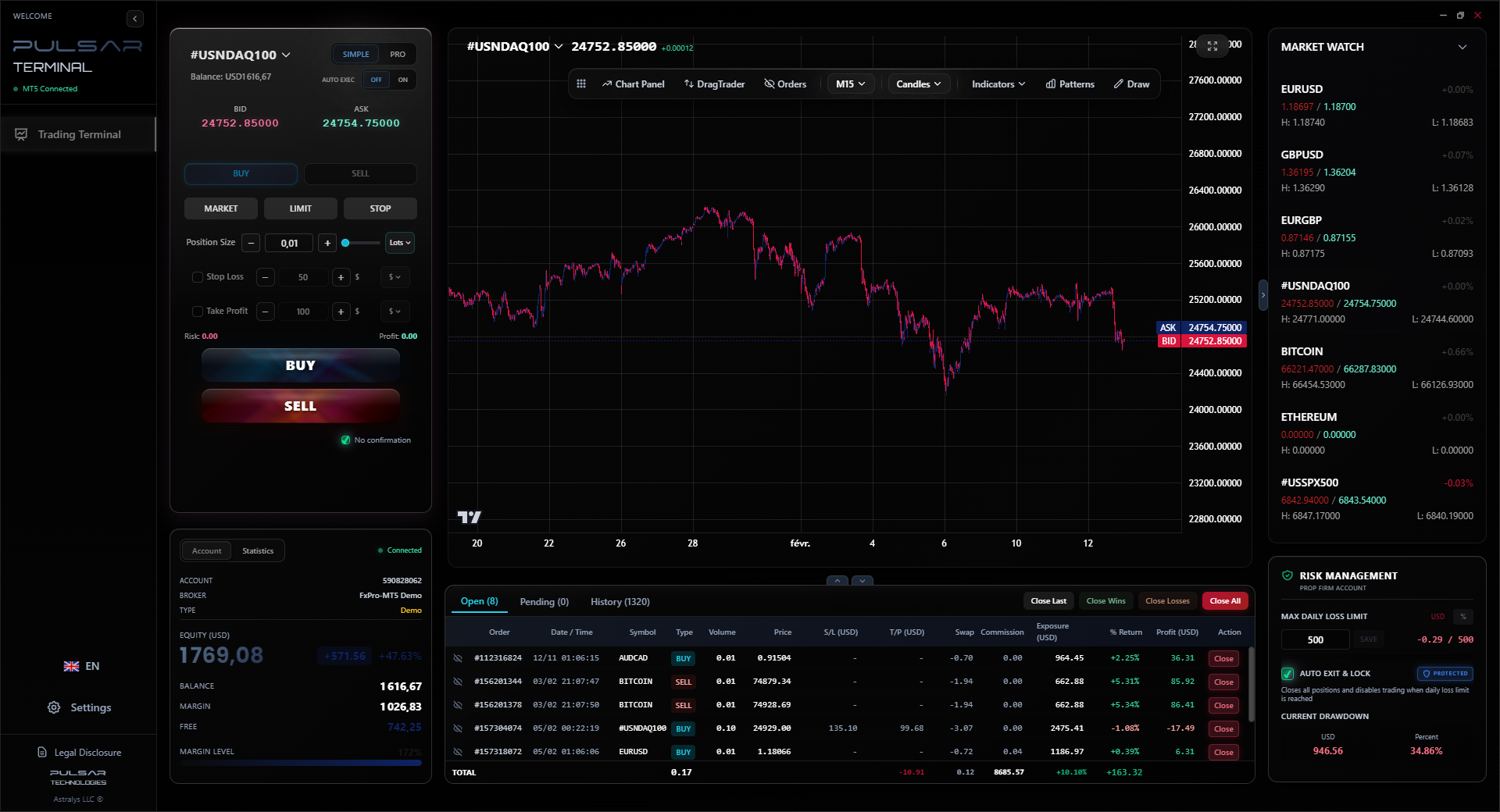
When analyzing volume clusters and profiles, having the right visualization tools directly on your MT5 platform makes spotting high-probability levels significantly faster and more accurate.
Pulsar Terminal
Lo strumento MT5 tutto-in-uno: ordini drag-and-drop, multi-TP/SL, trailing stop, grid trading, Volume Profile e protezione prop firm. Usato da oltre 1.000 trader ogni giorno.
Volume isn't just for entry signals - it's your best risk management tool. Here's how I use it.
Position Sizing Based on Volume
I never risk more than 1% of my capital on a single trade (old rule). But with volume, I adjust position size based on market conditions. In low-volume environments (like midday lull or pre-holiday), I reduce position size by 50%. The signals are less reliable, and slippage can be worse.
Use a position size calculator that accounts for average daily volume. If a stock normally trades 1 million shares daily and today it's only at 300,000 by 1 PM, something's off. Maybe there's news pending, or institutional players are absent. Either way, it's not a day for maximum risk.
Volume-Based Stops
Instead of arbitrary percentage stops, place stops below significant volume areas. If a stock has strong volume support at ₹500 (meaning lots of buying happened there), place your stop at ₹498, not ₹490. This gives your trade room to breathe while still protecting you if the volume level breaks.
I learned this trading XAU/USD (gold), where volume nodes are even more important. A stop placed too tight below a volume cluster gets taken out by noise constantly.
The Volume Warning Sign
When you're in a trade and volume suddenly dries up during a move, it's a warning. The move is losing momentum. Consider taking partial profits or tightening your stop. Conversely, if volume increases as your trade goes against you, get out. That's smart money moving against your position.
Nothing triggers a margin call faster than ignoring volume while you're wrong. I've been there - holding a losing Nifty short as volume kept increasing on up moves, telling me clearly I was on the wrong side. That one cost me ₹52,000 before I finally listened.
“The traders who survive will be those who understand not just how to read volume, but how to operate within SEBI's framework.”
Let me save you some money by sharing where I've messed up.
Mistake 1: Chasing High Volume Alone
Just because volume is high doesn't mean it's buying volume. In September 2024, Adani Ports showed massive volume at ₹1,350. I bought, thinking institutional accumulation. Turned out it was a large block seller exiting. The stock dropped to ₹1,280 in two days. Now I always check if the high volume comes with price acceptance (closing near the high of the range for buys, low of the range for sells).
Mistake 2: Ignoring Time of Day
Volume patterns change throughout the day. A volume spike at 11 AM means something different than the same spike at 2:30 PM. Early volume often establishes the day's range, while late volume confirms or rejects moves. I used to treat all volume equally - another expensive lesson.
Mistake 3: Not Adjusting for News
Earnings announcements, RBI policy, budget day - these events create volume anomalies. The volume isn't technical; it's event-driven. Trading your normal volume strategies on these days is dangerous. I lost ₹15,000 on a Budget Day trying to trade a normal volume breakout that got overwhelmed by news volatility.
Mistake 4: Overcomplicating
I once had eight volume indicators on my chart. VWAP, VP, OBV, volume MA, volume ROC, etc. They all conflicted, and I ended up paralyzed. Now I use two at most: volume profile and simple volume bars. More tools don't make you better - understanding does.
Remember, with SEBI's new algo rules, you can't just automate away these mistakes anymore. Every strategy needs approval, so you better understand it thoroughly before submitting it for exchange review.
💡 Consiglio di Winston
The most important volume is the volume that's NOT there. When price approaches a key level and volume dries up, it means no conviction. That's often your signal the level will break.
Here's my pre-trade checklist. I don't place a single order without running through this.
- Market Context: What's the overall market volume? Is it a normal day, expiry day, or pre-holiday? (Adjust position size accordingly)
- Instrument Volume: Is this stock/index trading at, above, or below its average volume for this time of day?
- Volume Pattern: Am I looking at confirmation (price and volume agree) or divergence (they disagree)?
- Volume Clusters: Where are the high-volume price levels? Are we approaching one, at one, or breaking away from one?
- Time Analysis: Is the volume pattern consistent throughout the day, or is there an anomaly at a specific time?
- News Check: Any scheduled news or events that could distort volume patterns?
- Risk Parameters: Based on the above, what's my position size? Where's my stop (preferably below/above a volume cluster)?
- SEBI Compliance: If this is an automated strategy, do I have the proper Algo-ID? Is my broker's API functioning correctly with the new 2FA requirements?
Start with paper trading this checklist for a month. Track every trade. You'll start seeing patterns you never noticed before.
Volume trading in India isn't getting easier with the new regulations, but it's getting more professional. The traders who survive will be those who understand not just how to read volume, but how to operate within SEBI's framework. The days of wild west algo trading are over. What's left is a more disciplined, transparent market where real skill with tools like volume analysis separates the consistent winners from the gamblers.
One last thing: volume tells you what's happening right now. It doesn't predict the future. Combine it with price action, understand the regulatory environment, and always, always manage your risk first. I've been trading for 12 years, and the months I've made the most money weren't when I found the perfect volume signal - they were when I avoided the obvious volume traps.
FAQ
Q1Can I still use automated volume trading strategies with SEBI's 2026 rules?
Yes, but with major restrictions. All algorithms must be approved by the exchange (NSE/BSE) and assigned a unique Algo-ID. They must be hosted on your broker's servers, not third-party systems. You'll need written consent from your broker acknowledging the risks, and any strategy sharing or selling is prohibited without exchange approval.
Q2What's the best volume indicator for Indian stocks?
For practical trading, Volume Profile is the most useful as it shows where volume actually traded at each price level, revealing support/resistance zones. Combine this with simple volume bars and a 20-period moving average to gauge if current volume is above or below average. Avoid overcomplicated indicators like OBV for intraday decisions.
Q3How do SEBI's new F&O rules affect volume analysis?
Significantly. The upfront premium requirement for options buying reduces capital efficiency, making accurate volume signals more important. The intraday position monitoring (4 random snapshots daily) means you can't hide overexposure. The removed calendar spread benefits on expiry days and extra 2% margin for short options change expiry-day volume patterns completely. You need to relearn volume behavior around expiry.
Q4Is volume analysis different for equities vs. F&O in India?
Yes. Equity volume shows actual share turnover, while F&O volume shows contract turnover with use effects. F&O volume is more sensitive to expiry cycles and has different patterns, especially with the new lot sizes targeting ₹15-20 lakhs market value. Also, F&O has real-time volume reporting while equity has a 15-minute delay.
Q5What's a simple volume strategy I can start with today?
Try the Opening Range Breakout: Mark the first 30-minute high/low (9:15-9:45 AM). Wait for a break of either level with volume at least 1.5x the 30-minute average. Enter on the retest of the broken level. Place your stop just outside the range. Start with Nifty or Bank Nifty for cleanest patterns, and always paper trade first.
Q6How do I know if high volume is buying or selling?
Look at where price closes within the candle. High volume with price closing near the candle's high suggests buying pressure. High volume with price closing near the candle's low suggests selling. Also, check Time & Sales if your broker provides it - you'll see large buy/sell orders directly. In their absence, watch for acceptance at higher/lower prices after the volume spike.
Q7Are there times when volume signals are less reliable?
Absolutely. During the first and last 30 minutes when volatility is highest, around major news events (RBI policy, earnings), on expiry days (especially with new SEBI rules), and during holiday-thinned sessions. Also, in very low-float stocks where a few large orders can distort volume patterns. Midday (11:30 AM-2 PM) often provides cleaner signals.
Lezione del Prof. Winston
Punti chiave:
- ✓Volume shows money flow, not just share count
- ✓SEBI's 2026 algo rules require exchange approval for all strategies
- ✓Volume clusters identify real support/resistance
- ✓Adjust position size for volume conditions
- ✓Low volume at key levels often precedes breaks
Quanto è stato utile questo articolo?
Clicca su una stella
Analisi Trading Settimanali
Analisi e strategie settimanali gratuite. Nessuno spam.
Sull'autore
Rajesh Sharma
Analista Forex Senior
Oltre 10 anni di trading sui mercati indiani e del Sud-Est asiatico. Ha iniziato con i derivati valutari del NSE prima di passare al forex internazionale. Specializzato in USD/INR e coppie dei mercati emergenti.
Commenti
Avviso di rischio
Il trading di strumenti finanziari comporta rischi significativi e potrebbe non essere adatto a tutti gli investitori. Le performance passate non garantiscono risultati futuri. Questo contenuto è fornito solo a scopo educativo e non deve essere considerato un consiglio di investimento. Conduci sempre le tue ricerche prima di fare trading.
Potrebbe interessarti anche

Cara Trading Forex Sukses: 7 Prinsip dari Trader Profesional
Cara trading forex sukses dengan 7 prinsip trader pro: manajemen modal, disiplin, journal trading, backtest. Data nyata, bukan janji profit palsu.
Jam Trading Forex Terbaik untuk Trader Indonesia: Panduan Lengkap dengan Tabel Waktu
Panduan jam trading forex untuk trader Indonesia. Tabel 4 sesi dunia, jam emas 20:00-00:00, sesi mana yang harus dihindari. Data akurat + tips dari trader berpengalaman.
Top 5 Sàn Forex Uy Tín Nhất 2026: Review Jujur dari Trader Indonesia
Top 5 sàn forex uy tín 2026 untuk trader Indonesia. Review jujur: spread, deposit, withdraw, dukungan lokal. Exness, XM, IC Markets & lebih.
Scarica Pulsar Terminal
Tutti questi calcolatori sono integrati in Pulsar Terminal con dati in tempo reale dal tuo conto MT5.
Scarica Pulsar Terminal