


Every trader in Lagos has heard the story: someone turned 50k NGN into millions overnight using crazy use.

Olumide Adeyemi
Pioniere del Trading in Africa Occidentale ·  Nigeria
☕ 12 min di lettura
Cosa imparerai:
Every trader in Lagos has heard the story: someone turned 50k NGN into millions overnight using crazy use. What they don't tell you is the next chapter, where that same person lost it all before the week was out. We're obsessed with the potential upside of use, but we rarely talk about the gut-wrenching reality of over leveraging. It's not about the ratio on your broker's page; it's about a mindset that confuses opportunity with a death wish. I've been there, staring at a margin call notification with my heart in my throat. Let's set the record straight on what over leveraging in forex really is, why it's so dangerous for Nigerian traders specifically, and how you can use use as a tool instead of a trap.
Let's get this straight from the start. When your broker offers you 1:500 use, they are not giving you free capital. They are lending you money. You put up a small deposit (your margin), and they lend you the rest to control a much larger position. For every 1 Naira in your account, they'll let you control 500 Naira worth of currency.
That sounds amazing, right? The potential for profit is magnified. But here's the brutal truth they don't put in the ads: your losses are magnified by the exact same amount. If the market moves 1% against you on a 1:500 trade, you've just lost 500% of your margin. Your account is gone. Poof.
In Nigeria, we're particularly susceptible to this pitch. With economic pressures and a desire for quick financial wins, the siren song of high use is loud. Brokers like Exness offer 'unlimited' use, and others like HFM and XM offer 1:1000 or more. They're legal, they're available, but using them without understanding is like driving a Ferrari on the Third Mainland Bridge during rush hour with no brakes.

Warning: High use doesn't make a bad strategy profitable. It just makes a losing trade destroy your account faster.
The key number isn't the use ratio; it's your position size. A 1:1000 use on a 0.01 lot trade is less risky than 1:100 use on a 1.0 lot trade. Your broker's offered use is just the ceiling. Your job is to decide how much of that ceiling you actually use. I learned this the hard way early on. I funded an account with $200 at a broker offering 1:500. I thought, "Great! I can trade like I have $100,000!" I opened a full lot on GBP/USD. A 10-pip move against me wiped out over half my account. I was liquidated before I could even process what happened. That's what over leveraging in forex feels like: a very expensive, very quick lesson.

💡 Consiglio di Winston
Your broker's maximum use is a measure of their risk appetite, not yours. Your personal maximum should be written on a sticky note next to your screen and be at least 10x smaller.
“Over leveraging isn't a ratio on a broker's page; it's the cold sweat you feel watching a 5-pip fluctuation.”
Over leveraging isn't just a number. It's a feeling. It's a set of conditions in your trading. If you recognize any of these, you're likely in the danger zone.
Your Heart Rate is a Trading Indicator If you find yourself unable to step away from the screen, constantly checking your P&L, and feeling genuine anxiety over small market fluctuations, your position is too big. Your body is telling you what your brain won't admit: you're risking more than you can comfortably lose. I used to get literal stomach aches. That was my signal.
The Margin Call is Looming Your used margin should be a small fraction of your equity. If you're consistently using 50%, 70%, or even 90% of your account balance as margin for open trades, you have no buffer. Any drawdown will trigger a margin call. Most platforms show this as a "Margin Level" percentage. If it drops below 100%, you're in trouble. Good brokers like IC Markets or Pepperstone will have clear warnings, but by then it's often too late.
One Trade Can Wipe You Out This is the ultimate test. Look at your open position. Now, imagine the market moves against you by a reasonable amount - say, 50 pips on a major pair. Use a position size calculator. If that 50-pip loss would decimate your account (e.g., cause a 20%+ loss), your position is oversized. You've over leveraged.
You're Trading to Recover Losses This is the most common trap in Nigeria. You lose 20k NGN on a trade. Panic sets in. Instead of accepting the loss and analyzing the mistake, you think, "I'll just double my position on the next trade to get it back fast." This is emotional over leveraging. You're no longer trading the market; you're trading your desperation. I've done this. It never ends well. You compound a single bad trade into a series of catastrophic decisions.
“In Nigeria, we don't have ESMA use caps. That means the most important regulator is the one between your ears.”
Our environment creates a perfect storm for over leveraging. It's not just about willpower; it's about context.
Economic Pressure & The 'Get Rich Quick' Mentality Let's be honest. With inflation and the value of the Naira, the pressure to find alternative income is immense. Forex trading is marketed as that escape hatch. Social media is flooded with "proof" of massive gains, often from traders using insane use. This creates an unrealistic benchmark. You feel behind if you're only making 5% a month, so you crank up the use to chase those fantasy returns. It's a trap.
Broker Offers Are Insanely High Compare our landscape to Europe. Under ESMA rules, use for retail traders is capped at 1:30 for major pairs. In Nigeria? Caps are virtually non-existent. Seeing 1:1000 from XM or 'unlimited' from Exness normalizes the abnormal. We start to think 1:100 is conservative, when in many regulated markets, it's not even an option. This distorts our perception of risk.
Payment & Tax Realities Funding your account can be a hassle with CBN restrictions. When you finally get money into a broker, the psychological barrier to lose it is huge. You think, "I went through so much to deposit this, I HAVE to make it work." This leads to over trading and over leveraging. Then, if you do make a profit, you're looking at a 10% Capital Gains Tax. This subconsciously pushes some traders to aim for even bigger gains to offset the tax, again leading to higher risk.
The Statistics Don't Lie Brokers are required to publish their client loss rates. For many serving our region, it's between 74% and 89% of retail accounts lose money. The primary driver of those losses isn't a lack of analysis; it's poor risk management, with over leveraging at the top of the list. You're not fighting the market; you're fighting a statistical probability stacked against the over-leveraged trader.
“In Nigeria, we don't have ESMA use caps. That means the most important regulator is the one between your ears.”
Forget the broker's maximum. Your safe use is a personal calculation. Here’s a simple, conservative framework I've used for years.
The 1% Rule (The Foundation) Never risk more than 1% of your total account equity on any single trade. This isn't about position size yet; it's about your stop-loss. If you have a 500,000 NGN account, your maximum risk per trade is 5,000 NGN.
Calculating Your Position Size This is where use is determined. Let's say you're trading USD/NGN (or more commonly, you'd trade USD via a major pair like EUR/USD).
- Find your risk in NGN: 1% of 500,000 NGN = 5,000 NGN.
- Define your stop-loss in pips: You analyze the chart and decide a sensible stop-loss is 25 pips away from your entry.
- Find the pip value: For a standard lot (100,000 units), 1 pip is usually ~$10. But you need to convert. Let's assume a USD/NGN rate.
- Use the formula:
Position Size = (Account Risk) / (Stop Loss in Pips * Pip Value)This will give you the lot size that ensures if you hit your 25-pip stop, you lose exactly 5,000 NGN, no more.

Example:
- Account: 500,000 NGN
- Risk: 1% = 5,000 NGN
- Trade: GBP/USD, Stop Loss: 30 pips
- Pip Value for a micro lot (1,000 units): ~$0.10 (approx. 130 NGN)
- Position Size = 5,000 NGN / (30 pips * 130 NGN/pip)
- Position Size ≈ 5,000 / 3,900 ≈ 1.28 micro lots.
With a 500k NGN account, a safe trade might only be 1.28 micro lots. That's using effective use of maybe 1:5 or 1:10, even if your account is capable of 1:500. This is the discipline that separates survivors from statistics.
What Effective use Are You Really Using?
You can calculate it: (Total Position Value) / (Your Account Equity). If you're trading $10,000 worth of currency with a $1,000 account, your effective use is 10:1. For a 500k NGN (~$330) account, a single micro lot ($1,000) is already about 3:1 use. Keep this number low, especially when starting. A tool like a position size calculator automates this and removes emotion.
💡 Consiglio di Winston
If you can't calculate your position size in your head within 10 seconds for a given stop-loss, your trade is too complex and you're guessing. Guessing with use is gambling.
“A margin call isn't bad luck; it's a post-mortem report on failed risk management.”
Theory is fine, but pain is a better teacher. Let me show you two trades from my own journal.
The Disaster: Gold (XAU/USD) Overreach I was confident. I'd read a few XAU/USD guides and saw a clear support level. Account balance: $1,000. Broker use available: 1:500.
- My Mistake: I thought, "Gold moves fast, I'll get in and out." I bought 0.5 lots of XAU/USD. My position value was over $90,000. Effective use: 90:1.
- The Move: Price dipped slightly below support, just 15 dollars.
- The Result: My stop-loss was too tight. The swing hit it. Loss: $75. That's 7.5% of my account gone in one trade. I was so shaken I missed the actual reversal and rally that followed. I was right on the direction, but my over-leveraged position couldn't withstand the normal market noise. I violated the 1% rule by a factor of seven.
The Success: EUR/USD with Discipline Same account, after I'd learned. Balance: ~$920.
- The Setup: A MACD indicator crossover on the 4-hour chart for EUR/USD. Stop-loss calculated: 20 pips.
- The Math: 1% risk = $9.20. Pip value for a micro lot = ~$0.10.
- Position Size: $9.20 / (20 pips * $0.10) = 4.6 micro lots. I rounded down to 4 micro lots (0.04 standard lots).
- Effective use: Position value ~$4,000 / Account $920 = ~4.3:1.
- The Result: Trade went my way. I took profit at 40 pips. Gain: $16. A modest 1.7% return on the account. But it was sustainable, repeatable, and I slept soundly. That's the power of controlled use.
The difference wasn't analysis skill. It was risk management. The second trade used a tiny fraction of my available use but aligned with what my account could actually bear.
“A margin call isn't bad luck; it's a post-mortem report on failed risk management.”
Knowing what over leveraging in forex is isn't enough. You need systems to prevent it.
Pre-Trade Checklist (Non-Negotiable)
- Calculate maximum risk (1% of equity).
- Determine stop-loss distance in pips based on chart structure, not desired dollar loss.
- Use a calculator to find the lot size. Do this before clicking buy/sell.
- Check your resulting margin used. Is it below 10% of your equity? Good.
Platform Tools are Your Friend Set up your trading platform to help you. On MT4/MT5, you can set a default "maximum lot size" in the properties. Make it small. Use the account history tab to review your weekly risk. If you see any trade where the loss exceeded 1.5% of that day's equity, you have a problem to fix.
The Prop Firm Angle Many Nigerian traders are trying prop firm challenges. These are the ultimate test of use control. They have strict daily loss limits (often 5%). If you're trading a $100,000 challenge account, a 5% daily loss is $5,000. That sounds huge, but with the use they provide, you can hit that in minutes with one bad, oversized trade. The discipline required here is extreme. You must trade tiny position sizes relative to the capital. It's a mental game of remembering the $5,000 is real to you, not the $100,000.
Emotional Guardrails If you have a losing day (say, -3%), stop. Close the platform. Your judgment is impaired. The urge to "get back to even" will lead to over leveraging. Likewise, after a big win, take a break. Euphoria leads to overconfidence, which leads to increasing position sizes beyond your rules.

Pro Tip: Open a demo account and set the balance to match your real account. Now, trade with only 1:10 effective use as a maximum. Do this for a month. Your goal isn't maximum profit; it's zero margin calls and consistent, small wins. This rewires your brain to see use as a limit, not a target.
💡 Consiglio di Winston
The most profitable month of my career was also the one where I used the lowest effective use. Consistency beats heroics every single time.
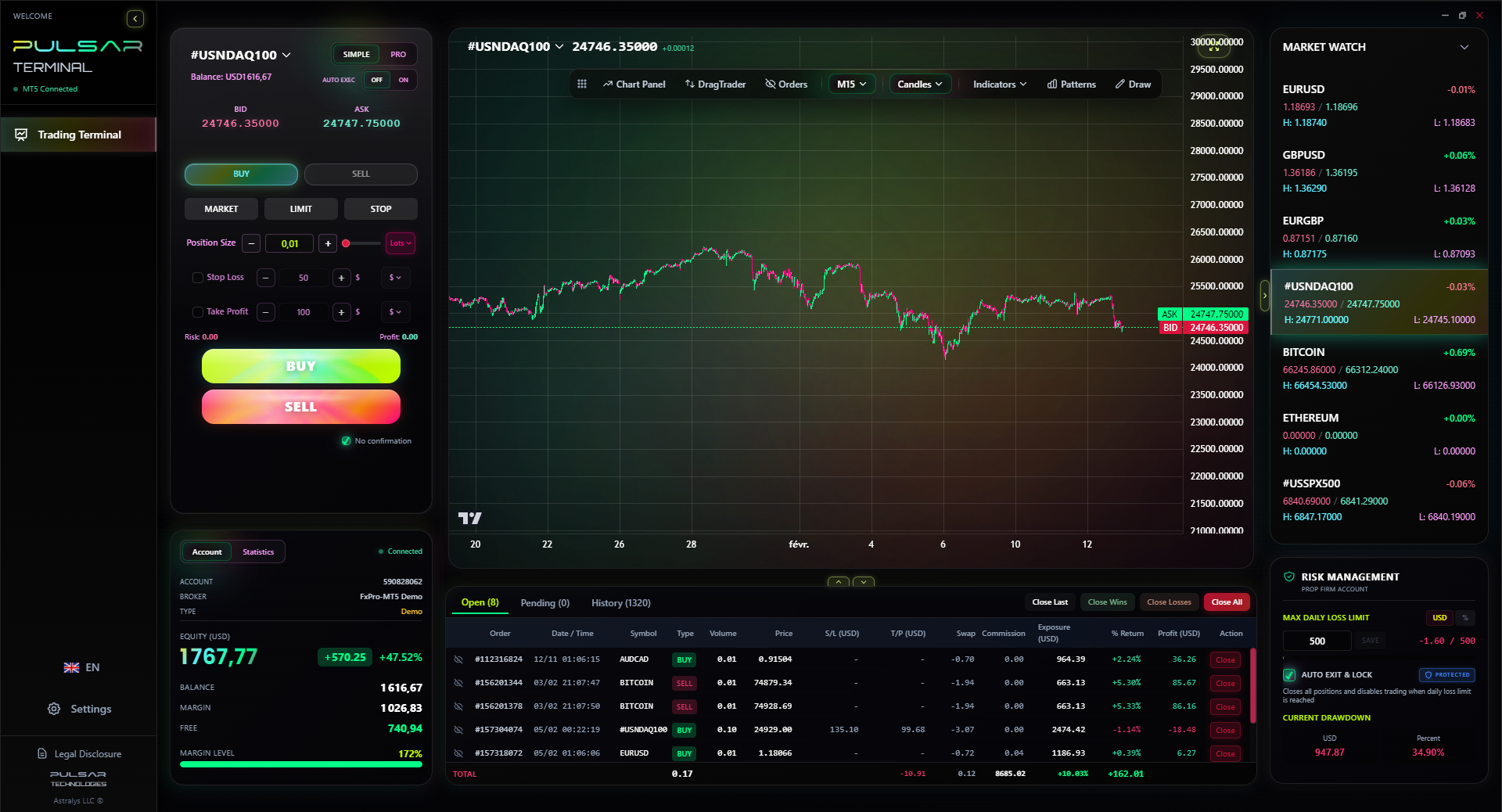
Sticking to a disciplined pre-trade checklist is easier when your trading tools help enforce the rules, like setting maximum position sizes and automatic risk calculations directly on your MT5 chart.
Pulsar Terminal
Lo strumento MT5 tutto-in-uno: ordini drag-and-drop, multi-TP/SL, trailing stop, grid trading, Volume Profile e protezione prop firm. Usato da oltre 1.000 trader ogni giorno.
“Using 1:1000 use on a 0.01 lot trade is smarter than using 1:50 on a 1.0 lot trade. Size always trumps ratio.”
The goal isn't to fear use. It's to respect it. For a Nigerian trader, smart use can be a genuine advantage. It allows you to participate in markets with smaller capital, which is our reality. But it must be surgical.
Think of it like this: use is the accelerator in your car. Pushing it to the floor on an open highway (a perfect, high-probability setup) can get you to your destination faster. Pushing it to the floor in a crowded market in Ojuelegba (a volatile, news-driven market) is a guaranteed crash.
Your journey should look like this:
- Start Extremely Low: Use effective use under 5:1. Master your emotions and your strategy at this level.
- Graduate Slowly: As your account grows and your win rate becomes consistent over 6+ months, you might gradually increase your risk per trade to 1.5% or 2%, and your effective use accordingly. This is a reward for proven discipline, not a starting point.
- Specialize: Different strategies use different use. A scalping strategy might use slightly higher use for small, quick moves with tight stops. A swing trading approach will use much lower use to withstand larger swings. Match your tool to the job.
Finally, always know your exit before your entry. A clear stop-loss defines your risk. Without it, you have no way to calculate a safe position size, and you are guaranteed to be over leveraged by the market's standards, not your own. That's the core answer to what over leveraging in forex is: it's entering a trade without knowing, and controlling, exactly how much you can afford to lose.
FAQ
Q1What use ratio is considered over leveraging in Nigeria?
There's no magic number. A 1:1000 ratio can be safe if your position size is tiny (e.g., 0.01 lots on a $1000 account). Over leveraging is defined by your effective use and risk per trade. If your effective use (total position value / your equity) is above 10:1 for a beginner, or your risk on any single trade is above 2% of your account, you're likely over leveraged.
Q2I received a margin call. What should I do immediately?
First, don't panic-deposit more money to try and save the trade. That's throwing good money after bad. The margin call is a system failure signal. Let the trade be liquidated. Then, close all other positions. Step away from the charts. Analyze what happened: Was your stop-loss too wide? Was your position size too large? Use it as a paid lesson. Rebuild your account with a strict 1% risk rule, or start over with a demo to regain confidence.
Q3Do Nigerian brokers offer negative balance protection?
Some do, like HFM, but not all. You must check your broker's terms. Negative balance protection means you can't lose more than you deposited. However, relying on this is dangerous. It's a last-resort safety net, not a strategy. Your goal should be to never get close to a negative balance through proper position sizing.
Q4How does the 10% capital gains tax affect my use decisions?
It shouldn't directly. Never increase your risk (use) to try and offset a future tax bill. That's a sure path to greater losses. Factor the tax into your net profit calculations. If you aim for a 15% annual return, understand that 1.5% of that will go to tax. Adjust your financial goals accordingly, not your trade risk.
Q5Is it better to use a broker with lower maximum use?
For beginners, absolutely. It acts as a forced discipline. A broker like AvaTrade offering 1:30 for retail accounts physically prevents you from using 1:500. This can save you from yourself while you're learning. As you gain experience, you can choose brokers with higher ceilings, but you'll have the discipline to self-impose your own low limits.
Q6Can I use high use successfully for scalping?
Scalpers often use higher effective use because their stop-losses are very tight (5-10 pips). This means the dollar risk per trade can still be kept small (1% of account). The key is the tight stop. If your scalping stop is 20 pips and you're using high use, your risk is enormous. It's the combination of stop-loss distance and lot size that matters, not the use setting alone.
Lezione del Prof. Winston
Punti chiave:
- ✓Never risk more than 1% of equity on a single trade.
- ✓Effective use >10:1 is a red zone for most traders.
- ✓Calculate position size *before* setting entry or stop-loss.
- ✓A losing trade should be a small, planned cost, not an account event.
Quanto è stato utile questo articolo?
Clicca su una stella
Analisi Trading Settimanali
Analisi e strategie settimanali gratuite. Nessuno spam.
Sull'autore
Olumide Adeyemi
Pioniere del Trading in Africa Occidentale
Uno degli educatori di trading forex più attivi in Nigeria. 8 anni di esperienza di trading da Lagos. Specializzato in strategie a basso capitale e sfide prop firm per trader africani.
Commenti
Avviso di rischio
Il trading di strumenti finanziari comporta rischi significativi e potrebbe non essere adatto a tutti gli investitori. Le performance passate non garantiscono risultati futuri. Questo contenuto è fornito solo a scopo educativo e non deve essere considerato un consiglio di investimento. Conduci sempre le tue ricerche prima di fare trading.
Potrebbe interessarti anche

Cara Trading Forex Sukses: 7 Prinsip dari Trader Profesional
Cara trading forex sukses dengan 7 prinsip trader pro: manajemen modal, disiplin, journal trading, backtest. Data nyata, bukan janji profit palsu.
Jam Trading Forex Terbaik untuk Trader Indonesia: Panduan Lengkap dengan Tabel Waktu
Panduan jam trading forex untuk trader Indonesia. Tabel 4 sesi dunia, jam emas 20:00-00:00, sesi mana yang harus dihindari. Data akurat + tips dari trader berpengalaman.
Top 5 Sàn Forex Uy Tín Nhất 2026: Review Jujur dari Trader Indonesia
Top 5 sàn forex uy tín 2026 untuk trader Indonesia. Review jujur: spread, deposit, withdraw, dukungan lokal. Exness, XM, IC Markets & lebih.
Scarica Pulsar Terminal
Tutti questi calcolatori sono integrati in Pulsar Terminal con dati in tempo reale dal tuo conto MT5.
Scarica Pulsar Terminal