


Here's a fact that'll mess with your head: no single entity 'controls' the $7.5 trillion daily forex market.

David van der Merwe
Trader dei Mercati Emergenti ·  South Africa
☕ 10 min di lettura
Cosa imparerai:
Here's a fact that'll mess with your head: no single entity 'controls' the $7.5 trillion daily forex market. Not the Fed, not the SARB, not even the big banks in London. It's a myth. The real answer is a messy, layered power struggle between institutions, corporations, and algorithms. If you're trading in South Africa and think you're just up against other retail punters, you're dead wrong. You're swimming in a ocean where whales make waves you can't even see coming. Let's pull back the curtain.
Every new trader imagines a shadowy room where men in suits pull levers to set prices. It's comforting to think someone's in charge. Reality is far more chaotic. The forex market is decentralized and over-the-counter (OTC). There's no central exchange like the JSE. Price discovery happens across thousands of trading desks, servers, and liquidity pools simultaneously.
The Bank for International Settlements (BIS) triennial survey is the closest thing we have to a map. The last one showed London handling 38% of global volume, New York 19%, and Singapore 9%. Johannesburg? It's a rounding error in the global scheme. This structure means control is fragmented. A decision in Tokyo can be amplified in London and reversed by a New York hedge fund's algorithm before your VPS in Cape Town even gets the data feed.
I learned this the hard way in 2015 during the Swiss Franc (CHF) 'Francogeddon' event. The Swiss National Bank (SNB) literally said it would defend the EUR/CHF peg 'at all costs.' I, like many, thought that was the ultimate control. Then they removed the peg without warning. My broker, Exness at the time, had its servers swamped. Stops were ignored. I watched a long position on EUR/CHF go from 1.2002 to 0.97 in minutes. Poof. There goes 15% of my account. The entity that was supposed to be in control changed its mind, and the market ate the little guys for breakfast. That's the first lesson: the appearance of control is often just a bluff.
“The appearance of control in forex is often just a bluff waiting to be called.”
If control is a spectrum, these guys sit at the top. They don't set the price every second, but they move the entire playing field.
Central Banks
This is the closest you get to direct control. The US Federal Reserve is the 800-pound gorilla. When Janet Yellen or Jerome Powell speaks, the USD moves. The South African Reserve Bank (SARB) matters too, but mostly for the ZAR. Their interest rate decisions and quantitative easing/tightening programs directly inject or remove currency from the system. They create the long-term trends we try to ride. Trading around SARB MPC meetings is a classic swing trading opportunity, but you better get your timing right.
Commercial & Investment Banks
Think JP Morgan, Citi, HSBC, Standard Bank. These are the market makers. They help the majority of client transactions (corporations, governments, funds) and their proprietary trading desks take huge positions. The interbank market is where the 'real' price is first formed before it trickles down to your broker. Their collective buying or selling creates the daily liquidity and often the short-term momentum. When you see a sudden 20-pip spike on the EUR/USD with no news? That's likely a big bank executing a block trade for a client.

Warning: Don't confuse correlation with causation. Just because a big bank is buying doesn't mean you should blindly follow. They might be hedging a complex derivative position unrelated to a directional bet.

💡 Consiglio di Winston
The market is a voting machine in the short term, but a weighing machine in the long term. The big players (central banks, funds) do the weighing. Your job is to vote correctly before the weight is officially announced.
“You're not trading against the market; you're trading against the combined intelligence and capital of every major financial institution on the planet.”
This layer amplifies and exploits the moves created by Tier 1.
Multinational Corporations (MNCs)
Companies like Sasol, Naspers, or Apple need to convert billions in revenue from foreign sales. A company like Naspers, with its Tencent stake, has massive USD/HKD exposures. When they hedge these exposures, they move the market. They're not speculating; they're managing risk. But a large, predictable hedge rollover can create temporary support or resistance levels that technical traders spot.
Hedge Funds & Asset Managers
Bridgewater, Renaissance, and the big asset managers like BlackRock. These are the pure speculators with the firepower to challenge central banks. George Soros breaking the Bank of England in 1992 is the legendary example. Today, it's more about algorithmic strategies that sniff out tiny inefficiencies across 50 pairs at once. They provide liquidity but can also violently remove it during a crisis, causing spreads to blow out.
Retail Aggregators (Your Broker)
This is where you interact with the market. Brokers like IC Markets or Pepperstone aggregate all their clients' orders. They don't control the market, but they control your access to it. Their liquidity providers (LPs), usually Tier 1 banks, give them a price feed. They then offer you that price plus a spread or commission. Your 1-lot trade is bundled with thousands of others before being sent to the LP. Your broker's decision on slippage, requotes, and margin call policies directly controls your personal trading outcome.
“You're not trading against the market; you're trading against the combined intelligence and capital of every major financial institution on the planet.”
So, who controls the forex market for you, a South African trader? Locally, it's the regulators who set the rules of the game.
The Financial Sector Conduct Authority (FSCA) is your main watchdog. They don't control the GBP/USD price, but they control who can offer you a chance to trade it. An FSCA license means the broker must segregate client funds, report transactions, and adhere to use limits. Since 2021, that use cap for retail clients is 30:1. That's a form of control designed to stop you from blowing up your account in 5 minutes. After seeing the 50:1 and 100:1 offers from offshore brokers, I thought this was restrictive. Now, I see it saved a lot of newbies from themselves.
The South African Reserve Bank (SARB), through its Financial Surveillance Department (FinSurv), controls the flow of capital. You, as a resident, have a R11 million single discretionary allowance and a R10 million foreign investment allowance per calendar year. Want to fund an international broker with more than that? You need tax clearance and SARB approval. This controls how much firepower you can deploy globally. They're not worried about your scalping strategy; they're worried about capital flight.
This local control is a good thing. It weeds out the obvious bucket shops. Always check the FSCA's FSP register. If your broker isn't on it, you have zero recourse if they vanish with your money. I once tested an unregulated 'offshore' broker with a small $500 deposit. The spreads were amazing until I tried to withdraw. Endless paperwork, 'verification' delays. I never got that $500 back. Consider it tuition.
💡 Consiglio di Winston
Stop looking for the puppet master. Instead, learn to hear the orchestra conductor. The tune is set by economic fundamentals; the volume is controlled by liquidity. Trade the melody, not the static.
“The only thing you have 100% control over is your risk per trade. Everything else is a negotiation.”
Let's get concrete. How does this 'control' translate to price action on your screen?
Central Bank Forward Guidance: In July 2022, the Fed signaled aggressive rate hikes. This wasn't a trade; it was a decree. The USD index (DXY) rallied for 3 straight months. Fighting that trend was financial suicide. The best play was to wait for pullbacks and go long USD pairs. My best trade that quarter was short EUR/USD from 1.0480 down to 1.0200. I didn't outsmart anyone. I just listened to the controller.
Corporate Hedging Flows: Major resource companies have to convert USD earnings to ZAR to pay local costs. Around month-ends and dividend seasons, you often see predictable buying pressure on USD/ZAR. It's not always enough to reverse a trend, but it can create a solid scalping opportunity for a 50-80 pip move.
The 'London Fix': At 4 PM London time (6 PM SAST), there's a benchmark fixing where funds and corporations settle contracts. The volume spike can cause massive, short-term volatility. I got caught on the wrong side of this in 2019. I was in a short GBP/USD trade, up 15 pips. At the fix, a huge buy order slammed the market, triggering my stop and reversing to a 25-pip loss in 60 seconds. The market wasn't wrong; I was just in the way of a scheduled, institutional tidal wave.

Example: Let's say the SARB hikes rates by 50bps vs. an expected 25bps. The immediate reaction is a ZAR rally. But who controls the sustained move? If the hike is seen as damaging to growth, hedge funds might start selling the ZAR on the premise the economy will weaken. The central bank starts the move, but the big speculators decide how far it goes.
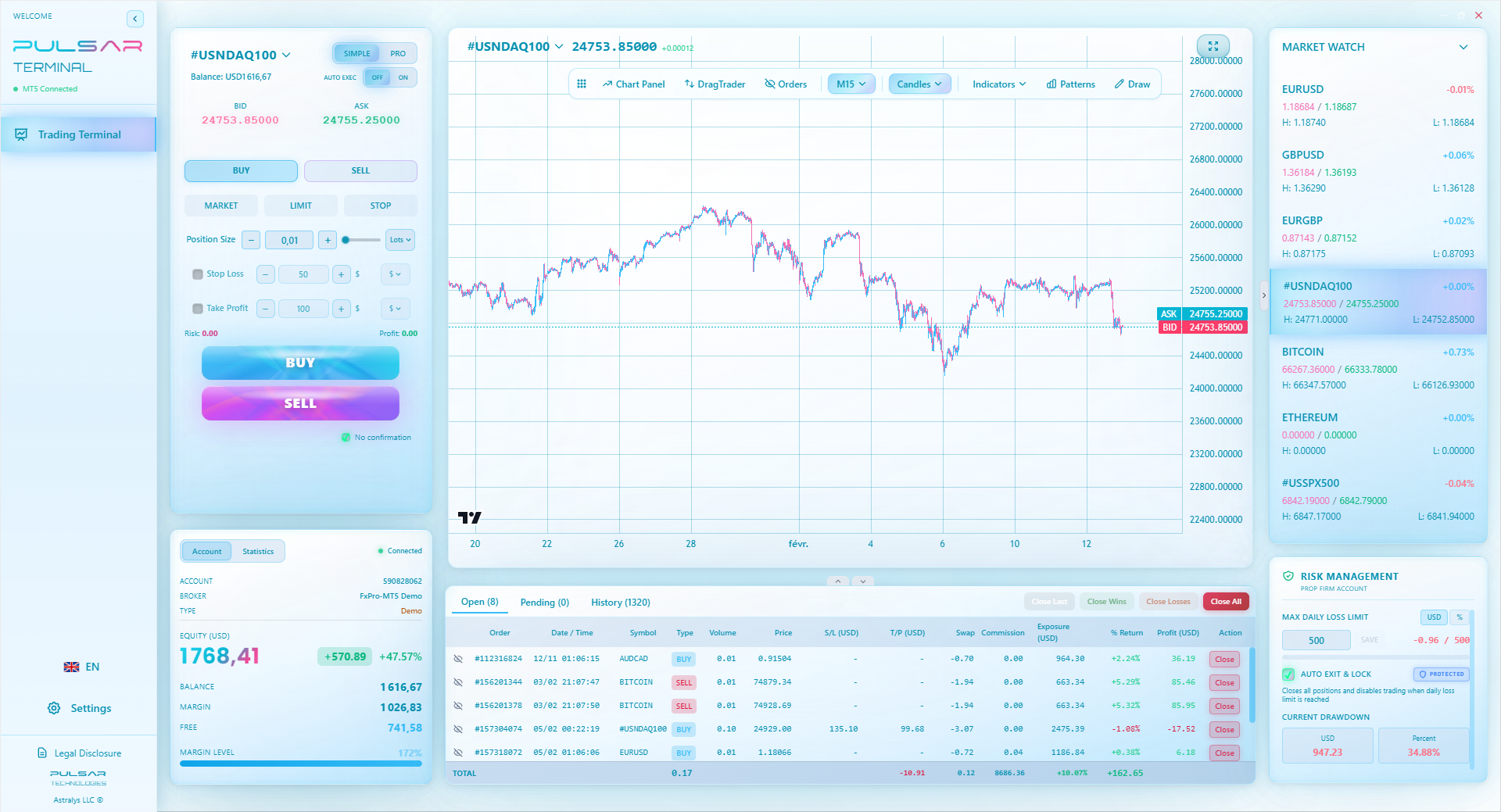
When the big players cause volatile spikes, precise order management is critical, which is where tools like Pulsar Terminal's drag-and-drop orders and multi-TP/SL features become indispensable.
Pulsar Terminal
Lo strumento MT5 tutto-in-uno: ordini drag-and-drop, multi-TP/SL, trailing stop, grid trading, Volume Profile e protezione prop firm. Usato da oltre 1.000 trader ogni giorno.
“The only thing you have 100% control over is your risk per trade. Everything else is a negotiation.”
Knowing who controls the forex market changes everything. It's not about finding a secret indicator. It's about aligning your tiny raft with the direction of the ocean liners.
1. Trade the News, Not the Noise. The only retail 'edge' is knowing when the big players have to act. Central bank meetings, CPI prints, large corporate M&A announcements. These create predictable volatility. Use an economic calendar. I made my worst trades trying to be clever in dead, low-volume Asian sessions. My best trades came from preparing for high-impact news and letting the institutional move carry me.
2. Liquidity is Your Friend. Trade the major pairs (EUR/USD, USD/JPY, GBP/USD) and major crosses. That's where the big players are. Exotic pairs like USD/ZAR or USD/TRY have their moments, but the spreads are wider and the moves can be manipulated by local banks or governments. The spread definition isn't just a cost; it's a signal of who's in control. A widening spread often means the big LPs are stepping back, increasing your risk.
3. Use a Position Size Calculator. Seriously. You have no control over the SNB or the Fed. The only thing you have 100% control over is your risk per trade. If you're trading with 30:1 use (thanks, FSCA), a 3.3% move against you wipes you out. I never risk more than 1% of my capital on a single idea. This single rule has kept me in the game for 12 years after multiple bad streaks.
4. Choose Your Broker Wisely. Your broker is your conduit to these power players. A good FSCA-regulated broker with strong liquidity providers (like XM or others) will give you fair execution. A bad one will slip you, requote you, and stop you out at the worst possible moment. They control your gateway.
💡 Consiglio di Winston
Your trading platform is your periscope into this vast ocean. If it's foggy, slow, or unreliable, you're blind. Invest in good tech. It's the one thing you can actually control.
“A good broker is a clear window to the market. A bad one is a funhouse mirror.”
The final acceptance is that you are a spectator with a betting slip. Your goal isn't to control or even predict every move. Your goal is to recognize who is in control right now and position yourself accordingly.
Is the Fed in a hiking cycle? Then the USD is likely the controlling force. Look for USD longs on weakness. Is there a geopolitical crisis causing a flight to safety? Then the JPY and CHF are in control. Stop trying to buy the dip in a risk-off environment.
Technical analysis works because it maps the collective psychology and order flow of all these players. A key support level holds because banks and funds have buy orders there. The RSI indicator showing overbought conditions might prompt profit-taking from large longs. Use tools like the MACD indicator not for magic signals, but to gauge the momentum being created by the larger forces.
I'll leave you with this. In 2020, when the pandemic hit, the market was controlled by pure, unadulterated panic. The Fed stepped in with infinite QE. That was the shift in control. I stopped all my short-term models. I simply bought USD/JPY (a safe-haven pair that broke down) every time it dipped, believing the Fed's control would overwhelm panic. It was a slow, grinding trade. Not exciting. But it turned a 20% profit over 6 months by just riding the shift in control. Sometimes, the smartest trade is to figure out who's the adult in the room and stand behind them.
FAQ
Q1Does the South African government control the Rand's value?
Not directly. The SARB can influence it through interest rates and occasional intervention, but the ZAR's value is set by global supply and demand. Factors like commodity prices (platinum, gold), the country's credit rating, and global risk sentiment have a far bigger impact than any government policy.
Q2Can retail traders move the forex market?
Individually, absolutely not. Even a million retail traders acting in unison would struggle to move a major pair for more than a few seconds. Retail order flow is aggregated by brokers and is a tiny fraction of daily volume. A single large bank can move more money in one trade than all retail traders in South Africa combined do in a week.
Q3Is forex trading in South Africa a scam if we don't control it?
No, it's not a scam, but it's an extremely difficult competitive environment. It's like opening a spaza shop next to a Makro. You can be profitable if you're smart, niche, and manage risk ruthlessly. The scam element comes from unregulated brokers who manipulate your prices or refuse withdrawals. Stick to FSCA-regulated brokers.
Q4What's the most important thing to watch to see who's in control?
The US Dollar Index (DXY) and bond yields. If the DXY is in a strong uptrend and US Treasury yields are rising, the Fed (and the market's expectation of Fed policy) is in control. Most global capital flows are tied to the USD. If the DXY is flat but gold (XAU/USD) is soaring, then fear or inflation might be the controlling theme.
Q5How do I know if my broker is manipulating my trades?
You can't know for sure, but red flags include: constant requotes on every entry, slippage that always seems to go against you, spreads that widen massively the moment you click buy/sell, and difficulty with withdrawals. A reputable, FSCA-regulated broker makes money from your volume (spreads/commissions), not from you losing. They want you to trade often, not blow up.
Q6With use capped at 30:1, do I have any chance of making real money?
Yes, but it redefines 'real money.' You won't turn R10,000 into R1,000,000 in a year (and if you try, you'll lose it). With good risk management (1-2% risk per trade) and a solid edge, 30:1 is more than enough to generate significant returns over time. It forces you to be a better trader, not a gambler. Focus on consistency, not home runs.
Lezione del Prof. Winston
Punti chiave:
- ✓No single entity controls the $7.5 trillion daily forex market.
- ✓Central banks and major commercial banks are the primary influencers.
- ✓SARB and FSCA control your access, not the global price.
- ✓Trade major pairs where institutional liquidity is highest.
- ✓Always use a position size calculator and risk <=1%.
Quanto è stato utile questo articolo?
Clicca su una stella
Analisi Trading Settimanali
Analisi e strategie settimanali gratuite. Nessuno spam.
Sull'autore
David van der Merwe
Trader dei Mercati Emergenti
Trader con base a Johannesburg con 11 anni di esperienza nelle valute dei mercati emergenti. Specializzato in coppie ZAR, trading regolamentato dalla FSCA e analisi del mercato sudafricano.
Commenti
Avviso di rischio
Il trading di strumenti finanziari comporta rischi significativi e potrebbe non essere adatto a tutti gli investitori. Le performance passate non garantiscono risultati futuri. Questo contenuto è fornito solo a scopo educativo e non deve essere considerato un consiglio di investimento. Conduci sempre le tue ricerche prima di fare trading.
Potrebbe interessarti anche

Cara Trading Forex Sukses: 7 Prinsip dari Trader Profesional
Cara trading forex sukses dengan 7 prinsip trader pro: manajemen modal, disiplin, journal trading, backtest. Data nyata, bukan janji profit palsu.
Jam Trading Forex Terbaik untuk Trader Indonesia: Panduan Lengkap dengan Tabel Waktu
Panduan jam trading forex untuk trader Indonesia. Tabel 4 sesi dunia, jam emas 20:00-00:00, sesi mana yang harus dihindari. Data akurat + tips dari trader berpengalaman.
Top 5 Sàn Forex Uy Tín Nhất 2026: Review Jujur dari Trader Indonesia
Top 5 sàn forex uy tín 2026 untuk trader Indonesia. Review jujur: spread, deposit, withdraw, dukungan lokal. Exness, XM, IC Markets & lebih.
Scarica Pulsar Terminal
Tutti questi calcolatori sono integrati in Pulsar Terminal con dati in tempo reale dal tuo conto MT5.
Scarica Pulsar Terminal