


You're probably wondering if forex trading is worth your time and money.

David van der Merwe
新興市場トレーダー ·  South Africa
☕ 10 分で読める
学べること:
- 1Accessibility: The Double-Edged Sword of Low Capital
- 2ZAR Accounts & Local Rules: Cutting Out the Middleman
- 3Liquidity & The 24/5 Market: Always Open, Always Dangerous
- 4use: The Professional's Tool, The Amateur's Weapon
- 5Diversification: Getting Off the JSE Island
- 6Strategy Flexibility: From Scalping to Swing Trading
- 7The Hidden Cost Advantage (If You're Smart)
- 8The Final Reality Check: It's All About You
You're probably wondering if forex trading is worth your time and money. Everyone talks about the potential, but what are the actual, tangible advantages for someone sitting in Johannesburg, Cape Town, or Durban? I've traded through bull markets, crashes, and everything in between for over a decade. The truth is, the advantages are real, but they're a double-edged sword. Let's cut through the hype and look at what the South African market genuinely offers you, and more importantly, how to not let those very advantages blow up your account.
This is the big one, and it's why forex has exploded here. You can literally start trading with the cost of a decent steak dinner. Brokers like Exness and others let you open accounts with $10 or less. That's roughly R180. Compare that to needing R50,000 for a decent JSE share portfolio or a massive deposit for a property. It feels like a gift.
But here's the brutal truth I learned the hard way: low barrier to entry is the number one reason most new traders fail. It makes trading seem like a game, not a business. When I started, I funded an account with R500, thinking it was 'play money.' I was leveraged to the hilt, took huge positions relative to my balance, and was wiped out in two days on a single USD/ZAR trade. The problem wasn't the market; it was me treating a professional undertaking like a lottery ticket because the entry fee was so low.

Warning: The ability to start small often leads to disastrously large risk-taking. That R180 account with 1:500 use means a R90,000 market exposure. One wrong move and you're not just losing your steak money.
The real advantage isn't that it's cheap. It's that you can practice with real money - tiny, insignificant amounts - to learn the emotional ropes without catastrophic loss. Use a position size calculator religiously, even with that R500. It builds the discipline you'll need when you scale up.

💡 ウィンストンのヒント
Your first R10,000 in the market isn't for making profit. It's tuition. Pay it willingly to learn risk management, and consider any money left over a bonus.
A few years back, you had to convert your rands to dollars, deal with offshore bank fees, and pray the exchange rate didn't move against you before your deposit even hit the broker. Now? It's seamless. Opening a ZAR-denominated account with an FSCA-regulated broker means you deposit and withdraw in rands. Your profit and loss are in rands. It removes a huge layer of friction and hidden cost.
The Financial Sector Conduct Authority (FSCA) oversight is another silent advantage. Knowing your broker has to play by a set of rules designed to protect you, the South African client, matters. It doesn't guarantee you'll win, but it does help ensure you won't get scammed by a bucket shop operation. Always, always check the FSP number on the FSCA's website. I once nearly signed up with a 'broker' offering unbelievable spreads; a five-minute check showed their license was suspended. That check saved me thousands.
This local framework lets you focus on trading, not on forex bureaucracy. Your tax obligations (yes, you have to pay tax on trading profits) are also clearer when everything is in ZAR from the start. It turns a global market into something you can manage from your local context.
“The true advantage of use is for a seasoned trader with a solid risk management system. For a beginner, it's a weapon.”
This is the technical powerhouse behind forex. The daily volume is insane - over $7.5 trillion. For you, this means two things: tight spreads and the ability to get in and out of trades fast. When you're trading a major pair like EUR/USD, the bid-ask spread is often less than a pip. You're not fighting against a illiquid market to fill your order.
The 24/5 Temptation
The market opens Sunday evening and runs until Friday night. You can trade after work, before work, in the middle of the night. I used to think this was pure freedom. Then I burned myself trading the Tokyo session at 3 AM because I saw a setup on the MACD indicator. I was exhausted, my judgment was off, and I misread the volume. The market's constant availability can build an addiction to action. You feel like you should be trading because the screen is moving.

Pro Tip: Your advantage isn't that you can trade 24 hours a day. It's that you can choose the most optimal 3-4 hour window for your strategy and lifestyle. For many focusing on USD/ZAR or EUR/USD, the London/New York overlap (3 PM - 5 PM SAST) is where the real meat of the movement happens.
The high liquidity also means news events get priced in violently and quickly. This is great if you're on the right side, terrifying if you're not. A tool that can help manage this is a platform with strong order types. For instance, setting a multi-level take-profit strategy on a volatile pair like XAU/USD during news lets you bank partial profits automatically as price moves, something advanced tools can help directly on your MT5 platform.
use is often marketed as the ultimate advantage. 'Control R100,000 with just R1,000!' It's seductive. In South Africa, use can go up to 1:500 for major pairs with some brokers. Let's be clear: this is not an advantage for a beginner. It is a professional tool for efficient capital use, and it's the fastest route to a margin call.
Here's a real number from my early days: I put R2,000 into an account. With 1:100 use, I bought 2 standard lots of EUR/USD. That's a R200,000 exposure. A 100-pip move against me (about 1%) would wipe out my entire account. It did. I learned that use amplifies everything: your gains, your losses, and most destructively, your emotions.
The true advantage of use is for a seasoned trader with a solid risk management system. It allows you to put up less capital for a given position size, freeing up capital for other trades or to withstand drawdowns. But you must pair it with microscopic position sizing. If you're using high use, your position should be so small that a 200-pip loss feels like a mosquito bite, not a gunshot wound.
| use | Capital Required for R100k Exposure | What a 100-pip Loss Does |
|---|---|---|
| 1:10 | R10,000 | -R1,000 (-10% of capital) |
| 1:100 | R1,000 | -R1,000 (-100% of capital) |
| 1:500 | R200 | -R1,000 (-500% of capital) |
See the difference? The 'advantage' of 1:500 is irrelevant if your risk management can't handle it.
💡 ウィンストンのヒント
If you can't explain in one sentence what will make you exit a trade before you enter it, you're not trading. You're gambling.
“Your advantage isn't that you *can* trade 24 hours a day. It's that you can *choose* the most optimal 3-4 hour window.”
The South African investment landscape can feel like an island. The JSE is dominated by a handful of big stocks (Naspers, anyone?) and is heavily influenced by local politics and load-shedding. Forex gives you a direct ticket off that island.
You can trade the Japanese Yen based on Bank of Japan policy, the Euro on ECB decisions, or the US Dollar on Fed announcements. Your portfolio's performance is no longer tied solely to the fortunes of South Africa. During periods of intense rand weakness, being long USD/ZAR could have hedged losses in your local equity portfolio.
But diversification for the sake of it is a trap. I once started trading AUD/JPY because it was 'uncorrelated.' I knew nothing about Australian export data or Japanese risk sentiment. I lost money on a trade where the setup was technically okay, but I was blindsided by fundamental news. The advantage isn't just having more pairs to trade; it's having more markets you understand to trade.
Start with pairs that have a logical connection to your world. USD/ZAR is obvious. Then maybe EUR/USD, as it's the world's most liquid pair and drives global sentiment. Build your knowledge outward from there. Don't jump into exotic pairs just because you can.
The forex market's structure supports any trading personality. Are you an adrenaline junkie who needs action? Try scalping the 1-minute chart during high volume. Are you more patient and analytical? Swing trading on the 4-hour or daily charts might be your fit.
This flexibility is a genuine advantage. You're not forced into one style. Early on, I tried to be a scalper because I thought that's what 'real' traders did. My personality is more patient. I'd get stressed, overtrade, and chase losses. My results turned around when I switched to swing trading, holding positions for days or weeks based on higher-timeframe analysis. I could do my analysis on Sunday night, set my orders, and manage them with a few check-ins per day.
The market accommodates both. The key is to match the strategy to your psychology, not the other way around. And whatever your style, precise order execution is non-negotiable. Whether you're setting a tight stop-loss for a scalp or a wide one for a swing trade, being able to place and modify those orders quickly and reliably is where the battle is often won or lost before the trade even starts.
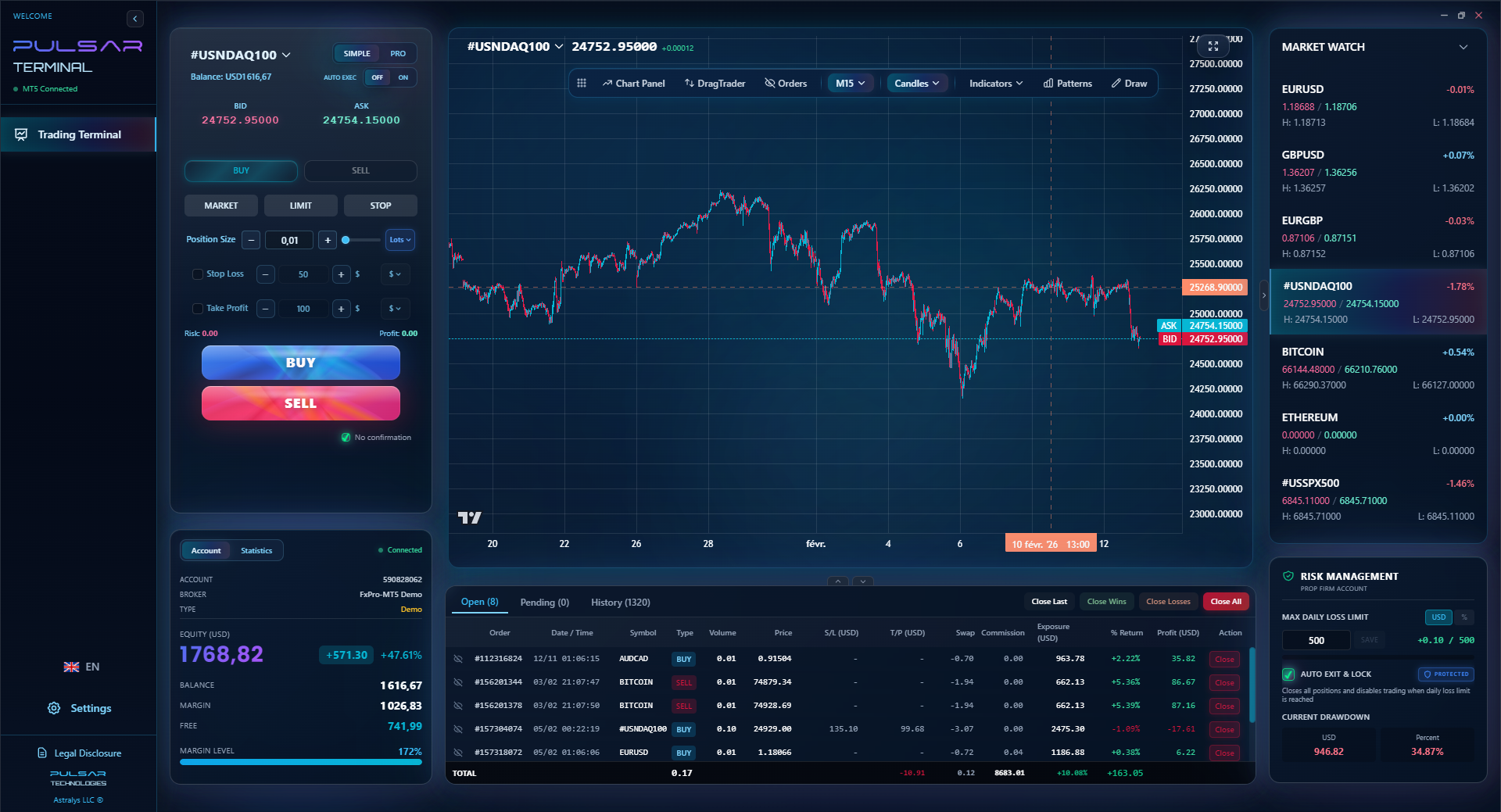
Executing precise multi-level orders for scalping or swing trading is critical, and Pulsar Terminal lets you drag-and-drop them directly onto your MT5 chart.
Pulsar Terminal
MT5オールインワンツール:ドラッグ&ドロップ注文、マルチTP/SL、トレーリングストップ、グリッドトレード、出来高プロファイル、プロップファーム保護。毎日1,000人以上のトレーダーが利用。
“All these advantages are just features of the market. They're neutral. The biggest advantage you have is between your ears.”
People focus on spreads and commissions, and yes, they're low. But the bigger cost advantage is in efficiency. No stamp duty. No brokerage fees on the JSE (though your CFD broker has its spread). No need for a securities account. The entire process from idea to executed trade can take seconds.
This efficiency also applies to learning. An immense amount of free, high-quality educational material exists for forex - more than for any other retail market. You can paper trade for months to test strategies without losing a cent. The cost to become competent is primarily your time and effort, not your capital.
However, this low-cost environment has a dark side: it makes switching strategies too easy. When a strategy has a normal losing streak (and they all do), the low cost of trading tempts you to abandon it and jump to the next shiny indicator. I've probably 'tested' two dozen systems over the years. The cost wasn't in money lost on any single system; it was in the constant restarting, never giving one method enough time to prove itself over hundreds of trades. The advantage of low costs is wasted if it fuels your impatience.
💡 ウィンストンのヒント
The market's 24/5 schedule is a test of your patience, not an invitation to your screen. The most powerful order you'll ever place is 'Do Nothing.'
Look, all these advantages of forex trading - accessibility, liquidity, use, flexibility - they're just features of the market. They're neutral. In the hands of a disciplined, patient, and risk-aware individual, they are powerful tools to build capital. In the hands of an emotional, impatient gambler, they are expertly designed mechanisms for transferring wealth from your pocket to someone else's.
The biggest advantage you have isn't in the market. It's between your ears. It's your ability to follow a plan, to lose money on a good trade and not deviate, to make money on a bad trade and not get arrogant. The South African market gives you a fantastic, regulated, accessible playground. But you still have to learn the rules of the game, and more importantly, the rules of yourself.
I've given you the map. The liquidity, the ZAR accounts, the 24/5 hours - they're all real. But your success depends entirely on how you navigate them. Start small, not just with money, but with ambition. Aim for consistent, boring gains. Protect your capital like it's the last water in the Karoo. That's how you turn these market advantages into a personal one.
FAQ
Q1Is forex trading legal in South Africa?
Yes, absolutely. It's legal and regulated by the Financial Sector Conduct Authority (FSCA). You must trade with an FSCA-licensed broker (they will have an FSP number) to ensure you have legal protection and that the broker adheres to local financial standards.
Q2What is the minimum amount I need to start forex trading in South Africa?
Technically, you can start with as little as $10 (around R180) with some international brokers. However, I strongly advise against this. A more realistic minimum to trade responsibly while practicing proper risk management is at least R5,000 to R10,000. This allows for meaningful position sizing without being wiped out by a single, small loss.
Q3What are the best currency pairs for South African beginners to trade?
Start with USD/ZAR. You understand the fundamentals (SA politics, US Fed policy). Then, move to a major pair with high liquidity and low spreads like EUR/USD. Avoid exotic pairs at the beginning. They have wider spreads and less predictable movements. Our EUR/USD guide breaks down the world's most traded pair.
Q4How does use work, and what's a safe level?
use lets you control a large position with a small deposit. In SA, it can go up to 1:500. 'Safe' depends entirely on your risk management. A beginner should use no more than 1:10 or 1:20. This means to control a R100,000 position, you'd put up R10,000 or R5,000 of your own capital. This gives the trade room to breathe without immediately triggering a margin call.
Q5Do I pay tax on forex trading profits in South Africa?
Yes. SARS views forex trading profits as income if you're seen as a regular trader. You must declare these profits in your annual tax return. Keep careful records of all your trades, deposits, and withdrawals. It's wise to consult with a tax professional familiar with trading income.
Q6Can I trade forex part-time with a full-time job?
Yes, and many successful traders do. The 24/5 market is a key advantage here. You can use a swing trading approach, analyzing the markets in the evening and setting orders that will execute the next day. This avoids the need to watch screens constantly during work hours.
Q7What's the biggest mistake new South African forex traders make?
Using too much use and having no risk management plan. They see the ability to control a huge position with little money and treat it like a casino. They risk 10%, 20%, or even 50% of their account on a single trade. One loss, and their trading journey is over before it began.
ウィンストン教授のレッスン
重要ポイント:
- ✓Treat a R500 account with the same risk rules as a R500,000 account.
- ✓Never risk more than 1-2% of your capital on any single trade.
- ✓Use use as a capital efficiency tool, not a profit multiplier.
- ✓Choose one major pair (like USD/ZAR or EUR/USD) and master it first.
この記事はどれくらい役に立ちましたか?
星をクリックして評価
週刊トレーディングインサイト
無料の週刊分析&戦略。スパムなし。
著者について
David van der Merwe
新興市場トレーダー
ヨハネスブルグ拠点で新興市場通貨11年のトレーダー。ZARペア、FSCA規制下の取引、南アフリカ市場分析を専門とする。
コメント
リスク警告
金融商品の取引には大きなリスクが伴い、すべての投資家に適しているわけではありません。過去の実績は将来の結果を保証するものではありません。本コンテンツは教育目的のみであり、投資助言として解釈すべきではありません。取引前に必ずご自身で調査を行ってください。
こちらもおすすめ

Cara Trading Forex Sukses: 7 Prinsip dari Trader Profesional
Cara trading forex sukses dengan 7 prinsip trader pro: manajemen modal, disiplin, journal trading, backtest. Data nyata, bukan janji profit palsu.
Jam Trading Forex Terbaik untuk Trader Indonesia: Panduan Lengkap dengan Tabel Waktu
Panduan jam trading forex untuk trader Indonesia. Tabel 4 sesi dunia, jam emas 20:00-00:00, sesi mana yang harus dihindari. Data akurat + tips dari trader berpengalaman.
Top 5 Sàn Forex Uy Tín Nhất 2026: Review Jujur dari Trader Indonesia
Top 5 sàn forex uy tín 2026 untuk trader Indonesia. Review jujur: spread, deposit, withdraw, dukungan lokal. Exness, XM, IC Markets & lebih.
