


Let me be brutally honest: if you're an Indian trader looking at those flashy YouTube ads for AI forex trading bots promising passive income from EUR/USD, you're being sold a fantasy that could land you in legal trouble.

Rajesh Sharma
シニアFXアナリスト ·  India
India
☕ 14 分で読める
学べること:
- 1The Legal Reality in India: It's Not What You Think
- 2SEBI's New 2026 Rules: The End of Rogue Bots
- 3Real Costs and Hidden Fees (The Numbers No One Shows)
- 4Building vs. Buying a Bot: A Trader's Perspective
- 5Brokers and Infrastructure: Your Bot's New Home
- 6Practical Strategy Ideas for the Indian Market
- 7My Failures and Hard-Won Lessons
Let me be brutally honest: if you're an Indian trader looking at those flashy YouTube ads for AI forex trading bots promising passive income from EUR/USD, you're being sold a fantasy that could land you in legal trouble. The reality is starkly different. I've seen too many traders lose money and face regulatory headaches chasing this mirage. In this guide, I'll walk you through exactly what's possible with AI trading in India today, what the new 2026 SEBI rules mean for you, and share my own painful lessons from trying to automate trades in this heavily regulated environment.
Here's the uncomfortable truth most 'gurus' won't tell you: trading forex with an AI bot on international pairs like EUR/USD through an offshore broker is illegal for Indian residents. Full stop. The Foreign Exchange Management Act (FEMA) is crystal clear on this. I learned this the hard way back in 2020 when I tried funding an account with a popular international broker. The transaction went through, but the compliance headache that followed from my bank wasn't worth it.
What IS legal? Trading INR-based currency derivatives on Indian exchanges. We're talking USD/INR, EUR/INR, GBP/INR, and JPY/INR futures and options. That's it. Those are your playing fields. This means any AI forex trading bot you use must be designed for these specific pairs and connected to a SEBI-regulated Indian broker like Zerodha or Upstox.

Warning: Using the Liberalised Remittance Scheme (LRS) to send money abroad for forex trading is explicitly prohibited by the RBI. That $250,000 annual limit? It doesn't apply to speculative trading. Trying to use it for that purpose can trigger audits and penalties.
The regulatory landscape just got tighter in April 2026. The RBI banned banks from offering certain rupee derivative contracts to curb speculation. This isn't about stopping trading, it's about controlling volatility and protecting the currency. As a trader, you need to understand these rules aren't obstacles, they're the boundaries of the game.
Why This Matters for Your Bot
If you're coding or buying an AI trading bot, its entire data training set needs to be based on USD/INR price action, not EUR/USD. The volatility patterns, liquidity times (9 AM to 5 PM IST), and fundamental drivers are completely different. A bot trained on GBP/USD data will be useless and dangerous when applied to GBP/INR.

💡 ウィンストンのヒント
Before you write a single line of code, spend a month manually trading USD/INR futures on paper. Note the timing of liquidity, how news impacts price, and where the spreads widen. This 'feel' for the market is the most valuable training data your AI will never have.
April 1, 2026, wasn't a joke for algo traders. SEBI dropped a complete regulatory framework that fundamentally changes how you can deploy an AI forex trading bot. I've read the 50-page circular, and here's what you actually need to know.
First, forget about running your bot from your home computer or some random cloud server. SEBI now mandates that algorithms must be hosted and deployed through your broker's own infrastructure. Your broker becomes the 'principal' and is fully responsible for your bot's actions. This means you can't just download a shady Expert Advisor (EA) from a forum and let it rip. The broker has to vet and approve it first.
Every single order your bot places must carry a unique exchange strategy ID. Think of it as a license plate for every trade. This creates full audit trails. SEBI is particularly wary of 'black box' strategies where the logic isn't transparent. They're pushing for 'white box' models where the decision-making process can be explained. If your AI model is a neural network that even you can't fully interpret, getting approval will be tough.

Pro Tip: When discussing bot strategies with your Indian broker now, focus on transparency. Prepare documentation that explains your AI's logic in simple terms. Backtest reports showing how it handles extreme volatility in USD/INR (which happens during RBI announcements) are crucial for approval.
API access requires static IP whitelisting and two-factor authentication. The days of simple username/password connections are over. This adds security but also complexity for developers. The order speed is capped too, at around 10 orders per second per exchange. For context, that's plenty for most retail strategies, but high-frequency shops are effectively shut out.
These rules exist because SEBI saw what happened in unregulated spaces. Bots blowing up accounts, manipulating illiquid hours, causing flash crashes. This framework is actually good for serious retail traders. It weeds out the garbage and creates a safer environment. Your main job is finding a broker with a strong algo approval and hosting system. Not all of them are equally prepared for this new world.
“The moment you think you can automate your way to laziness is the moment you start losing money.”
Let's talk money. Those ads show a bot making 20% a month with a 'one-time fee of $999'. That's fantasy accounting. Here's the real cost structure for running a legal AI bot in India, based on my own trading journal.
Brokerage & Spreads: This is your biggest ongoing cost. On USD/INR futures, expect brokerage to be around ₹20 per executed order (buy and sell counted separately) with a discount broker. The spread isn't fixed like in the spot forex market. It widens significantly during off-hours (post 5 PM) and around major economic data. I've seen the bid-ask gap balloon from 0.5 points to 5 points in seconds during a volatile RBI policy announcement. Your bot's entry and exit logic must account for this, or you'll get filled at terrible prices.
Infrastructure Costs: Since you must host through your broker, they may charge for this service. Some include it in premium account packages. Others charge a monthly VPS (Virtual Private Server) fee. Expect ₹500 to ₹2000 per month for a reliable, low-latency connection to the exchange servers. Running it on your home internet is no longer an option under the 2026 rules.
Development/Acquisition Cost: Building your own bot? Factor in hundreds of hours of coding, backtesting, and compliance documentation. Buying one? Any vendor selling a 'plug-and-play' AI bot for Indian currency derivatives right now is likely selling snake oil. The market is too niche and regulated. I wasted $1,200 on a 'universal forex EA' in 2023. It couldn't even be configured for the contract specifications of NSE's USD/INR futures. The lot size, tick size, expiry cycle - all wrong.
The Silent Killer: Slippage. In a less liquid market like EUR/INR (compared to EUR/USD), your bot's market orders can suffer serious slippage. A backtest showing a 10-point profit can turn into a 2-point loss in live trading because the liquidity wasn't there at your size. Always test with conservative order fills. Use a position size calculator religiously to ensure your bot's orders aren't too large for the market depth.
Here's a snapshot from my records for one month of running a simple mean-reversion bot on USD/INR:
| Item | Cost | Note |
|---|---|---|
| Brokerage (200 trades) | ₹4,000 | ₹20 per executed order |
| Exchange Transaction Charges | ₹1,150 | 0.002% of turnover |
| SEBI Turnover Fees | ₹575 | 0.001% of turnover |
| GST (on brokerage) | ₹720 | 18% |
| Broker VPS Hosting | ₹1,500 | Monthly fee |
| Total Costs | ₹7,945 | Before any profit/loss |
My bot generated a gross profit of ₹9,800 that month. Net profit? Just ₹1,855. The costs ate nearly 80% of the gross. This is the reality automated traders face. High frequency doesn't work with these fees. Your strategy needs wide enough profit targets to absorb them.
Should you code your own AI forex trading bot or buy one? After 12 years, my answer is unequivocal: if you have to ask, you should probably do neither. But let's break down the paths.
Building Your Own: This is the professional's route, but it's a massive undertaking. You need:
- Solid programming skills (Python with libraries like TensorFlow/PyTorch, or MQL5 for MT5).
- Deep understanding of the specific Indian currency derivatives market.
- Years of historical tick data for USD/INR futures (which isn't free or easy to get).
- Patience for the SEBI approval process.
I built my first bot in 2019. It was a simple system using the MACD indicator and a volatility filter. The coding took a month. The backtesting and optimization took three. Getting it to run reliably on my broker's demo system took another two. The total development time was six months for a relatively simple system. The advantage? I understood every line of code. When it lost money, I could diagnose why and improve it.
Buying a Bot: The market is 99% scams. The bots are usually over-optimized curve-fitted systems that worked perfectly on past EUR/USD data but have no relevance to USD/INR. Sellers use impressive jargon like 'neural network' and 'deep learning' to hide the fact that the strategy is garbage.
I made the mistake of purchasing a 'grid trading' bot in 2021. The sales page showed amazing equity curves. What it didn't show was that the strategy required holding 20-30 simultaneous positions, demanding huge margin. In a trending move in USD/INR (which happens often due to RBI intervention), the drawdown was catastrophic. I hit a margin call and lost 60% of the allocated capital in one week. The vendor's response? 'You didn't use the right settings.'
Warning: Any vendor who guarantees profits or shows backtest results without detailing maximum drawdown, Sharpe ratio, and profit factor is lying. For the Indian market, insist on seeing results specifically for USD/INR futures with all transaction costs included. If they can't provide that, walk away.
There's a middle path: using a platform that allows you to create bots visually, like some MT5 plugins. These let you define rules (IF RSI < 30 AND price above 200 MA, THEN BUY) without coding. They're limited but safer for beginners. Just remember, the strategy logic still has to be yours. A tool is only as good as the trader using it.
💡 ウィンストンのヒント
When backtesting, the most important number isn't total profit. It's the maximum consecutive losses and the largest peak-to-trough drawdown. If your bot can't survive a 5-loss streak with your chosen position size, it will fail in live trading.
“A bot trained on GBP/USD data will be useless and dangerous when applied to GBP/INR.”
Your choice of broker is now the most critical decision for automated trading. Under the 2026 rules, they're your gatekeeper, host, and compliance officer all in one.
SEBI-Regulated Indian Brokers: This is your only legal avenue for trading INR pairs. Brokers like Zerodha, Angel One, and ICICI Direct offer API access (often called 'algo trading' APIs) that connect to their systems. However, their support for complex AI models varies wildly. Some offer Python libraries, others only support their proprietary scripting languages. You need to dig into their developer documentation before committing.
Key questions to ask your broker:
- What is your algo strategy approval process and timeline?
- Do you provide historical tick data for backtesting?
- What are the specifications of your hosting VPS (CPU, RAM, latency to exchange)?
- What are the fees for API access and order placement?
- How do you handle connection drops or order failures?
The International Broker Grey Zone: Many international brokers like XM or IC Markets still accept Indian clients and offer powerful platforms like MT5 for bot development. Here's my frank take: using them to trade EUR/USD with a bot is illegal under FEMA. However, some traders use them for learning, developing, and backtesting strategies in a global market context. They might use a small demo account for this purpose. I'm not recommending this, but I'm acknowledging it happens. The risks are legal and financial. If the broker is on the RBI's alert list, your funds have zero protection.
Infrastructure is Key: Low latency is less critical for retail bots in India than reliability. A bot that misses a signal is better than a bot that places duplicate orders due to a glitch. Ensure your hosting has redundant power and internet connections. My system once crashed during a US NFP data release because the VPS provider had a network issue. I missed a great setup on USD/INR. Now I pay for a premium VPS with 99.9% uptime guarantee. It's worth every rupee.
Payment methods like UPI and NetBanking make funding Indian broker accounts seamless. Funding international accounts, however, involves high gateway fees (PayPal charges ~4.4% + forex spread) and compliance flags. It's a costly and risky hassle.
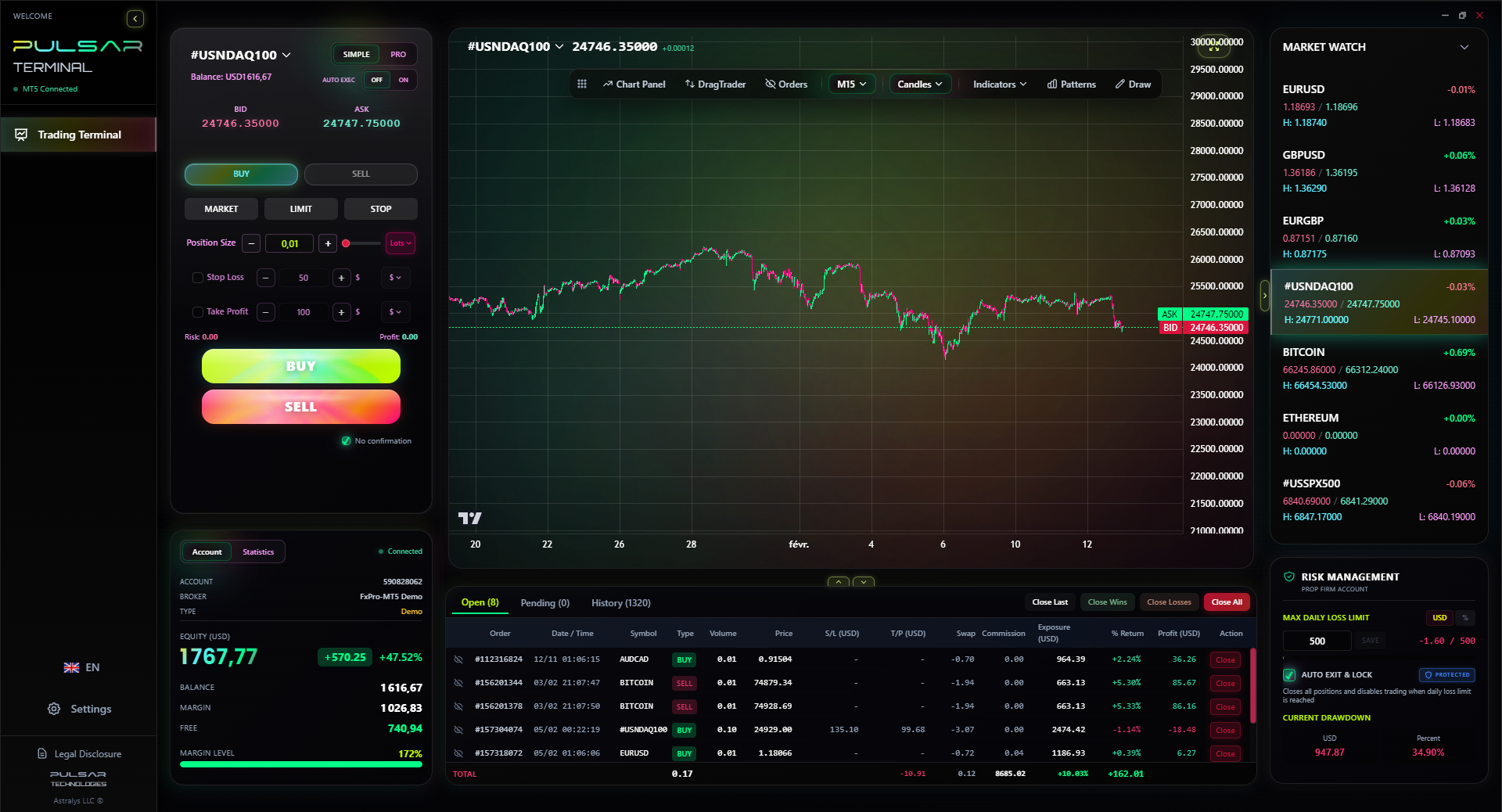
Managing multiple bot orders and complex risk parameters is where tools like Pulsar Terminal excel, letting you set automated trailing stops and breakeven levels directly on MT5 to protect your capital.
Pulsar Terminal
MT5オールインワンツール:ドラッグ&ドロップ注文、マルチTP/SL、トレーリングストップ、グリッドトレード、出来高プロファイル、プロップファーム保護。毎日1,000人以上のトレーダーが利用。
Forget copying strategies from YouTube videos about the London breakout. The Indian currency market has its own rhythm. Here are a few concepts that have worked in my automated systems, tailored to local conditions.
1. The RBI Policy Drift: The most predictable volatility in USD/INR happens around RBI monetary policy announcements (every two months). The market often forms a tight range in the 30 minutes before the announcement. A simple bot can place a buy order 20 points above this range and a sell order 20 points below, with a tight stop. The 'drift' after the news typically triggers one of these orders. The key is to exit within 15 minutes, as the direction often reverses. This is a form of scalping strategy.
2. USD/INR Carry Trade Simulation: While direct carry trades are complex, the price action often reflects this flow. When the US Fed is hiking rates and RBI is holding, USD/INR has a bullish bias. A bot can be programmed to favor long positions during these macroeconomic regimes, using a slower trend-following indicator like a 50-period moving average on the 4-hour chart. I combined this with the RSI indicator for entry timing. It's a form of swing trading.
3. The End-of-Day Squeeze: Indian corporate hedging activity often peaks at the end of the trading day (4:30-5:00 PM). This can cause exaggerated moves. A mean-reversion bot can look for extreme moves in the last hour that push price far from its daily volume-weighted average price (VWAP) and take a counter-trade, expecting a pullback before the session close.
Crucial Adjustment: All these strategies must include a 'liquidity check'. If the market depth on the buy or sell side is thin (common in EUR/INR), the bot should reduce position size or skip the trade altogether. Greedy position sizing is the fastest way to blow up an automated account.

Example: Let's say your bot's standard size is 10 lots of USD/INR (each lot is $1000). If the best 5 price levels on the order book only show total depth for 50 lots, entering with 10 lots is too aggressive. Your bot should scale down to maybe 2 or 3 lots to minimize market impact and slippage. This logic is non-negotiable for Indian markets.
💡 ウィンストンのヒント
Build a 'circuit breaker' into your bot's code. A simple rule that shuts down all trading if the account loses more than 5% in a single day or 10% in a week. No strategy, no matter how clever, is worth a margin call.
“Simplicity beats complexity. A strong set of simple rules often outperforms a brittle 'black box' AI.”
I want to end with vulnerability, because that's where the real learning is. I've lost real money with bots. Here are two expensive lessons.
Failure #1: The Overfit Monster (2022) I spent months building a complex LSTM (Long Short-Term Memory) neural network model. I fed it 5 years of USD/INR tick data. The backtest was a thing of beauty: 45% annual return with a smooth equity curve. I was convinced I'd built a money printer.
I deployed it with $5,000. The first month, it made $300. I was ecstatic. The second month, it lost $1,200. The model had perfectly learned the patterns of the past, including specific RBI intervention behaviors that were no longer relevant. The central bank had subtly changed its approach, and my AI couldn't adapt. It kept expecting reversals at certain levels that never came. I shut it down after a 25% drawdown. The lesson? Simplicity beats complexity. A strong set of simple rules that adapts to changing volatility often outperforms a brittle 'black box' AI. Now, I use AI more for market regime classification (is this a trending or ranging day?) rather than for direct trade signals.
Failure #2: Ignoring the Clock (2021) I built a bot designed to trade the 'Asian session' volatility in USD/INR. It worked well for months. Then, India shifted to Daylight Saving Time? No, but the US did. My bot's internal clock was set to GMT+5:30 (IST). The US shift changed the relative timing of the London open and key US data releases in IST. For a week, my bot was trading an hour 'off', missing its key windows and taking trades during dead periods. It generated a string of small losses. The fix was simple: make the bot source its time from the broker server, not my local machine. The lesson? Every assumption must be questioned. Time, holidays, contract rollovers, margin changes. Your bot must be aware of the real-world calendar, not just the price chart.
The biggest lesson overall? An AI forex trading bot isn't a 'set and forget' solution. It's a tool that requires more monitoring, more tweaking, and more understanding than manual trading. The moment you think you can automate your way to laziness is the moment you start losing money.
FAQ
Q1Can I legally use a forex trading bot from a company like Forex Fury or Forex Diamond in India?
Not for trading. These bots are designed for international forex pairs (like EUR/USD) on platforms like MT4/MT5. Using them would require an account with an offshore broker, which is illegal for speculative trading under FEMA. Even if you tried to adapt their logic to USD/INR on an Indian broker, the strategies are unlikely to work because they're built for different market dynamics and liquidity conditions.
Q2What's the minimum capital needed to start with an AI trading bot in India?
Realistically, you need at least ₹50,000 to ₹1,00,000. This isn't for the bot cost, but for trading capital. With smaller amounts, transaction costs (brokerage, taxes) will eat all your profits. For example, on a ₹25,000 account, a single ₹20 brokerage charge is 0.08% of your capital. If you make 10 trades a day, that's 0.8% gone just in fees. Your bot needs room to breathe and withstand drawdowns.
Q3Do I need to be a programmer to use an AI forex bot?
For a legal, customized bot in India, yes, you likely do. The off-the-shelf bot market for Indian currency derivatives is virtually non-existent due to the niche and regulated nature of the market. You'll either need to learn to code (Python is the standard) or hire a developer who understands both trading and SEBI's compliance requirements. Visual strategy builders exist but are limited.
Q4How does SEBI's 10 orders per second limit affect retail bots?
It doesn't, really. That's an extremely high frequency for a retail trader. If your bot is placing more than 10 orders in a second, you're either a high-frequency trading firm or your bot is malfunctioning. Most retail strategies might place 10-20 orders in an entire day. This limit is aimed at institutional players, not you.
Q5Can I trade gold (XAU/USD) with a bot from India?
No. Trading international commodities like spot gold (XAU/USD) through an offshore broker falls under the same FEMA restrictions as forex. It's not permitted for speculative purposes. You can trade gold futures (like GOLD1! on MCX) on Indian exchanges, and you could theoretically build a bot for that, but it's a different asset class with its own complexities. Check out our separate guide on XAU/USD for more on gold trading dynamics.
Q6Is MetaTrader 5 (MT5) still useful for Indian algo traders?
Yes, but with a big caveat. MT5 is an excellent platform for developing, backtesting, and optimizing trading robots using MQL5. You can use it for all that research. However, to trade live on Indian exchanges, your final, approved algorithm must run through your SEBI broker's infrastructure. You may not be able to directly connect your MT5 EA to their servers. Many developers use MT5 to create the logic, then port the core strategy to the broker's API.
ウィンストン教授のレッスン
重要ポイント:
- ✓Legal trading is confined to 4 INR pairs on Indian exchanges.
- ✓SEBI's 2026 rules mandate broker-hosted, approved algorithms.
- ✓Transaction costs can consume 80% of gross bot profits.
- ✓Market depth and liquidity checks are non-negotiable in Indian markets.
この記事はどれくらい役に立ちましたか?
星をクリックして評価
週刊トレーディングインサイト
無料の週刊分析&戦略。スパムなし。
著者について
Rajesh Sharma
シニアFXアナリスト
インド・南アジア市場で10年以上のトレード経験。NSEの通貨デリバティブからキャリアをスタートし、国際FXへ転向。USD/INRと新興国通貨ペアを専門とする。
コメント
リスク警告
金融商品の取引には大きなリスクが伴い、すべての投資家に適しているわけではありません。過去の実績は将来の結果を保証するものではありません。本コンテンツは教育目的のみであり、投資助言として解釈すべきではありません。取引前に必ずご自身で調査を行ってください。
こちらもおすすめ

Cara Trading Forex Sukses: 7 Prinsip dari Trader Profesional
Cara trading forex sukses dengan 7 prinsip trader pro: manajemen modal, disiplin, journal trading, backtest. Data nyata, bukan janji profit palsu.
Jam Trading Forex Terbaik untuk Trader Indonesia: Panduan Lengkap dengan Tabel Waktu
Panduan jam trading forex untuk trader Indonesia. Tabel 4 sesi dunia, jam emas 20:00-00:00, sesi mana yang harus dihindari. Data akurat + tips dari trader berpengalaman.
Top 5 Sàn Forex Uy Tín Nhất 2026: Review Jujur dari Trader Indonesia
Top 5 sàn forex uy tín 2026 untuk trader Indonesia. Review jujur: spread, deposit, withdraw, dukungan lokal. Exness, XM, IC Markets & lebih.
