


I was staring at my phone in late 2024, watching a signal from a popular app tell me to buy EUR/USD at 1.0850.

David van der Merwe
新興市場トレーダー ·  South Africa
☕ 12 分で読める
学べること:
I was staring at my phone in late 2024, watching a signal from a popular app tell me to buy EUR/USD at 1.0850. The logic seemed solid, the chart looked good. I took the trade. Two hours later, a surprise Fed comment sent the pair tumbling 80 pips, and my stop-loss was a distant memory. That R1,200 loss wasn't the app's fault. It was mine, for thinking a signal was a shortcut to skill. In South Africa, the market for forex signal apps is booming, but so is the number of traders blowing up their accounts while using them. This guide isn't just a list of apps. It's a risk manager's breakdown of how to use them, the critical FSCA rules you must know, and the hard truth about why they're rarely the solution you're looking for.
At their core, forex signal apps are notification services. They send you trade suggestions - usually an instrument, direction (buy/sell), entry price, stop-loss, and take-profit levels. They come in a few flavors.
Some are fully automated, using algorithms to scan the markets. Others are 'curated' by a human trader who shares their planned moves. The most common format you'll see is a Telegram channel or a dedicated mobile app pushing out alerts.
The promise is seductive, especially for a new trader: "Follow the experts and profit." I get it. When I started, I was overwhelmed. The idea of having a pro tell me exactly where to click was incredibly appealing. But here's the first reality check. A signal is just a piece of information. It has zero connection to your account size, your risk tolerance, or your psychology. Blindly following it is like letting a stranger decide how fast you should drive your car on a wet road.

Warning: In South Africa, providing these signals for a fee is now a regulated activity. If you're paying someone, they need an FSP license from the FSCA. More on that later, but it's the first filter you should apply.
These apps don't trade for you. They don't manage your position. They fire the starting pistol and then walk away. Your job - the hard part - begins the moment you get the alert. You have to decide on your position size calculator, place the order, and then sit with the emotional rollercoaster of the trade. That's where 90% of failures happen.
“The promise of a signal app is seductive, especially for a new trader: 'Follow the experts and profit.' I get it. When I started, I was overwhelmed.”
This is the most important section for any South African trader. Our regulatory environment changed decisively in 2024/2025, and ignoring this will cost you more than just pips.
The License is Non-Negotiable
The Financial Sector Conduct Authority (FSCA) made it crystal clear: selling forex trading signals is a financial service under the FAIS Act. That means anyone offering signals for payment must hold a Financial Services Provider (FSP) license. It's not a suggestion; it's the law.
Why does this matter to you? An unlicensed provider operates in the shadows. There's no oversight, no guarantee of their claimed track record, and no recourse for you if things go south. You're handing your trading plan to someone who isn't accountable to any authority.
The Kabelo Mogale Precedent
In October 2024, the FSCA didn't just issue a warning. They fined Kabelo Emanuel Mogale over R1 million and debarred him for ten years for providing unlicensed signals. This was a landmark action. It sent a message that this space is being watched. When you're evaluating an app or service, your first question should be: "What is your FSP number?" If they can't or won't provide it, walk away immediately. That R1 million fine is a price they paid for operating illegally; you don't want to be the customer who pays the price in lost capital.
What This Means for Your Broker Choice
This regulatory mindset extends to brokers. FSCA-licensed brokers (like those we review, such as Exness or IC Markets) must adhere to strict rules: client funds are segregated, use is capped at 30:1 for retail clients, and they must maintain financial soundness. Using a regulated broker is your second layer of defense. If a signal app recommends you use an offshore, unregulated broker to get higher use, see that as a massive red flag. They're guiding you into a less protected environment.

💡 ウィンストンのヒント
A signal is a hypothesis, not a command. Your job is to stress-test it against the chart and your rules before risking a cent.
“A signal is just a piece of information. It has zero connection to your account size, your risk tolerance, or your psychology.”
Everyone claims an 80%+ win rate. It's the industry's favourite marketing line. Your job is to be a sceptic. Here’s how I break them down.
Demand Real, Verifiable Track Records
A screenshot of a MetaTrader terminal showing profits is meaningless. It can be doctored, from a demo account, or just a lucky streak. You need a long-term, auditable record. Some services use third-party platforms like Myfxbook or FX Blue to auto-publish their live trading results. This is a good sign. Look for at least 12-18 months of consistent history. Check the drawdown - the peak-to-trough decline. A service might have a 70% win rate but a 40% drawdown. That means you could have watched nearly half your account vanish while following them. Could you stomach that?
I made this mistake early on. I subscribed to a service boasting a 90% win rate on scalping strategy signals. For two weeks, it was magic. Small, consistent wins. Then came one losing day that wiped out the profits of the previous ten. Their win rate was high, but their risk-to-reward was terrible. They were risking R150 to make R50. You can be right most of the time and still go broke.
Understand Their Strategy
What’s their edge? Do they trade news, pure price action, or indicators like the RSI indicator or MACD indicator? A provider that can articulate a clear, logical strategy is more trustworthy than one that just says "trust me." If their signals are all over the place - a XAU/USD guide scalp one minute, a multi-day EUR/USD guide swing the next - it suggests a lack of discipline.
The Cost Breakdown
Here’s what you’re really looking at, based on recent data:
| Provider | Cost (Approx.) | What You Get |
|---|---|---|
| Learn2Trade | R~650/month | Premium signals, claimed 79% win rate. |
| FXLeaders | R~740/month | Premium plan signals. |
| Signal Start | R~460/month + extra fees | Platform access, but you pay more to copy specific traders. |

Example: Paying R650 per month means you need to make at least that much from the signals just to break even on the subscription. If your account is R10,000, that's a 6.5% monthly hurdle before you even start making personal profit. It forces you to take more risk.
Ask yourself: Is the cost a fixed fee, or do they take a performance fee? A performance fee can align incentives, but it also might encourage them to take riskier trades to generate those fees.
“Everyone claims an 80%+ win rate. It's the industry's favourite marketing line. Your job is to be a sceptic.”
Let's apply the above criteria to some well-known names. Remember, this is an analysis, not a recommendation. Your due diligence is key.
Learn2Trade: They've been around a while and operate a popular Telegram channel. They offer a free tier (3 signals/week) which is a decent way to test their style without paying. Their premium claim of a 79% win rate is typical industry speak. They do provide clear entry/exit/stop levels. The big question mark for South Africans: are they FSCA licensed for providing this paid service? That's the first query you must resolve.
FXLeaders: Another established player with a broad range of signals across forex, indices, and commodities. User-reported accuracy is wide (70-90%), which tells you results vary wildly. They also offer educational content, which is a plus. Again, the licensing question is paramount for their paid premium plan.
Signal Start: This is more of a hybrid platform. You pay a base fee for access, and then you can choose to automatically copy specific signal providers within their environment, each with their own additional fee. It's like a marketplace for signals. The potential benefit is choice and some level of provider vetting by the platform. The downside is complexity and layered costs. It also places the execution burden on you or your broker's copy-trading system.
Direct Forex Signals / FxPremiere: These are examples of the many dedicated signal providers. They claim high win rates (89%+). The critical step here is extreme diligence. The October 2024 FSCA action proves that slick websites and big claims are not enough. An FSP license is your only starting point for trust.

Pro Tip: Before paying a single rand, use their free trial or follow their free signals on a demo account for a full month. Track every signal carefully - entry, exit, spread definition cost, the lot. See if their real-world results match the hype, and see if their trading style fits your life. A swing trading signal that requires holding for days is useless if you're prone to panic-closing positions overnight.
💡 ウィンストンのヒント
The monthly fee for a signal service is your first loss. If you can't afford to lose that amount without it hurting, you can't afford the service.
“Everyone claims an 80%+ win rate. It's the industry's favourite marketing line. Your job is to be a sceptic.”
This is where I see most traders, especially in South Africa's volatile market with loadshedding and rand swings, get destroyed. The signal is the easy part. Your reaction to it is the minefield.
The Disempowerment Effect
Relying on signals stops you from learning. You become a passive order-placer. When the signal wins, you credit the guru. When it loses, you blame them. You never develop your own market understanding or conviction. I've been there. After months of following signals, I realized I knew less about the markets than when I started. I had outsourced my thinking. When I finally decided to trade my own plan, I was terrified and unprepared.
The Execution Gap
A signal hits your phone. The market is moving fast. Do you enter at the exact price? What if the spread definition has widened? What if your internet buffers for a second? That perfect entry is often a fantasy. Slippage on entries and exits can turn a theoretically profitable signal into a loser. Most signal providers show their "ideal" entry on a closed candle. Getting that price in real time is a different game.
The Portfolio Mismatch
Signals are one-size-fits-all. They don't know you have R15,000 in your account with Pepperstone review and a margin call level you're terrified of hitting. They suggest a 50-pip stop loss on GBP/JPY. Is that 0.5% of your account or 5%? You have to figure that out. Using a position size calculator religiously is non-negotiable here. I once followed a gold signal that required a R2000 risk per trade. It was a standard size for the service, but it was 4% of my account at the time. I lost three in a row. A 12% drawdown from three signals left me shell-shocked and broke my confidence for months.
The Dependency Cycle
The worst outcome is psychological dependency. You start to believe you can't trade without the signals. This locks you into a permanent monthly cost and stunts any growth as a trader. The goal should be to use signals as a training wheel, not a permanent crutch.
“The worst outcome is psychological dependency. You start to believe you can't trade without the signals.”
If you're going to use signals, here's a framework to do it without surrendering your account's fate.
1. The Analyst, Not The Executor: Don't follow the signal blindly. When you get an alert, open your chart. Why are they suggesting this trade? Can you see the support level, the overbought RSI indicator, the breakout they're talking about? Use the signal as a prompt for your own analysis. If you can't see the logic, skip it. This turns a passive alert into an active learning session.
2. The Demo-Only Onramp: Never, ever use a new signal service with real money for the first 2-3 months. Run it side-by-side on a demo account. Log the results. Compare them to the provider's claims. This is the only way to strip away the marketing.
3. Risk Management is Your Job: The signal gives you direction and levels. You determine the position size. Always, always calculate your risk per trade as a percentage of your capital (I never risk more than 1% on any single idea, signal or not). This is the single most important thing you do.
4. Use Them for Confluence: Have your own trading view? Maybe you think EUR/USD is bullish. If a respected signal service then issues a buy signal on the same pair, that's confluence. It adds weight to your own thesis. This is a powerful way to use signals - as a secondary opinion to boost your confidence in your own work, not as a primary source.
5. Plan Your Exit Strategy: Know what you'll do if the trade goes wrong. Will you move your stop to breakeven after a certain point? Will you trail it? These decisions need to be yours, made before you enter, not in the heat of the moment. Automating this part is where technology truly helps.
💡 ウィンストンのヒント
Spend one hour learning position sizing for every minute you spend browsing for signals. It will save you more money.
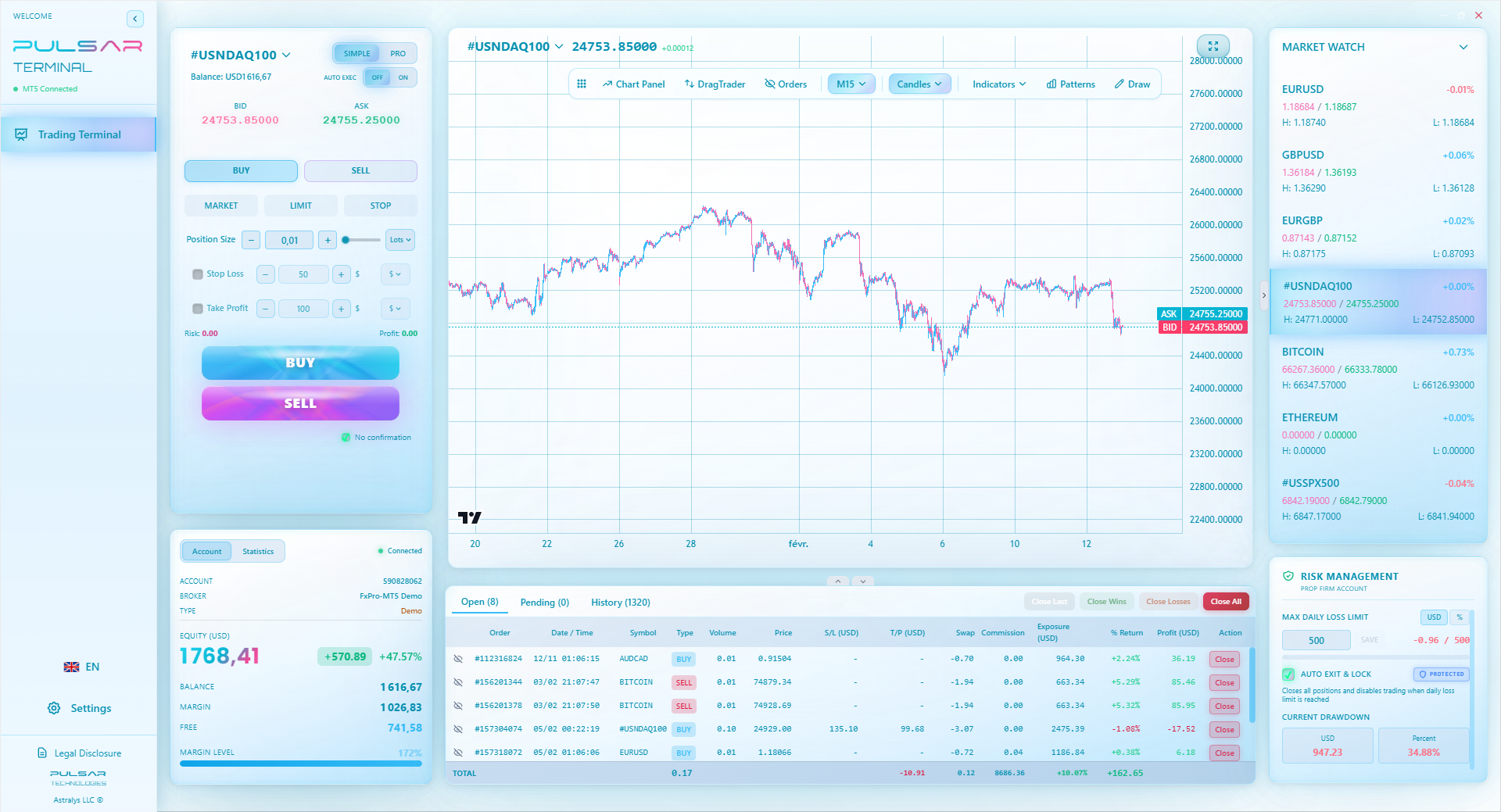
Managing the trades from your own analysis or a signal requires precise tools for stop-losses, take-profits, and risk, which is where a terminal like Pulsar excels on MT5.
Pulsar Terminal
MT5オールインワンツール:ドラッグ&ドロップ注文、マルチTP/SL、トレーリングストップ、グリッドトレード、出来高プロファイル、プロップファーム保護。毎日1,000人以上のトレーダーが利用。
“The market doesn't care who gave you the idea. It only reacts to the orders in the book.”
Let's be frank. The best app for forex signals is the one you use temporarily on the path to not needing any app at all. Your long-term goal should be self-sufficiency.
That starts with education - not just about indicators, but about market structure, macroeconomics, and, most crucially, yourself. Why did you close that winning trade early? Why did you double down on that loser? A journal is more valuable than a thousand signals.
Develop a simple, repeatable process. It could be as straightforward as: "I only trade EUR/USD guide and XAU/USD guide during the London-New York overlap. I look for a bounce off the 200-period moving average with RSI confirmation. I risk 1% per trade." That's a process. It's boring. It's limited. But it's yours. You can backtest it, refine it, and execute it with conviction.
Tools like advanced trading terminals can help you manage the trades you take from your own analysis far more effectively than any signal app can. They let you focus on the strategy, not the mechanics of order placement.
The market doesn't care who gave you the idea. It only reacts to the orders in the book. When the trade is on the line, and the screen is flashing red, the only thing that will keep you in or get you out is your own understanding and discipline. No signal app can give you that. You have to build it, one trade, one lesson, one survived drawdown at a time. That's the real work of trading, and there's no app that can do it for you.
FAQ
Q1Are forex signal apps legal in South Africa?
Using them is legal for you, the trader. However, since 2024/2025, it is illegal for any person or company to PROVIDE forex trading signals for a fee in South Africa without holding a Financial Services Provider (FSP) license from the FSCA. Always ask for and verify their FSP number before paying.
Q2What is the best free forex signal app?
Many services like Learn2Trade offer a free tier with limited signals. The 'best' is subjective. Use the free tier to test their style on a demo account. Remember, 'free' often means they are marketing their paid service, and the best signals may be reserved for paying subscribers.
Q3Can I get rich using forex signals?
Almost certainly not. Signal apps address only one small part of trading (entry ideas). They ignore position sizing, risk management, trade execution, and, most importantly, your trading psychology. Most traders lose money not because of bad entries, but because of poor risk management and emotional decisions - areas signals don't help with.
Q4How much do forex signal apps cost in ZAR?
Costs vary. Expect to pay between R450 to R750+ per month for premium services from international providers. Some platforms have additional fees for copying specific traders. Factor this cost into your trading profits; it's a monthly overhead you need to cover.
Q5What's more important, the win rate or the risk-reward ratio?
The risk-reward ratio is almost always more important. A service with a 50% win rate but a 1:2 risk-reward (risking R50 to make R100) can be very profitable. A service with an 80% win rate but a 1:0.5 risk-reward (risking R100 to make R50) can lose money over time. Always look at both metrics together.
Q6Should I use a signal app with a prop firm challenge?
This is extremely risky. Prop firm challenges (like those from FTMO, The5ers) have strict drawdown and daily loss limits. A string of losing signals from an app can blow your challenge in a day. If you use signals here, you must adjust the position size to be much smaller than the signal provider suggests to protect against their potential drawdown.
ウィンストン教授のレッスン
重要ポイント:
- ✓FSCA licensing is non-negotiable for paid providers.
- ✓Win rate is meaningless without seeing the risk-reward ratio.
- ✓Always test signals on demo for 2-3 months first.
- ✓You must control position size, not the signal provider.
- ✓Signals stunt growth if used as a permanent crutch.
この記事はどれくらい役に立ちましたか?
星をクリックして評価
週刊トレーディングインサイト
無料の週刊分析&戦略。スパムなし。
著者について
David van der Merwe
新興市場トレーダー
ヨハネスブルグ拠点で新興市場通貨11年のトレーダー。ZARペア、FSCA規制下の取引、南アフリカ市場分析を専門とする。
コメント
リスク警告
金融商品の取引には大きなリスクが伴い、すべての投資家に適しているわけではありません。過去の実績は将来の結果を保証するものではありません。本コンテンツは教育目的のみであり、投資助言として解釈すべきではありません。取引前に必ずご自身で調査を行ってください。
こちらもおすすめ

Cara Trading Forex Sukses: 7 Prinsip dari Trader Profesional
Cara trading forex sukses dengan 7 prinsip trader pro: manajemen modal, disiplin, journal trading, backtest. Data nyata, bukan janji profit palsu.
Jam Trading Forex Terbaik untuk Trader Indonesia: Panduan Lengkap dengan Tabel Waktu
Panduan jam trading forex untuk trader Indonesia. Tabel 4 sesi dunia, jam emas 20:00-00:00, sesi mana yang harus dihindari. Data akurat + tips dari trader berpengalaman.
Top 5 Sàn Forex Uy Tín Nhất 2026: Review Jujur dari Trader Indonesia
Top 5 sàn forex uy tín 2026 untuk trader Indonesia. Review jujur: spread, deposit, withdraw, dukungan lokal. Exness, XM, IC Markets & lebih.
