


It was October 2022, and the USD/BDT rate was screaming.

Daniel Harrington
コンテンツ責任者
☕ 9 分で読める
学べること:
It was October 2022, and the USD/BDT rate was screaming. The interbank rate had just crossed 110, and my phone wouldn't stop buzzing with messages from other traders. Everyone was trying to figure out how to get a piece of the action, scrambling to find a broker that would work from Dhaka or Chittagong. That frenzy, more than any chart, taught me the first brutal lesson about finding the best forex broker in Asia: if you don't understand the rules you're playing under, you're just donating your capital. Let's cut through the marketing and talk about what actually matters when you're trading from Bangladesh.
Before you even look at a broker's spreads, you need to look at your local laws. I'm not a lawyer, and this isn't legal advice, but I can tell you what I've seen. The Bangladesh Bank has historically maintained strict controls on foreign exchange. Trading international forex pairs with a retail broker often involves moving money across borders, which immediately puts you in a regulatory grey area that's more important than any broker feature.
I learned this the hard way in 2019. I funded an account with a popular European broker using a remittance method. The trade went fine (I lost, predictably), but withdrawing my remaining $500 was a two-month nightmare of paperwork and explanations. The broker wasn't the problem; the financial channel was. Your first job isn't finding the best forex broker in Asia, it's understanding what's permissible for you. Ignoring this is the fastest way to see your funds frozen.

Warning: Using personal travel quotas or misrepresenting transactions for trading purposes can lead to serious legal and financial consequences. Always prioritize compliance with local Bangladeshi regulations over finding slightly lower spreads.

💡 ウィンストンのヒント
A broker's withdrawal policy is their true review. A smooth, fast withdrawal process tells you everything about their operational integrity and respect for client capital.
Forget 'best in Asia' lists written by affiliates. A good broker for a Bangladeshi trader solves specific, practical problems. Let's break down what you should be obsessed with.
Funding and Withdrawal Realities
This is your lifeline. You need a broker that offers a clear, consistent, and compliant method to get money in and out. Look for brokers that support payment processors that actually operate here. Processing times matter. A '3-5 business day' withdrawal during a margin call is a crisis. I now prioritize brokers with a track record of reliable local bank transfers or specific e-wallet support over those with flashy trading contests.
The Spread on YOUR Pairs
You might be eyeing the exotic pairs, but your bread and butter will likely be the majors and maybe XAU/USD (gold). Don't just look at the EUR/USD spread advertised on the homepage. Check the spread on USD/JPY or GBP/USD during the Asian session when you'll probably be trading. A broker might have tight spreads on paper but massive slippage on market opens. I keep a demo account running just to monitor real-time spreads at my trading times before committing real money.
Platform Stability and Tools
MT4/MT5 is the standard for a reason. But does the broker's version support all the features? Can you easily set a trailing stop or multiple take-profit levels? I once missed a 120-pip move on AUD/USD because my broker's mobile app crashed on a stop-loss modification. Now, I test the platform's stability during high-volatility events like news releases on a demo. Tools matter. If you're into scalping strategy, even a half-second platform delay can kill your edge.

Example: Broker A has a 0.8 pip spread on EUR/USD. Broker B has a 1.2 pip spread. If Broker A's execution is slow and causes 2 pips of slippage on your entry, your effective cost is 2.8 pips. Broker B with fast, reliable execution at 1.2 pips is cheaper. Always think in effective cost, not advertised spread.
“A demo account isn't for practicing trading; it's for stress-testing a broker's systems.”
Brokers love to slap 'ECN' on their name like it's a badge of honor. Here's the translation. A Dealing Desk (Market Maker) broker may take the other side of your trade. This creates a potential conflict of interest, but it also often means they offer fixed spreads and smaller minimum deposits. STP (Straight Through Processing) brokers send your order to their liquidity providers. ECN (Electronic Communication Network) brokers plug you into an interbank network; you see the raw order book, but you pay a commission.
My experience? I started with a market maker. The spreads were fixed, which was great for my position size calculator because costs were predictable. But I noticed my stop-losses on GBP/USD news events were getting hit with uncanny precision just before a reversal. Switched to a true ECN/STP broker like IC Markets or Pepperstone. Yes, I paid commissions, but the execution felt cleaner, especially for my swing trading setups. For a beginner, a market maker's simplicity isn't evil. For an active trader, the transparency of an ECN/STP model is worth the commission.
| Model | Pros | Cons | Best For... |
|---|---|---|---|
| Market Maker | Fixed spreads, low min deposit, often more user-friendly. | Potential conflict of interest, requotes during volatility. | Beginners, traders with small accounts who value cost predictability. |
| STP/ECN | No conflict of interest, direct market access, often faster execution. | Variable spreads (can widen), usually charges a commission per trade. | Active traders, scalpers, those trading larger volumes who need transparency. |
Your broker due diligence is more important than your technical analysis. Here are the non-negotiable checks.
Regulation is Your Safety Net: This is the biggest one. A broker regulated by a top-tier authority (like ASIC in Australia, FCA in the UK, or CySEC in Cyprus) has to follow strict rules on client fund segregation, reporting, and conduct. It's not perfect, but it's a layer of protection. If a broker is only regulated in an offshore haven with no real oversight, understand you're taking a significant risk. I only consider brokers with at least one reputable license.
The Demo Account Lie: Everyone offers a demo. The trick is to use it correctly. Don't just practice trading. Test withdrawals from the demo (if possible). Contact customer support at 10 PM your time and see how long they take to respond. Execute trades during the London open and watch for slippage. Load the platform with indicators and see if it slows down. A demo is your free testing lab.
Withdrawal Horror Stories: Google '[Broker Name] withdrawal problem'. Every broker will have some complaints, but look for patterns. Are the complaints about slow KYC for Bangladeshi clients specifically? Are people waiting weeks? A cluster of recent, similar complaints is a giant red flag. I'd rather have slightly higher trading costs with a broker that has a flawless withdrawal reputation.

Pro Tip: Open two demo accounts with your finalist brokers. Place the exact same market order on the same pair at the same time. Compare the entry price you get filled at. That real-world execution test tells you more than any spec sheet.
💡 ウィンストンのヒント
Never conflate a winning trade with a good broker. You can win with a terrible platform. Judge your broker on execution, slippage, and stability when you lose.
“The peace of mind from knowing you can access your profits is a feature you can't put a price on.”
Let me be vulnerable so you don't have to be. My first 'broker' in 2017 wasn't a broker at all. It was a local investment pool promising 5% weekly returns. I put in $1,000. It worked for a month. Then the manager 'went on Hajj' and never returned. Lesson: If it sounds too good to be true, it's a scam. Full stop.
My first real international broker was a well-marketed one with fancy offices. Minimum deposit $200. I funded it. The platform was clunky, but I managed. My first big trade was shorting EUR/USD at 1.1850. It went my way quickly, up 50 pips. I went to move my stop-loss to breakeven. The platform 'froze for maintenance' for 20 minutes. The price reversed, took my original stop at 1.1900, and then continued back down. I lost $100 on a trade that should have been at worst breakeven. The issue wasn't my analysis; it was the broker's infrastructure. That's when I realized platform reliability is part of your trading edge.
Later, with a more established broker, I had a good run on XAU/USD. I grew a $2,000 account to $3,500 in a few months. I requested a $1,000 withdrawal. It was processed in 48 hours to my local bank. That feeling of trust is priceless. The peace of mind from knowing you can access your profits is a feature you can't put a price on. Now, I'd happily pay an extra 0.2 pip for that security. Don't underestimate it.
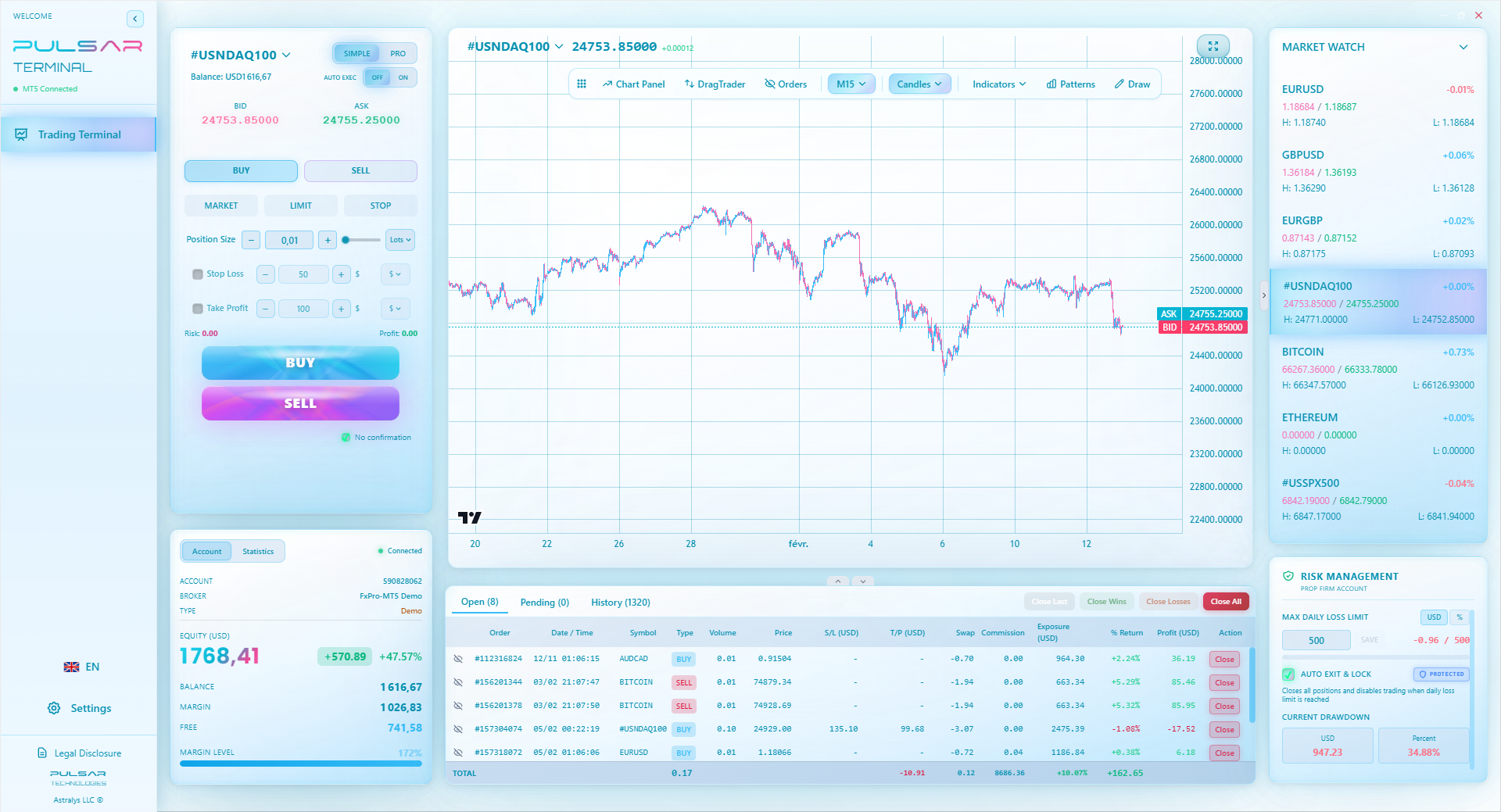
When your trade management is as critical as your broker choice, tools like Pulsar Terminal for MT5 automate advanced orders like trailing stops and partial closures, protecting profits no matter which broker you use.
Pulsar Terminal
MT5オールインワンツール:ドラッグ&ドロップ注文、マルチTP/SL、トレーリングストップ、グリッドトレード、出来高プロファイル、プロップファーム保護。毎日1,000人以上のトレーダーが利用。
So, who is the best forex broker in Asia for a Bangladeshi trader? There isn't one single answer. It's the broker that best fits your specific situation: your trading style, your capital size, and most importantly, your need for reliable, compliant financial channels.
Based on my 12 years and the experiences of traders I mentor, brokers like Exness (strong Asian presence, various account types), IC Markets (excellent raw spread ECN model), and XM (good for beginners with smaller deposits) often come up. But my top pick for you might be my last choice for someone else.
Here is your homework:
- Research Local Law: Understand the boundaries you must operate within. This is step zero.
- Define Your Needs: Are you a scalper needing ultra-low latency? A swing trader prioritizing stability? Write down your top 3 broker needs.
- Shortlist & Demo: Pick 2-3 regulated brokers that seem to match. Open demos and TEST them ruthlessly, as I described.
- Start Small: When you fund a live account, start with the absolute minimum. Make a few trades, but most importantly, test a withdrawal of a small amount first. If that process is smooth, you can add more capital.
Finding a broker is a trade in itself. You're investing your time and capital into a business relationship. Do the analysis. The best forex broker in Asia for you is the one you've vetted thoroughly, not the one with the shiniest advertisement.
FAQ
Q1Is forex trading legal for individuals in Bangladesh?
The Bangladesh Bank regulates foreign exchange. Retail trading with international brokers often involves moving funds abroad, which may fall outside typical personal remittance allowances. You must consult with a local financial legal expert to understand the current, specific regulations that apply to you. Never rely solely on internet forums for legal advice.
Q2What is the minimum deposit I should start with?
Start with the broker's absolute minimum, even if you have more capital. Your goal with the first deposit is to test the broker's systems - execution, platform, and crucially, the withdrawal process - not to make money. I'd rather see you test with $100 than risk $1,000 on an untrusted platform.
Q3Are offshore-regulated brokers safe?
They carry more risk. A license from a strict regulator like ASIC or FCA requires brokers to segregate client funds and adhere to capital requirements. Offshore regulators may not enforce these rules as rigorously. If you choose an offshore broker, understand you are accepting a higher level of counterparty risk and should be even more diligent about withdrawal tests.
Q4How important is customer support for a Bangladeshi trader?
Extremely important. Test their support via live chat and email before depositing. Ask specific questions about deposit methods for Bangladesh. If they can't give you clear, timely answers when you're trying to give them money, imagine how they'll respond when you need help during a problem.
Q5Should I choose a broker that offers a bonus?
Almost never. Bonuses usually come with restrictive terms (like high trading volume requirements before withdrawal) that tie your hands. They're a marketing tool. Focus on raw trading conditions - spreads, execution, platform - not one-time incentives. A low spread will save you more money over 100 trades than any sign-up bonus.
Q6Can I use international brokers like Exness or IC Markets from Bangladesh?
Many Bangladeshi traders access international brokers' websites. The technical access is usually possible. However, the critical issue is not website access, but the financial and regulatory compliance of funding your account and withdrawing profits according to Bangladeshi law. This is the aspect you must research thoroughly.
ウィンストン教授のレッスン
重要ポイント:
- ✓Legal compliance is your first trade setup.
- ✓Test withdrawals before large deposits.
- ✓Effective cost beats advertised spread.
- ✓Platform reliability is part of your edge.
この記事はどれくらい役に立ちましたか?
星をクリックして評価
週刊トレーディングインサイト
無料の週刊分析&戦略。スパムなし。
著者について
Daniel Harrington
コンテンツ責任者
The Trading Mentorのコンテンツ責任者。複雑なトレード概念をわかりやすく伝えることに情熱を持つベテラントレーダー。グローバルなトピック、戦略、プラットフォームガイドを担当。
コメント
リスク警告
金融商品の取引には大きなリスクが伴い、すべての投資家に適しているわけではありません。過去の実績は将来の結果を保証するものではありません。本コンテンツは教育目的のみであり、投資助言として解釈すべきではありません。取引前に必ずご自身で調査を行ってください。
こちらもおすすめ

Cara Trading Forex Sukses: 7 Prinsip dari Trader Profesional
Cara trading forex sukses dengan 7 prinsip trader pro: manajemen modal, disiplin, journal trading, backtest. Data nyata, bukan janji profit palsu.
Jam Trading Forex Terbaik untuk Trader Indonesia: Panduan Lengkap dengan Tabel Waktu
Panduan jam trading forex untuk trader Indonesia. Tabel 4 sesi dunia, jam emas 20:00-00:00, sesi mana yang harus dihindari. Data akurat + tips dari trader berpengalaman.
Top 5 Sàn Forex Uy Tín Nhất 2026: Review Jujur dari Trader Indonesia
Top 5 sàn forex uy tín 2026 untuk trader Indonesia. Review jujur: spread, deposit, withdraw, dukungan lokal. Exness, XM, IC Markets & lebih.
