


Most traders spend years looking for the 'best' forex market, chasing exotic pairs and volatile news, only to blow up their accounts.

Daniel Harrington
コンテンツ責任者
☕ 9 分で読める
学べること:
Most traders spend years looking for the 'best' forex market, chasing exotic pairs and volatile news, only to blow up their accounts. I did it too. The truth is, the best markets aren't the most exciting ones - they're the most predictable and liquid ones where your edge actually works. In Singapore, with our unique timezone and MAS regulations, your choice of market isn't just about profit potential; it's about survival. I'll show you exactly which pairs to focus on, when to trade them, and why ignoring this advice is the single biggest reason retail traders fail.
Forget what you've heard about 'hot' pairs. A good market is defined by three boring, non-negotiable factors: liquidity, spread, and predictable behavior.
Liquidity is everything. It's the volume of trades happening every second. High liquidity means your orders get filled at the price you see, not some skewed number the broker makes up. It also means lower spreads - the difference between the buy and sell price. A tight spread on a major pair like EUR/USD can be under 0.3 pips on a good ECN account. On an exotic pair, it can be 50 pips or more. You're losing money before you even start.

Example: Trade 1 standard lot (100,000 units) on EUR/USD with a 0.3 pip spread. Cost: $3. Trade 1 standard lot on USD/TRY with a 50 pip spread. Cost: $500. You need the exotic pair to move 50 pips just to break even on the spread. That's insane.
Predictable behavior comes from institutional participation. The big banks and funds trade the majors. They leave footprints - support, resistance, and patterns that repeat. Exotics are often driven by local politics or illiquidity gaps, which is just gambling.
I learned this the hard way in 2018. I was seduced by the wild swings in USD/ZAR (South African Rand). I made 23% in two days. Felt like a genius. Then a sudden central bank comment caused a 400-pip gap against me overnight. Wiped out my gains and 15% of my account. The spread widened so much my stop loss was useless. I was trading a casino, not a market.
Your first filter for the best forex markets to trade should always be: "Is this where the smart money goes?" If not, walk away.

💡 ウィンストンのヒント
The market's job is to make you feel smart right before it takes your money. Your job is to ignore the feeling and follow the liquidity.
These are the workhorses. They won't make you famous overnight, but they'll keep you in the game long enough to learn. For a Singapore trader, focusing here is non-negotiable.
EUR/USD: The King
This pair accounts for nearly a quarter of all global forex volume. The spread is razor-thin, and it moves with beautiful technical clarity during the London and New York overlaps. It's less prone to random spikes than other pairs. My most consistent profits have always come from EUR/USD swing trading setups on the 4-hour chart.
USD/JPY: The Trend Follower
This pair loves to trend. It's heavily influenced by the interest rate differential between the US Fed and the Bank of Japan. When US yields rise, USD/JPY often goes up. It's a great pair for trend strategies. Just watch out for intervention by Japanese authorities - they don't like it moving too fast in one direction.
GBP/USD: The Volatile Sibling
Higher volatility than EUR/USD, which means bigger potential rewards and risks. It reacts strongly to UK political news and Bank of England statements. The spreads are still excellent. I treat it as a secondary pair, only taking signals when they are exceptionally clear.
AUD/USD & USD/CAD: The Commodity Pairs
These are your proxies for global risk sentiment and commodity prices. AUD/USD follows iron ore and China's economy. USD/CAD follows oil. They offer great diversification from the purely monetary-driven pairs. During the Asian session (when we're awake), AUD/USD often has the most action.

Warning: Don't trade all of these at once. Pick one or two to master. Understanding the personality of a single pair is better than dabbling in five. I only consistently trade EUR/USD and occasionally AUD/USD. Mastery beats variety every time.
“Chasing the exotic 'story' is a disease. The cure is trading the boring, liquid majors.”
As a trader based here, you'll naturally watch the SGD. USD/SGD is classified as an exotic, but it's a top-tier one. With an average daily volume of over US$215 billion, it has decent liquidity. The MAS manages the SGD against a basket of currencies, not just the USD, so it tends to be less volatile than other Asian pairs.
Should you trade it? It depends.
The Case For It: You have local insight. You feel the economy, read the local news, and understand MAS policy nuances before the rest of the world. The spreads from MAS-regulated brokers like Saxo or OANDA are reasonable for a regional pair.
The Case Against It: The volume is still a fraction of the majors. During off-hours (Singapore night), liquidity can dry up, widening spreads. It can also be prone to sudden, sharp moves during MAS policy announcements.
My personal rule: I monitor USD/SGD for macroeconomic context, but I rarely trade it for pure technical setups. My edge is better on the global majors where the playing field is level and the data is abundant. However, if you have a strong fundamental view on Asian economics, it can be a valuable addition. Just remember our 5% margin rule (effectively 1:20 use) from the MAS - it applies here too, keeping your risk in check.
Our timezone in Singapore (GMT+8) is both a blessing and a curse. The core Asian session runs from about 8 am to 5 pm our time. This is when Tokyo, Singapore, and Hong Kong are active.
What's good:
- AUD/USD, NZD/USD, and USD/JPY are typically the most active major pairs. They often set their daily highs or lows during this session.
- Volatility is usually lower than the London/New York overlap. This can be great for scalping strategies if you have a low-spread broker like Pepperstone.
- It's a good time to analyze and plan for the European session.
What's bad:
- EUR/USD and GBP/USD are often sleeping. They might drift in a 20-30 pip range. Trying to force trades here is a recipe for death by a thousand cuts.
- The 'lunch lull' in Tokyo (around 12-1 pm SGT) can see volume drop off a cliff.
Here's my old Asian session mistake: I'd wake up, see no movement on EUR/USD, and start trading USD/JPY scalps out of boredom. Without a real edge in that pair, I'd give back all my careful weekly profits in one impatient morning.

Pro Tip: Use the Asian session to manage existing swing positions from the London session, or to scalp the opening moves in AUD/USD with very tight stops. Don't try to invent action where there isn't any. Sometimes the best trade is no trade.
💡 ウィンストンのヒント
If you can't explain why a specific pair is moving in three sentences or less, you shouldn't have a position in it. Complexity is the enemy of execution.
“Acceptance that you cannot be active in all sessions will put you ahead of 80% of traders who are burned out by Wednesday.”
If you want to protect your capital, you need a 'do not trade' list. These are where accounts go to die.
True Exotic Pairs: USD/TRY (Turkish Lira), USD/ZAR, EUR/TRY. The spreads are criminal, liquidity is thin, and they gap on political tweets. The potential reward never justifies the uncontrollable risk.
Low-Liquidity Crosses: Think GBP/NZD or CAD/CHF. The spread is wide, and the price action is often erratic and meaningless. They're illiquid for a reason - no one big is trading them.
During Major News Events: Even on majors, the 5 minutes before and after a high-impact news release (like US Non-Farm Payrolls) is a minefield. Spreads balloon, liquidity vanishes, and stops get hunted. I don't care if your MACD indicator is giving a signal. Wait for the dust to settle.
I have a note taped to my monitor: "Liquidity > Everything." It's there because I ignored it for two years. Chasing the exotic 'story' is a disease. The cure is trading the boring, liquid majors where your position size calculator and risk management actually mean something.
Let's build a realistic day for a serious retail trader in Singapore.
7:30 AM SGT: Market review. Check the daily closes on my watchlist: EUR/USD, AUD/USD, USD/JPY. Has price reached a key level I identified yesterday? I use the Volume Profile tool to see where price spent most of its time previously - those are high-volume nodes that act as magnets.
8:00 AM - 12:00 PM SGT (Asian Session): Focus on AUD/USD if there's a clear setup from the New York close. Small position, tight stop. Otherwise, I'm planning. I draw my key support/resistance lines on the 4-hour charts for the European session. I set price alerts. I am not trading for the sake of it.
3:00 PM SGT (London Open): This is go-time. Liquidity floods in. EUR/USD and GBP/USD start to wake up. I look for confirmations of my morning plans. Is price respecting my levels? This is where I take my primary swing trade entries for the day.
9:00 PM - 1:00 AM SGT (London/New York Overlap): The most volatile and liquid period. I'm either managing my existing positions (moving stops to breakeven, taking partial profits) or, if I missed the London move, looking for a retracement entry. I am not initiating new trades after midnight SGT. Fatigue kills judgment.
The Tools: I rely on a broker with reliable execution like IC Markets for their raw spreads. My charts are on a platform that allows precise order management. Manual trailing stops are a pain, so I use tools that automate it based on my rules, protecting profits without me babysitting the screen all night.
This routine isn't sexy. It's disciplined. It focuses on the best forex markets to trade at the times they are actually tradeable. It accepts that I, as a Singapore-based trader, cannot be active in all sessions. That acceptance alone will put you ahead of 80% of traders who are burned out and overtrading by Wednesday.
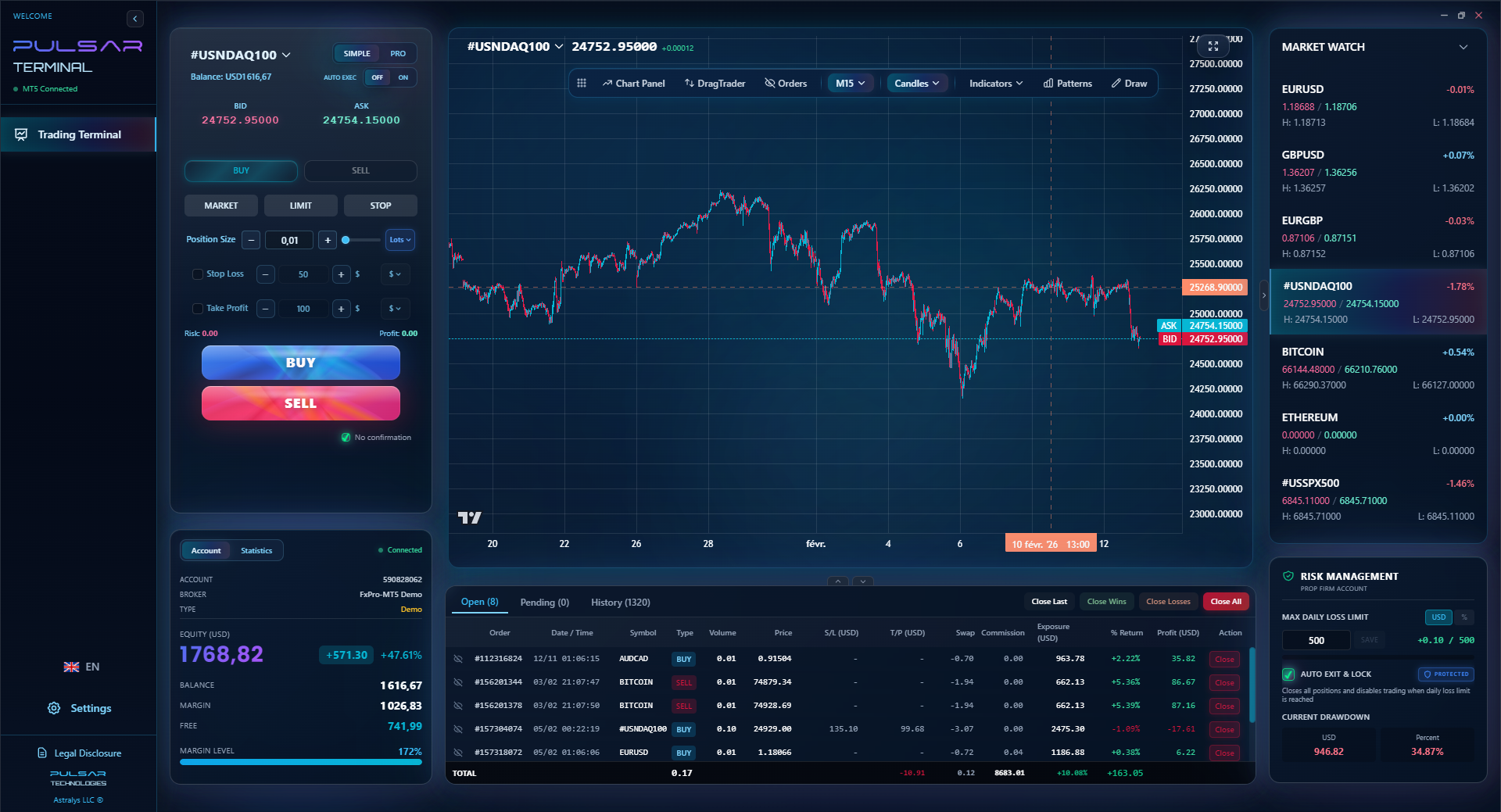
Managing multiple trades and precise exits across timezones is exhausting; Pulsar Terminal automates trailing stops and partial closures on MT5, so your Singapore session plan executes perfectly while you sleep.
Pulsar Terminal
MT5オールインワンツール:ドラッグ&ドロップ注文、マルチTP/SL、トレーリングストップ、グリッドトレード、出来高プロファイル、プロップファーム保護。毎日1,000人以上のトレーダーが利用。
FAQ
Q1Is forex trading legal in Singapore?
Yes, it's completely legal. The Monetary Authority of Singapore (MAS) regulates it. Always use an MAS-regulated broker to ensure your funds are segregated and you have negative balance protection.
Q2What is the best forex pair for beginners in Singapore?
Start with EUR/USD. It has the lowest spreads, the most predictable behavior, and endless learning resources. Master one pair before you even think about another.
Q3What use can I get in Singapore?
For retail traders, MAS guidance effectively caps use at 1:20 (a 5% margin requirement). This is a good thing - it prevents you from blowing up your account too quickly. Accredited investors may access higher use, but you shouldn't need it.
Q4What is a good spread for EUR/USD?
On a standard account, under 1.0 pip is decent. On a raw/ECN account, you should see average spreads between 0.1 and 0.3 pips. Anything consistently above 1.5 pips is eating into your profits.
Q5When is the best time to trade forex in Singapore?
The London session open (3-5 PM SGT) and the London/New York overlap (9 PM - 1 AM SGT) offer the best combination of liquidity and movement for the major pairs like EUR/USD and GBP/USD.
Q6Should I trade USD/SGD?
It can be traded, but treat it as a specialty pair. Your primary focus should be the global majors (EUR/USD, USD/JPY). Trade USD/SGD only if you have a strong fundamental thesis, and always be aware of lower liquidity outside Asian hours.
Q7How much money do I need to start forex trading in Singapore?
You can open accounts with $0 at some brokers, but that's not a trading plan. To practically apply risk management (risking 1% per trade), you should have at least $2,000-$3,000. This allows you to trade sensible position sizes on the majors without being immediately vulnerable to a margin call.
ウィンストン教授のレッスン
重要ポイント:
- ✓Liquidity is your first, second, and third filter for a tradeable market.
- ✓Master one major pair (EUR/USD) before adding a second.
- ✓Use the Asian session for planning, not forced trading.
- ✓The MAS's 1:20 use cap is a protective gift, not a limitation.
この記事はどれくらい役に立ちましたか?
星をクリックして評価
週刊トレーディングインサイト
無料の週刊分析&戦略。スパムなし。
著者について
Daniel Harrington
コンテンツ責任者
The Trading Mentorのコンテンツ責任者。複雑なトレード概念をわかりやすく伝えることに情熱を持つベテラントレーダー。グローバルなトピック、戦略、プラットフォームガイドを担当。
コメント
リスク警告
金融商品の取引には大きなリスクが伴い、すべての投資家に適しているわけではありません。過去の実績は将来の結果を保証するものではありません。本コンテンツは教育目的のみであり、投資助言として解釈すべきではありません。取引前に必ずご自身で調査を行ってください。
こちらもおすすめ

Cara Trading Forex Sukses: 7 Prinsip dari Trader Profesional
Cara trading forex sukses dengan 7 prinsip trader pro: manajemen modal, disiplin, journal trading, backtest. Data nyata, bukan janji profit palsu.
Jam Trading Forex Terbaik untuk Trader Indonesia: Panduan Lengkap dengan Tabel Waktu
Panduan jam trading forex untuk trader Indonesia. Tabel 4 sesi dunia, jam emas 20:00-00:00, sesi mana yang harus dihindari. Data akurat + tips dari trader berpengalaman.
Top 5 Sàn Forex Uy Tín Nhất 2026: Review Jujur dari Trader Indonesia
Top 5 sàn forex uy tín 2026 untuk trader Indonesia. Review jujur: spread, deposit, withdraw, dukungan lokal. Exness, XM, IC Markets & lebih.
