


I remember staring at my screen in 2015, my heart pounding.

Olumide Adeyemi
西アフリカ・トレーディングの先駆者 ·  Nigeria
☕ 9 分で読める
学べること:
I remember staring at my screen in 2015, my heart pounding. I was in a live trade room on YouTube, and the 'guru' was screaming to buy GBP/JPY. 'This is the one! Lamborghini money!' he yelled. I threw in $500. An hour later, I was down $420. The stream had ended, the chat was disabled, and my money was gone. That painful lesson cost me more than naira, it cost me trust. YouTube is packed with both the best forex teachers you'll ever find and the most dangerous predators. Let's talk about how to tell the difference.
Forget the rented mansions and fancy cars. A real teacher gives you a framework, not just signals. The best forex teacher on YouTube for you is the one whose explanation of a scalping strategy makes you nod and say, 'Okay, I can see why that works.' They talk about risk first, profit second. They show you their broker statement, warts and all, including the losing streaks. They explain the 'why' behind every entry and exit. A true educator focuses on concepts like position sizing, managing a margin call, and understanding the spread. They make the complex simple. I learned more about price action from one quiet Canadian guy drawing on a chart for 30 minutes than I did from 100 flashy 'millionaire mindset' videos.
The Humility Test
Watch for how they handle being wrong. Do they quietly close a losing trade on a live stream and explain what their analysis missed? Or do they make excuses - 'the banks manipulated it,' 'my SL was hunted'? The former is a teacher. The latter is a storyteller protecting his brand. The market will humble you every single week. You need a guide who's already been humbled and is honest about it.

💡 ウィンストンのヒント
A teacher who cannot clearly explain a complex concept in simple terms does not understand it well enough themselves. Clarity is the hallmark of true mastery.
“The best forex teacher on YouTube for you is the one whose explanation makes you say, 'Okay, I can see why that works.'”
I'm not going to give you a ranked list because what works for my 12-year swing trading brain won't work for a new scalper. Instead, here's a breakdown of teaching styles. Remember, the platform is global, but your application is local. You need to adapt their lessons to Lagos time, your broker's conditions, and naira psychology.
The Price Action Purists: These teachers live and breathe naked charts. No indicators, just support, resistance, and candle patterns. This is a fantastic foundation. It forces you to learn the language of the market itself. The downside for beginners? It can feel vague. 'You just see the rejection,' they say. It takes screen time to develop that eye.
The Indicator Architects: They build systems around tools like the RSI indicator and MACD indicator. They give you clear rules: 'Enter when RSI crosses above 30 on the 1-hour chart.' This is structured and comforting for new traders. The risk? You become a robot waiting for a signal without understanding the market context. A good teacher in this space will always tie the indicator back to what price is actually doing.
The Economic Drivers: Their focus is on fundamentals. They'll break down Central Bank of Nigeria statements, US Non-Farm Payrolls, and how oil prices affect USD/NGN. This is crucial knowledge, especially for swing trading. For a day trader, however, a CPI news spike can vaporize your technical setup in seconds. The best teachers blend this with technicals.

Warning: Be supremely wary of any channel whose primary content is 'live signals' or 'secret software.' Education is their product, not predictions. If they're constantly selling a magic box or a signal service, their incentive is to keep you dependent, not educated.
“A $1,100 profit was the most expensive lesson of my life - it made me believe in a fantasy.”
Our environment is unique. A great teacher from the US might not address your specific hurdles. You must filter their advice through these lenses.
Broker Stability & Spreads: When a teacher says 'I entered here,' ask if your broker offers the same execution. Nigerian traders often use international brokers like Exness, IC Markets, or XM for better regulation and tighter spreads. A strategy that works with a 0.1 pip spread on EUR/USD might fail with a 3-pip spread on a local platform. Always test a strategy on a demo account with your broker's conditions.
Internet & Power: A scalping strategy requiring millisecond precision is a nightmare if your light goes out or your data is slow. I learned this the hard way trying to copy a London session scalper. I'd get the entry, NEPA would take the light, and I'd come back to a stopped-out trade. Favor strategies that don't require you to be glued to the screen every second. This is one reason I gravitated toward swing trading.
The 'Maga' Mentality: Our social media space is flooded with fake flex. The best forex teacher on YouTube for a Nigerian is one who actively fights this. They should be talking about consistent 2-5% monthly returns, not 100% weeks. They should normalize withdrawing profits to pay bills, not just compounding to buy a phantom private jet. If a teacher's message feeds the 'get-rich-quick' itch, run.
“A $1,100 profit was the most expensive lesson of my life - it made me believe in a fantasy.”
Your B.S. detector needs to be on high alert. Here are the glaring signs of a channel that will cost you money.
- The Lifestyle Overload: If 70% of the video is shots of cars, watches, and club bottles, you're watching a marketer, not a trader. Real trading is boring. It's charts, journals, and patience.
- 'Risk-Free' Guarantees: Anyone who says trading is risk-free or offers a money-back guarantee on their 'winning system' is lying. The market guarantees nothing.
- Overly Complex Jargon to Sound Smart: They use five acronyms you don't know to explain a simple concept. A good teacher simplifies.
- No Evidence of Real Trading: They never show a live trade from login to exit on a platform you can verify. Only pre-recorded 'analysis' that always seems right. Ask yourself: if they're so profitable, why do they need my 50k naira for a course?
- The Cult Leader Vibe: They discourage you from watching other teachers or thinking for yourself. 'I am the only way.' This is dangerous isolation.

Example: I once paid 100k naira for a 'mentorship' from a flashy YouTube trader. His 'proprietary method' was literally just drawing Fibonacci retracements and trading the 50% level - a basic concept you can learn for free in 10 minutes. The expensive lesson was that the packaging is often worth more than the product.
💡 ウィンストンのヒント
Your greatest use is not in your broker's margin offer, but in your knowledge. Invest ten hours in learning before you invest one dollar in trading.
“The charlatans work to make you permanently dependent. Real educators work to make themselves obsolete to you.”
Don't just binge random videos. Be strategic. Treat learning to trade like a university course you're designing for yourself.
Phase 1: The Absolute Basics (2-4 Weeks) Find one clear, calm teacher who has a playlist called 'Forex Basics' or 'Beginner's Guide.' Watch it all. Take notes. Your goal is to understand: What is a currency pair? What is a bid/ask? What is a pip and how is it calculated? What is a long/short position? What is use? Don't move on until this is boringly familiar.
Phase 2: Market Analysis (1-2 Months) Now branch out. Watch a price action teacher for two weeks. Then watch an indicator-based teacher. Then a fundamentals teacher. Don't adopt a system yet. You're surveying the land. Start a demo account and just practice identifying what they're talking about. 'Oh, that's a double top he mentioned.'
Phase 3: Strategy & Psychology (Ongoing) Now, choose one simple strategy from the teacher who resonated most. It could be as simple as trading EUR/USD bounces off a key moving average. Back-test it on your demo account for 100 trades. Journal every single one. This is where you'll find the best forex teacher on YouTube for you - the one whose logic sticks in your head during a live trade.
Phase 4: Specialization Once you have a base, you can dive into specific instruments. If you're interested in gold, find a specialist who teaches XAU/USD dynamics. The learning never stops.
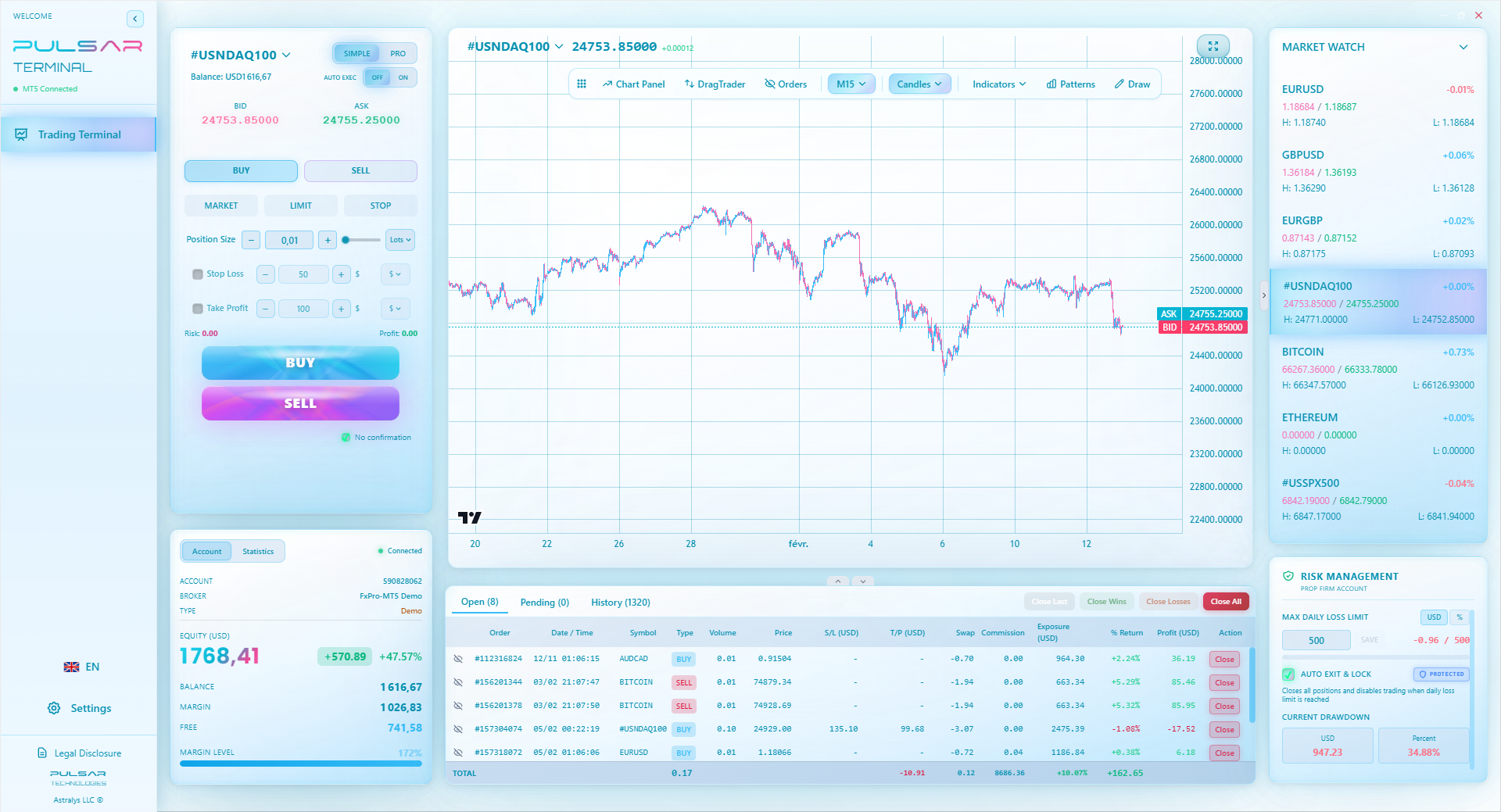
Building a disciplined trading plan is one thing, executing it without emotion is another. Tools like Pulsar Terminal help by letting you set multi-level take-profits and stop-losses directly on your MT5 chart before you even enter the trade, locking in your strategy.
Pulsar Terminal
MT5オールインワンツール:ドラッグ&ドロップ注文、マルチTP/SL、トレーリングストップ、グリッドトレード、出来高プロファイル、プロップファーム保護。毎日1,000人以上のトレーダーが利用。
“The charlatans work to make you permanently dependent. Real educators work to make themselves obsolete to you.”
Let me get specific with numbers. My first 'success' came from blindly following a YouTube signal caller in 2016. I turned $200 into $1,100 in three weeks. I felt like a genius. Then I lost it all in two days because I had no idea why I was entering those trades. The guru vanished when the losses came. That $1,100 profit was the most expensive lesson of my life - it made me believe in a fantasy.
The real turnaround started in 2018. I found a teacher who did weekly market recap videos. No signals, just review. He'd say, 'Here I saw this bullish order block on the 4-hour chart. I took a buy here at 1.1050, my stop was at 1.1020, and I took profit at 1.1080. Here's why my stop was there.' I back-tested his simple supply/demand concept on a demo for months. My first live trade with it was on USD/CAD. I bought at 1.3320, stopped out at 1.3295 (a 25-pip loss, about $25). It stung, but I understood why I lost. The next trade won. That pattern - understandable loss, followed by studied win - is the real foundation. I'm not a millionaire. I'm a consistent trader who pays his bills from his trading account. That YouTube teacher gave me the map, but I had to walk the path myself.
Another failure: I spent six months trying to copy a high-frequency scalper. My broker's execution wasn't as fast, my internet wasn't as stable, and my nerves couldn't handle it. I blew two small accounts. I was trying to use a Formula One strategy while driving on a Lagos road full of potholes. The strategy wasn't bad, it was just a terrible fit for my environment.
“You're trying to use a Formula One strategy while driving on a Lagos road full of potholes.”
YouTube is an incredible free library, but it's a starting point, not the finish line. The true test happens when you turn off the video and face the chart alone. Here's what you need to do to graduate.
Build Your Own Playbook: Compile your notes, your tested strategy rules, and your risk management parameters into one document. Your Trading Playbook. This is your personal constitution. It removes emotion in the moment. 'My playbook says don't trade during the first hour of the London session. So I wait.'
Find a Community, Not a Cult: Look for a small Discord or Telegram group of serious traders who are also learning. Avoid groups run by a guru where only he speaks. You want a place to share charts, ask questions, and get feedback from peers. This accountability is gold.
Embrace the Boring Work: The glamour is in the YouTube video. The profit is in the back-testing, the journal review every Saturday morning, and the disciplined repetition of your process. The best forex teacher on YouTube will eventually tell you that you don't need them anymore. That's when you know you've found a good one. They work to make themselves obsolete to you. The charlatans work to make you permanently dependent.
💡 ウィンストンのヒント
The market is a brutal examiner. YouTube teachers give you the textbook, but you must sit for the exam alone. No cheat sheets allowed.
FAQ
Q1Who is the number 1 forex teacher on YouTube?
There isn't one universal 'number one.' The best teacher is the one whose style matches your personality and trading goals. A scalper's best teacher will be different from a swing trader's. Focus on finding the most effective educator for you, not the most popular.
Q2Are free YouTube courses enough to become profitable?
The knowledge can be enough, but the application is everything. YouTube can give you the 'what' and the 'how.' But the 'when' and the discipline to execute come from your own screen time, back-testing, and developing emotional control. Free education provides the tools, but you have to build the house yourself.
Q3How can I verify if a YouTube trader is really profitable?
Look for consistent, verifiable evidence. Do they show live trading sessions from start to finish on a known platform? Do they discuss their losses openly and analytically? Be skeptical of only seeing myfxbook stats or isolated profit screenshots, which can be manipulated. A true professional is transparent about their process, not just their results.
Q4What's a good first strategy to learn from YouTube?
Start with a simple price action strategy based on support and resistance on a higher time frame like the 4-hour or daily chart. It's visual, doesn't rely on lagging indicators, and teaches you to read the market. Pair it with strict risk management - never risk more than 1% of your account on a trade. This gives you room to learn without blowing up.
Q5Why do Nigerian traders need to be extra careful with YouTube gurus?
Because the 'flashy lifestyle' narrative preys directly on the very real economic pressures and aspirations here. Scammers sell the dream of instant escape. They use relatable Nigerian accents and settings to build false trust. Always prioritize substance over spectacle and remember that real wealth is built quietly.
Q6Should I pay for a course from a YouTube trader?
Extremely rarely, and only after exhaustive due diligence. 95% of what you need is available for free. Before paying, ask: Does this course offer structured learning I can't get from their free content? Can I find reviews from independent, long-term students? Have I successfully tested their free concepts on a demo account? Never pay for promises of guaranteed profits.
ウィンストン教授のレッスン
重要ポイント:
- ✓Prioritize risk management education over signal calls.
- ✓Test every strategy with your broker's specific spreads.
- ✓Back-test any strategy for at least 100 trades.
- ✓Never risk more than 1% of your capital per trade.
この記事はどれくらい役に立ちましたか?
星をクリックして評価
週刊トレーディングインサイト
無料の週刊分析&戦略。スパムなし。
著者について
Olumide Adeyemi
西アフリカ・トレーディングの先駆者
ナイジェリアで最もアクティブなFXトレーディング教育者の一人。ラゴスから8年のトレード経験。アフリカのトレーダー向けの少額資金戦略とプロップファームチャレンジを専門とする。
コメント
リスク警告
金融商品の取引には大きなリスクが伴い、すべての投資家に適しているわけではありません。過去の実績は将来の結果を保証するものではありません。本コンテンツは教育目的のみであり、投資助言として解釈すべきではありません。取引前に必ずご自身で調査を行ってください。
こちらもおすすめ

Cara Trading Forex Sukses: 7 Prinsip dari Trader Profesional
Cara trading forex sukses dengan 7 prinsip trader pro: manajemen modal, disiplin, journal trading, backtest. Data nyata, bukan janji profit palsu.
Jam Trading Forex Terbaik untuk Trader Indonesia: Panduan Lengkap dengan Tabel Waktu
Panduan jam trading forex untuk trader Indonesia. Tabel 4 sesi dunia, jam emas 20:00-00:00, sesi mana yang harus dihindari. Data akurat + tips dari trader berpengalaman.
Top 5 Sàn Forex Uy Tín Nhất 2026: Review Jujur dari Trader Indonesia
Top 5 sàn forex uy tín 2026 untuk trader Indonesia. Review jujur: spread, deposit, withdraw, dukungan lokal. Exness, XM, IC Markets & lebih.
