


Let's cut to the chase.

Olumide Adeyemi
西アフリカ・トレーディングの先駆者 ·  Nigeria
☕ 9 分で読める
学べること:
- 1Why the Hunt for Signals is a Loser's Game
- 2What a Legitimate Signal Actually Looks Like (It's Rare)
- 3Free Signals vs. Paid Groups: The Hidden Cost
- 4The Only Sustainable Path: Build Your Own 'Signal' System
- 5Tools to Develop Your Edge, Not Outsource It
- 6Specific Pitfalls for the Nigerian Trader
- 7The Final Verdict: Should You Ever Use a Signal?
Let's cut to the chase. If you're searching for the 'best forex trading signals,' you're already on the path to losing money. I'm not being harsh, I'm being honest. The global signal industry is a multi-billion dollar business built on selling hope, not results. In Nigeria, where the hunger for financial escape is real, this hope is packaged and sold with devastating efficiency. I've seen traders blow ₦5 million accounts following 'gurus' with slick Instagram pages. This guide isn't about finding a magic signal provider. It's about understanding why that search is a trap, and what you should actually be doing.
You want a shortcut. I get it. The idea of getting an SMS that says 'BUY GBP/USD NOW' and watching the money roll in is intoxicating. But here's the ugly math no signal seller will show you.
First, survivorship bias. For every one signal service that shows you a winning track record, ten have already gone bust and disappeared. You only see the 'winner,' never the graveyard of failures. Second, even a broken clock is right twice a day. A provider can spam 100 vague signals a week. They'll highlight the 5 that worked and quietly forget the 95 that didn't. Their subscribers see the highlights and think it's genius.
I paid for a 'VIP' signal service back in 2018, costing $300 a month. They promised 80% win rates. For the first two weeks, it was magic. Then came a string of 7 losing trades in a row. When I asked about their risk management, they ghosted me. I lost $2,100 following them blindly before I stopped. The service is still running today, with new testimonials every week.
The core problem is dependency. You never learn. When the signals stop working (and they will), you have no system, no understanding, and a blown account. You're just renting someone else's luck until it runs out.

Warning: Any signal service that doesn't provide a verifiable, real-time, audited track record (like a publicly viewable Myfxbook link) is almost certainly manipulating their results. Past performance screenshots are worthless and easily faked.
“The global signal industry is a multi-billion dollar business built on selling hope, not results.”
Okay, let's say you ignore my advice and still want to evaluate a service. Here's what separates the 1% of semi-legit operations from the 99% of scams. It's not about the wins, it's about the transparency.
The Non-Negotiables
A real signal service must provide:
- Real-Time, Verified Track Record: A live, third-party verified account you can watch. Not screenshots, not a spreadsheet. A link to a platform like Myfxbook or FXBlue that shows every trade, live equity, drawdown, and the date the account started. No verification, no trust.
- Clear Risk Parameters: Every signal must come with a stated stop loss and take profit. Not 'we'll tell you when to exit.' A precise entry, SL, and TP. Their track record should show they respect these levels.
- Realistic Win Rate & Risk-Reward: Be deeply suspicious of anything claiming over 65% win rate with high risk-reward (like 1:3). It's statistically improbable over time. A 50% win rate with a solid 1:2 risk-reward is far more credible and profitable.
The Nigerian-Specific Red Flags
Watch for local marketing tricks: 'Mentorship' packages priced at ₦500,000, signals delivered via WhatsApp broadcast with no SL, and gurus posing in front of rented luxury cars. A true professional sells analysis and consistency, not a lifestyle fantasy.

Example: A service shows a track record of 40% wins, but a 1:3 risk-reward. For every 10 trades (4 wins, 6 losses): Profit = (4 wins * 3) = 12 units. Loss = (6 losses * 1) = 6 units. Net profit = 6 units. That's sustainable. A 70% win rate with a 1:1 risk-reward gives: (7 * 1) - (3 * 1) = 4 units net. The first service, with more losses, is actually more profitable. Focus on the combined equation, not just win rate.

💡 ウィンストンのヒント
A signal is just an opinion until it's validated by price action and protected by a stop-loss. Your job is to be the risk manager, not the fan club.
“You're just renting someone else's luck until it runs out.”
Let's break down the two main channels.
Free Telegram/WhatsApp Signals: These are almost always customer acquisition tools for brokers or bait for a paid upgrade. The analysis is thin, risk management is an afterthought, and the volume is high to create the illusion of activity. They get you used to following orders. The real cost isn't money, it's the losses you'll incur and the terrible habits you'll learn. You'll never learn proper position size calculation from a free signal chat.
Paid VIP Groups: This is where the big money is made (by the seller). You're paying for community and perceived access. The psychological trick is powerful: 'I paid ₦150,000 for this, so it must be good.' This creates a sunk cost fallacy that keeps you subscribed even during losing streaks. The 'guru' will blame market volatility, news events, or your broker's spread rather than their own analysis.
I once audited a popular paid group's calls for a month. They posted 52 signals. Only 18 hit their first take profit before their stop loss. Their advertised '1:2' risk-reward was a lie; they frequently moved stops wider, turning a 1:2 trade into a 1:0.5 disaster. The group members were cheering nonetheless, completely missing the decaying equity curve.
The best free resource is your own chart. Learning a simple swing trading structure or how to read basic support and resistance will yield better long-term results than 90% of signal groups.
“You're just renting someone else's luck until it runs out.”
This is the core of the article. Stop looking for signals and start building your own edge. This is what professional traders actually do. We don't follow others; we have a process that generates our own trade ideas.
Start With One Instrument
Don't try to trade everything. Pick one major pair like EUR/USD or a commodity like XAU/USD. Learn its personality - what time it moves, how it reacts to news. This focus is your first filter.
Define a Clear Trigger
Your 'signal' is a specific condition on your chart. It must be objective, not a feeling.
- Example 1: Price pulls back to the 50-period moving average on the 4-hour chart, and the 1-hour chart shows a bullish MACD crossover.
- Example 2: A clear support level holds on the daily chart with a pin bar formation.
Backtest this. Go back over the past year and mark every time this condition occurred. Did it work 6 out of 10 times? What was the average win vs. average loss? This is your personal win rate and risk-reward data - the only data you can trust.
The Risk Management Mandate
Your system is worthless without this. Before you know your entry, you must know your stop loss. This defines your position size. A good broker like IC Markets or Pepperstone offers tight spreads crucial for precise SL placement. Your rule might be: I never risk more than 1% of my capital on a single trade. Use a position size calculator every single time.
This process - Focus, Trigger, Risk - is your proprietary signal generator. It's boring. It's not sexy. But it's yours, and no one can take it away or switch it off.
💡 ウィンストンのヒント
If you wouldn't risk your own capital on an idea, selling it as a signal to others is ethically bankrupt. Build your own edge; it's the only one you can truly trust.
“Your first profitable system will likely be simple. Complexity is not sophistication.”
Instead of sending money to a signal seller, invest in tools that make you a better analyst.
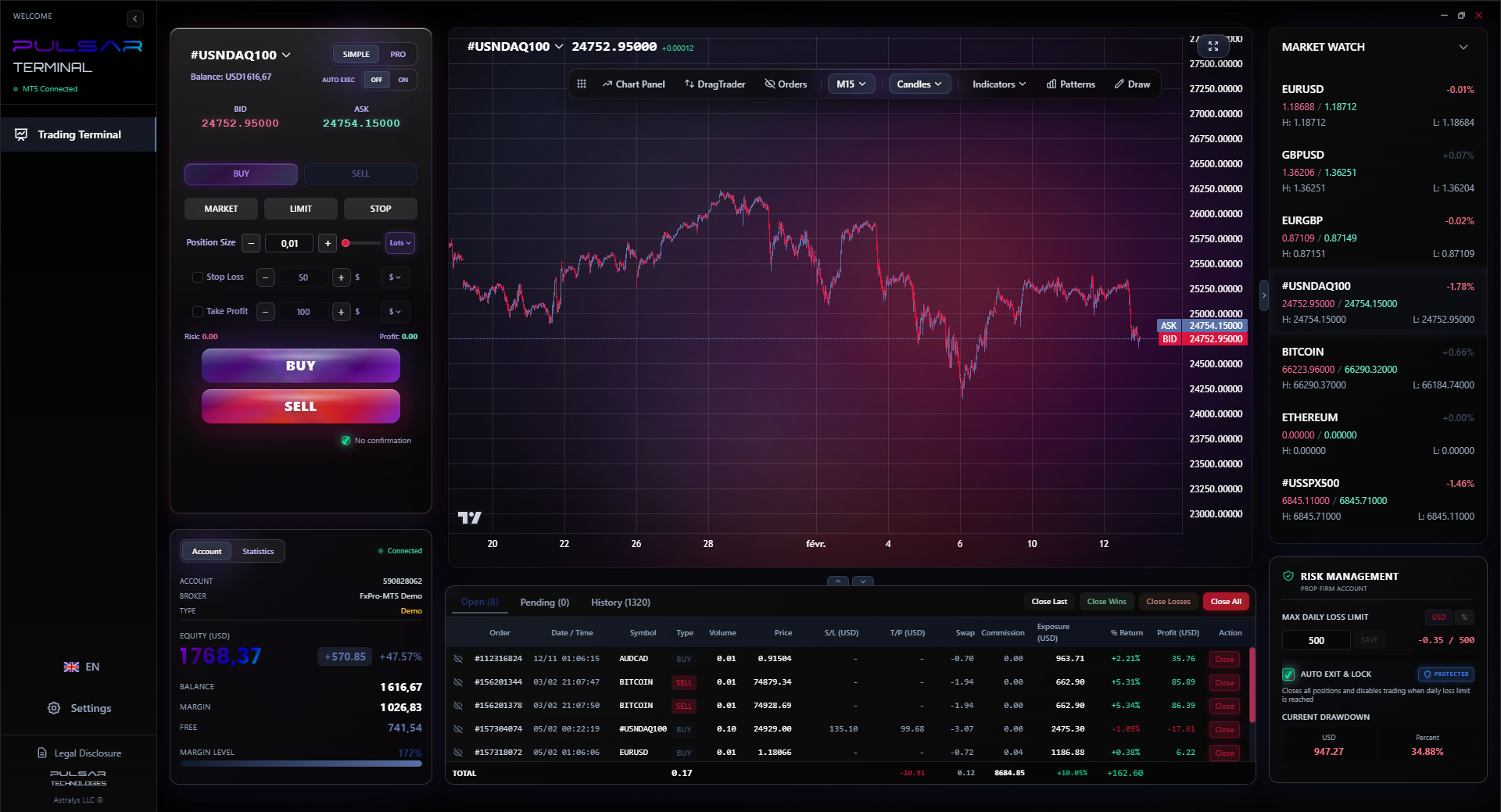
Charting Platforms: MT5 is standard, but its native tools are clunky. This is where a professional terminal like Pulsar Terminal changes the game. It plugs into your MT5 but gives you institutional-grade tools to spot your own setups faster and manage them with precision.
Backtesting Software: Test your ideas without risking a kobo. See if that RSI divergence strategy actually worked over 500 past trades.
Economic Calendars: Know when high-impact news is due. A good self-generated signal avoids trading 30 minutes before major US NFP data, for instance.
Journaling Software: This is the most important tool. Record every trade: your 'signal' reason, entry, exit, P&L, and most importantly, your emotional state. Review it weekly. You'll see your own patterns - like cutting winners short or letting losers run - which is more valuable than any external signal.
The goal is to transition from 'What trade should I take?' to 'My system has identified a potential setup here, and my rules say I may take it with X lot size.' That's the mindset shift that leads to consistency.

Building your own reliable trading system requires precise tools to manage entries, exits, and risk—exactly what Pulsar Terminal's drag-and-drop orders and multi-TP/SL features provide directly on your MT5 platform.
Pulsar Terminal
MT5オールインワンツール:ドラッグ&ドロップ注文、マルチTP/SL、トレーリングストップ、グリッドトレード、出来高プロファイル、プロップファーム保護。毎日1,000人以上のトレーダーが利用。
“Your first profitable system will likely be simple. Complexity is not sophistication.”
Our environment creates unique vulnerabilities that signal sellers exploit.
1. The 'Quick Rich' Pressure: With economic pressures real, the desperation for fast returns is high. Signal sellers market '₦100k to ₦1m in 30 days!' schemes. This pushes you towards high-use, high-risk strategies that guarantee a margin call, not riches.
2. Payment & Broker Issues: You might find a semi-decent signal, but if you're using an unregulated bucket-shop broker with huge spreads and requotes, the signal's entry and exit levels become meaningless. Your execution kills the trade. Stick with reputable, internationally regulated brokers with local support like Exness or XM, which offer fair execution.
3. Community Hype: The WhatsApp group frenzy. When a signal is posted, the 'YES SIR!' and 'LOADING!' messages create fear of missing out (FOMO). You enter without doing your own check. Learn to trade in silence. The crowd is usually wrong at extremes.
4. Ignoring the Fundamentals: Many signal sellers are pure technicians. For a currency pair, understanding the interest rate decisions of the US Fed vs. the ECB is critical. A technical buy signal on EUR/USD is useless if the Fed is in hawkish mode and the ECB is dovish. Your own system should factor in, or at least be aware of, the fundamental backdrop.
💡 ウィンストンのヒント
The market's noise is a signal seller's best friend. In chaos, they can claim anything. Your system should be a filter for that noise, not an amplifier of it.

“The 'best forex trading signals' in Nigeria aren't for sale on Instagram.”
Almost never. But there's one hypothetical exception.
If you find a service that meets all the transparency criteria (verified live track record, clear rules), you could use their signals as a learning tool, not a trade copier. Subscribe for one month. Don't follow their trades with real money.
Instead, when they post a signal, go to your chart. Try to reverse-engineer it. Why did they choose that entry? Where is the logical stop loss? What timeframe are they using? Compare their analysis to your own developing system. This turns their service into a paid course in market analysis.
But the moment you feel the urge to just copy-paste their trade to 'not miss out,' cancel the subscription immediately. You've slipped back into dependency.
The 'best forex trading signals' in Nigeria aren't for sale on Instagram. They are the quiet, disciplined, rule-based decisions you make after hours of study and practice. They are generated by your own tested system, executed on a reliable platform, and protected by iron-clad risk management. That's the only signal worth listening to.

Pro Tip: Your first profitable system will likely be simple. A combination of one trend indicator (like a moving average) and one momentum oscillator (like RSI) on a 4-hour or daily chart, with strict 1:1.5 risk-reward rules, can be incredibly strong. Complexity is not sophistication.
FAQ
Q1Are there any free forex signals that actually work?
Consistently? No. Free signals are marketing tools. They may work occasionally, but without a verified long-term track record and no accountability, they are useless for sustained profitability. The 'cost' is the losses you'll accrue and the bad habits you'll form.
Q2How much should I pay for a forex signal service?
Ideally, ₦0. If you insist on trying one for educational purposes, don't pay more than you're willing to lose completely. Any service charging ₦50,000+ per month is selling a dream, not a statistical edge. That money is better spent on charting software, books, or a demo account to practice your own system.
Q3What's the success rate of most forex signal providers?
The public success rate they advertise is meaningless (often 70-90%). The real success rate - measured by the percentage of subscribers who are consistently profitable after a year - is likely below 5%. The provider makes money from subscriptions; most subscribers do not make money from the signals.
Q4Can I use signals for scalping?
This is especially dangerous. Scalping requires ultra-fast execution and precision. A signal delivered via SMS or chat will have a lag, making the suggested entry and exit points obsolete. By the time you get it, the move is often over. Scalping demands your own direct screen presence and strategy.
Q5How do I verify a signal service's track record?
Demand a live, third-party verification link (Myfxbook, FXBlue, etc.). Check the start date - it should be at least 12 months old. Look at the maximum drawdown (should be under 20-25%). See if they trade during major news events (a red flag). No link, no verification, no subscription.
Q6Is it legal to sell forex signals in Nigeria?
The regulatory environment is evolving. While trading forex is legal, the sale of financial advice or signals falls into a grey area unless the seller is licensed by the SEC. Most signal sellers are not licensed. This means you have zero legal recourse if you lose money following their advice.
ウィンストン教授のレッスン
重要ポイント:
- ✓95% of paid signal services lose money for subscribers long-term.
- ✓Demand a 12+ month verified live track record, not screenshots.
- ✓A 50% win rate with 1:2 risk-reward beats a 70% win rate at 1:1.
- ✓Invest in tools for your own analysis, not subscriptions to others'.
- ✓Your final system should be simple, rule-based, and yours alone.
この記事はどれくらい役に立ちましたか?
星をクリックして評価
週刊トレーディングインサイト
無料の週刊分析&戦略。スパムなし。
著者について
Olumide Adeyemi
西アフリカ・トレーディングの先駆者
ナイジェリアで最もアクティブなFXトレーディング教育者の一人。ラゴスから8年のトレード経験。アフリカのトレーダー向けの少額資金戦略とプロップファームチャレンジを専門とする。
コメント
リスク警告
金融商品の取引には大きなリスクが伴い、すべての投資家に適しているわけではありません。過去の実績は将来の結果を保証するものではありません。本コンテンツは教育目的のみであり、投資助言として解釈すべきではありません。取引前に必ずご自身で調査を行ってください。
こちらもおすすめ

Cara Trading Forex Sukses: 7 Prinsip dari Trader Profesional
Cara trading forex sukses dengan 7 prinsip trader pro: manajemen modal, disiplin, journal trading, backtest. Data nyata, bukan janji profit palsu.
Jam Trading Forex Terbaik untuk Trader Indonesia: Panduan Lengkap dengan Tabel Waktu
Panduan jam trading forex untuk trader Indonesia. Tabel 4 sesi dunia, jam emas 20:00-00:00, sesi mana yang harus dihindari. Data akurat + tips dari trader berpengalaman.
Top 5 Sàn Forex Uy Tín Nhất 2026: Review Jujur dari Trader Indonesia
Top 5 sàn forex uy tín 2026 untuk trader Indonesia. Review jujur: spread, deposit, withdraw, dukungan lokal. Exness, XM, IC Markets & lebih.
