


Most free forex courses are rubbish.

Olumide Adeyemi
西アフリカ・トレーディングの先駆者 ·  Nigeria
☕ 9 分で読める
学べること:
- 1Why Most 'Free' Courses Are a Trap
- 2The Non-Negotiable Core Curriculum (All Free)
- 3The Nigerian Context: What No International Course Will Tell You
- 4From Knowledge to Strategy: Building Your Own Edge
- 5Pitfalls I Stepped In (So You Don't Have To)
- 6Your 90-Day Action Plan to Go From Zero to Knowledgeable
- 7When Does It Make Sense to Pay for Something?
Most free forex courses are rubbish. I know because I wasted six months and over ₦150,000 on data following bad advice from 'gurus' before I found a method that clicked. The truth is, the best free forex course isn't a single video series. It's a specific combination of foundational knowledge, local context, and relentless practice. This guide cuts through the noise to show you exactly what to learn, where to find it for free, and how to avoid the expensive mistakes I made.
Let's be blunt. The landscape here is flooded with 'mentors' offering a free introductory webinar that's just a two-hour sales pitch for a ₦500,000 'masterclass'. I fell for this early on. The free content is deliberately incomplete, leaving you confused and desperate enough to pay. Their strategy isn't education, it's lead generation.
Another common failure is the lack of Nigeria-specific context. A course made for Americans will teach you about tax-advantaged accounts and brokers that don't accept Nigerian clients. It won't mention the realities of funding your account with a domiciliary account or navigating the Central Bank of Nigeria's (CBN) policies on forex. It certainly won't warn you about the local 'prop firms' that are just clever Ponzi schemes.

Warning: If a 'free course' requires you to sign up with a specific broker using the promoter's link before you see the content, run. You're the product. Your spreads will be wider to pay their commission, which directly hurts your position size calculator results from day one.
The real best free forex course teaches universal principles you can apply with any reputable broker, like Exness or IC Markets, which have proven reliable for Nigerian traders.
“The real best free forex course teaches universal principles you can apply with any reputable broker.”
Forget fancy robot names and secret indicators. Profitable trading is built on boring, fundamental knowledge. This is your syllabus. Master these four areas with free resources, and you'll be ahead of 90% of newcomers.
Market Mechanics & Terminology
You must speak the language. This isn't optional. Understand what a pip is, how the spread works, and what use really means (it's a double-edged sword). Learn about order types: market, limit, stop. Babypips.com's 'School of Pipsology' is the gold standard here and it's completely free. Don't just read it, take notes.
Price Action & Chart Reading
This is where the rubber meets the road. You need to learn to read a naked chart. Focus on support and resistance, candlestick patterns (like pin bars and engulfing bars), and basic chart patterns (head and shoulders, triangles). I spent months obsessed with lagging indicators before I realized price itself tells the clearest story. A great free resource is the 'Price Action' playlist by Rayner Teo on YouTube. His teaching style is clear and practical.
Risk Management
This is the most important section, full stop. No strategy works without it. You must learn how to calculate your position size for every single trade. Never risk more than 1-2% of your capital on one trade. Understand what a stop-loss is and why you must always use one. The moment you think 'this trade is special, I'll move my stop,' you've lost. I learned this the hard way in 2015, letting a losing EUR/USD trade run until I got a margin call. That one mistake wiped out 30% of my account.
Trading Psychology
Your biggest enemy is in the mirror. Greed, fear, and impatience will destroy your account faster than a bad strategy. Learn about discipline, journaling your trades, and handling losses. Mark Douglas's 'Trading in the Zone' seminars are available for free on YouTube. This material is older but timeless. It changed my mindset completely.

💡 ウィンストンのヒント
Your first profitable strategy will feel boring. That's how you know it's real. Excitement in trading is usually a prelude to a loss.
“Risk management is the most important section, full stop. No strategy works without it.”
This is the missing module in every generic course. Applying your knowledge in Nigeria comes with unique challenges and opportunities.
First, broker choice is critical. You need a broker that reliably accepts Nigerian clients, offers convenient deposit/withdrawal methods (like bank transfer or local cards), and has a solid reputation. I've had good experiences with XM for their local support and Pepperstone for their tight spreads on major pairs. Do your own research, but start with brokers known to serve this market well.
Second, mind your data. Streaming charts and executing trades consumes data. What looks like a small loss on a trade can become significant if you're trading from a mobile phone with expensive data plans. I once had a profitable scalping strategy that became unprofitable once I factored in my weekly data costs. It's a real overhead.
Finally, beware of the local 'hustle' culture translated to forex. The pressure to 'blow' an account quickly or show off weekly profits on social media is a direct path to ruin. Forex is a marathon, not a 100-meter dash. Build your skills slowly with a demo account, then a very small live account. My first profitable year, I made just 12% return. It was boring. It was also real.
“Risk management is the most important section, full stop. No strategy works without it.”
Consuming information isn't trading. You now have the bricks (knowledge), but you need to build a house (a trading plan). This is where you transition from student to practitioner.
Start by choosing a single market. Don't jump between gold, EUR/USD, and USD/JPY. Pick one. I recommend starting with a major pair like EUR/USD because of its liquidity and lower spread. We have a dedicated EUR/USD guide that breaks down its personality.
Next, choose a single time frame. Are you a day trader checking charts every hour, or a swing trader looking at daily charts? Mixing time frames as a beginner leads to confusion and contradictory signals. I started on the 1-hour chart for swing trading.
Now, define your entry and exit rules with crystal clarity. For example: 'I will buy EUR/USD only if it bounces off a major daily support level and forms a bullish engulfing candle on the 1-hour chart. My stop-loss will be 20 pips below the swing low. My take-profit will be 40 pips away (a 1:2 risk-reward ratio).'
Test this plan relentlessly on a demo account for at least 100 trades. Keep a journal. Note everything: the time, your reasoning, your emotional state. This journal is your true best free forex course. It teaches you about yourself.

Pro Tip: Don't overload on indicators. Pick one or two to confirm price action. I use the RSI indicator to spot overbought/oversold conditions and the MACD indicator for trend momentum. More than that, and you get 'analysis paralysis.'
💡 ウィンストンのヒント
If you can't draw your trading plan on the back of a 'Pure Water' sachet in 30 seconds, it's too complicated. Simplify.
“Your biggest enemy is in the mirror. Greed, fear, and impatience will destroy your account faster than a bad strategy.”
Let me save you some money and heartache by sharing my most expensive lessons.
The Over-use Trap: When I started with a $500 account, I used 1:500 use to open large positions, thinking I'd make a fortune fast. A 10-pip move against me would cause panic. use amplifies both gains and losses. Now, even with a proven strategy, I rarely use more than 1:20 on my main account. It lets me sleep at night.
Changing Strategies Every Week: I'd see a YouTube video about a 'guaranteed' indicator, abandon my plan, and lose money. Then I'd jump to the next one. Consistency is key. A mediocre strategy followed with perfect discipline will beat a brilliant strategy followed erratically. Stick to your tested plan for a full quarter before even considering changes.
Trading Gold (XAU/USD) Too Early: Gold is volatile and moves in dollars, not pips. A $10 move is normal, but that can be 100 pips worth of value. I lost ₦80,000 in two days trading gold before I understood its unique volatility. If you're interested, study our XAU/USD guide thoroughly before trading it with real money.
Ignoring the Economic Calendar: I once entered a long trade on GBP/USD right before the Bank of England announced an unexpected rate hike. The pair dropped 150 pips in minutes. I learned to always check the calendar. High-impact news events create unpredictable volatility. It's often better to be flat (no trades) during these times.
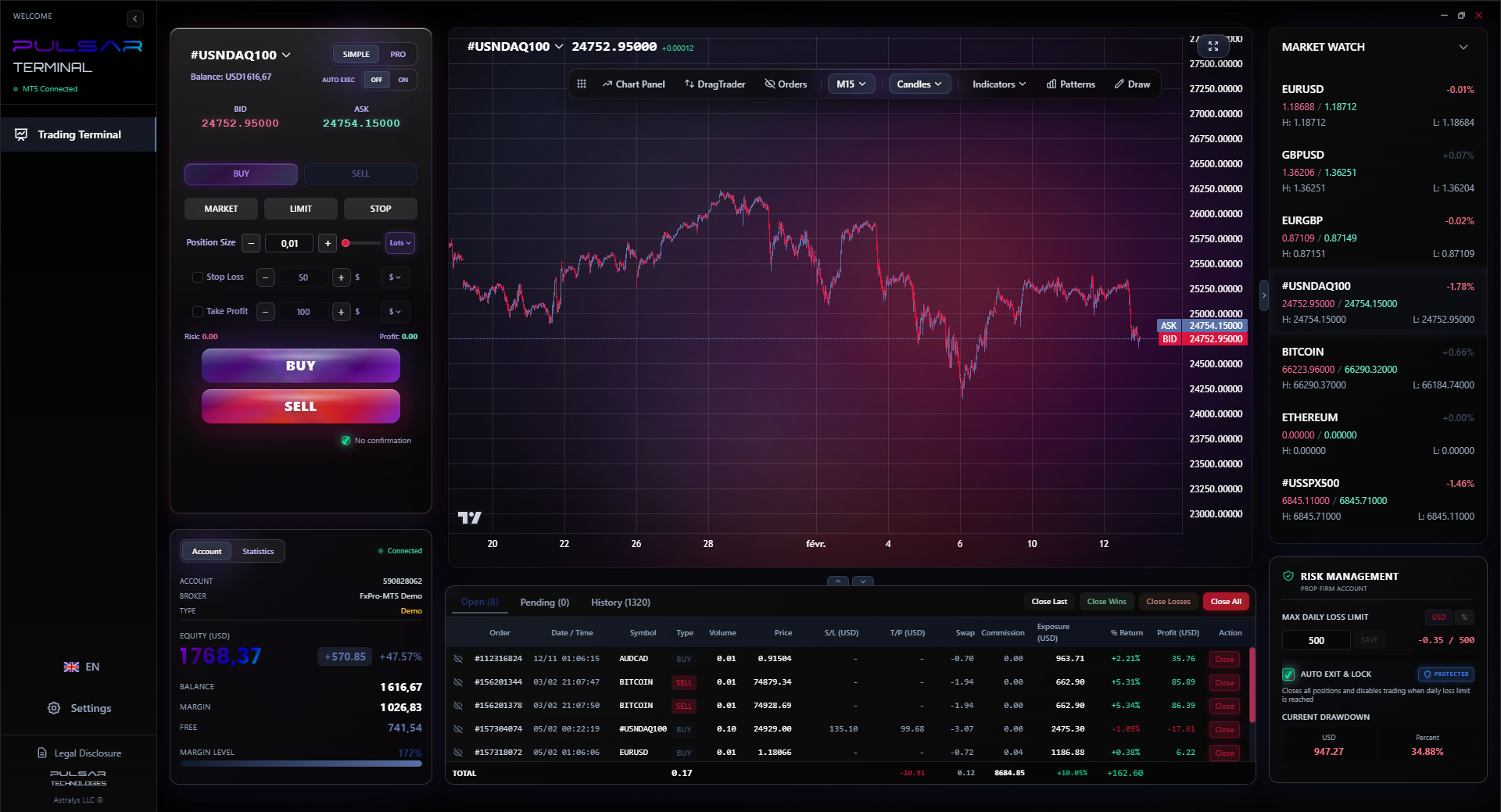
Managing multiple trades and strict stop-losses manually is stressful and error-prone, which is where a tool like Pulsar Terminal automates these tasks directly on your MT5 platform.
Pulsar Terminal
MT5オールインワンツール:ドラッグ&ドロップ注文、マルチTP/SL、トレーリングストップ、グリッドトレード、出来高プロファイル、プロップファーム保護。毎日1,000人以上のトレーダーが利用。
“Your biggest enemy is in the mirror. Greed, fear, and impatience will destroy your account faster than a bad strategy.”
Here's a step-by-step plan to structure your learning without spending a kobo.
Weeks 1-4: Foundation
- Complete the Babypips.com 'School of Pipsology.' 30 minutes a day.
- Open a demo account with a broker like IC Markets. Don't trade yet. Just get familiar with the platform.
- Watch Mark Douglas's psychology videos.
Weeks 5-8: Skill Building
- Deep dive into price action. Watch Rayner Teo's videos and practice identifying support/resistance on your demo charts.
- Learn one simple strategy (e.g., the pin bar reversal at support/resistance).
- Start paper trading this one strategy on your demo account. Execute 50 trades. Journal every one.
Weeks 9-12: Integration & Refinement
- Analyze your demo trade journal. What was your win rate? Your average win vs. average loss?
- Refine your entry rules based on what you observed.
- Formalize your full trading plan: Instrument, Time Frame, Entry Rules, Exit Rules (Stop-Loss & Take-Profit), Risk Per Trade (1%).
- Begin a second demo account and trade only this plan for another 50 trades. If you are consistently profitable, you may consider a small live account (e.g., $50).
This structured approach turns scattered free information into a coherent best free forex course. The value isn't in paying for secrets, it's in the disciplined application of public knowledge.
💡 ウィンストンのヒント
The data on your phone is a business expense. Track it. A strategy that needs constant chart watching might not be viable if your data bill is ₦5,000 a week.
“Consuming information isn't trading. You now have the bricks, but you need to build a house.”
After years of trading, I've only paid for two types of resources: advanced technical tools and time-saving software. The foundational education should always be free.
Consider a paid platform or advanced tool only after you have a proven, profitable strategy on a demo account. For example, a tool that helps you backtest your ideas faster or scan multiple charts for your specific setup can be worth it. It's an efficiency purchase, not an education purchase.
Never pay for signals. Ever. If someone could reliably predict the market, they'd be trading with their own billions, not selling signals for ₦5,000 a month. I subscribed to two different signal services early on. Both lost money over a 3-month period when I tracked their results objectively.
The only 'course' worth potentially paying for later in your journey is a very niche, advanced topic not covered in free material - like advanced order flow analysis or deep options strategies (if you branch out). For 99% of beginners, the free curriculum I've outlined is more than sufficient to build a solid foundation for a lifetime of trading.
FAQ
Q1Is Babypips.com really enough to learn forex?
Babypips provides the essential textbook knowledge - the 'what' and 'why.' It's necessary but not sufficient. You must combine it with practical price action study (like free YouTube content) and, most importantly, demo trading practice to learn the 'how.' Think of Babypips as your theory class, and chart time as your lab work.
Q2How long should I use a demo account before going live?
Until you are consistently profitable over at least 100 trades and across different market conditions (ranging and trending). For most people, this takes 3-6 months of serious practice. Going live too early is the most common reason people blow their first account. The demo account is your training ground. Don't rush off it.
Q3What's a realistic monthly return I should aim for as a beginner?
If you aim for 2-5% consistent return per month, you are thinking correctly. Anyone promising you 20% or more per month is lying or taking insane risks. A 5% monthly return, compounded, doubles your account in about 14 months. That's an excellent, sustainable goal. My first year of real profitability was around 11% total for the year.
Q4Can I trade forex successfully in Nigeria with just my smartphone?
Yes, you can, but it has limitations. Execution and chart analysis are harder on a small screen. It's fine for managing longer-term swing trades, but for active day trading or scalping, a computer is far superior. Also, be very mindful of your mobile data costs, as they can eat into your profits.
Q5Are there any truly free forex courses that don't try to sell me anything?
Yes. The combination I outlined - Babypips (foundations), Rayner Teo on YouTube (price action), and Mark Douglas (psychology) - is completely free with no upsell if you access them directly. Their business models are based on advertising or selling books, not on pressuring you into expensive mentorship programs.
Q6How much money do I need to start a live forex account in Nigeria?
You can start with as little as $50 (about ₦70,000) with some international brokers. However, I strongly recommend starting with at least $200-$500. This allows for proper position sizing and withstands normal drawdowns without immediately risking a margin call. Remember, you're paying for an education. That initial capital is tuition. Protect it.
ウィンストン教授のレッスン
重要ポイント:
- ✓Master the free core curriculum first: mechanics, price action, risk, psychology.
- ✓Always risk a maximum of 1-2% of your capital per trade.
- ✓Test any strategy for 100+ trades on demo before going live.
- ✓Aim for consistent 2-5% monthly returns, not get-rich-quick schemes.
- ✓Choose a Nigeria-friendly broker with reliable deposits/withdrawals.
この記事はどれくらい役に立ちましたか?
星をクリックして評価
週刊トレーディングインサイト
無料の週刊分析&戦略。スパムなし。
著者について
Olumide Adeyemi
西アフリカ・トレーディングの先駆者
ナイジェリアで最もアクティブなFXトレーディング教育者の一人。ラゴスから8年のトレード経験。アフリカのトレーダー向けの少額資金戦略とプロップファームチャレンジを専門とする。
コメント
リスク警告
金融商品の取引には大きなリスクが伴い、すべての投資家に適しているわけではありません。過去の実績は将来の結果を保証するものではありません。本コンテンツは教育目的のみであり、投資助言として解釈すべきではありません。取引前に必ずご自身で調査を行ってください。
こちらもおすすめ

Cara Trading Forex Sukses: 7 Prinsip dari Trader Profesional
Cara trading forex sukses dengan 7 prinsip trader pro: manajemen modal, disiplin, journal trading, backtest. Data nyata, bukan janji profit palsu.
Jam Trading Forex Terbaik untuk Trader Indonesia: Panduan Lengkap dengan Tabel Waktu
Panduan jam trading forex untuk trader Indonesia. Tabel 4 sesi dunia, jam emas 20:00-00:00, sesi mana yang harus dihindari. Data akurat + tips dari trader berpengalaman.
Top 5 Sàn Forex Uy Tín Nhất 2026: Review Jujur dari Trader Indonesia
Top 5 sàn forex uy tín 2026 untuk trader Indonesia. Review jujur: spread, deposit, withdraw, dukungan lokal. Exness, XM, IC Markets & lebih.
