


It was 10:15 PM AEST on a Tuesday.
Sarah Collins
トレーディングストラテジスト ·  Australia
☕ 10 分で読める
学べること:
It was 10:15 PM AEST on a Tuesday. My screen was a sea of red and green, the EUR/USD whipsawing in a 40-pip range every few minutes. I was trying to scalp the London/New York overlap, and my heart was pounding. I took three trades in fifteen minutes. Two were stopped out for a $120 loss. The third, a desperate long, somehow caught a momentum spike and netted me $95. I finished the session down $25, exhausted, and with a crystal-clear lesson: knowing the best time to trade forex in Australia isn't about finding the most action, it's about finding the right action for you. Let's break down what that actually means, from Sydney open to the late-night volatility, and how to not get chewed up by it.
Trading from Australia gives you a unique front-row seat. The Sydney session kicks off the global trading week, which means we get the first crack at setting the tone. But that's a double-edged sword. Early Monday moves can be erratic, driven by weekend news gaps. The real juice for us locals comes from understanding how our timezone interacts with the big three: Tokyo, London, and New York.
Our market is tightly wrapped by the Australian Securities and Investments Commission (ASIC). They're not messing around. After the 2021 reforms, retail use is capped at 30:1 for majors like the EUR/USD. That's a 3.33% margin requirement. It feels restrictive if you're used to the old 500:1 days, but I've seen it save more accounts than it's hurt. They also banned those dodgy deposit bonuses, which were always a trap anyway. The good news? ASIC's rules mean your money is with serious operators. Brokers need a million bucks in capital and must keep your funds segregated. You can check our deep dives on brokers like Pepperstone or IC Markets to see how they stack up under these rules.
The star of our local show is the AUD/USD, the 'Aussie'. It's a commodity currency, so it dances to the tune of iron ore prices, Chinese economic data, and global risk sentiment. When traders are feeling brave, they buy the Aussie. When they panic, they sell it. It's that simple, and that complex.

💡 ウィンストンのヒント
The Sydney open isn't for action, it's for intelligence. Watch the first 90 minutes to see how the market absorbs the weekend's news - it tells you the real sentiment.
“Knowing the best time to trade isn't about finding the most action, it's about finding the right action for you.”
All times are in Australian Eastern Standard Time (AEST). Remember, when Daylight Saving kicks in (first Sunday in Oct to first Sunday in Apr), everything shifts forward by one hour to AEDT. Your trading platform's server time is your bible, not your wall clock.
Sydney Session (7:00 AM – 4:00 PM AEST)
This is our session. Liquidity starts building here, primarily in AUD, NZD, and JPY pairs. It's often quieter than London or New York, but that can be a good thing. Trends established here can get a second wind when Tokyo joins. I use this session more for analysis and setting up watchlists than for frantic trading. The AUD/USD and AUD/JPY are your main actors here.
Tokyo Session (9:00 AM – 6:00 PM AEST)
The overlap with Sydney (9 AM - 4 PM) is the Asia-Pacific power hour. You'll see decent movement, especially if Japanese economic data drops. It's a more technical session often. I find breakouts that happen here can be false if they're not confirmed by London later.
London Session (5:00 PM – 2:00 AM AEST)
The big dog. This is when volume seriously picks up. Most of the world's forex transactions flow through London. All the major pairs come alive. If you're only going to trade one session, make it this one. The spreads on EUR/USD and GBP/USD tighten right up. This is prime time for any swing trading setups you've been eyeing.
New York Session (10:00 PM – 7:00 AM AEST)
The overlap with London (10 PM - 2 AM AEST) is the most volatile period of the entire 24-hour cycle. This is when I made that messy scalp I mentioned earlier. US economic data releases happen here, causing massive spikes. It's high reward, but the risk of getting stopped out by noise is enormous. After London closes at 2 AM, things quiet down fast.
“The London/NY overlap is where most new traders blow up. They see the big candles and jump in, only to get reversed by a single large order.”
This is the heart of finding the best time to trade forex in Australia. Overlaps mean more traders are active, which means more liquidity and tighter spreads. But more volume also means more volatility. You need to match the overlap to your strategy.

Example: On a typical day, the EUR/USD spread might be 0.8 pips during the Sydney session. During the London/New York overlap, that can crush down to 0.2 pips or less on a good ECN account. That's a 75% reduction in your immediate cost.
Here’s the breakdown of the key windows:
| Overlap Period (AEST) | Characteristics | Best For | Pairs to Watch |
|---|---|---|---|
| Sydney/Tokyo<br>9:00 AM – 4:00 PM | Steady, trend-building action. Good for Asia-Pacific fundamentals. | Swing position entries, analyzing early weekly direction. | AUD/USD, AUD/JPY, NZD/USD, USD/JPY |
| Tokyo/London<br>5:00 PM – 6:00 PM | Short but often sweet. The handoff from Asia to Europe can see a momentum shift. | Quick, directional plays if a clear break occurs. | EUR/JPY, GBP/JPY (the 'Yen crosses') |
| London/New York<br>10:00 PM – 2:00 AM | Peak volatility and liquidity. The market is most 'efficient' but also most chaotic. | Short-term scalping, news trading, catching big momentum moves. | All Majors, especially EUR/USD, GBP/USD, USD/JPY |
My brutal honesty? I stopped trying to scalp the London/NY overlap years ago. The speed and noise didn't suit my psychology. I now use that window to manage existing positions - moving stops to breakeven or taking partial profits - because the liquidity ensures I get a clean fill. My main trading happens in the London session alone, between 5 PM and 10 PM AEST. The trend is usually established, the spread is tight, but the manic energy hasn't hit yet.

Warning: The London/NY overlap is where most new traders blow up. They see the big candles and jump in, only to get reversed by a single large order. If you trade here, your position size calculator is your most important tool. Halve your normal size until you're consistently profitable.
💡 ウィンストンのヒント
If you must trade the 10 PM overlap, trade half your normal size. The volatility doubles the noise, which doubles the chance of a stupid mistake.
“The London/NY overlap is where most new traders blow up. They see the big candles and jump in, only to get reversed by a single large order.”
You can't talk about trading in Australia without dealing with ASIC's reality. Their 2021 rulebook didn't just change use, it changed when and how certain strategies are viable.
The 30:1 use cap (20:1 for minors, 10:1 for gold) means you need more capital to hold the same position size. This directly impacts strategies that rely on holding trades across multiple sessions. Let's say you're a swing trader eyeing a multi-day move on the AUD/NZD. With lower use, your margin requirement is higher, which ties up more of your capital. It makes you more selective. You can't afford to have five swing trades open at once unless you have a very large account.
This pushed me, and many traders I know, towards shorter timeframes during high-liquidity hours. Why? Because if you need to be more capital-efficient, you might aim for smaller, more frequent gains when spreads are tightest to maximize your edge. It inadvertently encourages more activity during the London and overlap sessions.
The negative balance protection is a lifesaver, but don't let it make you complacent. Just because you can't owe the broker money doesn't mean a series of 2% losses won't destroy your account. And the bonus ban? Thank ASIC for that. It forces you to choose a broker on execution and costs, not on a fake cash incentive. When reviewing brokers like XM or Exness for the Australian market, I now look purely at spread consistency during my trading hours and commission structures.
“Trade the chart, not your passport. Being a patriotic trader is a sure way to lose money.”
Trading your home currency has advantages. You feel the economic news intuitively. You know when consumer confidence is in the toilet. Use that.
The AUD/USD is a risk barometer. I have a simple, non-negotiable rule: I never go long AUD/USD if the S&P 500 futures are tanking. It just doesn't work. The correlation isn't 100%, but it's strong enough to be a primary filter.
Here's a real trade from last quarter. Iron ore prices were holding strong above $115/tonne, but China PMI data was due. I waited for the London session (5:30 PM AEST) for better liquidity. The data came in slightly better than expected. I bought AUD/USD at 0.6580. My stop was at 0.6540 (40 pips, a 1.2% risk on my account using the 30:1 max use). I didn't use the max, I used 15:1. I took half off at 0.6630 (+50 pips) and let the rest ride with a trailing stop. It got taken out at 0.6610 for a net gain of about 0.7% on the total risk. Boring? Maybe. Profitable? Yes.

Pro Tip: The AUD/JPY is often a cleaner trend follower than AUD/USD. It amplifies the risk-on/risk-off dynamic. Use the MACD indicator on the 4H chart to gauge momentum direction for swing trades on this pair.
The worst thing you can do is become a patriotic trader - always wanting the Aussie to go up. I've made that mistake. In 2022, I held a long AUD/USD position through a series of hawkish Fed comments because I was 'sure' the RBA would catch up. It didn't, and I gave back a month's gains. Trade the chart, not your passport.
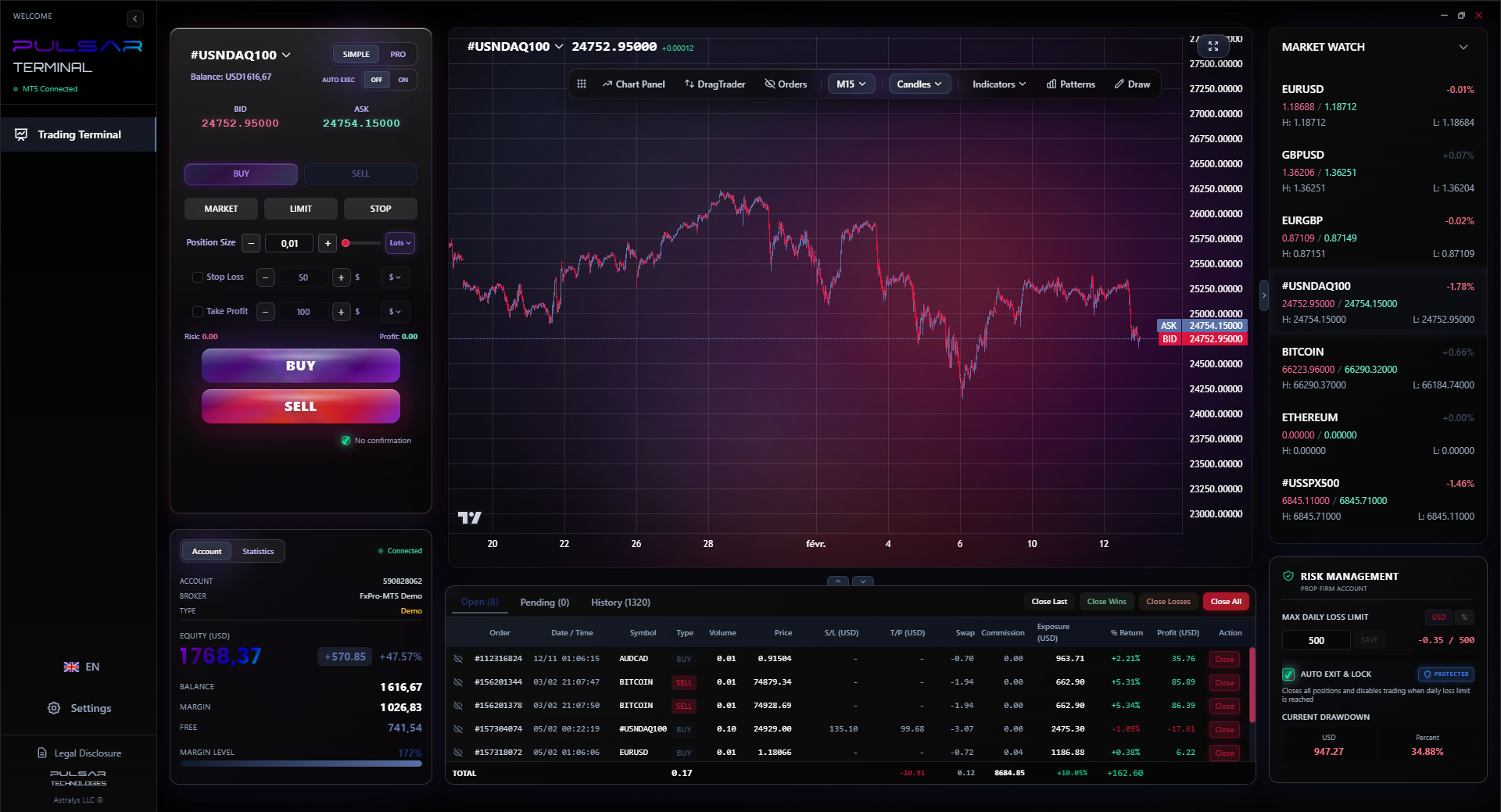
Managing multiple trades across different sessions is complex, but a tool like Pulsar Terminal lets you set multi-level take-profits and trailing stops on MT5 before you even go to bed, automating your strategy for the volatile overlaps.
Pulsar Terminal
MT5オールインワンツール:ドラッグ&ドロップ注文、マルチTP/SL、トレーリングストップ、グリッドトレード、出来高プロファイル、プロップファーム保護。毎日1,000人以上のトレーダーが利用。
“Trade the chart, not your passport. Being a patriotic trader is a sure way to lose money.”
Your broker choice is critical to exploiting the best times. You need two things: 1) Rock-solid execution during peak hours, and 2) A cost structure that doesn't eat your edge.
During the 10 PM-2 AM overlap, I've had brokers' platforms lag or requote me into a loss. That's unacceptable. Look for brokers with Tier-1 bank liquidity and a reputation for handling volume. This is where our reviews of IC Markets and Pepperstone are worth your time - they're built for this.
Account type matters. If you're trading the volatile overlaps, a Raw/ECN account with a commission and razor-thin spreads is usually better. The spread might be 0.0, but you pay $3.50 per lot per side. If you're a longer-term trader in the Sydney session, a standard account with a slightly higher but all-in spread might be simpler.
Check their local support hours. If your platform glitches at midnight, do you get a chatbot or a real person? Funding matters too. The best brokers offer instant, fee-free AUD deposits via PayID or POLi. You shouldn't be losing money on currency conversion before you even place a trade.
💡 ウィンストンのヒント
Set your chart to AEST or GMT. Never trade on 'local' time if your brain has to convert it. One less point of failure.
“Your trading schedule is a non-negotiable contract with your profitability. Stick to it.”
So, what's the best time to trade forex in Australia? The answer is: when it fits your life and your strategy.
The Part-Time Trader (9-5 Job): Your golden hours are the London session, from 5 PM to 10 PM AEST. It's active, liquid, and you can be fully focused. Forget the NY overlap; you need sleep. The Sydney open (7 AM) might offer 30 minutes of analysis before work.
The Full-Time Trader: You have more flexibility, but you need discipline more. You could trade the Sydney/Tokyo overlap for AUD setups, analyze during the quiet afternoon, and then execute in London. Only venture into the NY overlap if your strategy is specifically designed for that chaos.
The Weekender (Swing Trader): Your focus should be on the session transitions. Place orders before the Tokyo or London opens to catch breakouts from the Asian range. Your main job is analysis on Sunday evening and order management at the London open (5 PM AEST).
My schedule now? I'm at my desk by 4:30 PM AEST. I review my swing positions, check the Asian session price action, and plan for London. I'm actively trading from about 5:30 PM to 9:00 PM. I then set any stops or limit orders for the NY session and walk away. My computer is off by 10 PM. This routine saved my sanity and my account. Find yours, and stick to it like your profit depends on it - because it does.
FAQ
Q1What is the most volatile time to trade forex in Australia?
The most volatile period is the London/New York overlap, from 10:00 PM to 2:00 AM Australian Eastern Standard Time (AEST). This is when the highest volume of trades occurs, leading to big, fast moves. It's also the riskiest time for new traders.
Q2Can I trade forex 24/7 from Australia?
No. The forex market is open 24 hours a day, but only from 5:00 PM Monday AEST to 5:00 PM Friday AEST (when New York closes). The weekend is closed. While you can place orders anytime with some brokers, live pricing and execution only happen during that weekly window.
Q3How does Daylight Saving Time affect forex trading hours in Australia?
It shifts everything by one hour. From early October to early April, Australian Eastern Daylight Time (AEDT) is in effect. All session times move one hour later. For example, the London/New York overlap runs from 11:00 PM to 3:00 AM AEDT. Always check your trading platform's server time, which is usually set to GMT or AEST.
Q4Is the Sydney session good for trading?
It's good for specific things. It's excellent for trading the AUD and NZD pairs, and for establishing the early week's direction. It's generally less volatile than London, which can be better for calmly entering swing trades. It's not great for scalping the EUR/USD, as spreads are wider and moves can be choppy.
Q5What is the best pair to trade during the Australian session?
The AUD/USD is the obvious choice, as it's the local major. The AUD/JPY and NZD/USD also see strong activity. Focus on pairs where the AUD, NZD, or JPY are the base or quote currency, as these are the focal points of the Asia-Pacific region.
Q6Why are my spreads so high sometimes?
Spreads widen during low-liquidity periods. The worst times are usually after the New York close (from ~5:00 AM AEST) until the Sydney session properly kicks in, and during major news releases. If you're seeing consistently high spreads during peak overlap times, you might need a better broker with access to deeper liquidity pools.
Q7Does ASIC's 30:1 use limit apply to all accounts?
It applies to all retail client accounts. Some brokers offer 'professional' client status if you meet certain criteria (like large portfolio size and trading experience), which can come with higher use. However, you lose certain protections like negative balance protection. For most traders, you're working with the 30:1 cap.
ウィンストン教授のレッスン
重要ポイント:
- ✓London Session (5-10 PM AEST) offers the best balance of liquidity and sanity.
- ✓The 10 PM-2 AM overlap is peak volatility - trade smaller or just manage positions.
- ✓ASIC's 30:1 use forces better capital and risk management.
- ✓Always match your session choice to your strategy, not the other way around.
この記事はどれくらい役に立ちましたか?
星をクリックして評価
週刊トレーディングインサイト
無料の週刊分析&戦略。スパムなし。
著者について
Sarah Collins
トレーディングストラテジスト
ロンドン拠点のトレーディングストラテジスト、金融市場で12年の経験。シティ・オブ・ロンドンの証券会社で元アナリスト。GBPペア、欧州市場、FCA規制下の取引を担当。
コメント
リスク警告
金融商品の取引には大きなリスクが伴い、すべての投資家に適しているわけではありません。過去の実績は将来の結果を保証するものではありません。本コンテンツは教育目的のみであり、投資助言として解釈すべきではありません。取引前に必ずご自身で調査を行ってください。
こちらもおすすめ

Cara Trading Forex Sukses: 7 Prinsip dari Trader Profesional
Cara trading forex sukses dengan 7 prinsip trader pro: manajemen modal, disiplin, journal trading, backtest. Data nyata, bukan janji profit palsu.
Jam Trading Forex Terbaik untuk Trader Indonesia: Panduan Lengkap dengan Tabel Waktu
Panduan jam trading forex untuk trader Indonesia. Tabel 4 sesi dunia, jam emas 20:00-00:00, sesi mana yang harus dihindari. Data akurat + tips dari trader berpengalaman.
Top 5 Sàn Forex Uy Tín Nhất 2026: Review Jujur dari Trader Indonesia
Top 5 sàn forex uy tín 2026 untuk trader Indonesia. Review jujur: spread, deposit, withdraw, dukungan lokal. Exness, XM, IC Markets & lebih.
