


Most traders overcomplicate chart analysis with dozens of indicators, but the truth is, you can throw 90% of them away.

Olumide Adeyemi
西アフリカ・トレーディングの先駆者 ·  Nigeria
☕ 11 分で読める
学べること:
- 1What Is a Candlestick, Really?
- 2The Handful of Patterns That Actually Work
- 3Where I Went Wrong (So You Don't Have To)
- 4Building a Simple, Profitable Candle Stick Strategy
- 5Combining Candlesticks with Other Tools (The Right Way)
- 6The Psychology Behind the Patterns
- 7Your Action Plan: From Theory to Practice
Most traders overcomplicate chart analysis with dozens of indicators, but the truth is, you can throw 90% of them away. The real story of price is told in the raw, unfiltered language of candle sticks in forex. I spent years and lost a decent chunk of capital trying to find a 'better' system before I finally accepted that the market was screaming its intentions at me through these simple bars. This guide isn't about memorizing a hundred patterns. It's about learning the five or six that actually matter and, more importantly, understanding the psychology behind them so you can trade with conviction.
Forget the textbook definition for a second. A candlestick isn't just a data point. It's a snapshot of a battle. It shows you who won the fight for that specific period - whether it was a 1-minute skirmish or a daily war. The body shows you the opening and closing price. The wicks (or shadows) show you the extreme highs and lows where the price was rejected.
A long green (or white) body tells you the buyers were in control from open to close. A long red (or black) body means the sellers dominated. That's your first clue. But the real gold is in the wicks. A long upper wick on a red candle? That tells you buyers tried to push price up during the period, but sellers slammed it back down by the close. That's a sign of selling pressure, even if the candle closed near its open.

Example: Let's say EUR/USD opens a 1-hour candle at 1.0850. It rallies up to 1.0875, gets sold off hard, and closes at 1.0840. The candle will have a small red body (1.0850 to 1.0840) but a very long upper wick (from 1.0840 up to 1.0875). That wick is a story of failed bullish momentum.
I used to ignore wicks, focusing only on whether a candle closed up or down. Big mistake. Some of my most reliable reversal signals come from candles with tiny bodies and massive wicks. They represent indecision and rejection, which often precedes a big move.

💡 ウィンストンのヒント
A candle's close is its most important price. The wicks show the war, but the close tells you who won the battle for that period.
“A candlestick isn't just a data point. It's a snapshot of a battle.”
You can find lists of 50+ candlestick patterns online. Don't bother. In my 12 years, I've found consistent profitability with just a few. The key is context. A bullish pattern in a strong downtrend is usually a trap.
The Pin Bar (Hammer/Shooting Star)
This is my personal favorite. It's a single candle with a small body and a very long wick on one side. A hammer has a long lower wick and forms at a support level. It screams, "Sellers pushed price down, but buyers absorbed all that selling and pushed it back up!" A shooting star is the opposite: a long upper wick at resistance. I look for these after a clear move, not in choppy markets.
The Engulfing Pattern
This is a two-candle reversal pattern. A bullish engulfing happens when a green candle's body completely 'engulfs' the body of the previous red candle. It shows a dramatic shift in momentum from sellers to buyers. The bearish version is the opposite. The bigger the engulfing candle, the stronger the signal. But be careful. I've been caught many times taking an engulfing pattern in the middle of a range - it just leads to whipsaws.
The Doji
A doji has virtually the same open and close, creating a tiny body. It represents pure indecision. A doji after a strong trend can be a warning sign that the trend is running out of steam. Don't trade it alone. Wait for the next candle to confirm the direction. A doji followed by a big red candle? That's your sell signal.
Inside Bar
This is a consolidation pattern. The entire range (high to low) of an inside bar is contained within the range of the previous bar (the 'mother bar'). It shows a pause, a coiling of energy. I use it as a signal that a big breakout is coming, but I never try to guess the direction. I wait for the breakout and then trade in that direction. This pattern is core to many swing trading approaches.
Here’s a quick comparison of when these patterns are most effective:
| Pattern | Best Context | What It Signals |
|---|---|---|
| Pin Bar | At clear support/resistance after a move | Strong rejection of price level |
| Engulfing | Start of a new momentum move | Complete shift in control |
| Doji | After a strong trend run | Indecision, potential exhaustion |
| Inside Bar | During a period of consolidation | Impending volatility/breakout |
“You can find lists of 50+ candlestick patterns online. Don't bother.”
My early trading journals are a graveyard of failed candlestick trades. Here’s what I was doing wrong, presented with painful honesty.
Mistake 1: Trading Every Pattern, Everywhere. I’d see a hammer on a 5-minute chart in the middle of the London session chop and jump in. Result? A quick stop-out. Candlesticks need a story. A hammer at a major daily support level that’s held for weeks? That’s a story. A hammer in a random spot is just noise. I learned to only trade patterns that aligned with higher-timeframe structure.
Mistake 2: Ignoring the Wick-to-Body Ratio. I once took a ‘bullish engulfing’ where the green candle had a huge upper wick. The body engulfed the previous candle, sure, but the long wick showed massive rejection at the top. Price reversed immediately. Now, if the engulfing candle has a wick longer than its body, I treat it with extreme suspicion. The close is what matters most.
Mistake 3: Not Using a Stop Loss. This one hurts to admit. I saw a perfect-looking pin bar at a key level on GBP/USD. I was so confident I didn’t place a stop. The pattern ‘failed,’ and I watched my loss grow, hoping it would come back. It didn’t. I lost 2.3% of my account on one stupid trade. Every single candle pattern trade must have a stop loss placed beyond the extreme of the pattern’s wick. No exceptions. Understanding your position size calculator is useless if you don't respect your stop.
Mistake 4: Chasing the Tail of a Pin Bar. If a pin bar’s wick is 50 pips long, entering right at the close of that candle means your stop has to be 50+ pips away. That destroys your risk-to-reward. I learned to be patient. Wait for a small pullback into the body of the pin bar to enter. This gives you a tighter stop and a much better risk setup. It requires patience, but it saves capital.
“You can find lists of 50+ candlestick patterns online. Don't bother.”
Let’s get practical. Here’s a stripped-down framework I’ve used successfully on pairs like EUR/USD and XAU/USD. This isn't a holy grail, but it's a strong starting point.
Step 1: Find the Story on the Higher Timeframe. Start on the daily or 4-hour chart. Is price in a clear uptrend, downtrend, or range? Identify the key support and resistance levels. Never trade a 15-minute candle pattern against the daily trend direction unless you see overwhelming evidence.
Step 2: Wait for Price to Reach a Key Level. Let price come to a major support/resistance zone, a trendline, or a moving average that has reacted before. This is your stage.
Step 3: Switch to Your Entry Timeframe and Look for the Pattern. I typically use the 1-hour or 15-minute chart for entries. Wait for a clear pin bar, engulfing, or inside bar to form at that key level. The pattern should make sense with the higher-timeframe story (e.g., a bullish pin bar at daily support).
Step 4: Execute with Discipline.
- Entry: For a bullish pin bar, I might buy on a small pullback into the upper half of the candle's body.
- Stop Loss: Place your stop just beyond the extreme of the pattern's wick. For a bullish pin bar, that's below the low of the wick.
- Take Profit: Aim for a minimum 1:1.5 risk-to-reward. Look for the next logical resistance level to take profit. You can use a tool like a trailing stop to let winners run, a feature that platforms like Pulsar Terminal can automate on MT5.
A Real Trade Example: On March 15th, EUR/USD was approaching a strong daily support at 1.0720. On the 1-hour chart, it formed a clear bullish engulfing candle right at that level. I entered long at 1.0735 after a tiny pullback. Stop at 1.0709 (below the engulfing candle's low). Target was the previous minor resistance at 1.0780. The trade hit target in about 8 hours for a 45-pip gain. Risk was 26 pips. Not a home run, but a clean, high-probability play. The MACD indicator on the 4-hour chart was also showing bullish divergence, which added to my conviction.

Warning: This strategy will have losing trades. A pattern at a key level is a high-probability setup, not a guarantee. Your job is to manage risk so that the winners outweigh the losers over time. A string of losses can trigger a margin call if you're over-leveraged.
💡 ウィンストンのヒント
If you can't instantly see the pattern, it's not there. The strongest signals are obvious and don't require squinting at the chart.
“My early trading journals are a graveyard of failed candlestick trades.”
Candlesticks are your primary language, but sometimes you need a second opinion. The trick is to use tools that don't repaint or lag too much, so they confirm the story the candles are telling.
Support and Resistance: This is candlestick analysis's best friend. A doji or pin bar is meaningless in a vacuum. At a level that has caused reversals three times before? That's powerful. I draw my levels on higher timeframes and watch how candles react to them.
Volume: While true volume is tricky in forex, you can use tick volume or the volume profile tool on some platforms. A bullish engulfing pattern with high 'volume' is far more convincing than one with low volume. It shows real participation in the reversal.
A Simple Moving Average: I sometimes use a 20 or 50-period EMA to define the trend. If price pulls back to the EMA in an uptrend and forms a bullish hammer, that's a classic continuation setup. The EMA acts as dynamic support.
What NOT to Combine Them With: Avoid layering on five different oscillators like RSI indicator, Stochastic, and CCI. You'll get conflicting signals and end up paralyzed. I made this mistake early on. Pick one, maybe two, complementary tools. Candlesticks should always be the final arbiter for your entry. A good broker with clean charts, like IC Markets or Pepperstone, makes spotting these combinations much easier.
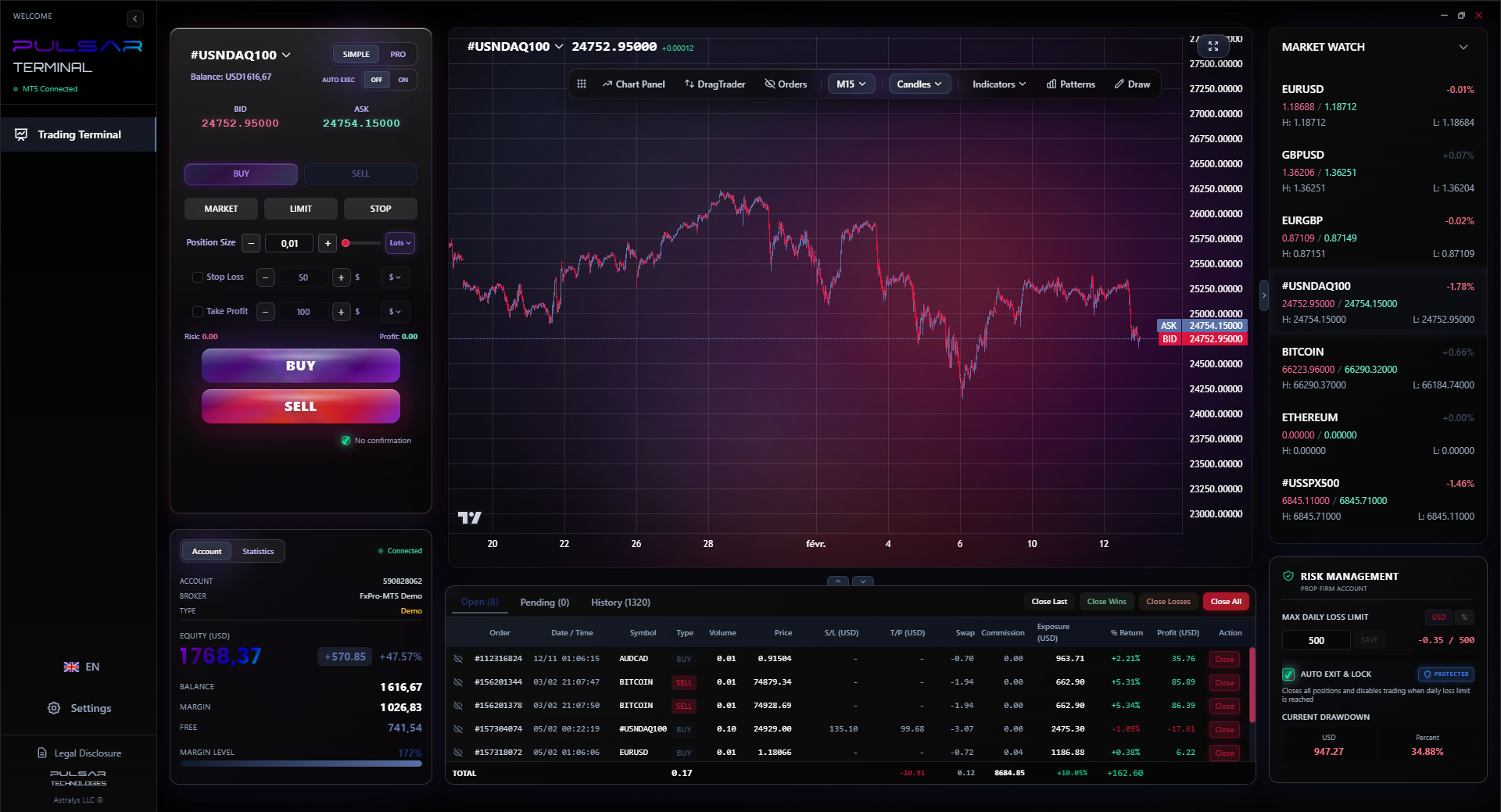
Managing multiple take-profit levels on a high-probability pin bar trade is simpler with tools that allow for partial closures and automated order management.
Pulsar Terminal
MT5オールインワンツール:ドラッグ&ドロップ注文、マルチTP/SL、トレーリングストップ、グリッドトレード、出来高プロファイル、プロップファーム保護。毎日1,000人以上のトレーダーが利用。
“My early trading journals are a graveyard of failed candlestick trades.”
This is what separates a chart reader from a trader. Every candle pattern represents a shift in market sentiment, a moment of fear or greed.
Think about a long-legged doji after a rally. The price shot up (bulls excited), then sold off hard (profit-taking/fear), then rallied again, and closed near the open. That candle tells you the bulls and bears fought to a standstill. The next candle reveals who won that battle and exhausted the other side.
A large bullish marubozu (a candle with no wicks) that closes at its high shows unrelenting buying pressure from open to close. There was never a moment where sellers had the upper hand. That's pure greed and FOMO driving price.
When you start seeing candles as emotional footprints, you stop guessing and start understanding. You'll begin to anticipate what pattern might form next. For instance, if price is stalling at a high with a series of small candles with upper wicks, you can sense a shooting star or bearish engulfing is coming. This understanding is critical for styles like scalping strategy, where reading intra-session sentiment is key.
💡 ウィンストンのヒント
Trade the pattern's failure. If a textbook bullish pin bar forms and price immediately breaks below its low, that's a powerful bearish signal in itself.
“When you start seeing candles as emotional footprints, you stop guessing and start understanding.”
Reading about candle sticks in forex is one thing. Making them work for you is another. Here's your homework.
- Go on a Demo Diet: For the next month, only trade based on candlestick patterns at key levels. Turn off all other indicators. Use a demo account from a broker like XM or Exness to practice risk-free. Your goal isn't profit, it's pattern recognition.
- Keep a Pattern Journal: Every day, mark up your charts. Find three potential setups based on what you've learned. Note the pattern, the context (trend, level), and what you would have done. Review it weekly. You'll be shocked at how quickly you improve.
- Start Small: When you go live, trade the smallest position size possible. Your goal for the first 20 trades is to execute your plan perfectly - entry, stop, target - not to make money. The money will follow the process.
- Master One Pattern First: Don't try to trade pin bars, engulfing patterns, and inside bars all at once. Spend two weeks only looking for and trading high-quality pin bars. Then move to the next. Depth beats breadth every time.
Candle sticks in forex gave me the confidence to stop following other people's signals and start reading the market myself. They turned the chaotic squiggles on a screen into a clear narrative of fear, greed, and opportunity. It's a skill that, once earned, never leaves you.
FAQ
Q1What is the best time frame for candlestick analysis in forex?
There's no single 'best' frame. Use multiple. I use the daily/4-hour to find the trend and key levels (the story), and the 1-hour or 15-minute to find and execute based on the candle patterns (the entry). Trading a 5-minute pin bar against the daily trend is usually a losing game.
Q2How reliable are candlestick patterns alone?
In isolation, not very. Their reliability skyrockets when they form at confluent areas like major support/resistance, trendlines, or with a technical indicator showing divergence. A hammer in the middle of nowhere is noise. A hammer at a 6-month support level is a high-probability signal.
Q3Can I use candlestick patterns for scalping?
Absolutely. In fact, many scalping strategy pros rely heavily on 1-minute and 5-minute candle patterns, especially inside bars and pin bars at intraday liquidity levels. The principles are the same, but speed and execution discipline are even more critical.
Q4What's the difference between a pin bar and a doji?
Both have small bodies, but the message is different. A pin bar has one very long wick, showing strong rejection from a price level. A doji has roughly equal upper and lower wicks, showing pure indecision and a battle between bulls and bears that ended in a stalemate.
Q5Do candlestick patterns work on all forex pairs?
They work on any liquid market, but they tend to be cleaner on major pairs like EUR/USD or GBP/USD that have high liquidity and lower spreads. On exotic pairs with wider spread definition and erratic moves, patterns can be more distorted and less reliable.
Q6How many pips should a candlestick pattern be?
It's not about a fixed pip size. It's about proportion relative to recent candles. A valid pin bar should have a wick at least 2-3 times the length of its body. A significant engulfing pattern should clearly swallow the previous candle, not just nick its edges.
ウィンストン教授のレッスン
重要ポイント:
- ✓Master the Pin Bar, Engulfing, Doji, and Inside Bar first.
- ✓Only trade patterns at confluent support/resistance levels.
- ✓Always place your stop loss beyond the pattern's extreme wick.
- ✓A pattern's reliability depends 80% on its location on the chart.
- ✓Use higher timeframes (4H/Daily) for direction, lower for entry.
この記事はどれくらい役に立ちましたか?
星をクリックして評価
週刊トレーディングインサイト
無料の週刊分析&戦略。スパムなし。
著者について
Olumide Adeyemi
西アフリカ・トレーディングの先駆者
ナイジェリアで最もアクティブなFXトレーディング教育者の一人。ラゴスから8年のトレード経験。アフリカのトレーダー向けの少額資金戦略とプロップファームチャレンジを専門とする。
コメント
リスク警告
金融商品の取引には大きなリスクが伴い、すべての投資家に適しているわけではありません。過去の実績は将来の結果を保証するものではありません。本コンテンツは教育目的のみであり、投資助言として解釈すべきではありません。取引前に必ずご自身で調査を行ってください。
こちらもおすすめ

Cara Trading Forex Sukses: 7 Prinsip dari Trader Profesional
Cara trading forex sukses dengan 7 prinsip trader pro: manajemen modal, disiplin, journal trading, backtest. Data nyata, bukan janji profit palsu.
Jam Trading Forex Terbaik untuk Trader Indonesia: Panduan Lengkap dengan Tabel Waktu
Panduan jam trading forex untuk trader Indonesia. Tabel 4 sesi dunia, jam emas 20:00-00:00, sesi mana yang harus dihindari. Data akurat + tips dari trader berpengalaman.
Top 5 Sàn Forex Uy Tín Nhất 2026: Review Jujur dari Trader Indonesia
Top 5 sàn forex uy tín 2026 untuk trader Indonesia. Review jujur: spread, deposit, withdraw, dukungan lokal. Exness, XM, IC Markets & lebih.
