


Here's the biggest myth about candle sticks pattern in forex: that memorizing a dozen shapes is the key to profits.

Olumide Adeyemi
西アフリカ・トレーディングの先駆者 ·  Nigeria
☕ 10 分で読める
学べること:
- 1What Are Candlesticks, Really? (Beyond the Wick and Body)
- 2The 5 Patterns Nigerian Traders Actually Need to Know
- 3Where Patterns Fail Most Traders (My Costly Lessons)
- 4Applying This in the Nigerian Market Context
- 5Building a Real Trade: Pattern + Confluence
- 6Going Deeper: Wick Analysis & "Failed" Patterns
- 7How to Practice Without Blowing Your Account
Here's the biggest myth about candle sticks pattern in forex: that memorizing a dozen shapes is the key to profits. I believed that too, early on. I'd spot a perfect-looking 'Hammer' on my MT5 chart, go all in, and watch the market smash my account instead of reversing. The truth? Patterns are just footprints in the sand, showing where price has been. The skill is knowing which footprints lead to a trap and which lead to opportunity. This guide isn't about pretty pictures. It's about how we, as Nigerian traders dealing with CBN restrictions and volatile pairs, can actually use these patterns to make better decisions.
Let's strip it back. A single candlestick is just a story about a battle between buyers and sellers over a specific time period - whether that's one minute, one hour, or one day. The body shows the opening and closing price. The wicks (or shadows) show the extreme highs and lows where price was rejected.
A long green body? Buyers dominated the session, pushing the price up from open to close. A long red body? Sellers were in control. A small body with long wicks? That's indecision. Neither side could claim victory, and price got pushed around. This is the foundational sentiment reading you must internalize before even thinking about patterns.
For us trading with Naira-denominated psychology, watching a long red candle on USD/NGN can feel very different than seeing one on EUR/USD. The local context matters. The first step is to stop seeing candles as shapes and start seeing them as a record of market emotion.

Example: On a 1-hour GBP/JPY chart, the candle opens at 185.00. Buyers push it up to 185.50, sellers fight back to 184.80, but buyers win the hour, closing it at 185.30. The candle will have a green body from 185.00 to 185.30, a wick above to 185.50, and a wick below to 184.80. That upper wick tells you sellers stepped in at 185.50.
“A candlestick pattern without context is just a pretty gamble.”
You can find lists of 50+ patterns online. Forget them. Most are rare or unreliable. These five appear constantly across all timeframes and currency pairs, and they've formed the core of my price action trading for years.
The Single-Bar Power Plays
The Hammer and Hanging Man: These look identical - a small body at the top of the candle with a long lower wick that's at least twice the body's height. The difference is context. A Hammer forms at the bottom of a downtrend and signals a potential bullish reversal (the market 'hammered out' a low). A Hanging Man forms at the top of an uptrend and is a bearish warning. I got this wrong in 2019, shorting after a Hammer in a downtrend because I forgot to check the trend first. Cost me 3% of my account.
The Doji: The ultimate indecision candle. The open and close are virtually the same, creating a tiny body with wicks on both sides. It tells you the bulls and bears fought to a standstill. On its own, it's just a pause. But when it appears at key support or resistance, it's a flashing warning that the trend may be exhausting. I use it as a signal to tighten my stop-loss, not necessarily to reverse.
The Multi-Bar Storytellers
Bullish & Bearish Engulfing Patterns: This is a two-candle reversal setup. The second candle's body completely 'engulfs' the body of the first candle. A Bullish Engulfing happens in a downtrend: a small red candle is followed by a large green candle that swallows it. It shows buyers aggressively taking over. This is one of my highest-probability entries for a swing trading reversal. The key? Wait for the engulfing candle to close before you enter.
Morning Star & Evening Star: These are three-candle reversal patterns. The Morning Star (bullish reversal) in a downtrend is: a long red candle, a small-bodied candle (like a Doji) that gaps down, then a long green candle that closes well into the first red candle's body. It shows selling pressure, indecision, then strong buying. It's more reliable than a single Hammer but requires patience.
The Three Soldiers & Three Crows: These are continuation patterns, not reversals. Three White Soldiers are three consecutive long green candles with small wicks, each closing higher than the last, in an uptrend. It shows sustained buying pressure. Three Black Crows are the bearish equivalent. I use these to add to a winning position, not to initiate a new one.

💡 ウィンストンのヒント
A pattern is just a symptom. Diagnose the market's condition (trending or ranging) first, then see if the pattern confirms the diagnosis.
“I lost money for months trying to use patterns for scalping before I realized I needed confluence from higher timeframes.”
This is the part most guides skip. Knowing a pattern is 20% of the work. The other 80% is knowing when to ignore it.
Mistake 1: Trading Patterns in Isolation. This was my rookie error. I'd see a perfect Doji and enter, ignoring the fact that price was crashing through a major support level on the daily chart. A pattern without context is a gamble. Always zoom out. What is the higher timeframe trend? Is price at a clear support or resistance level? A bullish pattern in the middle of a ranging market is often a fakeout.
Mistake 2: Chasing Perfection. You'll almost never see a textbook-perfect pattern on your live charts. The second candle of an Engulfing pattern might only engulf 90% of the first. Is it valid? Often, yes. I used to pass on these 'messy' setups, only to watch them play out perfectly. I learned that market structure and volume (or relative tick volume on Exness or IC Markets) are more important than aesthetic perfection.
Mistake 3: Ignoring the Wick Rejection. The most powerful signal in a candlestick is often the wick. A long upper wick after a rally shows sellers rejected higher prices. A long lower wick after a drop shows buyers stepped in. I now pay more attention to these 'rejection wicks' at key levels than I do to the classic patterns themselves. They often give you an earlier, cleaner entry.

Warning: A pattern on a low timeframe (like 1-minute or 5-minute) is incredibly noisy and prone to false signals. I lost money for months trying to use them for scalping strategy before I realized I needed much stronger confluence from higher timeframes. Start with the 1-hour and daily charts to build your intuition.
“I lost money for months trying to use patterns for scalping before I realized I needed confluence from higher timeframes.”
Trading from Nigeria adds unique layers. Our market access, preferred pairs, and even our psychology are different. Here’s how candlestick analysis fits into that reality.
Trading USD/NGN or Naira Pairs: If you're trading these on a broker's platform, understand the liquidity can be thin compared to majors like EUR/USD. This can lead to exaggerated, spikey candles with very long wicks. A Hammer on USD/NGN might be more common but also less reliable. You need a wider stop-loss to account for this volatility. I treat patterns on exotic pairs as suggestions, not commands.
Funding & Psychology: When you've struggled to fund your XM or Pepperstone account through localized transfers, there's a temptation to force trades to 'make it worth it.' This is deadly. Candlestick patterns require you to be patient and selective. You might only see one or two high-quality setups per week on your chosen pair. Waiting for them is the discipline that separates survivors from casualties.
Platform of Choice: Most of us use MT4 or MT5. The good news is candlesticks are the default. Use the bar count tool to measure wick-to-body ratios objectively. Don't just eyeball it. Is that lower wick truly 2x the body? Measure it. This objectivity removes emotion.
Tax Implications: Remember, that 10% capital gains tax applies to your gross profits. A successful trade based on a clean Morning Star pattern doesn't end at the exit. Factor that tax into your profit calculation from the start, so you're not overestimating your net gain. It affects your overall risk management and position size.
💡 ウィンストンのヒント
The most important candle is often the one *after* the pattern. It confirms who won the battle. Wait for it to close.
“The most powerful signal in a candlestick is often the wick, not the body.”
Let me walk you through a live trade I took last month, showing how a pattern only works with confluence. I was watching Gold (XAU/USD) on the 4-hour chart.
- The Context: Price was in a clear uptrend but had pulled back to a previous resistance level (which had now become support) around $2320.
- The Pattern: At this $2320 level, a Bullish Engulfing pattern formed. The engulfing candle closed strong.
- The Confluence: The $2320 level was also a 50% Fibonacci retracement of the prior swing up. My RSI indicator was showing oversold readings below 30. Three reasons to expect a bounce, not just one.
- The Execution: I entered a buy order after the engulfing candle closed at $2324. My stop-loss was placed just below the pattern's low at $2315 (a 9-point risk). My take-profit was set at the previous high near $2350.
- The Management: As price moved in my favor, I used a trailing stop to lock in profits. This is where discipline matters more than the initial pattern. The trade netted a 4.5% return on the risked capital.
The pattern was the trigger. The support level and RSI were the validation. Without that validation, I would have passed. Always stack the odds in your favor. Use your position size calculator religiously for every single setup, no matter how perfect it looks.
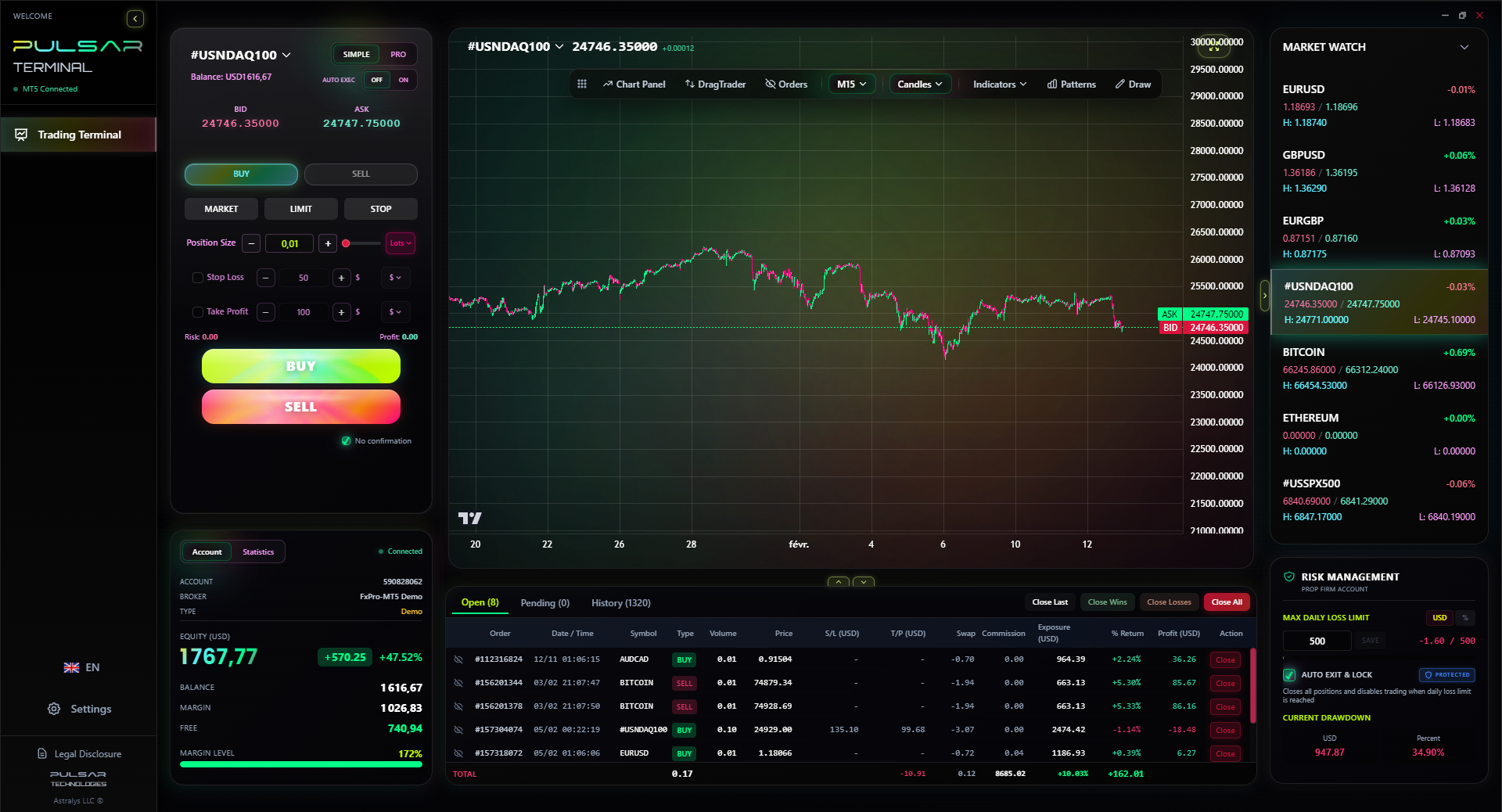
Managing a multi-TP trade based on a candlestick pattern is complex, but Pulsar Terminal lets you drag and drop all your orders and partial closures directly onto your MT5 chart.
Pulsar Terminal
MT5オールインワンツール:ドラッグ&ドロップ注文、マルチTP/SL、トレーリングストップ、グリッドトレード、出来高プロファイル、プロップファーム保護。毎日1,000人以上のトレーダーが利用。
“The most powerful signal in a candlestick is often the wick, not the body.”
Once you're comfortable with the basics, these two concepts will sharpen your edge.
Wick Analysis as a Leading Signal: Before a full Engulfing or Doji pattern forms, you often get a warning from a long wick. Let's say price rallies to a major resistance level and forms a candle with a very long upper wick and a small body. That's a 'shooting star' lookalike, showing rejection. You don't need to wait for the next candle to confirm a bearish pattern. You can plan for a reversal or at least exit any long positions. The wick told the story first.
Trading the "Failed" Pattern: This is counter-intuitive but powerful. A 'failed' pattern is when a classic setup forms but doesn't follow through. For example, a Bullish Engulfing pattern forms, but price immediately drops back below the low of the pattern. This failure often signals that the opposing force (sellers, in this case) is extremely strong. A failed bullish pattern can be a great signal to go short. I look for these failures at major trendlines or after significant news events.
💡 ウィンストンのヒント
If you can't immediately explain what a pattern's wicks are telling you about rejection, you're not ready to trade it.
“Master the story behind 4-5 patterns, not the shapes of 20.”
You can't learn this from a book. You have to screen-time. Here's a safe, structured way to build skill.
- Go to a Demo Account: Every broker offers one. Use it. Don't even think about real money yet.
- Pick One Major Pair: Start with EUR/USD. It's liquid and clean.
- The "Pattern Journal" Exercise: For two weeks, only use the daily chart. Every day, mark up the chart. Label every Hammer, Doji, and Engulfing pattern you see. Don't trade. Just label them. Then, watch what price does over the next 1-3 candles. Did it reverse? Continue? Do this religiously. You'll start to see which patterns at which levels actually work.
- Add One Element: In week three, add one confluence factor. Only note patterns that occur at a clear horizontal support/resistance line. See how the success rate changes.
- Simulate Trades: After a month of journaling, start placing demo trades based on your best-setup criteria. Track your win rate and average profit/loss. Only when you have at least 20 trades with a positive expectancy should you consider a small live account.
This process builds pattern recognition into your subconscious. You'll start to see the stories the charts are telling, not just the shapes.
FAQ
Q1What is the most reliable candlestick pattern for beginners in forex?
For beginners, the Engulfing pattern is the most reliable to start with. It's easy to spot (one candle completely swallowing the previous one), has a clear logic (aggressive takeover), and works across multiple timeframes. Just remember: always trade it in the direction of the engulfing candle and only when it aligns with the overall trend or a key support/resistance level.
Q2How many candlestick patterns do I really need to know?
You need to deeply understand 4-5, not vaguely know 20. Focus on the Hammer/Hanging Man, Doji, Bullish/Bearish Engulfing, and the Morning/Evening Star. Master the story behind these - why they form and what they signify about buyer/seller pressure. Depth beats breadth every time in trading.
Q3Can I use candlestick patterns alone to trade profitably?
Rarely, and not consistently. Patterns are entry triggers, not a complete strategy. Using them alone is like trying to drive by only looking at the hood ornament. You must combine them with other elements like support/resistance, trend analysis (using tools like the MACD indicator for confirmation), and strict risk management. They are a piece of the puzzle, not the whole picture.
Q4Do candlestick patterns work on all timeframes?
They form on all timeframes, but their reliability increases on higher timeframes. A Hammer on a 1-minute chart can be meaningless noise. The same Hammer on a daily chart, at a major support level, carries much more weight. I recommend beginners practice on the 1-hour and 4-hour charts first to avoid the false signals prevalent on lower timeframes.
Q5What is a 'pin bar' and how is it different from a Hammer?
A 'pin bar' is a popular term for a candlestick with a very long wick and a very small body, much like a Hammer or Shooting Star. The main difference is semantics and context. Traders often use 'pin bar' to describe this shape when it appears at any key level as a rejection signal, not strictly as a reversal pattern at a trend's end. The principle is the same: a long wick shows a strong price rejection.
Q6How do I avoid false signals from candlestick patterns?
Use confluence. A pattern is a false signal waiting to happen if it's the only reason for your trade. Wait for it to align with at least one other factor: a major support/resistance zone, a key Fibonacci level, or a divergence on a momentum oscillator like the RSI. Also, trade in the direction of the higher timeframe trend. This filters out the majority of bad setups.
Q7Are there specific candlestick patterns that work better for Nigerian traders?
The patterns themselves are universal. The difference lies in application. Nigerian traders often face higher volatility in certain pairs and need to be extra mindful of wider spreads. This makes patterns with clearer, stronger closes (like Engulfing patterns) more dependable than subtle ones (like a Doji) on volatile exotics. Always account for a larger spread definition and use a wider stop-loss when trading based on patterns in less liquid markets.
ウィンストン教授のレッスン
重要ポイント:
- ✓Trade patterns with trend & level confluence only.
- ✓Wait for the confirming candle to CLOSE.
- ✓Measure wicks: 2x body ratio is key.
- ✓Practice 2 weeks on demo before live cash.
- ✓Wider stops needed for exotic pairs.
この記事はどれくらい役に立ちましたか?
星をクリックして評価
週刊トレーディングインサイト
無料の週刊分析&戦略。スパムなし。
著者について
Olumide Adeyemi
西アフリカ・トレーディングの先駆者
ナイジェリアで最もアクティブなFXトレーディング教育者の一人。ラゴスから8年のトレード経験。アフリカのトレーダー向けの少額資金戦略とプロップファームチャレンジを専門とする。
コメント
リスク警告
金融商品の取引には大きなリスクが伴い、すべての投資家に適しているわけではありません。過去の実績は将来の結果を保証するものではありません。本コンテンツは教育目的のみであり、投資助言として解釈すべきではありません。取引前に必ずご自身で調査を行ってください。
こちらもおすすめ

Cara Trading Forex Sukses: 7 Prinsip dari Trader Profesional
Cara trading forex sukses dengan 7 prinsip trader pro: manajemen modal, disiplin, journal trading, backtest. Data nyata, bukan janji profit palsu.
Jam Trading Forex Terbaik untuk Trader Indonesia: Panduan Lengkap dengan Tabel Waktu
Panduan jam trading forex untuk trader Indonesia. Tabel 4 sesi dunia, jam emas 20:00-00:00, sesi mana yang harus dihindari. Data akurat + tips dari trader berpengalaman.
Top 5 Sàn Forex Uy Tín Nhất 2026: Review Jujur dari Trader Indonesia
Top 5 sàn forex uy tín 2026 untuk trader Indonesia. Review jujur: spread, deposit, withdraw, dukungan lokal. Exness, XM, IC Markets & lebih.
