


Ever watched a chart do nothing for days, felt the boredom, and then missed the massive move when it finally happened? That's price compression in action.

David van der Merwe
新興市場トレーダー ·  South Africa
☕ 9 分で読める
学べること:
Ever watched a chart do nothing for days, felt the boredom, and then missed the massive move when it finally happened? That's price compression in action. It's the market taking a deep breath before it screams. For us trading from SA, understanding this 'compression forex' isn't just a strategy, it's a survival skill. It teaches patience and timing in a market that's often anything but patient. Let's break down what it really is, how to spot it on your charts, and most importantly, how to trade it without getting your account shredded when the breakout finally comes.
Forget the fancy terms. Price compression is simple: the market gets stuck. The highs get lower, the lows get higher, and the price action gets squeezed into a tighter and tighter range. It looks boring. It feels dead. But underneath, pressure is building.
Think of it like coiling a spring. The tighter it gets, the more energy it stores for the eventual release. In the markets, that energy comes from trapped traders. Buyers keep buying at the support level, sellers keep selling at the resistance. Orders pile up on both sides. The moment one side gives way, all that pent-up energy explodes into a directional move.
This isn't some abstract theory. I've seen it play out on the USD/ZAR pair countless times. You'll get a week where it just chops between R18.20 and R18.40, the volume dries up, and everyone starts wondering if the market's broken. Then, a US inflation print hits or the SARB makes a comment, and boom – a 50-80 cent move in a single session. That's compression forex in its purest form.

Warning: Compression is NOT a trend. It's the absence of one. Trading it like a trending market is a sure way to lose money. You're waiting for the trend to start, not riding one.

💡 ウィンストンのヒント
The market spends most of its time compressing, not trending. If you only trade clear trends, you'll be bored and poor. Learning to trade the squeeze is learning to trade the market's most common state.
You don't need a PhD to see it. Your eyes are the best tool. Look for these signs on your MT5 or TradingView platform.
The Visual Squeeze: This is the most obvious one. Draw two trendlines. Connect the recent lower highs and the recent higher lows. If those lines are converging, you're looking at a compression pattern – often called a triangle (symmetrical, ascending, or descending). The price will bounce between these lines like a pinball, but with less and less room each time.
Volatility Dries Up: This is where indicators can help confirm what your eyes see. I use the Average True Range (ATR) indicator. When the ATR line starts falling off a cliff during a consolidation period, it's a textbook sign of compression. The market is literally becoming less volatile. I remember watching Gold (XAU/USD) in late 2023. The ATR dropped from over $30 to below $12 while price consolidated. The subsequent breakout was a $150 rally. You can learn more about trading instruments like this in our XAU/USD guide.
Volume Collapse: In a healthy trend, volume confirms the move. In compression, volume often disappears. The bars at the bottom of your chart get smaller and smaller. Fewer participants are willing to trade at these prices, which is why the range is so tight. The big players are waiting.
Local Pairs to Watch
Not all pairs compress the same way. Major pairs like EUR/USD are great for clean patterns. But for us in SA, USD/ZAR and EUR/ZAR can offer brilliant compression setups, especially around local budget speeches or MPC meetings. Just remember, the spreads are wider, so you need a bigger breakout to make the trade worthwhile. Always check your broker's live spread before entering. Understanding the spread definition is non-negotiable for this.
“Greed during compression is a special kind of stupid. The volatility squeeze often leads to an expansion that can be violent.”
Here's the brutal truth: most traders get the compression right and the trade wrong. They jump in too early, or too late, or with a position size that turns a good idea into a disaster. Here's a method that's saved me from myself more than once.
1. Define the Range: First, identify the clear support and resistance of the compression zone. Be objective. Don't draw lines where you want them to be. Use the last clear swing highs and lows.
2. Wait for the Close: This is the hardest part. Do NOT enter the trade the moment price pokes beyond the trendline. Wait for a 1-hour or 4-hour candle (depending on your timeframe) to close outside the range. This filters out false breakouts, or 'fakeouts,' which are incredibly common. I've been whipsawed more times than I care to admit by not waiting for the close.
3. Enter on the Retest (The Ideal Scenario): Often, price will break out, then drift back to test the broken support or resistance line. If it holds (i.e., price bounces off it), that's your high-probability entry. Your stop-loss goes just on the other side of that retested level.
4. Measure the Target: A rough guide is to measure the height of the compression pattern at its widest point and project that distance from the point of breakout. It's not gospel, but it gives you a logical profit zone.

Pro Tip: Never place your pending orders right on the trendline. Market makers love to run stops. Place your buy stop 5-10 pips above resistance, or your sell stop 5-10 pips below support. It costs a little more if you get the breakout, but it saves you from countless fakeouts.
This approach requires patience, which is the real commodity in trading. For more active styles, you might look at a scalping strategy, but compression trading is fundamentally a game of waiting.
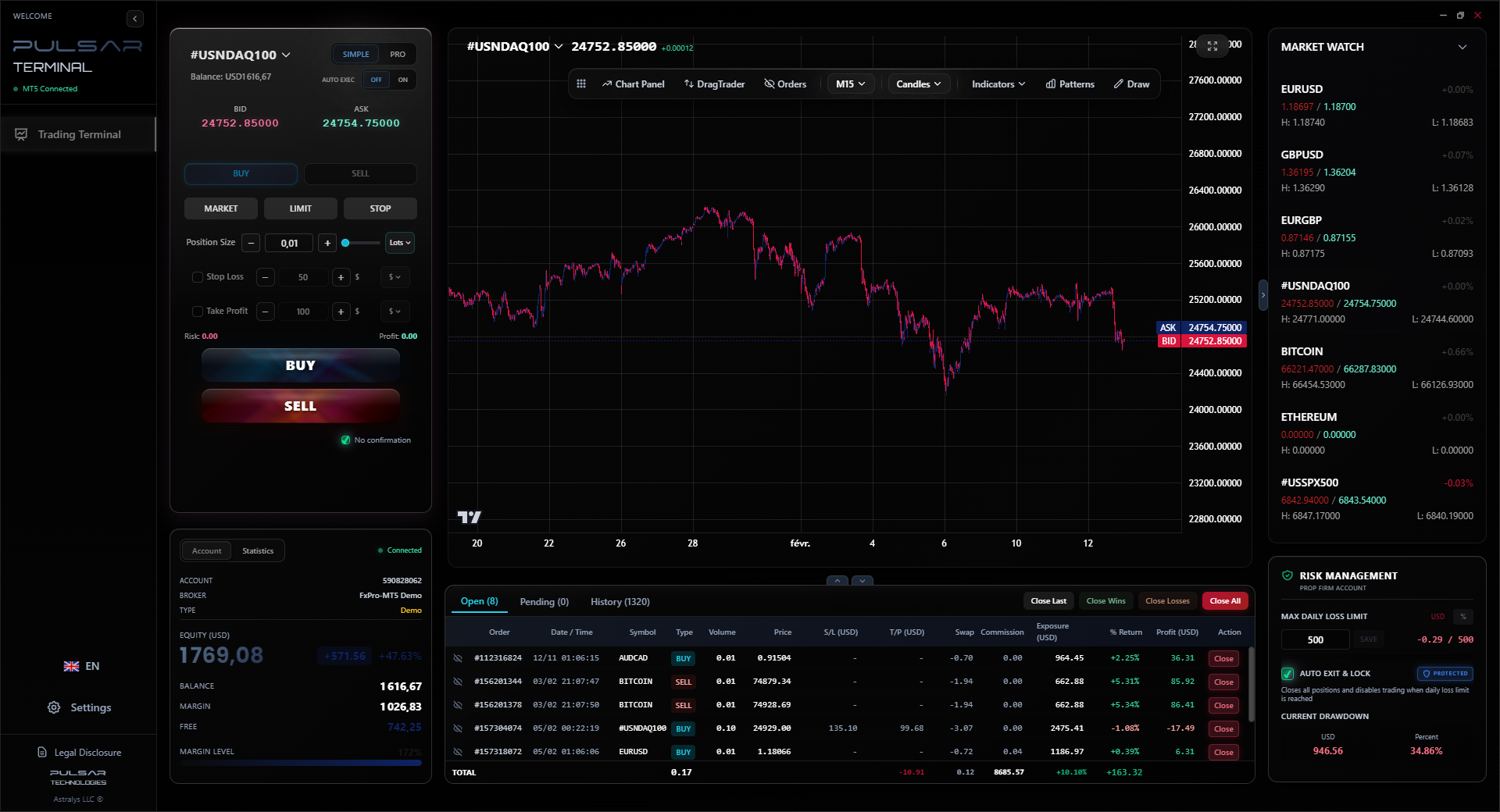
Managing multiple take-profit levels and a trailing stop on a volatile breakout is complex, but Pulsar Terminal automates it all directly on your MT5 chart.
Pulsar Terminal
MT5オールインワンツール:ドラッグ&ドロップ注文、マルチTP/SL、トレーリングストップ、グリッドトレード、出来高プロファイル、プロップファーム保護。毎日1,000人以上のトレーダーが利用。
This is where I see 90% of traders blow up on compression trades. The volatility is low, so they think, "I can use a tiny stop loss." Or, "This is a sure thing, I'll size up." Both thoughts are account killers.
Why Small Stops Fail: In compression, price naturally oscillates between support and resistance. A stop loss placed too tight inside the range will get taken out by normal market noise before the real breakout happens. You'll be stopped out and then watch the market rocket in your original direction. Your stop needs to be on the other side of the consolidation, respecting the structure.
Position Sizing is Everything: Because your stop loss is logically wider, your position size must be smaller to keep your risk (in Rands) the same. If you normally risk R500 per trade with a 20-pip stop, and a compression trade requires a 50-pip stop, you need to cut your lot size by more than half. Use a position size calculator every single time. Don't guess.
Let me give you a real, painful example. Early in my career, I spotted a beautiful compression on GBP/JPY. I was so convinced of the breakout I risked 3% of my account instead of my usual 1%. The breakout happened... in the wrong direction. My wide stop was hit, and I lost R15,000 in a day. It took me months to claw that back. Greed during compression is a special kind of stupid.
The volatility squeeze often leads to a volatility expansion that can be violent. If you're on the wrong side without a stop, you're facing a margin call. Brokers like IC Markets or Pepperstone have tight margins, which is great for use but deadly if you're not careful.
💡 ウィンストンのヒント
Your profit target should be at least 1.5 times the distance of your stop loss on a compression breakout. If the math doesn't work, the trade isn't worth taking. Preserve your capital for the high-odds setups.
“Your job isn't to be right every time, it's to manage risk so that when you are right, you make significantly more than you lose.”
Trading compression from SA isn't just about charts. You need the right shop to trade from. The FSCA is our watchdog, and you should never trade with a broker not licensed by them. It's not worth the risk.
Why Regulation Matters: An FSCA-licensed ODP (Over-the-Counter Derivatives Provider) like Khwezi Trade must segregate client funds. That means your money is held separately from the company's money. If the broker goes under (it happens), your capital should be safer. Unregulated brokers? Your money is just part of their operating budget.
Costs That Bite: Compression trading often involves sitting in a trade for a while, waiting for the breakout. This makes costs critical.
| Cost Factor | Why It Matters for Compression |
|---|---|
| Spreads | You enter/exit at range extremes. A wide spread means you start the trade already in the red. Look for tight spreads. Khwezi Trade advertises from 0.4 pips, which is competitive. |
| Overnight Swap Fees | If you hold for days waiting for the breakout, swaps can eat into profits. Check your broker's swap rates or consider a swap-free account if it aligns with your strategy. |
| Minimum Deposit | This affects how you structure your risk. A ZAR 500 minimum (like Khwezi's ZAR One account) is accessible, but ensure you can still trade with proper position sizing. |
Platform is Key: You need clean, reliable charts. Most local and international brokers here offer MetaTrader 5 (MT5). It's the industry standard for a reason. The charting tools are essential for drawing those trendlines accurately. Some brokers, like Exness or XM, also offer solid MT5 access to South African clients.
I've made most of these. Learn from my lost Rands.
1. Predicting the Direction: You don't know if the breakout will be up or down. Don't fall in love with a bullish or bearish bias. Prepare for both. Set alerts for both sides of the range and let the market tell you which way it's going.
2. Chasing the Breakout: The breakout move can be fast. If you miss the initial entry, don't FOMO (Fear Of Missing Out) and chase it 50 pips later. The best risk/reward is gone. Wait for the next compression or a retest. There's always another trade.
3. Ignoring Higher Timeframes: A compression on the 15-minute chart means nothing if it's just noise within a daily chart trend. Always zoom out. Does the compression form at a key daily support or resistance? That gives the eventual breakout more weight. This is where tools like the MACD indicator on a higher timeframe can help gauge the underlying momentum.
4. Forgetting the News: Compression often breaks on fundamental catalysts. An SARB interest rate decision, a US jobs report, a sudden shift in commodity prices (vital for the Rand). Be aware of the economic calendar. Holding a compression trade through a major news event is gambling, not trading.
, compression forex is a game of probability, not certainty. Even the most perfect triangle can fail. Your job isn't to be right every time, it's to manage risk so that when you are right, you make significantly more than you lose when you're wrong. This mindset is what separates a swing trading professional from a hopeful amateur.
FAQ
Q1Is forex trading and using strategies like price compression legal in South Africa?
Yes, absolutely. Forex trading is legal and regulated by the Financial Sector Conduct Authority (FSCA). Using price compression as a trading strategy is just a method of analysis; there are no specific laws against it. The critical rule is that you must use an FSCA-licensed broker to ensure your funds are protected under South African law.
Q2What's the best timeframe to trade compression forex?
It works on all timeframes, but each has a different character. The 1-hour and 4-hour charts are a great sweet spot for most retail traders, offering clearer patterns without the noise of lower timeframes. Daily chart compressions lead to much larger moves but require immense patience. I'd avoid the 1-minute and 5-minute charts for this strategy - the fakeouts are brutal.
Q3How long does price compression typically last before a breakout?
There's no set rule. It can last a few hours on a 15-minute chart or several weeks on a daily chart. The key isn't timing the duration, but identifying the structure. The tighter and longer the compression, the more powerful the eventual breakout tends to be. I've seen compressions resolve in 8 bars and others drag on for 50+.
Q4Can I use indicators like Bollinger Bands to spot compression?
Yes, Bollinger Bands are excellent for this. When the bands contract or 'squeeze,' it's a visual representation of decreasing volatility - the essence of compression. The strategy then is to trade the move when the bands start expanding again. The Squeeze indicator on TradingView is literally built for this concept.
Q5What is a 'false breakout' and how can I avoid them?
A false breakout (or fakeout) is when price moves beyond a support/resistance level, tricks traders into entering, and then reverses sharply back into the range. The best way to avoid them is to wait for a candle to CLOSE beyond the level, not just touch it. Even better, wait for a pullback and retest of the level for confirmation. It means you might miss the very first pip of the move, but your win rate will improve dramatically.
Q6Do I need a special type of trading account for this?
No special account needed, but the account features matter. A raw spread or ECN account with low, consistent spreads is ideal because you're trading range boundaries. A standard account with a variable, wide spread can hurt your entry/exit precision. Also, ensure your broker's platform (like MT5) has reliable drawing tools for your trendlines.
ウィンストン教授のレッスン
重要ポイント:
- ✓Wait for the candle close beyond the range, not just the touch.
- ✓Position size must be smaller to accommodate logically wider stops.
- ✓A falling ATR indicator visually confirms the volatility squeeze.
- ✓Always be prepared for a breakout in either direction.
この記事はどれくらい役に立ちましたか?
星をクリックして評価
週刊トレーディングインサイト
無料の週刊分析&戦略。スパムなし。
著者について
David van der Merwe
新興市場トレーダー
ヨハネスブルグ拠点で新興市場通貨11年のトレーダー。ZARペア、FSCA規制下の取引、南アフリカ市場分析を専門とする。
コメント
リスク警告
金融商品の取引には大きなリスクが伴い、すべての投資家に適しているわけではありません。過去の実績は将来の結果を保証するものではありません。本コンテンツは教育目的のみであり、投資助言として解釈すべきではありません。取引前に必ずご自身で調査を行ってください。
こちらもおすすめ

Cara Trading Forex Sukses: 7 Prinsip dari Trader Profesional
Cara trading forex sukses dengan 7 prinsip trader pro: manajemen modal, disiplin, journal trading, backtest. Data nyata, bukan janji profit palsu.
Jam Trading Forex Terbaik untuk Trader Indonesia: Panduan Lengkap dengan Tabel Waktu
Panduan jam trading forex untuk trader Indonesia. Tabel 4 sesi dunia, jam emas 20:00-00:00, sesi mana yang harus dihindari. Data akurat + tips dari trader berpengalaman.
Top 5 Sàn Forex Uy Tín Nhất 2026: Review Jujur dari Trader Indonesia
Top 5 sàn forex uy tín 2026 untuk trader Indonesia. Review jujur: spread, deposit, withdraw, dukungan lokal. Exness, XM, IC Markets & lebih.
