


Why do you keep blowing up your account right when you think you've got it figured out? You backtest a strategy, it works for a week, you get confident, and then a single trade wipes out a month of gains.

Olumide Adeyemi
西アフリカ・トレーディングの先駆者 ·  Nigeria
☕ 10 分で読める
学べること:
- 1What Consistency Actually Means (It's Not What You Think)
- 2The Nigerian Realities: Taxes, Execution & The Naira
- 3The Math of Survival: Non-Negotiable Position Sizing
- 4Building a Mechanical Trading Plan (Your Boring Blueprint)
- 5The Psychology: Embracing the Grind
- 6Tools to Enforce Discipline (Not Just Analysis)
- 7Putting It All Together: Your Weekly Routine
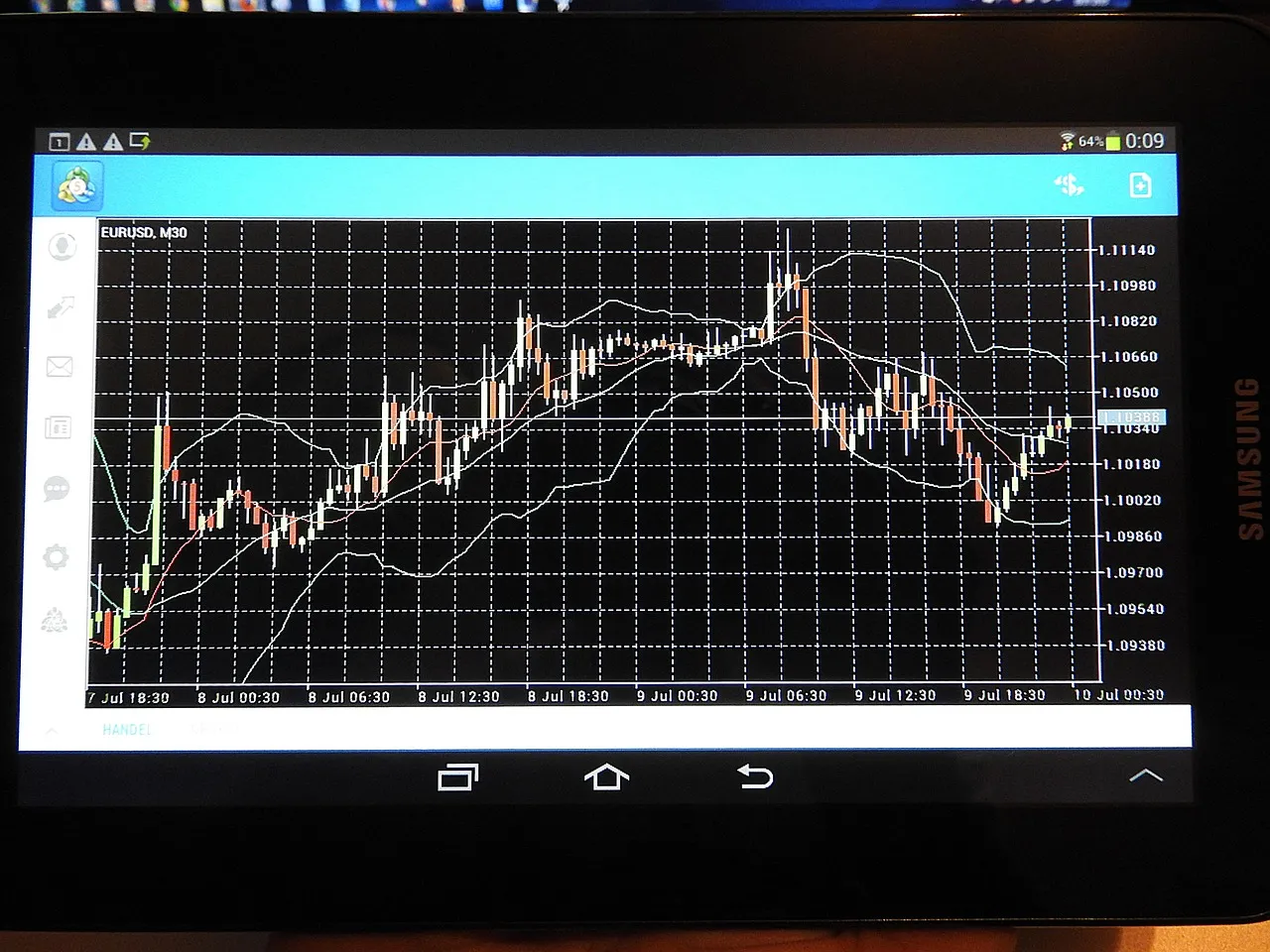
Why do you keep blowing up your account right when you think you've got it figured out? You backtest a strategy, it works for a week, you get confident, and then a single trade wipes out a month of gains. Sound familiar? The dream of consistent forex profits in Nigeria is real, but the path is littered with the wreckage of accounts that chased it the wrong way. I've been there. This isn't about finding a magic indicator. It's about building a system so boring and mechanical that your emotions can't sabotage it, and understanding the local realities - like that 10% tax bite - that most guides ignore.
Consistency in forex trading doesn't mean winning every day. That's a fantasy. If you're chasing that, you're already doomed. Real consistency means your process is the same, trade after trade, win or lose. It means your risk per trade is a fixed percentage, your entry and exit rules are clear, and you follow them even when you're scared or greedy.
Think of it like a bakery. A consistent bakery doesn't magically produce perfect bread every single day. Some days the humidity is off, sometimes an oven element fails. But the baker follows the same recipe, uses the same quality ingredients, and bakes at the same temperature. Over a month, the profits are predictable. Your trading account should work the same way. You will have losing weeks. The data is brutal: globally, between 69% and 83% of retail CFD accounts lose money. Your goal isn't to be in the 17% who never lose; it's to be in the tiny fraction of that 17% who have a repeatable, survivable process.

Warning: If your idea of consistency is a 90% win rate from a signal group on WhatsApp, you are being set up for a catastrophic loss. High win-rate strategies often rely on huge, unsustainable risk-to-reward ratios. One loss kills you.
I learned this the hard way early on. I had a scalping strategy on EUR/NGN that was winning 7 out of 10 trades. I felt unstoppable. Then, one Friday during low liquidity, the CBN made an unexpected comment. The spread widened from 50 pips to over 300 in seconds. My stop-loss was ignored (a slippage nightmare), and that one trade wiped out the profits from the previous 27 wins. I was consistent in my entries, but I was inconsistent in my understanding of execution risk. That's the level of detail that matters.

💡 ウィンストンのヒント
Consistency isn't a result, it's a cause. You don't get consistent profits and then become disciplined. You become disciplined in your process, and consistent profits are the eventual outcome. Focus on the input, not the output.
“Real consistency means your process is the same, trade after trade, win or lose.”
You can't build a consistent plan without factoring in the local environment. Ignoring this is like planning a road trip without checking the price of fuel.
First, the taxman. The Federal Inland Revenue Service (FIRS) wants 10% of your gross forex trading profits as Capital Gains Tax. Gross profits. Not net after losses. This changes your math dramatically. If you make N100,000 in profit this month, you owe N10,000. That means your actual, keepable profit is N90,000. If your strategy only yields a 5% return before tax, you're really making 4.5%. You must build this into your profit targets. A strategy that seems viable internationally might be unprofitable here after taxes and wider spreads on exotic pairs.
Execution is Everything
Your brilliant analysis means nothing if you can't get a good fill. During major news events or periods of low liquidity (like late Friday nights WAT), spreads on pairs involving the Naira can balloon. You might plan a trade with a 20-pip stop, but if the spread is 50 pips when you enter, you're already in a deep hole. This makes trading NGN pairs like USD/NGN particularly tricky for precise strategies. I often found more consistent execution sticking to major pairs like EUR/USD through international brokers with deeper liquidity, even though it means dealing with currency conversion.

Pro Tip: Always use a position size calculator that lets you input the spread. If your calculated risk is 1% based on your stop-loss distance, but the spread eats half that distance, your real risk is much higher. Recalculate.
Broker choice is critical. You need a platform that offers stable execution during volatile times. Many Nigerian traders use brokers like Exness or IC Markets for their MT5 access and reliable order fills. The platform itself is a key part of your consistent toolkit.
“If your idea of consistency is a 90% win rate from a signal group on WhatsApp, you are being set up for a catastrophic loss.”
This is the absolute core of consistency. If you take nothing else from this guide, take this: you must risk a fixed, small percentage of your capital on every single trade. No exceptions.
For Nigerian traders starting out, I recommend 1% maximum. If you have a N500,000 account, you risk N5,000 per trade. Not N50,000 because you have a "strong feeling." This one rule protects you from yourself. It means you can survive a string of losses - which you will have - without a margin call wiping you out.
Let's do the brutal math. If you risk 5% per trade and have five losing trades in a row (which happens to every strategy), your account is down 25%. You now need to make back 33% just to break even. The pressure becomes immense, and you start breaking your own rules. At 1% risk, five losses is a 5% drawdown. Annoying, but recoverable.
Here’s a table showing the damage:
| Risk Per Trade | After 5 Consecutive Losses | Gain Needed to Recover |
|---|---|---|
| 1% | -5% | +5.3% |
| 2% | -10% | +11.1% |
| 5% | -25% | +33.3% |
| 10% | -50% | +100% |
I keep a sticky note on my monitor: "N1,000,000 account. 1% = N10,000 risk. Always." It's that simple, and that difficult. When I was swing trading XAU/USD last year, I had a run of 8 losses out of 10 trades. It was mentally tough. But because I was risking 0.8% per trade, my total drawdown was 6.4%. I stuck to the plan, the strategy mean-reverted, and I finished the quarter up. Without strict position sizing, I would have been gone.

“If your idea of consistency is a 90% win rate from a signal group on WhatsApp, you are being set up for a catastrophic loss.”
Your trading plan is your recipe. It must be so detailed that a stranger could execute it. Ambiguity is the enemy of consistency.
A solid plan answers these questions before the market opens:
- Market Condition: Am I only trading in a clear trend, or during ranges? How do I define that? (e.g., Price above 200 EMA = trend up).
- Entry Signal: What is the exact trigger? Is it a MACD indicator crossover with price closing above a key level? Not just "MACD crossover."
- Stop-Loss: Where does it go, exactly? Is it below the recent swing low, or a fixed number of pips? How far is that in Naira terms?
- Take-Profit: Where do I take profit? Is it a 2:1 risk-to-reward target? Do I take partial profits at 1:1? This must be predefined.
- Daily/Weekly Loss Limit: I have a hard rule: if I lose 3% of my account in a day, I shut it down. No revenge trading.
For example, my old plan for a breakout strategy was vague: "Enter when price breaks resistance." I got whipsawed constantly. My new plan is mechanical: "Enter on a buy stop order 5 pips above the previous day's high, but only if the 1-hour RSI indicator is above 40 and not overbought. Stop-loss is placed at the previous day's low. Take-profit is set at a distance twice the size of the stop-loss."
Boring? Yes. Consistent? Infinitely more so. This removes the emotion of "Should I enter now?" The rule either fires or it doesn't.
💡 ウィンストンのヒント
Your first loss is often your smallest loss. The moment you move a stop-loss further away 'just to give the trade room,' you have abandoned your system. The loss you're trying to avoid will find you later, and it will be bigger.
“Aim for 3-5% a month, consistently. That feels painfully slow week-to-week, but it compounds like a monster.”
Your mindset is the software that runs your mechanical plan. If the software is buggy (emotional, impulsive), the best hardware (strategy) will fail.
The biggest psychological trap for Nigerian traders is the need for quick, life-changing money. The economy is tough, and the temptation to turn N200k into N2m in a month is huge. This leads to over-leveraging and blowing up. Consistency is about accepting slow, compounding growth. Aim for 3-5% a month, consistently. That turns N1,000,000 into over N1,400,000 in a year. That's a fantastic return, but it feels painfully slow week-to-week.
You must also become comfortable with being wrong. A high win rate is not the goal. A positive expectancy is. A strategy can lose 6 out of 10 trades and still be highly profitable if the winning trades are much bigger than the losers. If you can't sit through six losses waiting for those four wins, you'll abandon a good strategy right before it pays.
Keep a trade journal. Not just "bought EUR/USD, won." Log your emotional state: "Felt anxious after two losses, almost reduced position size on trade 3, but stuck to 1%." This self-awareness is what turns knowledge into disciplined action. I review my journal every Sunday. It's cringe-worthy sometimes, but it's the best feedback loop you have.
“Aim for 3-5% a month, consistently. That feels painfully slow week-to-week, but it compounds like a monster.”
We spend 95% of our time talking about analysis tools (indicators, chart patterns) and 5% on tools that enforce discipline. That ratio is backwards.
The right tools automate your rules and take your shaky hands out of the equation.
Use Trade Management Tools: Instead of manually moving stop-losses to breakeven, use an automated trailing stop. Many platforms have this built in. This guarantees you'll lock in profits if the market reverses, removing the "maybe it will come back" hope that turns winners into losers.
Platform Choice: A stable platform like MetaTrader 5 is essential. But consider tools that plug into it to automate your plan's risk management aspects. For instance, tools that can automatically calculate and set your position size based on your predefined risk percentage and stop-loss distance prevent you from accidentally doubling down.
Alerts Over Execution: Sometimes, the best tool is a simple price alert. If your plan says to sell if price closes below the 50 EMA, set an alert. Don't sit there staring at the chart, inviting temptation to jump the gun. Let the alert tell you when to check, then follow your plan.
The goal is to systemize as much as possible. The fewer discretionary decisions you make in the heat of the moment, the more consistent you'll be.
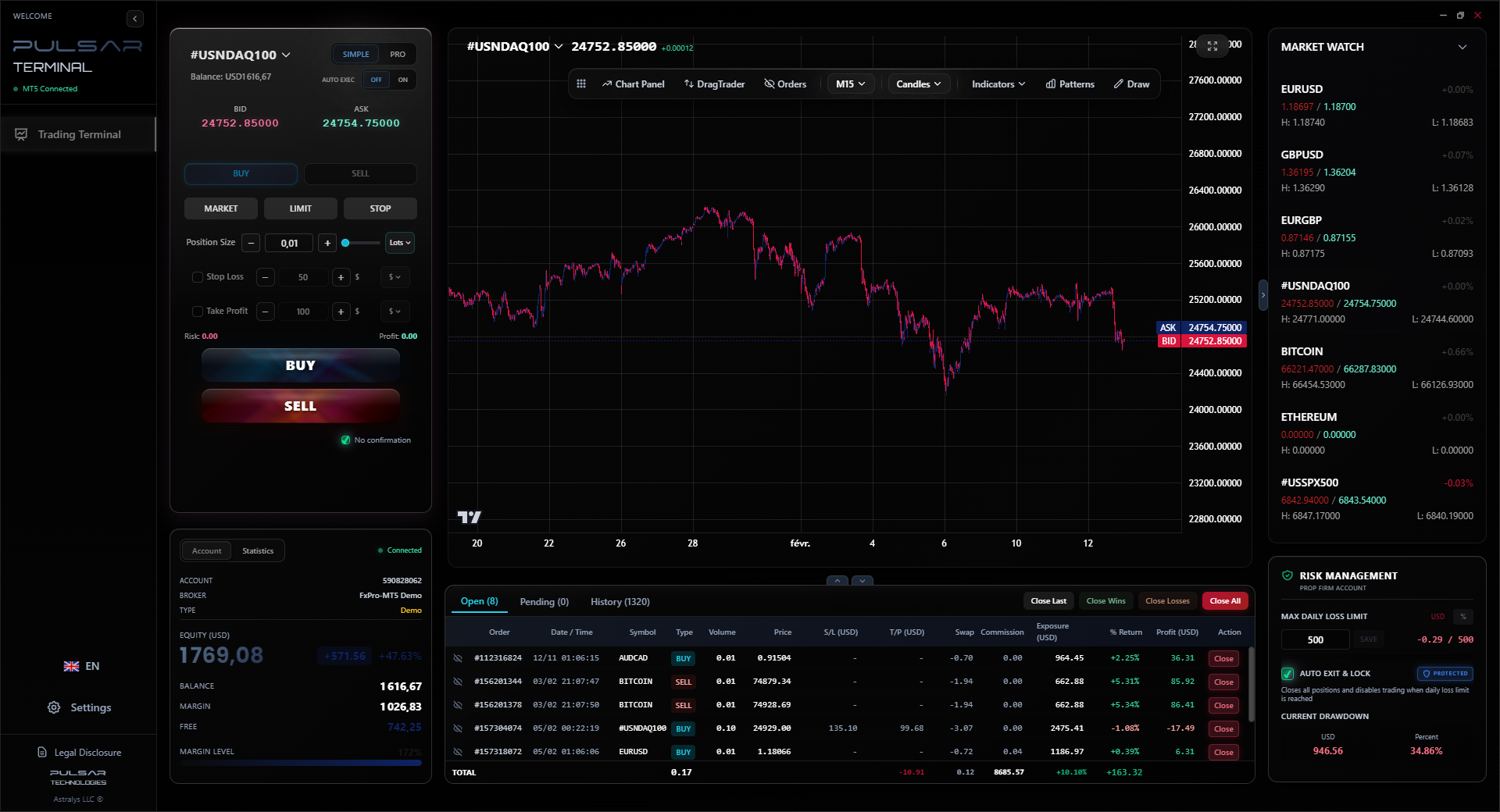
Enforcing a disciplined trade management plan is easier when your tools automate it, like setting multi-level take-profits and trailing stops directly on your MT5 charts.
Pulsar Terminal
MT5オールインワンツール:ドラッグ&ドロップ注文、マルチTP/SL、トレーリングストップ、グリッドトレード、出来高プロファイル、プロップファーム保護。毎日1,000人以上のトレーダーが利用。
“A day with no trades is a successful day if it wasn't in your plan.”
Consistency in forex trading is a weekly practice, not a one-time setup. Here’s what my routine looks like, and what I suggest you adopt:
Sunday Evening (Planning):
- Review the overall market structure. Are the majors trending? Is there high-impact news this week (CBN meetings, US NFP)?
- I mark key support/resistance levels on my charts for the week. I don't predict, I just prepare the map.
- I check my account balance and mentally reconfirm my 1% risk number.
Trading Day (Execution):
- I only trade during the most liquid overlaps (1 PM - 5 PM WAT, when London and New York are open). This gives me the tightest spreads and best chance for clean fills.
- I wait for my setup. If it doesn't come, I do nothing. A day with no trades is a successful day if it wasn't in your plan.
- When a trade triggers, I enter, set my stop-loss and take-profit immediately, and walk away. I might set a price alert for my TP/SL levels, but I avoid watching it tick up and down.
Friday Afternoon (Review):
- I close any remaining trades before the weekend (for peace of mind).
- I update my journal with notes on each trade and my mindset.
- I calculate my weekly P&L and check it against my 3% daily loss limit. Did I stay within my rules?
- Most importantly, I do not adjust my strategy based on one week's results. I need at least 50-100 trades to know if a change is statistically valid.
This routine is boring. It lacks the adrenaline of chasing news spikes. But over the last three years, it's the only thing that has produced a steady, upward equity curve for me. It turns trading from a casino visit into a manageable business operation.

FAQ
Q1What is the most important rule for consistency in forex trading?
Fixed fractional position sizing. Risking a fixed, small percentage (like 1%) of your account on every single trade is non-negotiable. It's the mathematical foundation that lets you survive losing streaks and compound gains over time.
Q2How do I handle the 10% capital gains tax on forex profits in Nigeria?
You must factor it into your profit targets from the start. If your strategy aims for a 10% return, remember that 1% goes to FIRS. This makes low-yield, high-frequency strategies less viable. It's better to aim for fewer, higher-probability swing trades with better risk-reward to offset the tax impact. Keep careful records of all trades for tax reporting.
Q3I keep changing strategies after a few losses. How do I stop?
This is the #1 consistency killer. You must backtest a strategy thoroughly (100+ historical trades) to understand its expected win rate and drawdown. Then, you commit to trading it live for a pre-defined sample size (e.g., 50 trades) without deviation. Judge the strategy by its long-term expectancy, not by 5-trade sequences. A trade journal is critical for holding yourself accountable to this.
Q4Is it better to trade USD/NGN or major pairs like EUR/USD for consistency?
For most Nigerian traders, major pairs like EUR/USD offer more consistency. The spreads are tighter, liquidity is higher, and price action is often cleaner and less prone to sudden, unpredictable gaps from local news. Trading USD/NGN can be profitable, but the wider spreads and potential for CBN-induced volatility make precise, consistent strategy execution much harder.
Q5What's a realistic monthly return goal for a consistent trader?
Aim for 3-5% consistent return per month on your account. This might sound small, but it compounds powerfully. A 5% monthly return turns N1,000,000 into over N1,795,000 in a year. Chasing 20%+ per month almost always involves unsustainable risk and leads to account blow-ups.
Q6How do I choose a broker that supports consistent trading?
Prioritize regulation, execution speed, and stable spreads. Look for brokers regulated by reputable bodies (like ASIC or FCA) that are known to serve Nigerian clients well, such as IC Markets or Pepperstone. Test their platform demo during volatile times (like London open) to see if spreads stay reasonable and orders are filled without major slippage.
ウィンストン教授のレッスン
重要ポイント:
- ✓Risk a maximum of 1% of your account per trade. Always.
- ✓Factor Nigeria's 10% capital gains tax into all profit calculations.
- ✓Judge your strategy over 50-100 trades, not 5.
- ✓Trade major pairs for cleaner execution and tighter spreads.
- ✓A 3-5% monthly return is a realistic and powerful goal.
この記事はどれくらい役に立ちましたか?
星をクリックして評価
週刊トレーディングインサイト
無料の週刊分析&戦略。スパムなし。
著者について
Olumide Adeyemi
西アフリカ・トレーディングの先駆者
ナイジェリアで最もアクティブなFXトレーディング教育者の一人。ラゴスから8年のトレード経験。アフリカのトレーダー向けの少額資金戦略とプロップファームチャレンジを専門とする。
コメント
リスク警告
金融商品の取引には大きなリスクが伴い、すべての投資家に適しているわけではありません。過去の実績は将来の結果を保証するものではありません。本コンテンツは教育目的のみであり、投資助言として解釈すべきではありません。取引前に必ずご自身で調査を行ってください。
こちらもおすすめ

Cara Trading Forex Sukses: 7 Prinsip dari Trader Profesional
Cara trading forex sukses dengan 7 prinsip trader pro: manajemen modal, disiplin, journal trading, backtest. Data nyata, bukan janji profit palsu.
Jam Trading Forex Terbaik untuk Trader Indonesia: Panduan Lengkap dengan Tabel Waktu
Panduan jam trading forex untuk trader Indonesia. Tabel 4 sesi dunia, jam emas 20:00-00:00, sesi mana yang harus dihindari. Data akurat + tips dari trader berpengalaman.
Top 5 Sàn Forex Uy Tín Nhất 2026: Review Jujur dari Trader Indonesia
Top 5 sàn forex uy tín 2026 untuk trader Indonesia. Review jujur: spread, deposit, withdraw, dukungan lokal. Exness, XM, IC Markets & lebih.
