


I remember staring at the screen as Nifty futures ripped through what I thought was a rock-solid support level.

Rajesh Sharma
シニアFXアナリスト ·  India
India
☕ 14 分で読める
学べること:
- 1What the Hell is a CPR, Anyway?
- 2Why CPR Fits the Indian Market (And Why It's Getting Harder)
- 3The Only CPR Setups You Need for Nifty & Bank Nifty
- 4How SEBI's 2024-2026 Rules Murder (And Save) CPR Traders
- 5CPR Doesn't Work Alone: The Supporting Cast
- 6Choosing Your Weapon: Brokers & Platforms for CPR in India
- 7Where CPR Traders Go to Die (I've Visited All These Graves)
- 8Your CPR Trading Plan for Monday Morning
I remember staring at the screen as Nifty futures ripped through what I thought was a rock-solid support level. It was a classic Central Pivot Range (CPR) setup, the price was hugging the pivot, and I went long with a tight stop. The market didn't just break the CPR; it vaporized it, taking ₹18,500 of my capital with it in about 12 minutes. That was the day I learned that in India, a CPR trading strategy isn't just about drawing lines on a chart. It's about understanding the new regulatory jungle SEBI has built since 2024, where margin calls and auto-square-offs happen faster than you can say 'pivot'. Let's talk about how to actually use CPR to survive and profit here.
Forget the complex jargon. The Central Pivot Range (CPR) is just a fancy name for a zone on your chart that acts like a magnet for price. It's calculated from the previous day's high, low, and close. Unlike a single pivot point line, it gives you a range - a 'zone' - which is far more realistic in the chaotic Indian markets.
The calculation is simple, but you'll never do it by hand. Your trading platform should do it. Here's what it spits out:
- Pivot Point (P): The central anchor. (High + Low + Close) / 3.
- Top Central Pivot (TC): Resistance level 1. (Pivot * 2) - Previous Low.
- Bottom Central Pivot (BC): Support level 1. (Pivot * 2) - Previous High.
The space between TC and BC is your CPR. If today's price is trading above this range, the bias is bullish. If it's below, it's bearish. Simple.

Example: Let's say Bank Nifty yesterday had a High of 48,200, a Low of 47,500, and closed at 47,900. Pivot (P) = (48200 + 47500 + 47900) / 3 = 47866.67 TC = (47866.67 * 2) - 47500 = 48233.34 BC = (47866.67 * 2) - 48200 = 47533.34 So, the CPR for today is the zone between 47,533 and 48,233.
This zone becomes your primary battlefield for the day. The real magic, and where most new traders mess up, is in interpreting the CPR's width and position. A narrow CPR (like 50-70 points on Nifty) often precedes a big, volatile move. A wide CPR suggests consolidation. I've blown up accounts ignoring that simple truth.
Indians love intraday trading. We're obsessed with the 9:15 to 3:30 thrill. CPR is perfect for this because it's a daily reset. You get a fresh set of levels every morning, which aligns perfectly with our mandatory square-off rules. You're not carrying baggage overnight.
But here's the kicker: SEBI has been on a warpath since 2024, and they've fundamentally changed the game for strategies like CPR.
The New Cost of Doing Business
Your CPR trade isn't just a bet on price hitting a level. It's a bet that you can cover the taxes and fees before price reverses. Let's break down a typical ₹2 lakh intraday trade in Nifty futures, assuming you use a decent discount broker:
| Charge | Rate | Approx. Cost on ₹2L Trade |
|---|---|---|
| Brokerage | ₹20 per order | ₹40 (buy & sell) |
| Exchange Charge | ~0.00325% | ₹6.50 |
| SEBI Turnover Fee | 0.0001% | ₹0.20 |
| GST (18% on above) | 18% | ~₹8.50 |
| Stamp Duty | 0.003% (on buy) | ₹6 |
| Total | ~₹61.20 |
That's your 'spread' to overcome. On a 10-point Nifty move with a 50-lot mini contract, that's about 1.2 points just to break even. This is why your position size calculator is your best friend. A tight CPR bounce might only give you 15-20 points. Slap on another 0.025% STT when you sell, and your profit gets a haircut before you even see it.
The use Trap
Brokers still offer up to 5x intraday use. That means for that ₹2 lakh trade, you might only need ₹40,000 in your account. Sounds great for a CPR bounce play, right? Wrong. This is how you get a margin call at 2:45 PM when SEBI's new intraday monitoring snapshots your position and volatility spikes. The 20% minimum margin rule isn't a suggestion; it's a cliff edge.

💡 ウィンストンのヒント
The market doesn't know what a CPR is. It only knows order flow. Your CPR level is just a place where, historically, orders have clustered. Treat it as a high-probability area for a reaction, not a guaranteed bounce.
“In India, a CPR trading strategy isn't just about drawing lines on a chart. It's about understanding the new regulatory jungle SEBI has built since 2024.”
You'll see a hundred fancy setups online. I've traded most of them. These two are the only ones that have consistently paid my bills in the Indian context.
1. The CPR Opening Range Breakout (The 9:45 AM Special) This is my bread and butter. The market opens, and price spends the first 15-30 minutes probing the CPR zone. It coils. Your job is to wait for a clear break and close (a 5-minute candle works) above the TC or below the BC. The key? Volume. If Bank Nifty breaks above the TC on weak volume, it's a fakeout 70% of the time. I enter on the retest of the breached level. Stop loss goes just inside the CPR.
Real Trade Example (Loss): On March 15, 2026, Nifty opened at 22,150. The CPR was 22,120 (BC) to 22,180 (TC). It hovered for 20 minutes, then a strong green candle broke above 22,180. I went long at 22,185. Volume was mediocre, but I ignored it. Price tagged 22,210, then reversed hard. It sliced back through the TC and my stop at 22,175. Loss: ₹5,000. The lesson? The break was on an F&O expiry day during one of SEBI's random intraday snapshots - liquidity dried up. I didn't check the calendar.
2. The Virgin CPR Bounce This is a powerful mean reversion play. A 'Virgin CPR' is when yesterday's price never touched the CPR range. It traded entirely above or below it. Today, if price approaches that untouched CPR from the previous day, it acts like a steel wall. The stats say it holds about 40% of the time, but when it does, the bounce is violent.

Warning: This setup is gold, but you must be patient. Wait for price to actually react at the level - a long wick, a pin bar, a bullish engulfing pattern. Don't just buy because price is near the number. Combine it with an oscillator like the RSI indicator showing oversold/overbought conditions for a better edge.
For scalping strategy enthusiasts, the edges of the CPR (TC and BC) offer excellent 5-10 point scalps in Bank Nifty, but the revised lot sizes and higher margins mean your risk per scalp is now significantly higher. It's not the game it was in 2023.
If you're using a CPR trading strategy post-2026 and aren't aware of these changes, you're trading blindfolded. SEBI isn't trying to stop you from trading; they're trying to stop you from blowing up. Ironically, their rules create new patterns.
The F&O Carnage & The CPR Squeeze: Because 89% of individual F&O traders lost money, SEBI jacked up margins. That short Bank Nifty straddle that needed ₹1.2 lakh now needs over ₹2 lakh. What does this mean for CPR? It reduces the number of players able to take those positions, which can lead to false breaks. Low liquidity near CPR levels means a few large orders can shove price through the zone, triggering your stop, before it snaps back. You need wider stops, which means smaller position sizes. It's a brutal adjustment.
The 2:45 PM Ghost: The new intraday monitoring rule is a CPR trader's specific nightmare. Exchanges must take random snapshots, including one between 2:45 PM and 3:30 PM. If you're in a CPR-based trade hoping for a late-day move, and a large institution breaches its ₹5,000 crore intraday limit during this snapshot, they'll be forced to unwind. This can cause a massive, news-less spike that obliterates your carefully drawn BC support. I've learned to avoid new CPR entries after 2:30 PM unless it's a slam-dunk.
The Algo Tagging Rule: From April 1, 2026, every algo order has a unique ID. This is great for the market's health, but it also means the 'dumb money' flow you could sometimes read is getting filtered. The algos are better at identifying and exploiting CPR levels than you are. Your edge now comes from patience and psychology, not just spotting the level on the chart.
These rules force discipline. They make you respect position sizing and timing. In a weird way, they've made me a better trader, but they've also made the CPR a more contested, volatile area. You can't just set and forget.
“Your CPR trade isn't just a bet on price hitting a level. It's a bet that you can cover the taxes and fees before price reverses.”
Trading CPR by itself is like trying to drive with only a rear-view mirror. You need context.
Volume Profile is CPR's Best Friend: This is non-negotiable for me now. Overlay a Volume Profile on your 15-minute or 30-minute chart. If the day's CPR zone aligns with a high-volume node from the Volume Profile, that level's importance is magnified 10x. It becomes a concrete floor or ceiling. If the CPR is in a low-volume area, be wary - price can skate through it with little effort. Tools that combine these views are becoming essential.
The MACD Confluence: I use the MACD indicator on a 30-minute chart for bias. If price is approaching the BC support, but the MACD histogram is still plunging lower on the 30-minute, I'll avoid the long. I want to see the selling momentum slow down (histogram bars getting shorter) as price hits the CPR. This simple filter has saved me from countless losing 'bounce' trades.
CPR for Swing Trading in Stocks: Yes, it works beyond indices. For delivery-based swing trades in stocks like Reliance or TCS, I use the weekly CPR. The weekly TC and BC often mark fantastic areas to scale into or out of positions. The key difference? You're dodging the intraday tax hell (STT is 0.1% for delivery) and the 3:30 PM gun. Your stop can be sensible, below the weekly BC, not a tight intraday one.

Pro Tip: On expiry days, especially with the new reduced weekly expiries, discard the normal CPR. The volatility is manufactured and insane. Use the previous day's high and low as your primary guides, with the CPR as a secondary, weaker reference. The 'additional extreme loss margin' of 2% on short options creates wild, unpredictable covering rallies.
💡 ウィンストンのヒント
After a major news event, throw yesterday's CPR in the trash. The market's memory is reset. The new range is being established by the news-driven price action, not by yesterday's sleepy range.
Your broker can make or break your CPR strategy. It's not just about cheap brokerage.
The CPR Indicator: First, can your platform plot CPR automatically? Most mainstream platforms like Zerodha's Kite, Upstox Pro, or MT5 can, often with custom scripts. If you're manually calculating and drawing lines, you're already behind.
Execution Speed & Slippage: This is critical for CPR breakouts. A 10-point breakout in Bank Nifty can happen in seconds. If your broker's order routing is slow, your entry price will be worse, and your risk/reward is ruined before you start. I've tested this. On a fast broker during a genuine breakout, I might get filled at +2 points from my trigger. On a slow one, it can be +5 or more. That's half your potential profit gone.
use & Margin Policies: With SEBI's new margins, brokers are stricter. Some will auto-square-off your position the second your margin dips below requirement, with no warning. Others might give you a brief window. You need to know your broker's policy inside out. A CPR trade that goes slightly against you shouldn't trigger a panic square-off because of a temporary mark-to-market loss.
International Brokers for CFD Trading: Some traders use international brokers like Exness review, IC Markets review, or XM review to trade Nifty or Bank Nifty CFDs. The CPR strategy works the same, but the context is different: no STT, no Indian market timings, and different use rules. The CPR levels might see slightly different reactions due to the different participant pool. It's a valid alternative, but you're trading a derivative of a derivative. Understand the risks.
My advice? Start with a reputable domestic broker that offers a strong platform with reliable CPR plotting. Pay the ₹20 brokerage. Focus on mastering the strategy before you chase the lowest cost.
“If your CPR level fails, step away. The market structure has changed. Wait for a new setup.”
Let me save you some money and heartache. Here are the classic blunders.
Mistake 1: Trading the CPR in a Vacuum. You see price at the BC and go long, ignoring the fact that the US Fed is speaking in 30 minutes or that it's a monthly expiry. Macro events and news will steamroll any technical level. Check the economic calendar. Always.
Mistake 2: The Revenge Trade. The market breaks your CPR level and hits your stop. You're pissed. You see it stall 10 points later and think, "Ah, it was a fakeout!" and jump back in the original direction. This is how a ₹5,000 loss becomes a ₹25,000 loss in two trades. If your CPR level fails, step away. The market structure has changed. Wait for a new setup.
Mistake 3: Ignoring Width. A CPR that's only 30 points wide on Nifty is a coiled spring. Placing your stop loss just 5 points inside it is suicide. The initial burst of volatility will almost certainly take you out. Respect the width. Your stop should be placed considering the CPR's narrowness, maybe using an ATR (Average True Range) filter.
Mistake 4: Forgetting the Auto-Square-Off. This is the most embarrassing one. You're in a perfect CPR bounce trade, it's 3:25 PM, you're in profit and waiting for a little more... and then your broker's system automatically squares off your position at the market price. You might even get a worse price and a small penalty. Set an alarm for 3:10 PM. Decide your exit before then. The market doesn't care about your perfect setup after 3:30.
Mistake 5: Overleveraging the Virgin CPR. The stats are seductive. '80% accuracy!' they scream. So you pile in with 5x use. But that 20% failure rate will wipe out weeks of gains in one go. Trade the Virgin CPR, but trade it with the same sane position size calculator you use for everything else.
Theory is useless without action. Here's a concrete, step-by-step plan to implement a CPR trading strategy this week.
Pre-Market (9:00 AM):
- Calculate/Plot CPR for Nifty and Bank Nifty based on Friday's data.
- Note if it's a 'Virgin CPR' from Friday.
- Check the economic calendar. Any major events? Expiry day?
- Decide your maximum risk for the day (e.g., 1% of capital).
- Use your position size calculator to determine lot size based on your typical stop distance.
Market Open to 10:00 AM:
- Observe. Don't trade. Watch how price interacts with the CPR zone.
- Is the range being respected? Is it being violently rejected?
- Check volume on the first 30-minute candle.
Entry (10:00 AM onwards):
- Look for one of your two setups: a confirmed breakout with volume, or a rejection/ bounce at a CPR boundary with a confirming candle pattern.
- Is there confluence? (e.g., CPR BC + 30-min MACD slowing its descent).
- Enter at market or on a limit order at the retest.
Risk Management:
- Stop Loss: Place it beyond the CPR zone, not at its edge. For a long at BC, stop below the BC, considering the CPR width.
- Take Profit: Aim for a 1:1.5 or 1:2 risk-reward ratio. Your first target could be the opposite side of the CPR (TC if you bought at BC).
- Trailing Stop: Once in profit, move your stop to breakeven. Then, trail it behind significant swing lows/highs.
Post-Market:
- Journal the trade. Did the CPR hold? Why or why not?
- Note any interference from news or SEBI-related volatility.
- Calculate your exact P&L after all charges. This keeps you honest.
Start with paper trading this plan for a week. Then, move to one mini lot. The goal isn't to get rich on Monday. The goal is to execute the process flawlessly. The CPR is a reliable tool, but in the new Indian market, you are the most important variable. Your discipline in the face of random snapshots, higher costs, and auto-square-offs is what will determine if this strategy works for you.
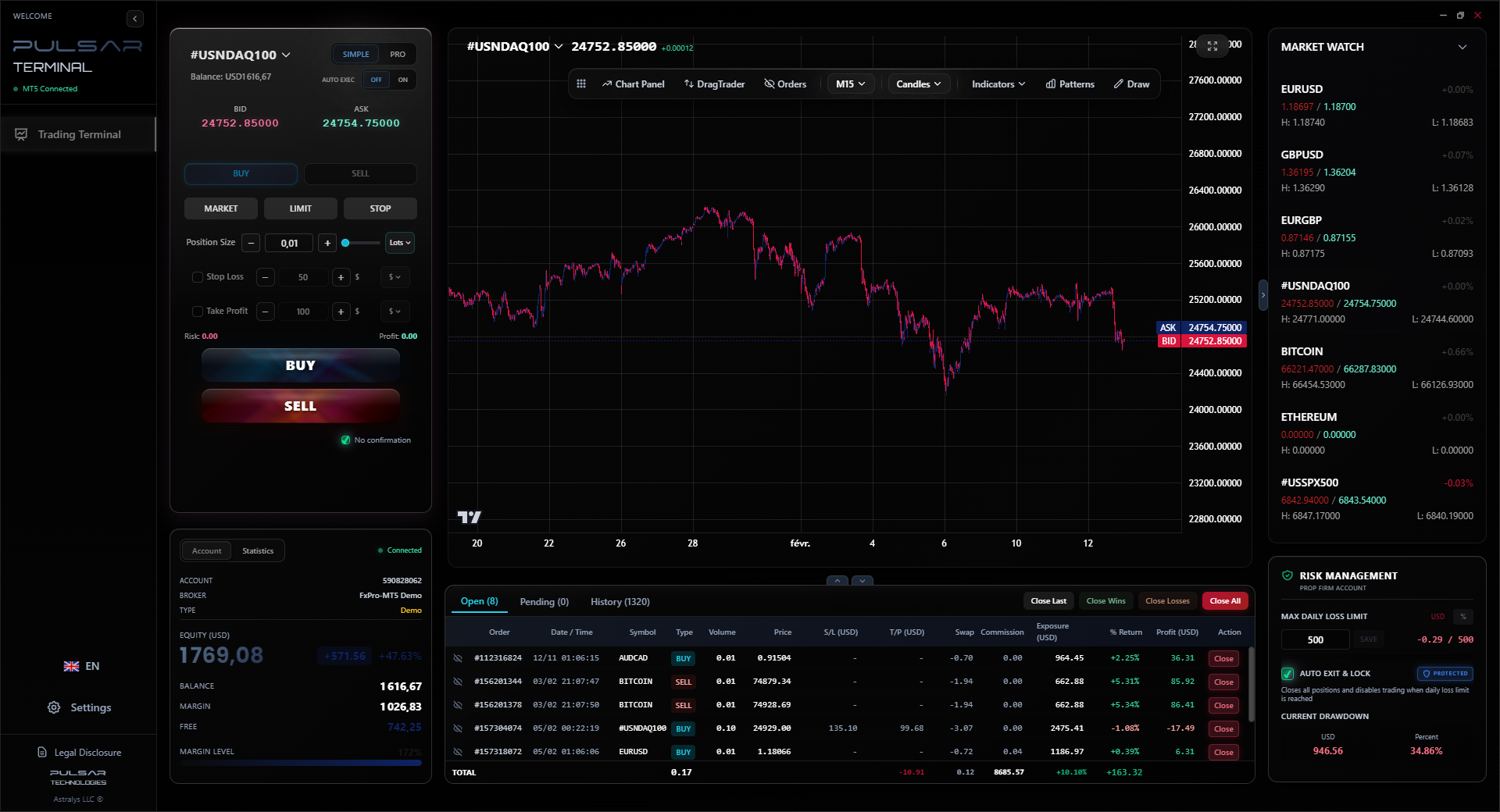
Manually trailing stops on a fast-moving CPR breakout is stressful; Pulsar Terminal automates trailing stops and breakeven moves directly on your MT5 chart, so you can lock in profits without staring at the screen.
Pulsar Terminal
MT5オールインワンツール:ドラッグ&ドロップ注文、マルチTP/SL、トレーリングストップ、グリッドトレード、出来高プロファイル、プロップファーム保護。毎日1,000人以上のトレーダーが利用。
FAQ
Q1Is the CPR trading strategy profitable in India?
It can be, but it's not a magic bullet. Its profitability now hinges more on your ability to manage new SEBI rules (like intraday monitoring and higher margins) and transaction costs (STT, GST) than on the indicator itself. A backtest might show a 58% win rate, but real-world slippage and taxes eat significantly into that.
Q2What time frame is best for CPR trading in Nifty?
For intraday, the 5-minute and 15-minute charts are most common for entry timing. However, you must use the daily CPR calculation as your primary reference. I also keep a 30-minute chart open to assess the broader momentum with indicators like MACD, which helps avoid fading a strong trend just because price is at a CPR level.
Q3Can I use CPR for positional trading in Indian stocks?
Absolutely. Switch to the weekly time frame. Calculate the CPR using the previous week's high, low, and close. The weekly TC and BC act as strong support/resistance zones for swing trades lasting days to weeks. This avoids the intraday noise and the mandatory square-off rule, but you'll pay the higher 0.1% STT on delivery.
Q4How do SEBI's new F&O rules affect my CPR strategy?
Massively. Higher margins mean fewer participants and potentially false breaks at CPR levels. Increased lot sizes mean each point movement hits your P&L harder, requiring more precise entries. The reduction in weekly expiries concentrates volatility on one day, making CPR less reliable on that specific session. You must adjust your position size and stop-loss width accordingly.
Q5What's the single biggest mistake CPR traders make?
Trading it in isolation. A CPR level is just a calculation. It gains power from confluence: a prior high/low, a volume profile node, or a trendline. Entering a trade just because price touched the BC, without any other evidence of a reversal, is a surefire way to get run over by the market's momentum.
Q6Do I need a special platform or broker for CPR?
You need a platform that can automatically plot the CPR indicator. Most modern platforms (Zerodha Kite, Upstox Pro, MT5) can do this, sometimes with a custom script. The bigger differentiator is execution speed and reliability, especially around the 3:20 PM auto-square-off time when server load is high.
ウィンストン教授のレッスン
重要ポイント:
- ✓CPR width predicts volatility: narrow range = big move coming.
- ✓Always add GST & STT to your break-even calculation.
- ✓Avoid new CPR trades after 2:30 PM due to SEBI snapshots.
- ✓Virgin CPR fails 20% of time; never over-use it.
この記事はどれくらい役に立ちましたか?
星をクリックして評価
週刊トレーディングインサイト
無料の週刊分析&戦略。スパムなし。
著者について
Rajesh Sharma
シニアFXアナリスト
インド・南アジア市場で10年以上のトレード経験。NSEの通貨デリバティブからキャリアをスタートし、国際FXへ転向。USD/INRと新興国通貨ペアを専門とする。
コメント
リスク警告
金融商品の取引には大きなリスクが伴い、すべての投資家に適しているわけではありません。過去の実績は将来の結果を保証するものではありません。本コンテンツは教育目的のみであり、投資助言として解釈すべきではありません。取引前に必ずご自身で調査を行ってください。
こちらもおすすめ

Cara Trading Forex Sukses: 7 Prinsip dari Trader Profesional
Cara trading forex sukses dengan 7 prinsip trader pro: manajemen modal, disiplin, journal trading, backtest. Data nyata, bukan janji profit palsu.
Jam Trading Forex Terbaik untuk Trader Indonesia: Panduan Lengkap dengan Tabel Waktu
Panduan jam trading forex untuk trader Indonesia. Tabel 4 sesi dunia, jam emas 20:00-00:00, sesi mana yang harus dihindari. Data akurat + tips dari trader berpengalaman.
Top 5 Sàn Forex Uy Tín Nhất 2026: Review Jujur dari Trader Indonesia
Top 5 sàn forex uy tín 2026 untuk trader Indonesia. Review jujur: spread, deposit, withdraw, dukungan lokal. Exness, XM, IC Markets & lebih.
