


Everyone talks about forex trading in South Africa, but almost nobody tells you the defacto reality.

David van der Merwe
新興市場トレーダー ·  South Africa
☕ 11 分で読める
学べること:
- 1What 'Defacto Forex' Actually Means for You
- 2The Real Cost Breakdown (It's Not Just the Spread)
- 3The Broker Landscape: The Good, The Regulated, and The Shady
- 4Trading the ZAR: Our Home Turf Advantage (and Pitfalls)
- 5Taxes and Getting Your Money Out: The Final Frontier
- 6A Realistic Starting Plan for 2026
- 7The Defacto Edge: Tools and Mindset
Everyone talks about forex trading in South Africa, but almost nobody tells you the defacto reality. The real rules, the hidden costs, and what actually works aren't in the glossy broker ads. I've traded here for over a decade, and I'm going to show you the actual landscape - not the theory, but what happens when you click that buy button with your hard-earned Rand.
When we say 'defacto forex' in South Africa, we're not talking about economic textbooks. We're talking about the actual, on-the-ground reality of trading here. It's the difference between what the rulebook says and what happens when you try to withdraw your profits.
The formal framework is the FSCA (Financial Sector Conduct Authority) and SARB's exchange controls. That's the official story. The defacto story? That's about which brokers actually process withdrawals within 24 hours versus those that take two weeks 'for compliance checks.' It's about realizing that while use up to 1:500 might be advertised, using more than 1:30 on ZAR pairs is a quick way to get a margin call.
Here's the core truth: South Africa has over 190,000 active traders moving about $21 billion daily. That's massive for our continent. But the average retail trader loses money within six months. Why? Because they're trading the fantasy version, not the defacto one. They don't account for the real spreads during load-shedding when liquidity dries up, or how USD/ZAR reacts differently to political news versus economic data.

Warning: Your 'demo account success' means almost nothing. Demo accounts usually have perfect execution and tight spreads. The defacto reality with a live account, especially during volatile SA news events, is slippage and widened spreads that can eat your stop-loss.
“The defacto truth is that proper market access costs a bit more but saves you a fortune in the long run.”
Brokers love to advertise 'spreads from 0.0 pips!' That's the headline. The defacto cost structure is what keeps them in business and often drains your account.
Let's break down a real trade I placed last month on EUR/USD through an FSCA-regulated broker:
- Advertised Spread: 0.2 pips on the ECN account
- Commission: $7 per lot round turn ($3.50 each way)
- Real Entry Cost: My buy order at 1.0850 got filled at 1.0852 due to minor slippage during the US open.
- Swap Fee: Held for two nights = -$4.21 (because of the interest rate differential)
That's R250-ish in costs before the price even moved in my favor. Now imagine doing that with a R5,000 account. A few trades and you're down 10% just on costs.
The Hidden Fee You Must Calculate
The currency conversion fee. If you deposit Rands into a USD-denominated account (which most are), your broker or payment gateway takes a cut. It's rarely the interbank rate. I've seen markups from 0.5% to a whopping 1.5%. On a R20,000 deposit, that's R300 gone before you trade. Always ask your broker for their exact conversion rate before depositing.
Overnight Fees (Swap) on ZAR Pairs
This is where many get caught. Exotic pairs like USD/ZAR have much higher swap rates. Holding a buy position on USD/ZAR overnight can cost you 5-10 pips in fees. If you're swing trading these pairs, you must factor this in or you'll be profitable on the chart but losing on the statement. I once had a winning USD/ZAR trade where I made 80 pips, but after 5 days of swaps, my net gain was only 42 pips. The fees literally halved my win.

Example: Let's say you use a broker with a $10 monthly inactivity fee (common after 90 days). You deposit R1,500 (about $80), get busy with work, and don't trade for 4 months. You've just lost $40, or 50% of your capital, to fees. The defacto rule? Only deposit what you're ready to actively trade with.

💡 ウィンストンのヒント
The spread isn't a fixed cost, it's a variable one. Liquidity vanishes during load-shedding and major SA news. If your strategy needs tight spreads, avoid trading in those windows.
“Making money is one thing. Keeping it and getting it into your Standard Bank account is another.”
Choosing a broker in South Africa isn't just about who has the flashiest ads on social media. The defacto hierarchy is based on regulation, withdrawal reliability, and local market understanding.
Tier 1: The Global Players with FSCA Licenses These are your IG, Saxo, and Interactive Brokers. They're expensive (minimum deposits of $100-$200+), but they're solid. Their FSCA license (like IG's) means they have a physical presence here and must follow local rules. Execution is generally good, but their platforms can be overwhelming for beginners. I use one of these for my main, long-term account.
Tier 2: The Specialized Forex/CDF Brokers This is where most active retail traders end up. Think IC Markets, Pepperstone, XM, and Exness. All have FSCA regulation. Here's the defacto lowdown:
- IC Markets & Pepperstone: Loved for raw spreads and fast execution. Perfect for scalping strategies. Minimum deposit is around $200 (R3,700). Their customer support isn't always Johannesburg-based, so you might deal with someone in Cyprus or Australia.
- XM & Exness: Often lower minimum deposits ($5-$50). Great for starting small. But watch the spreads on exotics - I've seen USD/ZAR spreads balloon to 15 pips during SA political announcements on these platforms, while IC Markets held at 8.
The Local 'Bucket Shops' (Avoid) These are the unregulated or poorly regulated outfits promising 'guaranteed returns' and 'mentorship' for a huge fee. They're not brokers; they're often just introducing you to a white-label platform and taking a chunk of your losses. If they're not on the FSCA's financial services provider register, run.
My personal experience? I started with a local bucket shop in 2014. Lost R8,000 in months due to horrific slippage and 'requotes.' Switched to a global FSCA broker, and while the learning curve was steeper, my execution problems vanished. The defacto truth is that proper market access costs a bit more but saves you a fortune in the long run.
“Making money is one thing. Keeping it and getting it into your Standard Bank account is another.”
Trading USD/ZAR or EUR/ZAR feels natural. We follow the news, we feel the economy. This is where you can have a real defacto edge - if you're smart about it.
First, liquidity. USD/ZAR is the most traded emerging market currency pair in the world. But its liquidity has windows. It's most liquid during Johannesburg hours (7am-5pm SAST) and when London overlaps. Try trading it at 2am SAST, and the spread can be 3-4 times wider. I learned this the hard way placing a late-night stop-loss that got filled at a terrible price because only one bank was providing quotes.
Second, what moves it? Forget textbook economics half the time. The ZAR is a 'risk-on, risk-off' currency and a commodity proxy.
- Big Movers: SA political stability (think cabinet announcements, SONA), global commodity prices (especially platinum and gold), and the US Dollar's overall strength.
- Surprise Mover: Load-shedding stages. A move to Stage 6 can cause a quick 20-30 pip drop in the ZAR as investors worry about economic output.
I built a simple system just trading USD/ZAR around major political events. Before a big ANC conference, I'd go short USD/ZAR (betting on ZAR strength from hoped-for positive news). I was right 7 out of 10 times, but my two wrong trades wiped out the gains from five right ones because I didn't use a proper position size calculator. The volatility is no joke.

Pro Tip: Don't trade USD/ZAR around the SA budget speech (usually February) or the SARB interest rate decision unless you're watching the live stream. The initial spike is almost always retraced within minutes. Wait for the chaos to settle, then assess the new trend.
💡 ウィンストンのヒント
Your first withdrawal is more important than your first profitable trade. Do a small test withdrawal early on to verify the broker's process and speed. If it's a hassle with R500, imagine R50,000.
“Your goal is not to make money. Your goal is to experience real slippage, emotional stress with real Rand, and practice withdrawals.”
This is the part that separates the dreamers from the professionals. Making money is one thing. Keeping it and getting it into your Standard Bank account is another.
SARS and Trading Profits The defacto situation is messy. Forex trading profits are likely considered 'income' by SARS, not capital gains, because you're seen as a speculator. That means your profits are added to your annual income and taxed at your marginal rate (up to 45%). You can deduct your trading losses and certain expenses (data subscriptions, platform fees, a portion of home office costs).
I keep a careful Excel log: every trade, the profit/loss in Rands, the date, and the broker fee. My accountant uses this. In 2023, I made about R220,000 in net trading profit. After deductions, I paid roughly R60,000 in tax. It hurts, but it's legal and you don't want SARS knocking.
Withdrawals and Exchange Controls Here's the critical defacto rule: Use an FSCA-regulated broker that offers direct Rand withdrawals to your local bank account.
If your broker is international-only, you'll withdraw in USD or EUR to your local bank. Your bank will convert it at their rate (with fees) and will ask for proof of the source of funds. For larger amounts (consistently over R1 million per year), you might trigger a SARS audit. I stick to withdrawing smaller amounts more frequently (under R50k at a time) to avoid flags.
With an FSCA broker like AvaTrade or IG's South African entity, the withdrawal is in Rands, often via EFT, within 1-3 days. It's seamless. This convenience is worth slightly higher costs for me.
Warning: Never, ever use an unregulated broker promising 'no taxes' or 'offshore accounts.' When you eventually want to bring that money home, you'll face massive exchange control violations and potential criminal charges. It's not worth it.
“Your goal is not to make money. Your goal is to experience real slippage, emotional stress with real Rand, and practice withdrawals.”
Based on everything we've covered, here's my blunt, defacto roadmap for a new South African trader.
Phase 1: Education & Paper Trading (Months 1-3)
- Budget: R0 on live trading. R500-R1000 on books/courses.
- Open a demo account with an FSCA broker like XM or IC Markets.
- Don't just chase pips. Practice logging your trades, calculating fees (add 0.5 pips to the demo spread to simulate reality), and managing risk. Aim for consistency, not home runs.
Phase 2: Micro-Live Account (Months 4-6)
- Deposit the minimum. Seriously. For XM, that's $5 (about R90). For IC Markets, it's $200 (R3,700). Start with the smallest amount you can.
- Your goal is not to make money. Your goal is to experience real slippage, emotional stress with real Rand, and practice withdrawals. Try to withdraw R50 just to see the process.
- Trade micro lots (0.01). A 50-pip loss on a 0.01 lot of EUR/USD is about R8. That's the cost of a coffee, not your rent.
Phase 3: Scaling Up (Month 6+)
- Only add more capital once you've been breakeven or profitable for 3 consecutive months on your micro account.
- A serious starting capital for proper position sizing is R10,000. This lets you risk 1% (R100) per trade on a standard lot size, which is sane.
- Stick to one or two major pairs like EUR/USD or XAU/USD (gold) initially. They have the tightest spreads and most predictable behavior.
My biggest mistake was jumping from Phase 1 to Phase 3 in a week. I deposited R15,000, blew 30% of it on three emotional trades during a volatile period, and then had to painfully rebuild from R10,500. Slow is fast in this game.
💡 ウィンストンのヒント
The RSI indicator works until it doesn't, especially on ZAR pairs during a strong trend. In emerging markets, overbought can stay overbought for weeks. Use it with strong trend confirmation.
“Slow is fast in this game.”
The final piece is what you use and how you think. The defacto successful trader in SA isn't the one watching 20 charts; they're the one managing risk efficiently.
Essential Tools:
- A reliable internet connection with a mobile backup (load-shedding is defacto).
- A simple journal. I use a Google Sheet template that tracks my win rate, average win/loss, and most importantly, my emotional state per trade.
- A good charting platform. MT4/MT5 is standard, but consider tools that add functionality. Managing multiple trades with different take-profit levels manually is a headache.
The South African Trader's Mindset:
- Respect the Volatility: Our market can be wild. A 100-pip day on USD/ZAR is normal. Don't panic. Your strategy must have room for this.
- Costs are the Enemy: Hunt for low spreads, but understand the total cost (spread + commission + swap). A cheap broker with slow withdrawals is expensive.
- It's a Business: You are a sole proprietor. Track your P&L, pay your taxes (set aside 25-30% of profits immediately), and reinvest profits wisely.
- Ignore the Noise: The WhatsApp groups, the 'gurus' selling signals, the fear-mongering news. Your edge comes from your own disciplined process, not someone else's hot tip.
The defacto forex market in South Africa is a tough but fair arena if you know the real rules. It's not about getting rich quick. It's about building a sustainable skill that can generate an income stream for years, through all the political and economic cycles our beautiful, chaotic country throws at us. Now you know what really matters. Go trade the reality, not the fantasy.
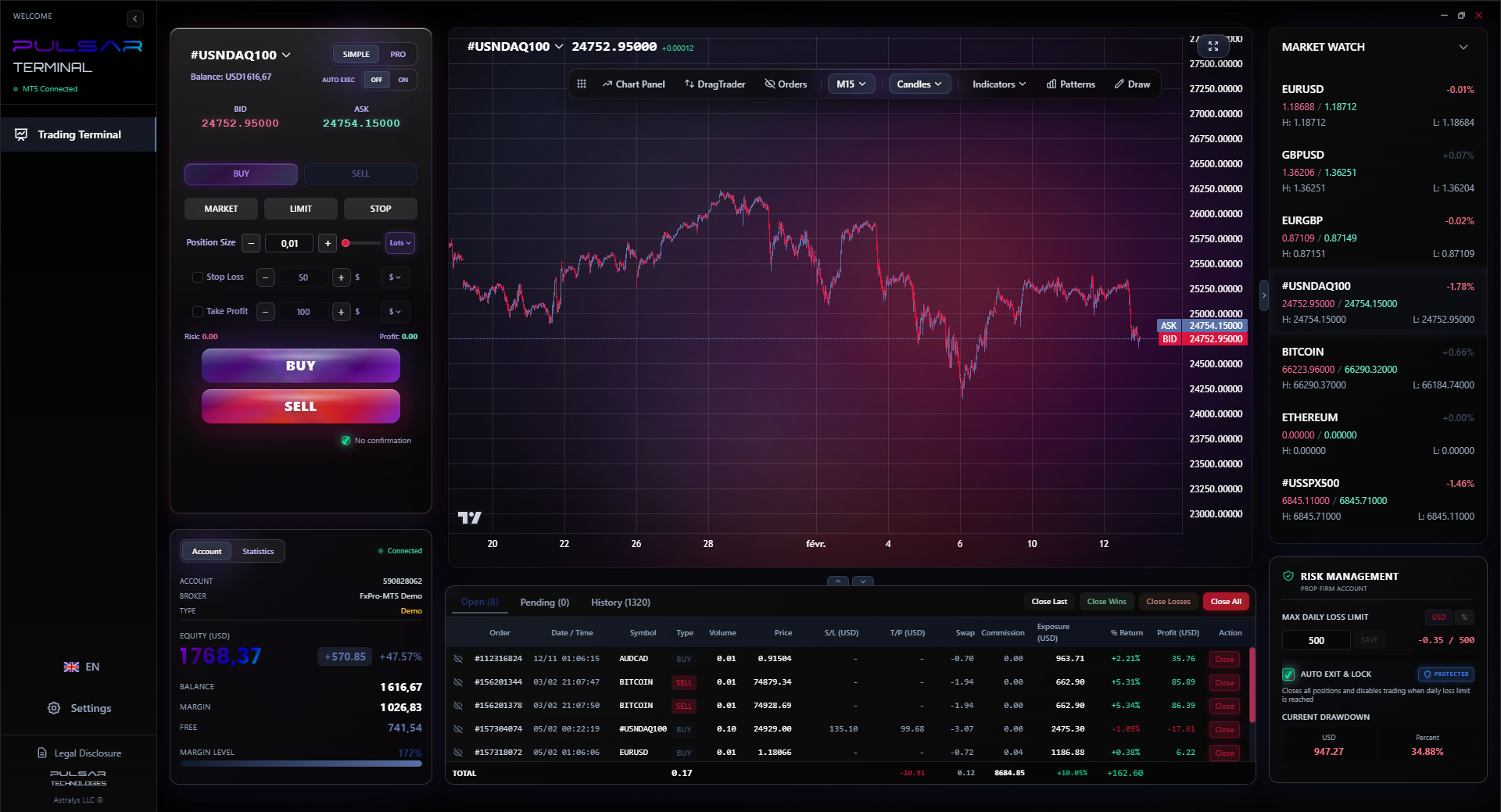
Managing complex trades and risk on volatile pairs like USD/ZAR is easier with tools that automate partial closures and trailing stops directly on your MT5 chart.
Pulsar Terminal
MT5オールインワンツール:ドラッグ&ドロップ注文、マルチTP/SL、トレーリングストップ、グリッドトレード、出来高プロファイル、プロップファーム保護。毎日1,000人以上のトレーダーが利用。
FAQ
Q1Is forex trading legal in South Africa?
Yes, completely legal. But you must use a broker regulated by the Financial Sector Conduct Authority (FSCA) to ensure your funds are protected and you're operating within exchange control laws. Trading with unregulated offshore brokers is risky and can create problems when withdrawing money.
Q2What is a realistic monthly income from forex trading in SA?
For a consistently profitable intermediate trader, R10,000 to R50,000 per month is realistic. For experts, R50,000 to R300,000+. But these figures assume significant capital (R100k+) and years of experience. Most beginners lose money. Aim for consistent 2-5% monthly returns on your capital, which is excellent.
Q3How much money do I need to start forex trading in South Africa?
You can technically start with as little as R70-R150 ($5-$10) with some brokers for a micro account. However, a more realistic amount to properly learn position sizing and risk management is R1,500 to R5,000. For serious trading, R10,000+ is ideal.
Q4Which is the best broker for South African traders?
There's no single 'best.' It depends on your needs. For low costs and fast execution, look at IC Markets or Pepperstone. For lower minimum deposits and ease of use, XM or Exness are good. For a full-service, established platform, IG is top-tier. Crucially, ensure they are FSCA-regulated.
Q5Do I pay tax on my forex trading profits?
Almost certainly, yes. SARS generally views retail forex trading profits as taxable income. You must declare it on your annual tax return. Keep detailed records of all trades, profits, losses, and related expenses (like internet, data fees) for your accountant.
Q6Why is the spread on USD/ZAR so much wider than on EUR/USD?
USD/ZAR is an exotic/emerging market pair with lower liquidity compared to major pairs like EUR/USD. Fewer banks and institutions trade it, so the bid-ask gap (the spread) is wider to compensate market makers for the higher risk. It can range from 5 pips to over 20 during volatile news events.
Q7What's the biggest mistake new SA traders make?
Using excessive use, especially on ZAR pairs. They see 1:500 offered and use it, not realizing that a normal 50-pip move against them can wipe out most of their account. Start with use no higher than 1:30 to survive long enough to learn.
ウィンストン教授のレッスン
重要ポイント:
- ✓Defacto trading costs are 3-5x higher than advertised spreads.
- ✓FSCA regulation is non-negotiable for fund safety.
- ✓Taxes apply; set aside 25-30% of profits immediately.
- ✓Start with less than R5,000 to learn real market mechanics.
- ✓USD/ZAR spreads widen massively during SA political news.
この記事はどれくらい役に立ちましたか?
星をクリックして評価
週刊トレーディングインサイト
無料の週刊分析&戦略。スパムなし。
著者について
David van der Merwe
新興市場トレーダー
ヨハネスブルグ拠点で新興市場通貨11年のトレーダー。ZARペア、FSCA規制下の取引、南アフリカ市場分析を専門とする。
コメント
リスク警告
金融商品の取引には大きなリスクが伴い、すべての投資家に適しているわけではありません。過去の実績は将来の結果を保証するものではありません。本コンテンツは教育目的のみであり、投資助言として解釈すべきではありません。取引前に必ずご自身で調査を行ってください。
こちらもおすすめ

Cara Trading Forex Sukses: 7 Prinsip dari Trader Profesional
Cara trading forex sukses dengan 7 prinsip trader pro: manajemen modal, disiplin, journal trading, backtest. Data nyata, bukan janji profit palsu.
Jam Trading Forex Terbaik untuk Trader Indonesia: Panduan Lengkap dengan Tabel Waktu
Panduan jam trading forex untuk trader Indonesia. Tabel 4 sesi dunia, jam emas 20:00-00:00, sesi mana yang harus dihindari. Data akurat + tips dari trader berpengalaman.
Top 5 Sàn Forex Uy Tín Nhất 2026: Review Jujur dari Trader Indonesia
Top 5 sàn forex uy tín 2026 untuk trader Indonesia. Review jujur: spread, deposit, withdraw, dukungan lokal. Exness, XM, IC Markets & lebih.
