


You've got R20,000 in your trading account, you're in a winning trade, and your platform shows your 'Equity' is now R22,500.

David van der Merwe
新興市場トレーダー ·  South Africa
☕ 11 分で読める
学べること:
- 1What is Equity? The Simple Formula You Must Know
- 2Equity vs. Balance vs. Free Margin: Untangling the Trio
- 3Why Equity is Your #1 Metric (Especially in South Africa)
- 4FSCA Rules & use: How They Squeeze Your Equity
- 5Managing Equity Drawdowns: The Trader's Gut Check
- 6Broker Differences: How Your Platform Displays Equity
- 7Tax and Equity: What SARS Cares About (And Doesn't)
- 8Advanced Tactics: Using Equity as a Strategy Tool
You've got R20,000 in your trading account, you're in a winning trade, and your platform shows your 'Equity' is now R22,500. But what does that number actually mean for you, right now? If you don't know, you're flying blind. In South Africa's regulated market, understanding your equity isn't just theory, it's the difference between staying in the game and getting a nasty call from your broker. Let's break down this critical number, how the FSCA's rules affect it, and why it should be the main number you watch.
Forget the fancy definitions. In plain English, your equity is your account's live, breathing value at this very second. It's not what you started with. It's what you've got right now, including all the profits or losses from your open trades.
The formula is dead simple: Equity = Account Balance + Unrealized P/L
Let's make it real. You deposit R15,000. That's your balance. You open a trade on USD/ZAR, and it moves in your favor, showing a floating profit of R1,200. Your equity is now R16,200. If that trade turns against you and shows a R800 loss, your equity drops to R14,200. Your balance? It's still R15,000 until you close the trade.
This is the core of the equity meaning in forex trading. It's your real-time financial pulse. Watching your balance tells you nothing about your current risk. Watching your equity tells you everything.

Warning: A common rookie mistake is looking at the account balance and thinking "I'm fine." Meanwhile, their equity is tanking because of open losing positions, inching them closer to a margin call. The balance is a rear-view mirror. Equity is the windshield.
These three numbers on your MT4/MT5 platform cause more confusion than a load-shedding schedule. Let's clear it up.
Account Balance: This is your historical bookkeeping. It's the sum of all your deposits, withdrawals, and the realized profit/loss from closed trades. No open trades? Your balance and equity are the same number.
Equity: As we know, this is Balance + the current value of your open trades. It's the now.
Free Margin: This is your available trading power. It's calculated as Equity - Used Margin. Used Margin is the cash your broker has locked up as collateral for your open positions.
A Practical Example with Rand
Let's say your balance is R50,000. You open a position that requires R10,000 as margin (your Used Margin). The trade immediately goes against you, showing a floating loss of R2,000.
- Balance: R50,000 (unchanged)
- Equity: R48,000 (R50,000 - R2,000 loss)
- Used Margin: R10,000
- Free Margin: R38,000 (R48,000 Equity - R10,000 Used Margin)
This Free Margin of R38,000 is what you have left to open new trades. If your equity falls to the point where Free Margin hits zero, you get a margin call. This is why monitoring equity is non-negotiable for proper position size management.

💡 ウィンストンのヒント
Your equity is your oxygen tank. You can't see the oxygen, but the gauge is all that matters. Never trade without knowing what that gauge says.
“A dropping equity number induces panic far more than a static balance. You need to be comfortable with its movement.”
In South Africa, with the FSCA's 30:1 use cap for retail traders, your equity becomes even more critical. Higher use amplifies both gains and losses against your equity. A small market move can have a big impact on that number.
Your equity directly determines:
- Your Margin Status: Brokers calculate your Margin Level as (Equity / Used Margin) * 100%. If this falls below their stop-out level (often 50% or 20%), they start closing your positions, biggest loser first. I learned this the hard way in 2018. I was focused on my balance being positive, but a correlated pair move crushed my equity. My margin level hit 49%, and my broker's system liquidated a GBP/USD trade for a R4,200 loss before it could recover. The trade would have been profitable 3 hours later. I was watching the wrong number.
- Your Risk Per Trade: Smart risk management means risking a percentage of your equity, not your balance. If you risk 2% of a R100,000 balance but have open losses dragging equity down to R90,000, you're actually risking more than 2% of your real capital. Always base your stop-loss calculations on current equity.
- Your Psychological State: Seeing your equity fluctuate is the real test. A dropping equity number induces panic far more than a static balance. You need to be comfortable with its movement to avoid emotional decisions.

Pro Tip: Set a personal "equity drawdown limit." Mine is 20%. If my equity falls 20% from its highest point in the month, I close all trades and stop trading for 48 hours. This rule has saved me from revenge trading more times than I can count.
The FSCA's 30:1 use rule for major pairs (and lower for minors/exotics) was implemented for your protection, but it changes the equity game. It forces you to put up more of your own cash (margin) for each trade.
Here’s the practical impact: With lower use, a given market move causes a smaller percentage swing in your equity compared to the wild 500:1 days. This sounds safer, and it is. But it also means you need more capital to achieve the same potential return (in Rand terms) on a trade, which can tempt traders to over-size their positions relative to their equity.
Let's compare using a standard lot (100,000 units):
| Scenario | use | Margin Required for 1 Lot EUR/USD | Equity Swing for a 100-pip Move |
|---|---|---|---|
| Pre-2021 (Common) | 100:1 | ~R20,000* | ~R13,000 Profit/Loss |
| Current FSCA Retail | 30:1 | ~R66,667* | ~R13,000 Profit/Loss |
| *Approximate ZAR values based on EUR/ZAR ~20.00. |
Notice the key point? The profit/loss in Rand is the same (100 pips on EUR/USD is ~$1000, or ~R20,000). But the margin required is over triple. This means the same losing trade consumes a much larger chunk of your available capital (Free Margin), causing your equity to drop faster relative to your account size if you're over-leveraged.
The lesson: Don't be fooled by the lower use into thinking you can take bigger risks. You must be even more disciplined with your equity-based position sizing. A good scalping strategy under these rules requires surgical precision, not a hammer.
“SARS does not tax your equity. They tax your *realized* profits.”
Drawdown is the decline in your equity from a peak to a trough. It's inevitable. How you handle it defines you as a trader.
My Personal Drawdown Disaster (And Recovery) In early 2022, I got cocky. I had a great Q4. My equity peaked at R285,000. I started breaking my rules, adding to losing positions on gold (XAU/USD). A sustained rally against me saw my equity plunge to R199,000 - a 30% drawdown. I was physically sick. I didn't use a hard stop; I kept moving it, hoping for a reversal.
The turnaround came from one action: I closed everything. I took a 5-day break. When I returned, I traded at 25% of my normal position size until I had 10 consecutive, small, disciplined wins. It took 6 weeks to climb back to R240,000. The loss of time and mental capital was far worse than the loss of money.
Strategies to Protect Equity
- Use Stop-Losses Religiously: Base them on the chart, not on how much of your equity you're willing to lose. Then, use a position size calculator to ensure the potential loss is only 1-2% of your equity.
- Correlation Awareness: Don't open multiple trades on correlated pairs (like EUR/USD and GBP/USD). You're effectively doubling your risk on one market move, hammering your equity from two sides.
- Equity Trail Stops: Some advanced platforms or tools allow you to set a stop that trails based on a percentage of total equity, not just price. This is a top-tier method for swing trading accounts.

Example: You have R100,000 equity. Your rule is to risk 1.5% per trade. That's R1,500. If your trade setup has a 50-pip stop-loss, you calculate: R1,500 / (50 pips * [ZAR pip value]) = Your correct lot size. This ties risk directly to equity.
💡 ウィンストンのヒント
The FSCA gave you a 30:1 seatbelt. It's there to save your life (equity) in a crash. Don't unbuckle it by over-leveraging just to feel the speed.
Not all brokers display or handle equity calculations identically, especially regarding swaps/rollover interest. This can cause confusion.
Local vs. International Brokers: An FSCA-regulated broker like Khwezi Trade or IG South Africa will display equity in ZAR, with all calculations (margin, profit/loss) converted at their current rate. An international broker like IC Markets or Pepperstone might display your equity in USD, even if your account is denominated in ZAR. You must know which currency your "equity" figure is in.
The Swap/Interest Quirk: Here's a subtle one. Your unrealized P/L for equity calculation typically does NOT include the daily swap/rollover interest charge or credit. That gets applied to your balance (and thus your equity) once, at the broker's specific rollover time (often 22:00 GMT). So, if you're holding a trade overnight, your equity at 21:55 GMT won't reflect the swap that will be added or deducted in 5 minutes. This is a small thing, but if you're holding large positions for weeks, it adds up.
My Advice: Stick with reputable, well-regulated brokers. I've used both Exness and XM for their low spreads, but I always double-check their specific policies on equity calculation and margin calls. Read the fine print on their website about "Account Terms" or "Margins." A broker's stop-out level is a critical number that interacts directly with your equity.
Manually managing equity-based stops across multiple trades is a headache; Pulsar Terminal lets you set trailing stops and breakeven levels that automatically lock in profits as your equity grows, directly on your MT5 charts.
Pulsar Terminal
MT5オールインワンツール:ドラッグ&ドロップ注文、マルチTP/SL、トレーリングストップ、グリッドトレード、出来高プロファイル、プロップファーム保護。毎日1,000人以上のトレーダーが利用。
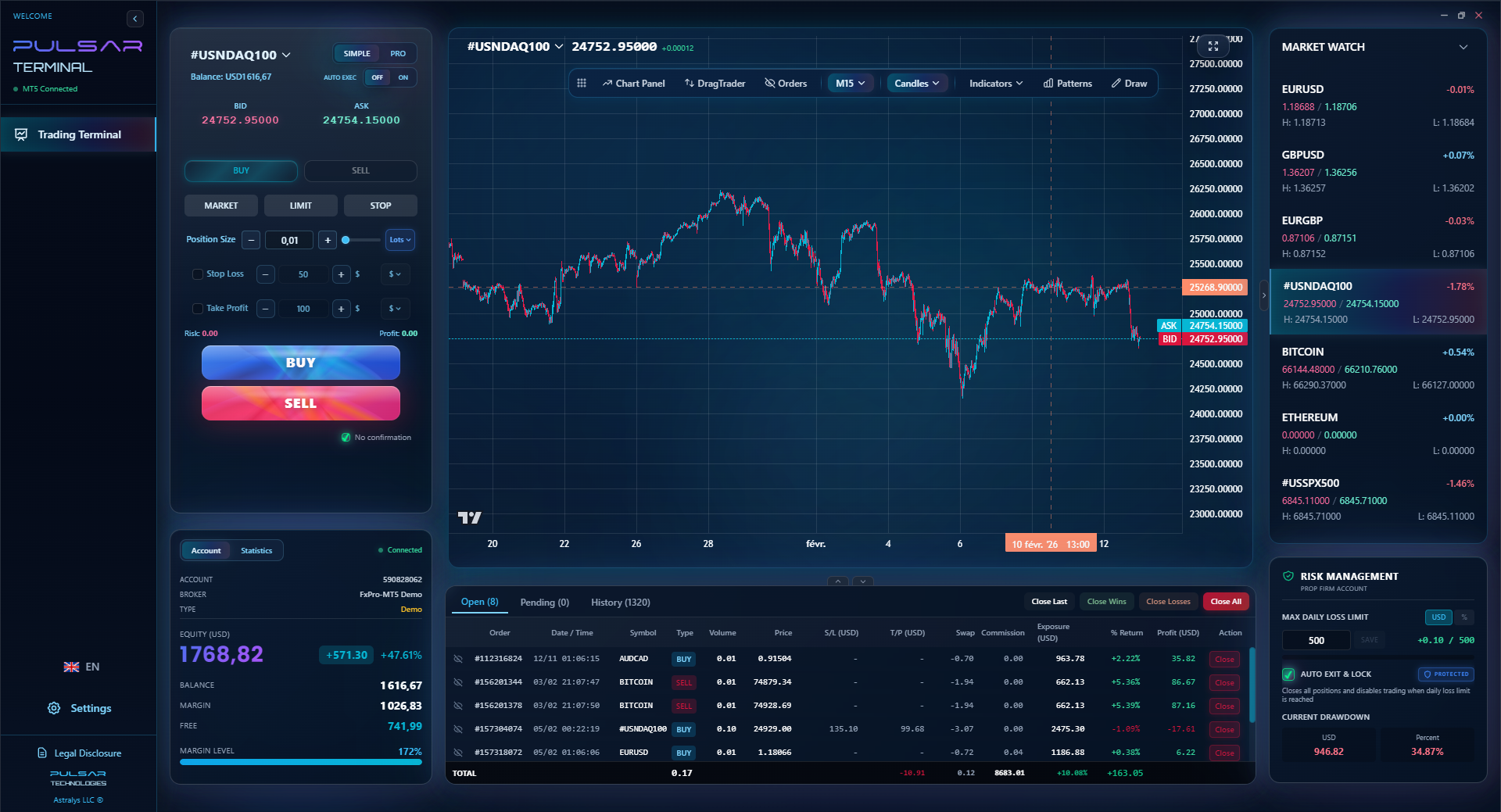
“The trend of your equity curve is everything. Is it consistently rising with small dips, or is it a volatile rollercoaster?”
This is crucial for every South African trader. SARS does not tax your equity. They tax your realized profits.
Your equity bounces around daily with unrealized gains and losses. SARS doesn't care about that. They only care when you close a trade, convert a profit to real money, and it hits your balance. That's a taxable event. Similarly, a realized loss can be deducted.
Practical Tax Scenario: Your balance starts the year at R100,000. During the year, your equity hits a high of R180,000 but you only close some trades. By year-end, after all trades are closed, your balance is R140,000.
- Your Taxable Income: R40,000 (the realized profit: R140,000 final balance - R100,000 starting balance).
- The R40,000 equity peak you didn't capture? Irrelevant for tax.
You must declare this R40,000 as income on your annual tax return (ITR12). It gets added to your other income (salary, etc.) and taxed at your marginal rate (18%-45%). Keep careful records of every closed trade - date, instrument, buy/sell price, profit/loss in Rands. A good trading journal or broker statement is essential.
Remember, trading with an FSCA-regulated broker makes this simpler, as they are required to keep proper records and provide you with annual tax certificates in line with South African law.
Once you're comfortable monitoring equity, you can use it proactively.
1. The Equity Curve as a Performance Metric: Chart your equity over time (weekly closing equity is fine). This is your true performance chart, not your win rate. The trend of this curve is everything. Is it consistently rising with small dips (healthy)? Or is it a volatile rollercoaster (dangerous)? If your equity curve goes flat or down for 2-3 months, your strategy may be broken or market conditions have changed.
2. Scaling Based on Equity: This is a professional move. You define equity milestones where you adjust your risk per trade.
- Example: Risk 1% of equity until equity > R200,000. Then, risk 0.75% until equity > R350,000. Then, risk 0.5%. This systematically reduces risk as your account grows, protecting your capital base. It's the opposite of getting greedy.
3. Hedging to Stabilize Equity: In times of extreme volatility, you might open a small, negatively correlated position not to make money, but to reduce the violent swings in your equity. For instance, if you have a large long USD/ZAR position and fear a sudden political announcement, a tiny long gold (XAU/USD) position can act as a partial hedge. The goal isn't profit on the hedge; it's to smooth the equity curve and keep your psychology intact. This is an advanced tactic and can backfire if correlations break down.
Mastering these concepts moves you from just watching equity to using it as a strategic dashboard. It turns a simple number into your most powerful management tool.
💡 ウィンストンのヒント
If you can't look at a 10% equity drawdown without sweating, your position size is too big. Psychology is managed through numbers first.
FAQ
Q1Is equity the same as the money I can withdraw?
No, not exactly. Your equity includes unrealized profits. You can only withdraw cash based on your Free Margin, which is derived from your equity. If you have R50,000 equity but R20,000 is tied up as margin for open trades, you likely can't withdraw the full R50,000 without closing positions first.
Q2What happens if my equity goes to zero?
If your equity falls to or below the level required to maintain your open positions (i.e., Free Margin hits zero), your broker will issue a margin call and then begin a stop-out, forcibly closing your trades to prevent your account from going negative. You will lose the margin you posted for those trades.
Q3Does the FSCA's 30:1 use limit affect how I calculate my equity?
It doesn't change the equity formula, but it dramatically affects the inputs. Because you need more margin per trade, a losing trade will consume a larger portion of your account's capital, causing a sharper percentage drop in your equity if you're not careful with position sizing. It forces you to be more equity-conscious.
Q4How often should I check my equity?
It depends on your style. A scalper might watch it second-by-second. A swing trader should check at least once a day when they review their trades. Obsessively watching it fluctuate can lead to panic. Set your stops based on your strategy, then trust them. The key is to check it at logical intervals for review, not reactively.
Q5Why did my equity change when I didn't have any open trades?
This is usually due to one of two things: 1) A deposit or withdrawal you made, which changes your balance and thus your equity. 2) The deduction or credit of swap/rollover interest from a trade you just closed or that was applied at the daily rollover time after you closed a position.
Q6For tax in South Africa, do I pay tax on my total equity at year-end?
Absolutely not. SARS taxes only realized profits. Your equity includes unrealized (floating) gains which are not taxed. You only pay tax on the net profit from trades you have actually closed during the tax year. Keep detailed records of all closed trades.
ウィンストン教授のレッスン
重要ポイント:
- ✓Equity = Balance + Floating P/L. It's your live account value.
- ✓Free Margin, derived from Equity, is your available trading power.
- ✓FSCA's 30:1 use makes disciplined equity management non-negotiable.
- ✓Risk a percentage of equity, not balance, on every trade.
- ✓SARS taxes closed trades, not your fluctuating equity.
この記事はどれくらい役に立ちましたか?
星をクリックして評価
週刊トレーディングインサイト
無料の週刊分析&戦略。スパムなし。
著者について
David van der Merwe
新興市場トレーダー
ヨハネスブルグ拠点で新興市場通貨11年のトレーダー。ZARペア、FSCA規制下の取引、南アフリカ市場分析を専門とする。
コメント
リスク警告
金融商品の取引には大きなリスクが伴い、すべての投資家に適しているわけではありません。過去の実績は将来の結果を保証するものではありません。本コンテンツは教育目的のみであり、投資助言として解釈すべきではありません。取引前に必ずご自身で調査を行ってください。
こちらもおすすめ

Cara Trading Forex Sukses: 7 Prinsip dari Trader Profesional
Cara trading forex sukses dengan 7 prinsip trader pro: manajemen modal, disiplin, journal trading, backtest. Data nyata, bukan janji profit palsu.
Jam Trading Forex Terbaik untuk Trader Indonesia: Panduan Lengkap dengan Tabel Waktu
Panduan jam trading forex untuk trader Indonesia. Tabel 4 sesi dunia, jam emas 20:00-00:00, sesi mana yang harus dihindari. Data akurat + tips dari trader berpengalaman.
Top 5 Sàn Forex Uy Tín Nhất 2026: Review Jujur dari Trader Indonesia
Top 5 sàn forex uy tín 2026 untuk trader Indonesia. Review jujur: spread, deposit, withdraw, dukungan lokal. Exness, XM, IC Markets & lebih.
