


Here's the truth most trading gurus won't tell you: drawing a few lines on a chart and calling it 'Fibonacci trading' is a surefire way to blow your account.

David van der Merwe
新興市場トレーダー ·  South Africa
☕ 11 分で読める
学べること:
- 1What Are Fibonacci Retracement Levels? (No, It's Not Magic)
- 2How to Draw Fibonacci Correctly (This is Where Most People Screw Up)
- 3Key Levels & What They Actually Mean for Your Trade
- 4Fibonacci Doesn't Work Alone: The Essential Combo
- 5The South African Context: Regulations, Pairs & Practicalities
- 6Mistakes I've Made (So You Don't Have To)
- 7Putting It Together: A Simple Fib Trade Plan
- 8Beyond the Basics: Extensions & Other Tools
Here's the truth most trading gurus won't tell you: drawing a few lines on a chart and calling it 'Fibonacci trading' is a surefire way to blow your account. I've seen it a hundred times. A trader in Johannesburg or Cape Town watches one YouTube video, slaps the Fib tool on a random move, and then wonders why price smashes straight through their 'key level'. It's not magic, it's a tool. And like any tool, it's useless in the wrong hands. This guide will cut through the nonsense and show you how to actually use Fibonacci retracement levels forex trading, specifically for our market, our regulations, and our unique challenges as South African traders.
Let's get the basics out of the way without the mystical fluff. Fibonacci retracement levels are horizontal lines drawn on a chart that indicate where price might find support or resistance after a significant move. They're based on ratios derived from the Fibonacci sequence (0.236, 0.382, 0.500, 0.618, 0.786).
The 0.618 level (61.8%) is the most famous, the 'golden ratio'. But here's the kicker: markets don't care about ancient mathematics. These levels work because enough traders are watching them, creating a self-fulfilling prophecy. It's crowd psychology, not divine intervention.
In the South African context, you're applying this to a market with specific quirks. Trading USD/ZAR or EUR/ZAR? These pairs can be more volatile than the majors like EUR/USD. That means price might overshoot or undershoot these levels more dramatically, especially during local market hours or around SARB announcements. You can't just copy a strategy from a US trader and expect it to work the same way here.

Warning: Don't fall for the 'secret Fibonacci code' sales pitch. There isn't one. The value is in consistency and combining it with other tools, which we'll get into.

💡 ウィンストンのヒント
The 50% retracement level is a psychological magnet, often more powerful than the 61.8%. Watch it like a hawk.
This is the single biggest mistake I see. You can't just click the tool anywhere. If your anchor points are wrong, the entire analysis is garbage.
The Swing High and Swing Low Rule
For a retracement in an uptrend, you draw from the swing low to the swing high (low to high). The tool will then project the retracement levels downward. For a downtrend, you draw from the swing high to the swing low (high to low). It projects upward.
You must use significant swing points. Not every little wiggle. Look for the clear trough before a major rally, or the clear peak before a major sell-off. On the USD/ZAR daily chart, for instance, you'd use the major turning points that align with shifts in commodity prices or risk sentiment.
A Real Trade Example (Where I Got It Wrong)
Back in 2022, on the EUR/USD, I identified a strong upward move. I drew my Fib from a low of 1.0350 to a high of 1.0770. Price retraced and hovered around the 0.618 level (1.0520). I entered a buy, convinced it was the perfect bounce. I ignored the fact that the overall momentum was fading and the MACD indicator was showing a bearish divergence. Price kissed the 0.618 level and then tanked straight through the 0.786 level. I took a 45-pip loss. The Fib level was technically correct, but my trade context was dead wrong.

Pro Tip: Always draw on higher time frames first (Daily, H4). Those levels carry more weight. Then see if they align with levels on your lower trading time frame. A 0.618 level on the daily chart is a much bigger deal than one on the 15-minute chart.
“If your anchor points are wrong, the entire Fibonacci analysis is garbage.”
Not all Fib levels are created equal. Let's break down what you should really watch.
- 23.6% Level: A shallow retracement. Often a sign of a very strong, impulsive trend. If price only pulls back here and rockets off, the trend is powerful. In a fast-moving pair like GBP/JPY, this can be a common bounce point.
- 38.2% & 50% Levels: The 'action zone'. This is where most healthy retracements find support/resistance. Many institutional swing trading strategies look for entries here. The 50% level isn't a true Fibonacci number, but it's so widely watched it acts like one.
- 61.8% Level (The Golden Ratio): The big one. This is the make-or-break level for the trend. If price retraces deeply to 61.8% and holds, the original trend has a strong chance of resuming. If it breaks cleanly, the trend is likely exhausted, and you might be looking at a deeper retracement or even a reversal.
- 78.6% Level: A deep retracement. This is often the last line of defense for the trend. A break here usually signals the move is over, and price is likely to test the origin (100% retracement).
In our market, with the FSCA's 30:1 use limit for retail traders, trading deep retracements like the 78.6% can be risky. Your stop loss needs to be wider, which means your position size calculator must be adjusted aggressively to avoid a quick margin call. A 50-pip stop on EUR/USD is one thing; a 150-pip stop on USD/ZAR is another beast entirely with limited use.
Using Fib levels in isolation is a recipe for disaster. They are a confluence filter, not a standalone signal.
1. Combine with Horizontal Support/Resistance: This is non-negotiable. If a key Fib level (say, 0.618) aligns with a previous major swing high or low that's now acting as support, you have high-probability confluence. The market is telling you two different stories that agree on one price.
2. Use with Momentum Indicators: Before entering at a Fib level, check the momentum. Is the RSI indicator showing oversold conditions in an uptrend retracement? Is the MACD histogram starting to tick up? This helps you avoid catching a falling knife.
3. Watch for Price Action Confirmation: Don't just buy the second price touches the Fib line. Look for a rejection candle - a pin bar, a bullish engulfing pattern, a double bottom. Let the market show you it respects the level. I learned this the hard way trying to scalping strategy Fib levels on the 5-minute chart without any confirmation. The spreads alone ate my profits.
4. Trend Lines and Channels: Draw your trend lines. A Fib level that sits right on a rising trend line in an uptrend is a powerful signal. It's like the market has multiple reasons to bounce right there.

Example: You're watching EUR/USD retrace in an uptrend. It approaches the 0.5 Fib level at 1.0850. You also note that 1.0850 was a previous resistance level in February that broke. The RSI is at 40 (not oversold, but cooling off). A bullish pin bar forms on the H1 chart right at 1.0850. That is a trade setup. Not just 'price is at the Fib'.
💡 ウィンストンのヒント
If price slices through the 78.6% level without pausing, the trend is almost certainly over. Don't fight it.
“Using Fib levels in isolation is a recipe for disaster. They are a confluence filter, not a standalone signal.”
Trading from South Africa isn't the same as trading from London or New York. You have to factor in our rules and our market's personality.
Regulatory Reality (FSCA): You must use an FSCA-licensed broker. This isn't a suggestion; it's for your protection. Brokers like IG (FSP 41393), AvaTrade (license 45984), and local favourite Khwezi Trade are under the regulator's eye. This affects your use (max 30:1 retail), ensures client money segregation, and gives you recourse if things go south. Trading with an unregulated offshore broker to get 500:1 use is a fantastic way to lose everything with zero protection.
Trading the ZAR Pairs: USD/ZAR and EUR/ZAR are your home game. They have wider spreads - think 5 pips on USD/ZAR with a broker like Pepperstone and 14 pips on EUR/ZAR. This changes your Fib game. A 38.2% retracement might be 80 pips deep. Your stop loss must account for this spread and volatility. A tight 20-pip stop is suicide. You need to trade smaller sizes to accommodate wider stops. Always know your exact cost per pip definition on these pairs.
Tax Implications (SARS): Remember, your profitable Fib trades generate income. It's not a hobby. You need to declare profits to SARS. Keep a detailed trading journal. That loss I took on EUR/USD? It offset other gains that tax year.
Local Broker Minimums: Your capital affects your strategy. If you're starting with Khwezi Trade's 500 ZAR minimum, you can't realistically trade USD/ZAR standard lots. You'll be in micro or cent accounts. This makes Fib scalping strategy on lower timeframes very difficult due to the spread cost. Focus on higher timeframes where the moves are larger relative to the spread.
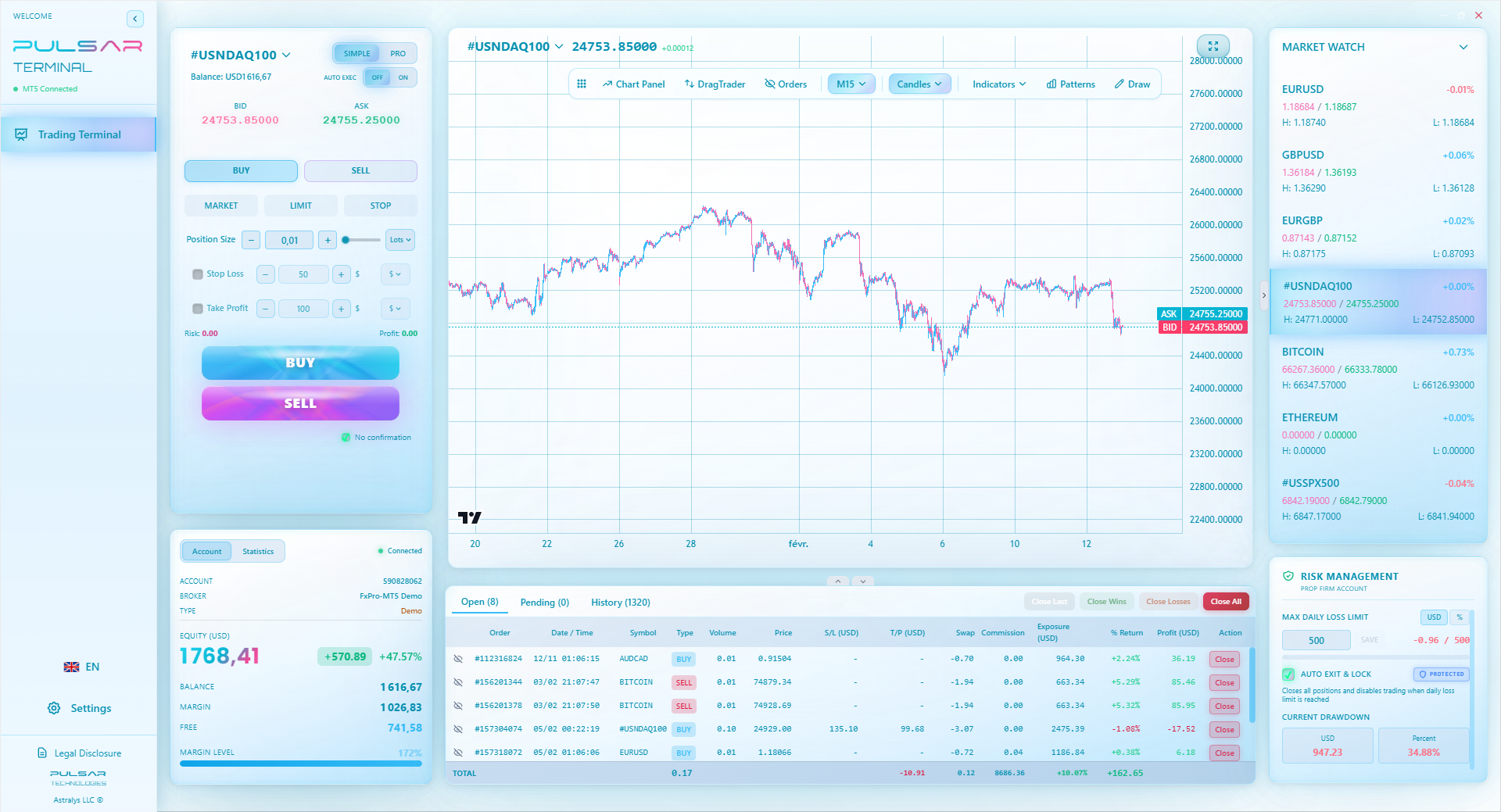
Managing multiple take-profit levels at Fibonacci extensions is a hassle, but tools like Pulsar Terminal let you set them with a simple drag-and-drop directly on your MT5 chart.
Pulsar Terminal
MT5オールインワンツール:ドラッグ&ドロップ注文、マルチTP/SL、トレーリングストップ、グリッドトレード、出来高プロファイル、プロップファーム保護。毎日1,000人以上のトレーダーが利用。
Let's get personal. Here's where I've paid my 'tuition fees' to the market using Fibs.
- Over-plotting: I used to have charts that looked like spider webs. Fibs on every minor swing, on multiple time frames. It created paralysis. Solution: Clean your chart. One major Fib from the most recent significant swing. Maybe one from the prior major swing if levels are clustering.
- Ignoring the Trend: The biggest sin. Drawing a Fib retracement in a downtrend and then trying to buy at the 0.618 level because 'it's a Fib support'. No. In a downtrend, the 0.618 level is resistance for a potential bounce lower. The tool direction defines the level's role.
- Forgetting about the 100% Level: The extension. If price blows past the 0.786 level, the next target isn't a mystery. It's often the 100% level, meaning a full retracement to where the move started. I've been caught short in a strong trend, watched price blow past my Fibs, and didn't have the sense to see the 100% level as the next logical target for the pullback.
- Relying on Default Settings: Most platforms only show 0.0, 23.6, 38.2, 50, 61.8, 78.6, 100. Many traders add the 88.6% level. It's another deep level that can act as support/resistance. Don't be afraid to customize your tool.
- Chasing Entries: You see a perfect bounce off the 0.382 level, but you missed the entry. Price is now 15 pips away. Don't chase it. The best risk/reward was at the level. Wait for the next setup. Chasing is how you enter right before the retracement continues.
“Trading with an unregulated offshore broker to get 500:1 use is a fantastic way to lose everything with zero protection.”
Here’s a concrete, step-by-step plan for a South African trader.
Step 1: Identify the Trend (Daily Chart). Is USD/ZAR in a clear uptrend? Use price structure and maybe a moving average.
Step 2: Find the Correct Swing. On the Daily, mark the last significant swing low (support) and the subsequent swing high (resistance).
Step 3: Draw the Fib. From the swing low TO the swing high. Your retracement levels are now projected.
Step 4: Wait for the Retracement. Monitor the H4 or H1 chart. Don't act yet. Let price come to a key level (preferably 0.5 or 0.618).
Step 5: Seek Confluence. At that Fib level, is there horizontal support? Is the RSI indicator above 30 and starting to curl up? Look for a bullish price action candle.
Step 6: Entry & Risk Management. Enter on a break of the high of the confirmation candle. Place your stop loss below the recent swing low that formed at the Fib zone (giving the trade room). Use your position size calculator so this stop represents 1-2% of your capital, factoring in the ZAR pair's wider spread definition.
Step 7: Take Profit. Your first target can be the previous swing high (the 0% Fib level). A more aggressive target could be a Fibonacci extension level (like 1.618), but that's for another lesson.
This plan forces discipline. It removes emotion. You're not guessing; you're waiting for the market to meet your predefined criteria.
💡 ウィンストンのヒント
For ZAR pairs, add 50% to your usual stop-loss distance. Our market's normal noise will stop you out otherwise.
Once you're comfortable with retracements, you can explore how the pros use Fibs.
Fibonacci Extensions: These project beyond the 100% level to give profit targets in the direction of the trend. Common extension levels are 1.272, 1.414, and the famous 1.618. If you buy at a 0.618 retracement and the trend resumes, the 1.618 extension is a common target. This is crucial for setting multiple take-profit levels.
Fibonacci Channels & Fans: These are different tools. Channels create parallel lines of support/resistance. Fans create diagonal trend lines at Fib angles. They're less universally followed than retracements but can be useful for identifying dynamic support in a strong trend.
The key takeaway? Master retracements first. Get profitable with them. Then, and only then, start layering in extensions for better target setting. Don't complicate your chart before you've nailed the fundamentals. I spent months confused because I was trying to use three different Fib tools at once before I could reliably trade with one.
FAQ
Q1What is the most important Fibonacci retracement level in forex?
The 61.8% level is considered the most significant, often called the 'golden ratio'. It's the key level that defines whether a retracement is shallow or deep. If price holds here, the trend is strong. If it breaks, the trend is in serious doubt. However, the 50% level is also massively important due to its widespread use by traders.
Q2Can I use Fibonacci retracement levels for scalping in South Africa?
You can, but it's tough, especially on ZAR pairs. The wider spreads on pairs like USD/ZAR (often 5+ pips) eat into the small profits you're targeting on lower timeframes. It's more effective for scalping strategy on major pairs like EUR/USD with tight spreads from brokers like IC Markets or Tickmill. Even then, you need perfect execution and must combine Fibs with other confirming signals on the 5 or 15-minute chart.
Q3How do I know which swing high and low to use for drawing Fibonacci?
Use the most recent, significant swing points. On a daily chart, look for the clear low before a sustained rally and the clear high before a sustained pullback. Avoid using minor wicks or tiny consolidations. The swing should be visually obvious. If you're unsure, zoom out. The bigger the swing, the more reliable the resulting Fib levels will be.
Q4Are Fibonacci retracement levels reliable for trading USD/ZAR?
They are as reliable as on any other pair, but you must adjust for volatility. USD/ZAR moves in larger increments, so the Fib levels will be further apart. This means your stop losses need to be wider, and your position size must be smaller to manage risk, especially under the FSCA's 30:1 use limit. Always check for confluence with other factors like major round numbers or previous highs/lows.
Q5Do professional traders in South Africa use Fibonacci levels?
Absolutely. Many institutional desks and professional retail traders use them as a framework for identifying potential support and resistance zones. They don't use them in isolation but as a key part of a confluence-based strategy. The levels are watched by enough market participants globally to create real reactions, including in the ZAR market.
Q6What's the biggest mistake beginners make with Fibonacci?
Drawing the tool incorrectly (wrong swing points) and treating the levels as guaranteed bounce zones. A Fib level is not a trade signal. It's an area of interest. The mistake is entering a trade the moment price touches the line without any other confirmation from price action, momentum, or volume.
ウィンストン教授のレッスン
重要ポイント:
- ✓Always draw Fib from significant swing low to high (uptrend) or high to low (downtrend).
- ✓The 61.8% level is the trend's last stand. A break there signals major weakness.
- ✓Never trade a Fib level without at least one other form of confirmation.
- ✓On ZAR pairs, widen stops by 50% to account for higher volatility.
この記事はどれくらい役に立ちましたか?
星をクリックして評価
週刊トレーディングインサイト
無料の週刊分析&戦略。スパムなし。
著者について
David van der Merwe
新興市場トレーダー
ヨハネスブルグ拠点で新興市場通貨11年のトレーダー。ZARペア、FSCA規制下の取引、南アフリカ市場分析を専門とする。
コメント
リスク警告
金融商品の取引には大きなリスクが伴い、すべての投資家に適しているわけではありません。過去の実績は将来の結果を保証するものではありません。本コンテンツは教育目的のみであり、投資助言として解釈すべきではありません。取引前に必ずご自身で調査を行ってください。
こちらもおすすめ

Cara Trading Forex Sukses: 7 Prinsip dari Trader Profesional
Cara trading forex sukses dengan 7 prinsip trader pro: manajemen modal, disiplin, journal trading, backtest. Data nyata, bukan janji profit palsu.
Jam Trading Forex Terbaik untuk Trader Indonesia: Panduan Lengkap dengan Tabel Waktu
Panduan jam trading forex untuk trader Indonesia. Tabel 4 sesi dunia, jam emas 20:00-00:00, sesi mana yang harus dihindari. Data akurat + tips dari trader berpengalaman.
Top 5 Sàn Forex Uy Tín Nhất 2026: Review Jujur dari Trader Indonesia
Top 5 sàn forex uy tín 2026 untuk trader Indonesia. Review jujur: spread, deposit, withdraw, dukungan lokal. Exness, XM, IC Markets & lebih.
