


Most people think a forex administrator is just a compliance officer or a broker.

David van der Merwe
新興市場トレーダー ·  South Africa
☕ 10 分で読める
学べること:
- 1What Does a Forex Administrator Actually Do?
- 2The South African Rulebook: FSCA, SARB, and You
- 3Building Your Trading Operating Model
- 4The Silent Profit Killers: Costs & Fees
- 5Essential Tools for the Modern Administrator
- 6Pitfalls I've Fallen Into (So You Don't Have To)
- 7A Week in the Life of a Forex Administrator
Most people think a forex administrator is just a compliance officer or a broker. They're wrong. If you're trading with your own capital in South Africa, you are the forex administrator. You're the CEO, risk manager, compliance officer, and execution desk of a one-person financial firm. This isn't a side hustle; it's running a micro-hedge fund from your study in Sandton or your flat in Sea Point. I've blown accounts, faced margin calls, and finally found consistency by treating trading as a serious administrative operation. Let me show you what that really means.
Forget the corporate job title. In the context of a retail trader, being a forex administrator means taking full operational responsibility for your trading business. It's the boring, essential stuff that separates gamblers from professionals.
I learned this the hard way in 2017. I had a great month, up 23% on my R50,000 account trading USD/ZAR. Got cocky. I didn't log my trades properly, ignored my own rules on position size, and then a surprise SARB announcement hit. I was over-leveraged and didn't have a clear stop-loss level documented. The result? A single trade wiped out 65% of that month's gains because my 'administration' was a mess. I was reacting, not managing.
Your core duties include:
- Capital Allocation: Deciding what percentage of your total capital risks on any single trade. This isn't a guess. (I use a strict 1% rule now, which you can model with our position size calculator).
- Record Keeping: carefully logging every trade: entry, exit, rationale, emotional state. This is your P&L and your learning tool.
- Compliance & Risk Enforcement: Being your own FSCA. This means adhering to your trading plan's rules on use (the FSCA caps retail at 30:1 for a reason), daily loss limits, and allowed instruments.
- Broker & Platform Management: Choosing the right infrastructure. This is where knowing local brokers matters. For raw spreads and execution, I've used IC Markets for ECN access. For beginners, XM offers great educational support and a low minimum deposit.
The mindset shift is crucial. You're not just looking for the next trade; you're managing a system designed to survive long enough to let your edge play out.

💡 ウィンストンのヒント
Your trading journal is your most valuable asset. A trade not logged is a lesson not learned. Review it weekly, not monthly.
Operating as a forex administrator in South Africa means working within a specific, active regulatory framework. Ignoring this is professional suicide.
The Financial Sector Conduct Authority (FSCA) is your main point of contact. They're not the enemy; they're the reason the shady bucket shops get shut down. When you choose a broker, FSCA regulation is your first filter. It means client funds should be segregated, and the firm has minimum capital requirements. That R100,000 fine they gave JP Markets in 2023? That's them working for you.
The use Cap
The 30:1 use cap for retail traders is a gift, not a restriction. Early on, I chased 100:1 and 200:1 offers from offshore brokers. It felt like free money. It wasn't. It was a fast track to a margin call. That use cap forces you to use sensible position sizes. On a R20,000 account, 30:1 use on USD/ZAR still gives you plenty of room to work, but it prevents the catastrophic wipeouts that end trading careers.
The SARB's Role
The South African Reserve Bank (SARB) influences your trading every day. They set interest rates, which affect the ZAR's yield appeal. They also monitor capital flows. Their statements are market-moving events. I got caught short on USD/ZAR in 2022 when the SARB hiked rates more aggressively than expected. The 150-pip spike against me was a brutal lesson in central bank watching.

Warning: Trading with an unregulated or poorly regulated foreign broker might offer higher use, but you have zero recourse under South African law if something goes wrong. Your funds are not protected. The administrative headache of chasing withdrawals across time zones isn't worth it.
Your administrative duty here is simple: verify your broker's FSCA license number. It's usually on their website footer. If you can't find it, look elsewhere.
“You're not just looking for the next trade; you're managing a system designed to survive.”
This is your business plan. It's a living document that outlines how your one-person firm functions.
1. The Capital Structure
How much are you allocating? Be brutally realistic. The ideal start is R5,000 to R20,000 for serious trading. I started with R8,000. I split it: R7,000 was active trading capital, R1,000 was a 'buffer' for costs like bank fees (which can be R60+ per withdrawal) and potential slippage.
2. The Strategy & Execution Protocol
What are you trading? Your edge? My focus is primarily EUR/USD for its liquidity and USD/ZAR for local knowledge. Define your entry/exit rules. Are you a scalper or a swing trader? This dictates your platform setup, time commitment, and broker choice (ECN for scalping, standard for swing).
3. The Risk Management Framework
This is your most important administrative task.
- Per-Trade Risk: Never risk more than 1-2% of your account. On a R10,000 account, that's R100-R200 per trade.
- Daily Drawdown Limit: Mine is 5%. If I lose R500 in a day, I shut it down. No questions.
- Stop-Loss Placement: Always, always, always. It's not a suggestion; it's an order. Your future self will thank you.

Example: Trading USD/ZAR at 18.5000 with a R10,000 account. You'll risk 1% (R100). Your stop-loss is 50 pips away. A standard lot (100,000 units) move of 1 pip is roughly R5.40. To risk R100, you can trade a position size of about 0.18 lots. (R100 / (50 pips * R5.40 per pip)). This math is non-negotiable.
4. The Technology Stack
Your platform is your office. MT4/MT5 is the standard. But as an administrator, you need tools that enforce your rules. This is where journaling software and advanced trade management tools come in. Manual discipline fails when you're tired or emotional.
As the administrator, you control the P&L. Hidden costs are a leak in your hull. Let's break down the real numbers you fight against.
1. The Spread: This is the broker's cut. On USD/ZAR, a 'good' spread might be 40-50 pips during active hours. On a 0.1 lot trade, that's R27-R34 gone before you even start. That's why brokers like Exness or IC Markets, with their tight ECN spreads, are worth considering for active traders. On majors like EUR/USD, look for sub-1 pip spreads.
2. Overnight Financing (Swap): If you hold a position past 10 PM SAST, you pay or earn interest. On a long USD/ZAR trade (buying USD, selling ZAR), you might pay a negative swap because SA interest rates are often higher. I once held a swing trade for a week and made R120 in profit, but the swap charges were R95. My net gain was a joke. You must factor this into your holding period.
3. The Banking System. This is the South African special. Funding your broker account isn't free.
- Local Transfer: ~R19-R60.
- International Payment (if broker doesn't have ZAR account): R250-R500 per transaction.
- Currency Conversion: Your bank's spread on the USD/ZAR rate can be 1-2% worse than the interbank rate.
Administrator's Fix: Use brokers that offer ZAR-denominated accounts and local payment methods (like Ozow, SiD). It cuts the forex and international fees to zero. I switched to a broker with a ZAR account and saved over R2000 in banking fees in a single year. That's a 2% return on a R100,000 account before trading a single pip.
💡 ウィンストンのヒント
Treat your trading capital like a surgeon's scalpel, not a lottery ticket. Preserve it first, grow it second. That's the core of administration.
“The 30:1 use cap for retail traders is a gift, not a restriction.”
Gone are the days of a notepad and a calculator. Your efficiency as an administrator depends on your tech stack.
1. Advanced Charting & Order Management: MT4/MT5 is good, but vanilla. You need to manage multiple take-profits, trailing stops, and breakeven moves efficiently. Doing this manually on a fast-moving pair like USD/ZAR is a recipe for missed opportunities and sloppy execution.
2. Trade Journaling Software: This is non-negotiable. You need to track not just wins and losses, but your performance per strategy, time of day, and emotional state. I use a dedicated journal. Reviewing it showed me 70% of my losses came from trades taken after 3 PM SAST when I was fatigued. I now stop trading at 2:30 PM. Problem solved.
3. Economic Calendars: You must administrate around news events. SARB MPC meetings, US Non-Farm Payrolls, CPI prints - these are dates in your diary. I mark them in red and avoid opening new positions 30 minutes before and after.
4. Risk Calculators: Don't do the math in your head. Use a calculator to determine your exact position size based on your stop-loss distance and account risk. It takes 10 seconds and removes emotion.
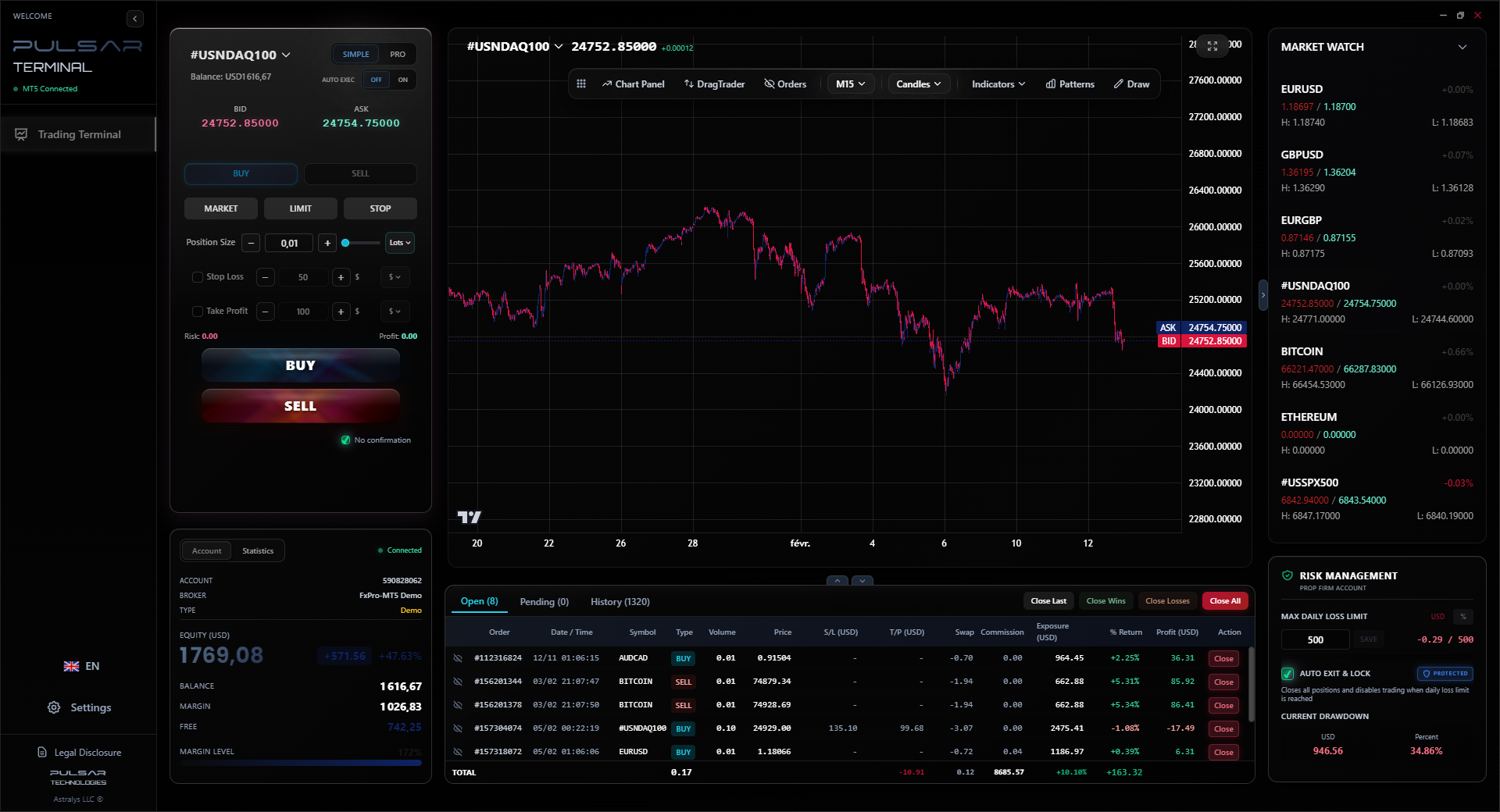
Manually managing multiple take-profits and trailing stops on volatile pairs like USD/ZAR is an administrative nightmare, but tools like Pulsar Terminal automate this directly on your MT5 platform, enforcing your rules without emotion.
Pulsar Terminal
MT5オールインワンツール:ドラッグ&ドロップ注文、マルチTP/SL、トレーリングストップ、グリッドトレード、出来高プロファイル、プロップファーム保護。毎日1,000人以上のトレーダーが利用。
This is the vulnerable part. The admin fails.
Pitfall 1: The 'One More Trade' Override. You've hit your daily loss limit. The market is moving. You think, 'I can get it back.' You disable your daily stop rule in the platform and trade. This is the administrator firing the compliance officer. I did this in 2019. Turned a R800 bad day into a R3,500 disaster. The fix? Make the rule physically hard to break. Use a platform tool that can auto-disable your trading after a certain loss.
Pitfall 2: Neglecting the Journal. A week of good trading, you get lazy. You don't log the trades. Then a losing streak hits, and you have no data to diagnose why. Was it your strategy or your execution? You don't know. The journal is your business's financial statements. You wouldn't run a shop without tracking inventory.
Pitfall 3: Chasing the 'Hot' Pair. Everyone's talking about GBP/JPY volatility. But your operating model is built for USD/ZAR and EUR/USD. You jump in anyway, without adjusting your position sizing for the different volatility. The wider stops blow through your 1% risk rule. Stick to your model. Expand only after paper trading and amending your plan.
Pitfall 4: Ignoring Cash Flow. You need to withdraw profits for living expenses. You didn't factor in the 3-day bank processing time and the R250 fee. You're forced to keep more capital in the trading account than planned, distorting your risk percentages. Schedule and cost your withdrawals like a CFO.
💡 ウィンストンのヒント
The market doesn't care about your ego. Your rules do. Let your administrative framework make the tough decisions to close losing trades.
“The glamour isn't in the wild bets; it's in the steady, managed growth of a well-run operation.”
Let's make this concrete. Here's what my process looks like now, after years of refinement.
Sunday Evening (1 hour):
- Review economic calendar for the week. Flag high-impact events (SARB, Fed).
- Review weekly charts for my core pairs (USD/ZAR, EUR/USD, XAU/USD).
- Set rough support/resistance levels. No trading, just planning.
Pre-Market Open (Daily, 15 mins):
- Check for any overnight gaps or news.
- Run through my checklist: Am I rested? Is my risk for the day set (1% per trade, 5% max daily)?
- Ensure trading platform and journal are open.
Trading Session:
- Trades only come from my pre-defined strategy (price action at key levels, confirmed by the MACD indicator divergence).
- For every potential trade: 1) Identify entry/stop/target. 2) Plug into position size calculator. 3) Enter trade with stop and limit orders immediately. 4) Log trade in journal with screenshot and note.
Post-Market (Daily, 20 mins):
- Review all closed trades. Did they follow my plan? Even the winners get scrutinized.
- Update my running P&L and check against daily drawdown limit.
- Quick journal note on my mindset.
Friday Afternoon (30 mins):
- Weekly review. What was my win rate? Average win vs. average loss? Any technical issues?
- Withdraw any profits above my 'core capital' amount, scheduling the bank transfer.
This routine is boring. It's administrative. But it's the reason I've survived and grown my account consistently for the past 5 years. The glamour isn't in the wild bets; it's in the steady, managed growth of a well-run operation.
FAQ
Q1Is being a forex administrator the same as being a forex trader?
No. A trader executes ideas. A forex administrator runs the entire business that houses the trader. The administrator handles risk, compliance, record-keeping, capital allocation, and technology. You need to be both, but the administrative role is what ensures long-term survival.
Q2What's the single most important task for a South African forex administrator?
Enforcing the FSCA's 30:1 use rule on yourself, even if your broker offers more. Then, managing your position size so you never risk more than 1-2% of your account on a trade. These two rules alone will prevent account blow-ups.
Q3How much does it really cost to start trading forex in South Africa?
You can technically start with R500. Realistically, to trade properly with sensible position sizing and absorb costs, you need at least R5,000. A serious starting capital is R20,000. Remember to budget for bank fees (R60-R500 per withdrawal) and the spread, which is a cost on every single trade.
Q4Can I use international brokers like Pepperstone or Exness as a South African?
Yes, and many like Pepperstone and Exness are popular. But as the administrator, you must weigh the pros (tight spreads, good tech) against the cons (international bank fees, less direct recourse via the FSCA). Always ensure they are regulated by a top-tier authority like ASIC or CySEC.
Q5How do I handle tax on forex profits in South Africa?
Forex trading profits are considered income from a business or capital gains, depending on SARS's assessment of your trading frequency and intent. This is a complex area. Your key administrative duty is to keep impeccable, auditable records of all trades, deposits, and withdrawals. Consult a tax professional who understands trading. Do not guess.
Q6What's a common technical mistake new administrators make?
They don't understand how the spread impacts their strategy. Trying to scalp USD/ZAR with a 5-pip target when the spread is 40 pips is mathematically doomed. They also ignore swap rates, which can turn a winning swing trade into a loser over time. Know all your costs.
ウィンストン教授のレッスン
重要ポイント:
- ✓You are the CEO of your trading firm. Act like it.
- ✓Never risk more than 1% of capital on a single trade.
- ✓FSCA regulation is your first filter for a broker.
- ✓Log every trade. Your journal is your business plan.
- ✓Factor in ALL costs: spread, swap, and bank fees.
この記事はどれくらい役に立ちましたか?
星をクリックして評価
週刊トレーディングインサイト
無料の週刊分析&戦略。スパムなし。
著者について
David van der Merwe
新興市場トレーダー
ヨハネスブルグ拠点で新興市場通貨11年のトレーダー。ZARペア、FSCA規制下の取引、南アフリカ市場分析を専門とする。
コメント
リスク警告
金融商品の取引には大きなリスクが伴い、すべての投資家に適しているわけではありません。過去の実績は将来の結果を保証するものではありません。本コンテンツは教育目的のみであり、投資助言として解釈すべきではありません。取引前に必ずご自身で調査を行ってください。
こちらもおすすめ

Cara Trading Forex Sukses: 7 Prinsip dari Trader Profesional
Cara trading forex sukses dengan 7 prinsip trader pro: manajemen modal, disiplin, journal trading, backtest. Data nyata, bukan janji profit palsu.
Jam Trading Forex Terbaik untuk Trader Indonesia: Panduan Lengkap dengan Tabel Waktu
Panduan jam trading forex untuk trader Indonesia. Tabel 4 sesi dunia, jam emas 20:00-00:00, sesi mana yang harus dihindari. Data akurat + tips dari trader berpengalaman.
Top 5 Sàn Forex Uy Tín Nhất 2026: Review Jujur dari Trader Indonesia
Top 5 sàn forex uy tín 2026 untuk trader Indonesia. Review jujur: spread, deposit, withdraw, dukungan lokal. Exness, XM, IC Markets & lebih.
