


You've seen the Instagram stories, right? The rented supercars, the stacks of cash on hotel beds, the forexboys lifestyle plastered everywhere.

David van der Merwe
新興市場トレーダー ·  South Africa
☕ 11 分で読める
学べること:
- 1What Exactly Are 'Forex Boys'?
- 2Trading in South Africa: Rules, Rand, and Reality
- 3Prop Firms and Challenges: The New Gateway
- 4Building Real Trading Skills (Not Just Hype)
- 5Choosing a Broker in South Africa: Safety First
- 6Pitfalls I Fell Into (So You Don't Have To)
- 7Your Path Forward: From Beginner to Consistent
You've seen the Instagram stories, right? The rented supercars, the stacks of cash on hotel beds, the #forexboys lifestyle plastered everywhere. Maybe a mate from varsity is suddenly a 'funded trader' and won't stop talking about it. You're sitting there wondering: is this for real, or is it just another way to lose your hard-earned Rands? Let's cut through the noise. I've been trading for over 12 years, and I've seen this cycle more times than I can count. This isn't about bashing a dream; it's about separating the dangerous fantasy from the actual, grind-it-out skill of trading.
Let's define our terms. In South Africa, 'forex boys' isn't a technical term. It's a cultural label. It refers to a specific subset of mostly young, male traders (and aspiring traders) who aggressively market a hyper-materialistic, get-rich-quick version of forex trading. Their primary platform isn't a trading terminal; it's social media.
Their content follows a predictable script: luxury goods (often rented), motivational quotes about 'the grind,' screenshots of profit statements (sometimes doctored), and promises of mentorship for a fee. The goal isn't just to trade; it's to build a personal brand that sells the idea of trading success. This is crucial to understand. For many, the real product isn't a trading strategy; it's the dream itself, packaged as a course, a signal service, or a 'prop firm challenge' guide.
I'm not saying every young trader in SA is a scammer. Far from it. There are incredibly disciplined, quiet professionals making a real living. But the 'forex boys' archetype is the loudest voice in the room right now, and it's creating a dangerous perception for newcomers.

Warning: If someone's main evidence of trading prowess is their lifestyle photos, not their audited, multi-year track record, your alarm bells should be ringing. Real traders are often boring. We talk about risk-reward ratios and economic calendars, not bottle service.
“The 'forex boys' real product isn't a trading strategy; it's the dream itself, packaged and sold.”
Trading here operates under a specific set of rules you need to know. The Financial Sector Conduct Authority (FSCA) is our watchdog. Any legitimate broker offering services to South Africans should be licensed by them. You can and should check the FSCA's website for a broker's FSP number. Trading itself is 100% legal for individuals.
Your lifeblood will be the South African Rand (ZAR). You'll fund your account in Rands, and most brokers will offer accounts denominated in ZAR, USD, or EUR. Pairs like USD/ZAR and EUR/ZAR are obviously popular locally, but be warned: they can be wildly volatile. The spread (the difference between buy and sell price) on USD/ZAR can easily be 80-150 pips with some brokers. That's a huge cost to overcome before you even start making a profit. Compare that to the 0.5-1.5 pip spread on something like EUR/USD. It changes how you approach every trade.
Payment methods are straightforward: EFT (Electronic Funds Transfer) from your local bank is the most common. Some brokers accept credit cards or e-wallets like Ozow. Withdrawals back to your SA bank account usually take 1-3 business days.
The most popular platform, hands down, is MetaTrader. MT4 is still the king, but MT5 is gaining ground. It's what everyone uses, from beginners to pros. Knowing your way around MT4 or MT5 is a basic requirement. If a 'forex boy' is trying to sell you on a secret, proprietary platform nobody's heard of, run.

Example: Let's say you trade 1 standard lot (100,000 units) of USD/ZAR with a 100 pip spread. At a rate of R18.50/$1, each pip is worth about R100. A 100 pip spread means you start the trade R10,000 in the hole. You need the market to move 100 pips in your favor just to break even. That's the reality of trading volatile pairs.

💡 ウィンストンのヒント
A 100-pip spread on USD/ZAR means you need the market to gift you R10,000 before you earn a cent. Start with EUR/USD where the cost of entry is a few hundred Rands.
“Real traders are often boring. We talk about risk-reward ratios, not bottle service.”
This is where a huge part of the 'forex boys' narrative lives now. Proprietary trading firms (prop firms) like FTMO, The5%ers, and Funded Next have exploded in popularity. The pitch is seductive: pass a trading challenge (the 'eval'), and they'll give you hundreds of thousands of dollars of their capital to trade. You keep most of the profits.
On paper, it's a fantastic opportunity. In practice, it's a psychological meat grinder. The challenge rules are brutally strict. You have a profit target (e.g., 10% in 30 days), a maximum daily loss (e.g., 5%), and a maximum overall loss (e.g., 10%). Hit any loss limit, and you're out. The fee to attempt the challenge can range from $200 to over $500. For many young South Africans, that's a month's savings.
The 'forex boys' often pose as gurus who have 'cracked the code' to these challenges. They'll sell you a 'strategy' or a 'copy-trade' service to help you pass. Here's my blunt experience: I failed two of these challenges before I passed one. The first time, I blew the daily loss limit in three days trying to scalp the news. The second time, I hit the profit target but then violated a rule on a weekend by holding a hedge position I didn't understand. I lost R8,000 ($~430) in fees before I finally passed a $100,000 challenge using a boring, disciplined swing trading approach.
The secret isn't a magical indicator. It's extreme discipline, a solid risk management plan, and treating the challenge like a job, not a lottery ticket. Tools that help automate risk rules are worth their weight in gold here.

Pro Tip: Before you pay for a prop firm challenge, practice the exact rules on a demo account for a full month. Use a position size calculator religiously to ensure you never risk more than 1-2% of your challenge account on a single trade. If you can't be profitable and rule-compliant in demo, you won't be in the real thing.
“Real traders are often boring. We talk about risk-reward ratios, not bottle service.”
So, if you ignore the Instagram flex, what should you actually learn? It's a marathon, not a sprint. Start with the absolute basics. Understand what a pip is, how use works (and how it can destroy you), and what a margin call is. Open a demo account and just get used to placing trades, setting stop-loss and take-profit orders.
Find a Strategy That Fits Your Life
Are you a student who can check charts between lectures? Scalping might seem tempting, but it's incredibly stressful and requires total focus. Do you have a 9-5 job? Then swing trading, where you hold trades for days, is probably more realistic. I'm a swing trader at heart. I made my best trade ever in 2020, buying XAU/USD (gold) at $1,480 and riding it up to $1,920 over several months. That patience paid off more than any frantic day of scalping ever did.
Learn to Read the Market, Not Just Indicators
Indicators are tools, not crystal balls. The RSI indicator can tell you if a market is overbought or oversold. The MACD indicator can help spot momentum shifts. But they lag. They tell you what has happened. Price action - understanding support, resistance, and candlestick patterns - tells you what is happening right now. Spend more time learning to read the raw price chart.
Journal Everything
This is non-negotiable. Every trade. Entry price, exit price, why you took it, what you were feeling, screenshots of the chart. I have journals going back 8 years. They're my most valuable resource. They show me my repetitive mistakes (like overtrading on Fridays) and my proven strengths.
“I turned a +R5,000 trade into a -R50 trade because I didn't stick to my plan. Greed is an expensive teacher.”
This is the most important financial decision you'll make as a trader. Do not sign up with the broker your favourite 'forex boy' promotes without doing your own homework. Regulation is your safety net.
Look for brokers with a strong global reputation AND a specific FSCA license. Some of the internationally recognised brokers that properly serve the South African market include IC Markets, Pepperstone, and XM. Exness is also popular but do your own due diligence on their specific offering for ZAR accounts.
Here’s a quick comparison of what to look for:
| Feature | What to Look For | Why It Matters in SA |
|---|---|---|
| Regulation | FSCA License (FSP number) + other top-tier (ASIC, FCA) | Ensures client fund segregation, legal recourse, and fair practices. |
| ZAR Accounts | Ability to deposit/withdraw in Rands, account denominated in ZAR. | Avoids costly bank conversion fees on every transaction. |
| Spreads & Commissions | Competitive spreads on majors (EUR/USD < 1.0 pip) and clear ZAR pair costs. | Lower costs mean higher potential profits. Know the USD/ZAR spread! |
| Platform | Full support for MT4/MT5. | The industry standard. Ensures you can use all common tools and indicators. |
| Customer Support | Local phone number, WhatsApp, or 24/5 live chat that actually responds. | When you have a withdrawal issue at 4 PM on a Friday, you need help. |
Deposit a small amount first. Test the withdrawal process. If you encounter delays or excuses, it's a major red flag. Your broker should be the boring, reliable foundation of your trading business, not a source of drama.
💡 ウィンストンのヒント
Your trading journal is your only true mentor. A losing trade with perfect execution is a better teacher than a winning trade born from luck.
“I turned a +R5,000 trade into a -R50 trade because I didn't stick to my plan. Greed is an expensive teacher.”
Let me be the cautionary tale. I lost R15,000 in my first six months. Not to a scam broker, but to my own ignorance and ego. Here’s exactly where I went wrong.
1. Overleveraging. This is the killer. My first broker offered 1:500 use. I thought, 'Great! I can turn R1,000 into R500,000!' What actually happened was I put R1,000 in, opened a position that used R400,000 of notional value, and a tiny 25-pip move against me wiped out my entire account. I learned that use is a tool for precise position size control, not a magic profit multiplier.
2. Chasing 'Sure Thing' Signals. I paid for a signal service from a guy with a flashy car. His trades were always posted after they were already in profit. When I followed them live, they lost. I was paying for curated history, not real-time skill.
3. Trading Without a Stop-Loss. I once bought EUR/USD, it went against me, and I thought, 'It'll come back.' I went to bed. I woke up to a margin call. The trade had moved 140 pips against me, and my account was liquidated. A stop-loss is not a suggestion; it's a seatbelt.
4. Letting a Winner Turn into a Loser. This hurts. I bought gold (XAU/USD) at $1,820 with a 50-pip profit target. It hit $1,830, and I got greedy. I moved my target to $1,850. It reversed, took out my breakeven stop, and closed at $1,819 for a loss. I turned a +R5,000 trade into a -R50 trade because I didn't stick to my plan. Now, I use tools that automatically move my stop to breakeven once a trade goes a certain distance in my favor. It removes the emotion.
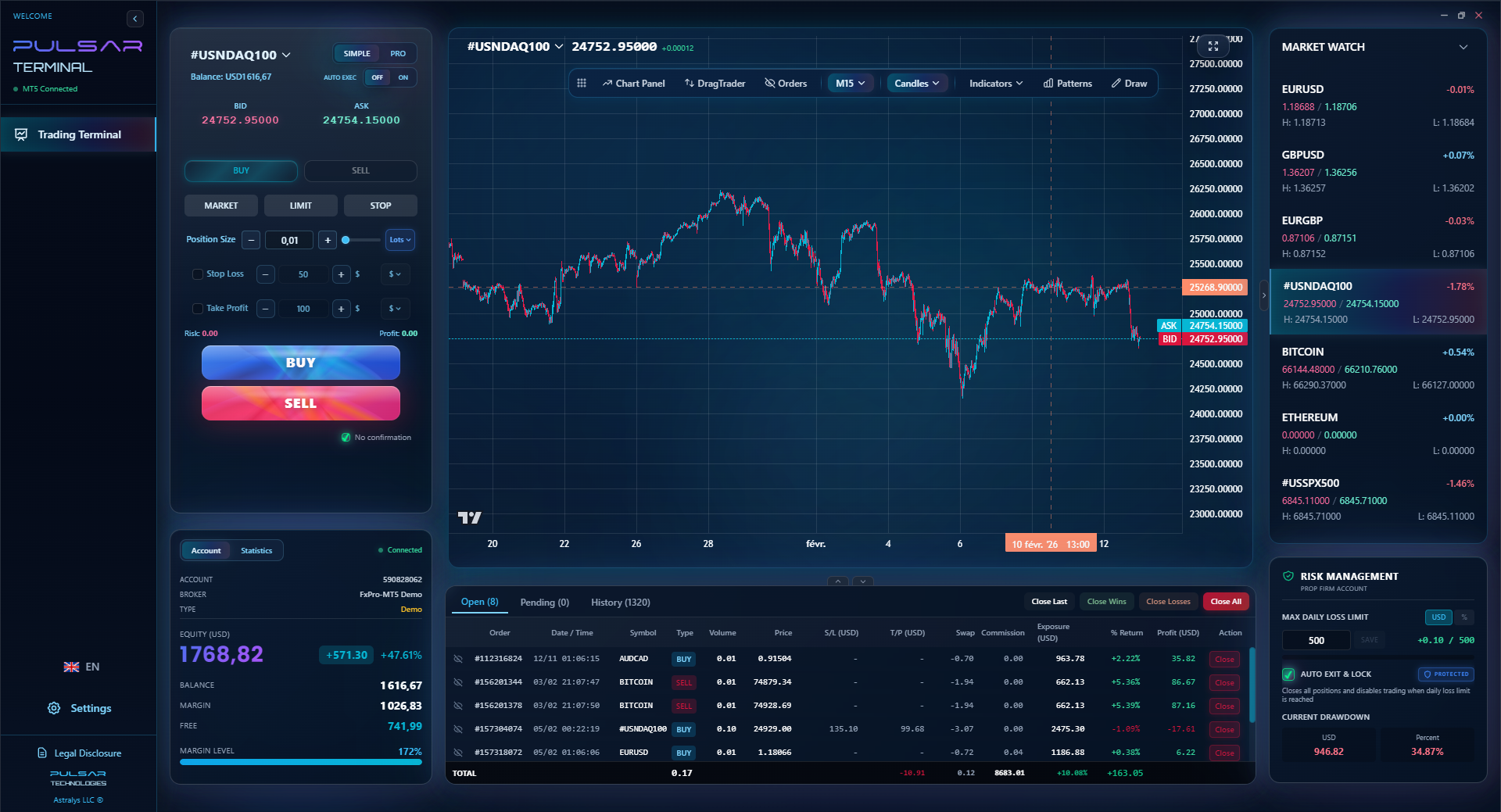
Managing multiple trades and strict prop firm rules by hand is stressful; Pulsar Terminal automates trailing stops, breakeven moves, and daily loss limits directly on your MT5 chart.
Pulsar Terminal
MT5オールインワンツール:ドラッグ&ドロップ注文、マルチTP/SL、トレーリングストップ、グリッドトレード、出来高プロファイル、プロップファーム保護。毎日1,000人以上のトレーダーが利用。
“The dream of financial freedom through trading is not a lie. But the path sold by the 'forex boys' almost always is.”
Forget the Lamborghini for a moment. Let's talk about a realistic, step-by-step path.
Year 1: The Apprenticeship. Your only goal is to not lose money. Trade a demo account for at least 3-6 months. Then, fund a live account with money you can afford to lose completely - R2,000, R5,000 max. Your goal is to practice executing your plan with real emotion on the line. Focus on preserving capital.
Year 2: The Consistency Grind. Aim for small, consistent returns. A 3-5% return per month is phenomenal. At this stage, consider a prop firm challenge with a small fee, using the skills you've honed. The goal is to pass and get a funded account, which removes your personal capital from the line of fire.
Year 3+: Scaling Up. Now you have a track record, a proven strategy, and possibly prop firm capital. You can start to scale your position sizes methodically. This is where the real financial change happens, slowly and steadily.
Throughout all of this, keep learning. The market changes. Read books, follow real economists (not hype men), and analyze your trades. The 'forex boys' will come and go with the market cycles. The serious traders will still be here, quietly working, long after the Instagram accounts have gone silent.
The dream of financial freedom through trading is not a lie. But the path sold by the 'forex boys' almost always is. The real path is quieter, harder, and infinitely more rewarding. It's not about looking like a trader; it's about being one.
FAQ
Q1Is forex trading legal in South Africa?
Yes, absolutely. It is legal for individuals to trade forex in South Africa. The key is to use a broker that is properly licensed by the Financial Sector Conduct Authority (FSCA) to ensure your funds are protected and you're dealing with a legitimate entity.
Q2How much money do I need to start forex trading in South Africa?
You can start with very little. Some brokers allow you to open a live account with as little as R500 or R1,000. However, I strongly recommend you start with a demo account (free) for several months. When you go live, only use money you can afford to lose completely. A more realistic starter amount for proper risk management is R5,000 to R10,000.
Q3What is the best trading platform for beginners in SA?
MetaTrader 4 (MT4) is the most common and beginner-friendly platform in South Africa and globally. It's stable, has thousands of free indicators, and there's a massive amount of educational content available for it. Most reputable brokers, like IC Markets or Pepperstone, offer it.
Q4Are prop firm challenges a scam?
Not inherently. Reputable prop firms like FTMO or The5%ers are legitimate businesses. However, the way they are often marketed by 'forex boys' can be scammy. The challenges are very difficult by design, and many people fail repeatedly, losing their challenge fees. The scam is when someone sells you a 'guaranteed' method to pass. The only way to pass is with genuine skill and discipline.
Q5What is the biggest mistake new South African traders make?
Two tied for first: 1) Overleveraging because they see 1:500 and think it's free money (it's a debt trap), and 2) Trading USD/ZAR or EUR/ZAR without understanding the massive spreads. They'll enter a trade already hundreds of Rands in the hole due to the spread and wonder why they never win.
Q6Can I really make a living from forex trading in SA?
Yes, but it's a small minority who do. It requires years of dedication, treating it like a profession, and significant capital (your own or a prop firm's). Aiming for a secondary income stream first is far more realistic. Thinking you'll replace a full salary in 6 months is a surefire way to blow up your account.
Q7How do I avoid forex scams in South Africa?
Check FSCA registration for any broker or 'investment scheme.' Avoid anyone promising guaranteed returns or pressuring you to invest quickly. Never send money to a personal bank account for 'managed trading.' Use well-known, internationally regulated brokers, and be deeply skeptical of social media traders whose main proof is their lifestyle, not a verifiable track record.
ウィンストン教授のレッスン
重要ポイント:
- ✓Verify FSCA registration for any broker before depositing a single Rand.
- ✓A 100-pip spread on USD/ZAR can cost you R10,000 before you break even.
- ✓Prop firm challenges require rule discipline, not just profit.
- ✓Overleveraging is the fastest path to a margin call and a zero balance.
- ✓Trade your demo account for 3-6 months before risking real money.
この記事はどれくらい役に立ちましたか?
星をクリックして評価
週刊トレーディングインサイト
無料の週刊分析&戦略。スパムなし。
著者について
David van der Merwe
新興市場トレーダー
ヨハネスブルグ拠点で新興市場通貨11年のトレーダー。ZARペア、FSCA規制下の取引、南アフリカ市場分析を専門とする。
コメント
リスク警告
金融商品の取引には大きなリスクが伴い、すべての投資家に適しているわけではありません。過去の実績は将来の結果を保証するものではありません。本コンテンツは教育目的のみであり、投資助言として解釈すべきではありません。取引前に必ずご自身で調査を行ってください。
こちらもおすすめ

Cara Trading Forex Sukses: 7 Prinsip dari Trader Profesional
Cara trading forex sukses dengan 7 prinsip trader pro: manajemen modal, disiplin, journal trading, backtest. Data nyata, bukan janji profit palsu.
Jam Trading Forex Terbaik untuk Trader Indonesia: Panduan Lengkap dengan Tabel Waktu
Panduan jam trading forex untuk trader Indonesia. Tabel 4 sesi dunia, jam emas 20:00-00:00, sesi mana yang harus dihindari. Data akurat + tips dari trader berpengalaman.
Top 5 Sàn Forex Uy Tín Nhất 2026: Review Jujur dari Trader Indonesia
Top 5 sàn forex uy tín 2026 untuk trader Indonesia. Review jujur: spread, deposit, withdraw, dukungan lokal. Exness, XM, IC Markets & lebih.
