


I was staring at a USD/ZAR chart in late 2022, watching it rip past R18.50.

David van der Merwe
新興市場トレーダー ·  South Africa
☕ 10 分で読める
学べること:
- 1The SA Forex Education Market: A Wild West
- 2Breaking Down the Real Costs: From R179 to R100k
- 3What a Worthwhile Course MUST Cover (No Matter the Price)
- 4Free vs. Paid: The Veteran Take
- 5The Hidden Costs Beyond the Course Fee
- 6Red Flags and How to Verify a Course
- 7My Recommended Path for SA Beginners (2024 Onwards)
I was staring at a USD/ZAR chart in late 2022, watching it rip past R18.50. My phone was buzzing with messages from a guy who'd paid R25,000 for a 'guaranteed profit' forex course. He was asking me, panicked, where to set his stop loss. The course guru hadn't covered that. It was the moment I realized most discussions about forex course price in South Africa miss the point entirely. It's not about the rand amount. It's about the value, the regulation, and the brutal reality check you're not getting.
Let's cut through the noise. The landscape for learning to trade here is, frankly, a mess. On one end, you've got Instagram gurus selling PDFs for R179 that are just copied Wikipedia pages. On the other, you have slick operations in Sandton charging R100,000 for 'elite mentorship' that often just teaches you how to blow up an account faster. In the middle, that's where the real value sometimes hides, but you need a miner's lamp to find it.
The Financial Sector Conduct Authority (FSCA) regulates brokers, but anyone can call themselves a trading educator. There's no license, no standard, no watchdog for course quality. This creates a massive information asymmetry. A new trader sees a Lamborghini in an ad and thinks the course price is an investment. I see a trader about to learn the hard way that a fancy car doesn't mean someone can teach.

Warning: If a course 'guarantees' profits or focuses more on the instructor's lifestyle than on risk management charts, run. That's not education; it's a sales pitch for a dream. The first lesson of trading is managing loss, not chasing gain.
I've sat in on these courses. One 'advanced' session I audited (cost: R15,000) spent 45 minutes explaining what a pip definition is. That's foundational stuff you should know from free YouTube videos before you spend a cent. The real forex course price in South Africa often includes a heavy tax on your naivety.

💡 ウィンストンのヒント
The price of a course is a one-time fee. The cost of not learning proper risk management is your entire account. Guess which one hurts more.
So what are you actually looking at? Let's put real numbers on the table, based on what's out there right now.
The Budget Tier (R0 - R2,500) This is the realm of e-books, cheap online videos, and broker-provided materials. For example, brokers like XM or Exness have entire free academies. A lot of it is basic, but it's a legitimate starting point. The danger here is the ultra-cheap paid courses (R179-R500). They're usually just repackaged free information. You might learn what a candlestick is, but you won't learn how to build a strategy with them.
The Mid-Range (R2,500 - R30,000) This is the most crowded and confusing bracket. Here's where you'll find structured online programs and local academy workshops.
- Wealth Forex Academy: Online Standard Package for R4,999.
- Aspire FX: 2-day in-person group course for R4,500 per person.
- Generic 'Pro Trader' Courses: Often priced around R10,000-R15,000.
The value here is wildly inconsistent. Some offer genuine structure and community. Others are just longer, more expensive versions of the budget tier. You must scrutinize the curriculum. Does it cover back-testing? Psychology? A clear scalping strategy or swing trading framework? Or is it just 10 modules on different indicators?
The Premium Tier (R30,000+) This is the one-on-one mentorship, live trading room, 'inner circle' territory. Forex Masters charges R15,000 for one-to-one training. I've seen others go up to R100,000. For this price, you should expect personalized feedback, risk management coaching, and accountability. The problem? It's impossible to verify the mentor's real, consistent track record. I once mentored a trader who'd previously paid R80k. His 'mentor' just had him copy trades without explanation. When the strategy stopped working, he was left with nothing but debt.

Example: Let's say you have R10,000 to spend. Option A: A R10,000 course. Option B: R500 on three good trading books, R1,500 for a TradingView premium subscription for a year, and R8,000 in a demo account treated as real capital (using a position size calculator religiously). After six months, the Option B trader will almost always be ahead.
“The real forex course price in South Africa often includes a heavy tax on your naivety.”
Forget the price tag for a second. If the curriculum doesn't hammer these points, you're wasting your money.
The Non-Negotiables
- Risk Management FIRST: This isn't the last module; it's the foundation. Position sizing, stop-loss placement, understanding margin call mechanics, risk-reward ratios. If they don't teach you how to not lose money before they teach you how to make it, walk away.
- The South African Context: A good local course will address trading with ZAR pairs like USD/ZAR. They'll explain the wider spread definition, the impact of local liquidity, and how SARB policies can cause volatility. They must cover the tax implications with SARS. Trading an exotic pair like USD/ZAR is different from trading EUR/USD, and you need to know why.
- Psychology & Journaling: You are your own worst enemy. Any course that doesn't dedicate serious time to trading psychology, discipline, and the necessity of a detailed trade journal is selling you a broken tool.
- Strategy, Not Just Indicators: Learning about the RSI indicator and MACD indicator is easy. Learning how to combine them into a rule-based, back-tested strategy with clear entry/exit rules is the hard part. The course must build a complete system.
My own worst loss, a R40,000 drawdown in 2018, happened because I knew a strategy but hadn't internalized the psychology. I overrode my rules because I was 'sure.' No course had prepared me for that feeling. The ones that are worth a higher forex course price in South Africa spend as much time on your head as on your charts.
Here's my blunt opinion: You can get 80% of the way there for free. The final 20% is where a paid course might help, but only if it's the right one.
The Free Route is strong:
- Broker Academies: IC Markets, Pepperstone, and others have extensive, free materials.
- YouTube (Curated): Search for specific concepts: 'how to backtest a strategy,' 'risk management for beginners.' Avoid the 'get rich quick' channels.
- Demo Accounts: This is your free practical lab. Treat it like real money.
- Books: 'Trading in the Zone' by Mark Douglas (psychology) and 'The Daily Trading Coach' by Brett Steenbarger cost less than R500 each.
When Paid Makes Sense: You might consider paying when you're stuck. You understand the basics, you have a journal, but your strategy is inconsistent. A good paid course or mentor can provide structured learning and personalized feedback to break through that plateau. The key is to buy specific knowledge to solve a specific problem, not just a generic 'become a trader' package.

Pro Tip: Before spending a rand, contact the course provider. Ask for a detailed syllabus. Ask what percentage of the course is dedicated to risk management and psychology. If they can't provide it or it's less than 30%, save your money.
💡 ウィンストンのヒント
If you wouldn't trust the person to babysit your kid, don't trust them with your trading education. Character matters more than claimed returns.
“You can get 80% of the way there for free. The final 20% is where a paid course *might* help, but only if it's the right one.”
The course price is just the entry ticket. The real forex course price in South Africa includes all the ancillary costs of actually trading.
- Trading Capital: This is the big one. You need money you can afford to lose to practice for real. A course is theory until applied.
- Platform & Data Fees: While MT4/MT5 are often free, advanced charting software (like TradingView Pro) or data feeds cost money.
- Spread & Commission Costs: This is how you pay to play. Even with a good strategy, you're fighting the spread definition. On USD/ZAR, spreads can be 50-100 pips during volatile sessions. That's a huge hurdle to overcome before you even make a cent of profit. You need to understand this math cold.
- Time: The biggest hidden cost. Hundreds of hours of screen time, study, and review. If a course promises to make you profitable in a weekend, it's lying.
I learned this the hard way early on. I bought a R7,000 course, then immediately deposited R5,000 with a broker offering 'tight spreads.' I didn't realize the effective cost including commission was high. I was scalping on a 1-minute chart, and the costs ate my account alive in two weeks. The course hadn't taught me how to calculate if my strategy could overcome the broker's costs. That was a R12,000 lesson (course + lost capital) in due diligence.
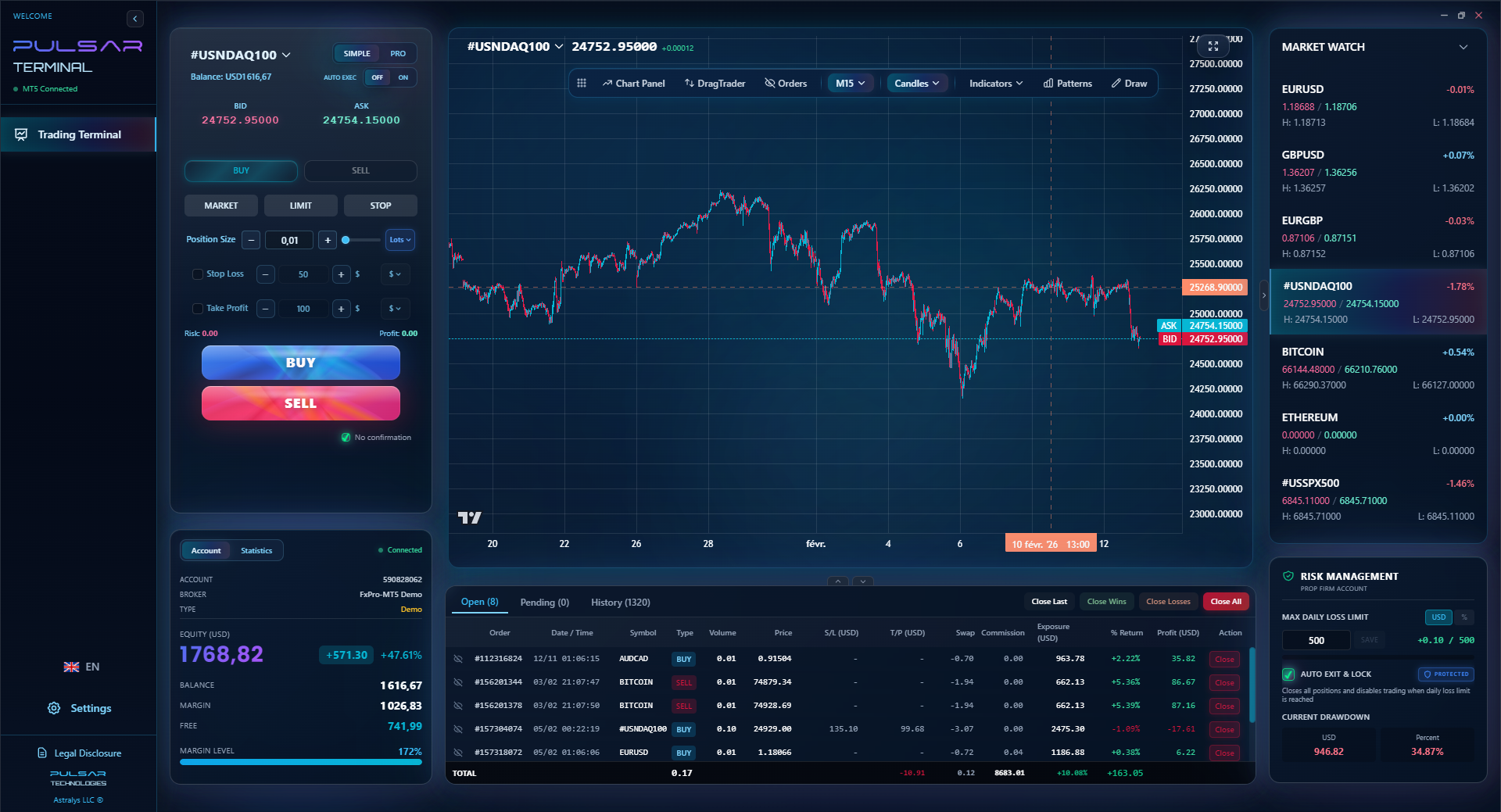
Manually calculating risk for every trade is where beginners fail; a tool like Pulsar Terminal automates position sizing and risk directly on your MT5 chart, enforcing the discipline a good course should teach.
Pulsar Terminal
MT5オールインワンツール:ドラッグ&ドロップ注文、マルチTP/SL、トレーリングストップ、グリッドトレード、出来高プロファイル、プロップファーム保護。毎日1,000人以上のトレーダーが利用。
Protect yourself. Here's your checklist:
Red Flags:
- Guaranteed Profits: The biggest lie in trading. Instant skip.
- Focus on Lifestyle: More pics of cars and watches than charts and trade journals.
- Vague Curriculum: 'We teach you the secrets the banks don't want you to know.' Nonsense.
- High-Pressure Sales: 'Discount expires tonight!' This is education, not a timeshare.
- No Proof of Real Trading: If the educator won't discuss their own approach to risk or show a long-term, audited track record (not just a few winning screenshots), be skeptical.
Verification Steps:
- Demand a Syllabus: In writing.
- Search for Reviews: Look for independent reviews, not testimonials on their site.
- Ask About Their Trades: 'Can you walk me through a recent loss you took and why?' A real trader can do this easily. A guru will deflect.
- Check FSCA Status (for associated brokers): If they push you to use a specific broker, check if that broker is FSCA-regulated. If not, that's a major warning sign about the whole operation.
Remember, a legitimate educator wants you to succeed because it validates their teaching. A scammer just wants your initial payment.
“Your goal is to preserve capital while learning, not get rich from the first trade.”
If I were starting today in Johannesburg or Cape Town with zero knowledge, here's exactly what I'd do, step-by-step.
Months 1-3: The Free Foundation.
- Open a demo account with a reputable, FSCA-regulated broker like those we've reviewed (IC Markets review, Pepperstone review).
- Go through their entire free education section. Take notes.
- Read 'A Beginner's Guide to the Forex Market' by Abe Cofnas. Learn what moves the XAU/USD guide (gold) and USD/ZAR.
- Follow the markets daily without trading. Just watch. Get a feel for the rhythm.
Months 4-6: Strategy & Demo.
- Pick ONE simple strategy to study (e.g., a price action swing strategy). Learn it inside out from free online sources.
- Back-test it on your demo platform for at least 100 trades. Keep a detailed journal in a spreadsheet.
- Start forward-testing on demo with strict rules. Use a position size calculator for every single trade.
Only Then, Consider Paid Help. By now, you'll have specific questions. 'My strategy works in ranging markets but fails at breakouts.' Now you can look for a course or mentor that specifically addresses that gap. Maybe it's a R3,000 course on market structure. You're buying a surgical tool, not a hope-in-a-box.
The total forex course price in South Africa for this path? Maybe R1,000 for books and a software subscription. The rest is invested in your own disciplined effort, which is the only thing that truly generates returns in this business.
FAQ
Q1What is the average price of a forex trading course in South Africa?
There's no true average because the range is insane. You'll see everything from R179 PDFs to R100,000 'mastermind' programs. Most structured courses from local academies sit between R4,500 and R15,000. But price is a terrible indicator of quality here.
Q2Are free forex courses from brokers any good?
They're excellent for building a foundation. Brokers like IC Markets, Pepperstone, and XM have complete free sections covering basics, analysis, and even some strategy. They won't give you a 'secret system,' but they will teach you the rules of the road. Always start here before spending money.
Q3What should I look for in a forex course as a South African?
Look for content specific to our context: trading ZAR pairs (understanding their wider spreads and volatility), explanations of FSCA rules and use limits (30:1 for retail), and guidance on SARS tax implications for trading profits. If a course only talks about EUR/USD and ignores USD/ZAR, it's not built for you.
Q4Is one-on-one mentorship worth the high cost?
It can be, but it's the riskiest purchase. It's only worth it if you've already done the basic work and have a live trading journal. You need a mentor to critique your specific process, not teach you what a pip is. Vet them mercilessly. Ask for a trial session or to speak to past students.
Q5Can I learn forex trading without paying for a course?
Absolutely. I know profitable traders who never paid for a course. They used free broker education, read books, practiced relentlessly on demo, and learned from their own carefully journaled mistakes. A course can accelerate the process, but it's not a necessity. Discipline and screen time are.
Q6How much trading capital do I need after taking a course?
This is critical. The course fee is separate. You need risk capital you can afford to lose. Even with a good course, start small. Many brokers have minimum deposits of $100 (roughly R1,800+). I'd recommend starting with no more than R5,000 in a live account, and even then, trade micro lots. Your goal is to preserve capital while learning, not get rich from the first trade.
ウィンストン教授のレッスン
重要ポイント:
- ✓Course price is a poor indicator of quality; curriculum is everything.
- ✓No course can replace 500+ hours of deliberate screen time and practice.
- ✓If it doesn't cover ZAR pairs and SA taxes, it's not built for you.
- ✓Your first R10k is better spent on books and demo trading than a generic course.
この記事はどれくらい役に立ちましたか?
星をクリックして評価
週刊トレーディングインサイト
無料の週刊分析&戦略。スパムなし。
著者について
David van der Merwe
新興市場トレーダー
ヨハネスブルグ拠点で新興市場通貨11年のトレーダー。ZARペア、FSCA規制下の取引、南アフリカ市場分析を専門とする。
コメント
リスク警告
金融商品の取引には大きなリスクが伴い、すべての投資家に適しているわけではありません。過去の実績は将来の結果を保証するものではありません。本コンテンツは教育目的のみであり、投資助言として解釈すべきではありません。取引前に必ずご自身で調査を行ってください。
こちらもおすすめ

Cara Trading Forex Sukses: 7 Prinsip dari Trader Profesional
Cara trading forex sukses dengan 7 prinsip trader pro: manajemen modal, disiplin, journal trading, backtest. Data nyata, bukan janji profit palsu.
Jam Trading Forex Terbaik untuk Trader Indonesia: Panduan Lengkap dengan Tabel Waktu
Panduan jam trading forex untuk trader Indonesia. Tabel 4 sesi dunia, jam emas 20:00-00:00, sesi mana yang harus dihindari. Data akurat + tips dari trader berpengalaman.
Top 5 Sàn Forex Uy Tín Nhất 2026: Review Jujur dari Trader Indonesia
Top 5 sàn forex uy tín 2026 untuk trader Indonesia. Review jujur: spread, deposit, withdraw, dukungan lokal. Exness, XM, IC Markets & lebih.
