


I remember staring at my screen in 2012, watching a GBP/USD trade bleed out.

Olumide Adeyemi
西アフリカ・トレーディングの先駆者 ·  Nigeria
☕ 11 分で読める
学べること:
- 1What Forex Really Is (And What It Isn't)
- 2The Key Players and Currency Pairs You Need to Know
- 3How Prices Move: Understanding Pips, Lots, and use
- 4The Trading Sessions and When to Find Volatility
- 5How to Analyze the Market: Technical vs. Fundamental
- 6The Top 3 Mistakes Nigerian Traders Make (And How to Avoid Them)
- 7Your First Steps as a Nigerian Forex Trader
I remember staring at my screen in 2012, watching a GBP/USD trade bleed out. I'd put on 0.5 lots, convinced the pound was about to rally. It didn't. I watched £400 (about 280,000 Naira at the time) evaporate in an hour, my stomach in knots. I'd heard the term 'forex,' thrown money at it, and got burned. Why? Because I didn't truly understand the forex definition - not just the textbook one, but what it means for a trader sitting in Lagos, dealing with spreads, liquidity, and their own psychology. That loss taught me more than any win ever could. Let's break it down, the real way.
Forget the complex jargon for a second. At its core, the forex definition is simple: it's the global marketplace where you exchange one national currency for another. The 'foreign exchange' market. But here's the critical part most newbies in Nigeria miss: you're not buying a physical thing. You're buying a price relationship.
When you buy EUR/USD, you're betting the euro will strengthen relative to the US dollar. You're trading the exchange rate itself. The market is decentralized, meaning there's no single physical location like the Nigerian Stock Exchange. It's a network of banks, institutions, hedge funds, and retail traders (like you and me) all connected electronically. This is why it's open 24 hours a day, five days a week - when Tokyo closes, London opens, then New York.
What it isn't? A get-rich-quick scheme. That's the first myth to shatter. It's a zero-sum game. For every naira you make, someone else is losing one. The brokers make money on the spread (the difference between buy and sell prices), and the big banks have advantages in speed and information. Your edge comes from discipline, risk management, and a solid strategy, not luck.

Warning: Many 'forex gurus' in Nigeria sell the dream of easy money. If a course or signal service promises guaranteed returns, run. The only guarantee in forex is that poor risk management will lose you money.
I learned this the hard way after that GBP/USD loss. I switched my focus from chasing profits to protecting my capital. That mental shift was everything.

💡 ウィンストンのヒント
A clear forex definition starts with accepting it's a probability business, not a certainty engine. Your job is to manage risk, not predict the future.
“The only guarantee in forex is that poor risk management will lose you money.”
Understanding who's in the market helps you understand why prices move. The big players set the tone.
The Major Players:
- Commercial & Investment Banks: Like Citibank or Standard Chartered. They help transactions for clients and trade for their own books. This 'interbank market' is where the real volume is.
- Central Banks: The Central Bank of Nigeria (CBN) is a prime example. When they intervene to support or weaken the Naira, it creates massive waves. Their interest rate decisions are market-moving events.
- Multinational Corporations: Think of a company like Dangote Group needing to convert USD profits to Naira. Their large transactions can move rates.
- Hedge Funds & Institutional Investors: They move billions, often based on complex algorithms.
- Retail Traders: That's us. We're the smallest fish, but thanks to online brokers, we have access to the same pool.
The Currency Pairs You'll Trade
Currencies are quoted in pairs. The first is the 'base,' the second is the 'quote.'
Majors: These all involve the USD. They have the tightest spreads and highest liquidity.
- EUR/USD (Euro vs. US Dollar)
- GBP/USD (British Pound vs. US Dollar)
- USD/JPY (US Dollar vs. Japanese Yen)
- USD/CHF (US Dollar vs. Swiss Franc)
- AUD/USD (Australian Dollar vs. US Dollar)
- USD/CAD (US Dollar vs. Canadian Dollar)
- NZD/USD (New Zealand Dollar vs. US Dollar)
Minors (Crosses): Pairs that don't include the USD. EUR/GBP or AUD/JPY are examples. Spreads are wider.
Exotics: A major currency paired with one from a developing economy. USD/NGN (US Dollar vs. Nigerian Naira) is an exotic pair. Be very careful here. Exotics can have extremely wide spreads, low liquidity, and be prone to sudden, unpredictable moves from government intervention. I avoid trading Naira pairs for this reason; the CBN's actions can wipe out a technical setup in seconds.
For most Nigerian traders starting out, sticking to the majors, especially EUR/USD, is the wisest move. The liquidity means you can get in and out easily. I have a full guide on navigating the nuances of the EUR/USD guide that builds on this foundation.
“Starting with micro lots is the single best advice I can give. It lets you learn with real money without the existential fear.”
This is where the rubber meets the road. You need to speak the language of movement and size.
The Pip: A 'Percentage in Point.' It's the smallest standard move a currency pair can make. For most pairs (like EUR/USD), it's 0.0001. If EUR/USD moves from 1.0850 to 1.0851, it moved 1 pip. For JPY pairs (like USD/JPY), a pip is 0.01. Understanding the value of a pip definition is non-negotiable for calculating profit and loss.
The Lot: This is your trade size.
- Standard Lot: 100,000 units of the base currency.
- Mini Lot: 10,000 units.
- Micro Lot: 1,000 units.
Here's a real example from my journal: I bought 1 micro lot (0.01) of EUR/USD at 1.0750. It rose to 1.0800 - a 50-pip gain. The pip value for a micro lot of EUR/USD is roughly $0.10. So, 50 pips x $0.10 = $5 profit. Small, but controlled. Starting with micro lots is the single best advice I can give. It lets you learn with real money without the existential fear.
use: Your Double-Edged Sword: use lets you control a large position with a small deposit (margin). A 1:100 use means with $100, you can control a $10,000 position. Nigerian brokers like Exness or XM often offer high use.

Example: With $100 margin at 1:100 use, you control $10,000. A 1% move against you (100 pips on EUR/USD) wipes out your entire $100. That's a margin call.
I used to chase high use, thinking it was the key to big profits. It's the key to big losses. Now, I rarely use more than 1:10, even if my account allows 1:500. Discipline over excitement. Always use a position size calculator before every single trade.
“Starting with micro lots is the single best advice I can give. It lets you learn with real money without the existential fear.”
The market's personality changes throughout the day. Trading the London session at 2 AM Nigerian time is a different beast to trading the Asian session.
| Session | Nigerian Time (WAT) | Key Centers | Volatility & Character |
|---|---|---|---|
| Sydney/Asia | 12 AM - 8 AM | Sydney, Tokyo | Generally quieter. Can set the tone for the day. Good for analyzing overnight moves. |
| London | 8 AM - 5 PM | London, Frankfurt | The most volatile session. Overlaps with Asia early and New York later. Huge volume, clear trends often develop. My personal favorite for swing trading entries. |
| New York | 1 PM - 10 PM | New York | High volatility, especially when overlapping with London (1 PM - 5 PM WAT). US economic data releases cause big spikes. |
| Pacific | 10 PM - 12 AM | Wellington | Very thin, choppy markets. Best avoided for most strategies. |
A lesson from my logs: I used to try and scalping strategy during the Asian session, chasing 5-10 pip moves. The spreads were often wider relative to the movement, eating into profits. I was forcing trades. Now, I prepare during Asia, place my orders ahead of the London open, and manage them through the overlap. The market gives you windows of opportunity; you don't have to be active in all of them.
💡 ウィンストンのヒント
If you can't articulate your trade's fundamental 'why' in one sentence, you're gambling on chart noise. Always know which economic story you're riding.
“Your goal for the first year is not to get rich. Your goal is to not blow up your account.”
You need a lens to view the market. Most traders use two: technical and fundamental analysis.
Technical Analysis: This is studying past price action to predict future movement. You're looking at charts, patterns, and indicators. The core idea is that history tends to repeat itself because market psychology is consistent.
- Tools: Support/Resistance, Trend Lines, Candlestick Patterns.
- Indicators: Things like the RSI indicator (to spot overbought/oversold conditions) or the MACD indicator (to gauge momentum).
- My Use: I'm about 70% technical. I use price action and a couple of indicators to find high-probability entry zones. But indicators lag. They tell you what has happened, not what will happen.
Fundamental Analysis: This looks at the economic, social, and political forces that affect supply and demand for a currency. Think interest rates, inflation (CPI), GDP, employment data, and political stability.
- For a Nigerian Trader: The US Non-Farm Payrolls report or the Federal Reserve's interest rate decision will move EUR/USD more than any pattern on your chart. You MUST have an economic calendar.
The best approach is a blend. Use fundamentals to understand the why behind the big trend (is the USD fundamentally strong right now?). Then use technicals to decide when and where to enter a trade in line with that trend. Fighting the fundamental trend with a technical setup is a sure way to lose.

Pro Tip: Don't get lost in 'indicator overload.' I started with 15+ indicators on my chart. It was noise. Now I use pure price action, maybe with one or two indicators for confirmation. Clean charts lead to clear decisions.
“Your goal for the first year is not to get rich. Your goal is to not blow up your account.”
I've made these. My friends have made these. Let's save you the pain and lost Naira.
1. No Risk Management Plan: This is the killer. You must know, before you click buy, how much you are willing to lose on that trade. The golden rule: risk no more than 1-2% of your trading capital on any single trade. On a 500,000 Naira account, that's 5,000-10,000 Naira max risk per trade. Use a stop-loss order every single time. Letting a losing trade 'run' hoping it will come back is how accounts blow up.
2. Overtrading & Revenge Trading: After a loss, the urge to 'get it back immediately' is powerful. This is revenge trading. It leads to emotional decisions, bigger positions, and ignoring your strategy. I had a losing day, broke my rules, and took three impulsive trades in an hour. I turned a 20,000 Naira loss into a 65,000 Naira loss. Walk away. The market will be there tomorrow.
3. Chasing the 'Holy Grail' System: There isn't one. You will waste money buying expensive EAs (Expert Advisors) or signal services from fake gurus. The system that works is the one you understand, have tested, and can execute with discipline. Spend your time and money on education and building your own process, not on magic bullets. A reliable broker like IC Markets or Pepperstone with good execution is a better investment than any signal service.
💡 ウィンストンのヒント
Your first live account goal should be to survive 100 trades, not to double your money. Survival teaches you what profitability never could.
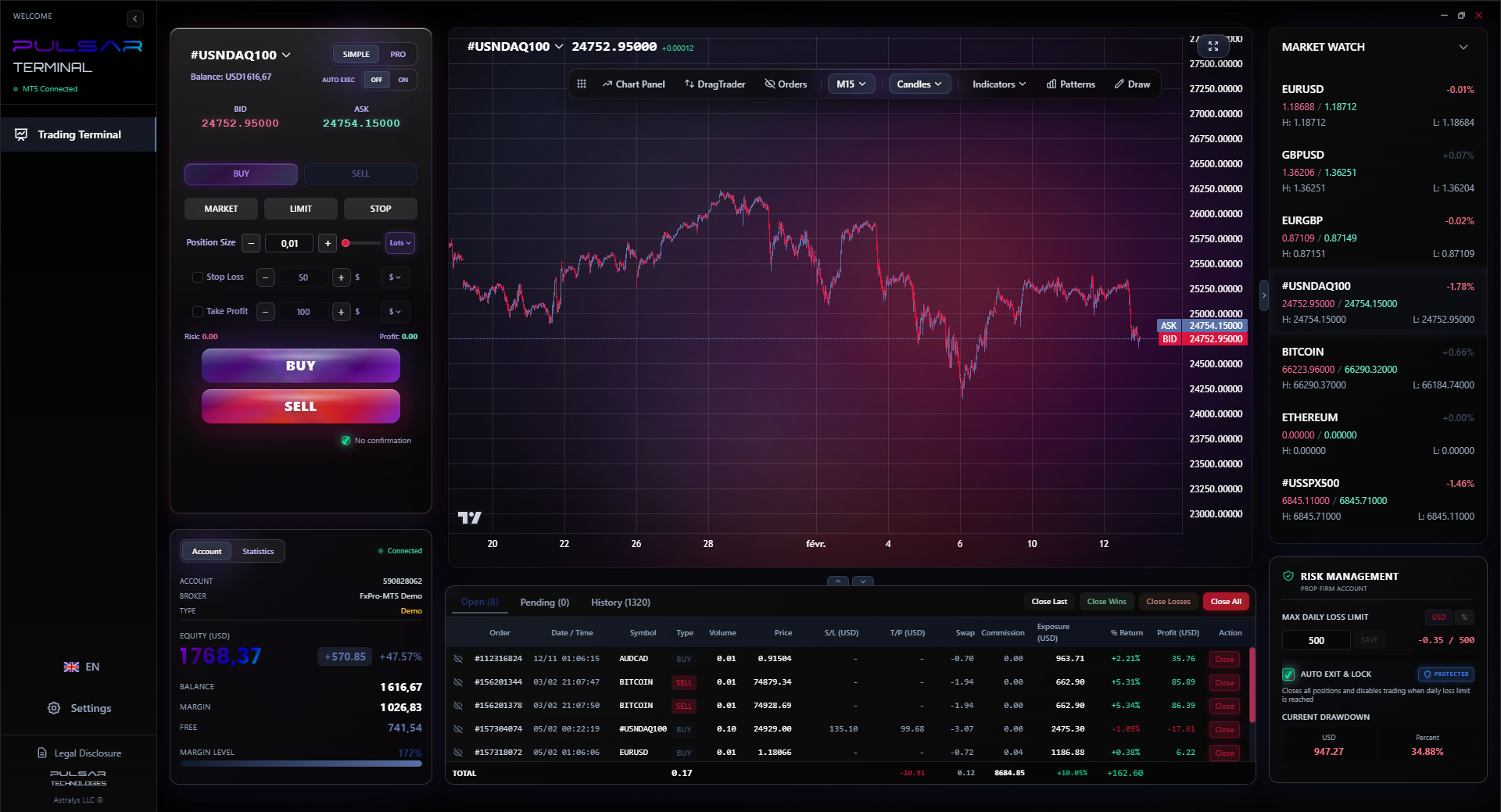
Sticking to a strict 1-2% risk rule is easier said than done, but tools like Pulsar Terminal automate position sizing and stop-loss placement directly on your MT5 chart, removing emotion from the equation.
Pulsar Terminal
MT5オールインワンツール:ドラッグ&ドロップ注文、マルチTP/SL、トレーリングストップ、グリッドトレード、出来高プロファイル、プロップファーム保護。毎日1,000人以上のトレーダーが利用。
“The market gives you windows of opportunity; you don't have to be active in all of them.”
Alright, you understand the forex definition and the pitfalls. How do you actually start?
1. Educate Yourself Relentlessly: Use free resources first. Babypips.com has a fantastic free 'School of Pipsology.' Read books on trading psychology (Mark Douglas's Trading in the Zone is essential).
2. Find a Reputable Regulated Broker: This is crucial for the safety of your funds. Look for brokers regulated by bodies like CySEC (Cyprus) or the FCA (UK) that accept Nigerian clients. Check their deposit/withdrawal methods (bank transfer, credit/debit cards, maybe cryptocurrencies). Read detailed reviews to compare spreads, fees, and platform stability. Our reviews of Exness, XM, and others are a good starting point.
3. Open a Demo Account: Practice for at least 3-6 months. Treat the virtual money like real money. Test your strategy. Make all your beginner mistakes here, where it doesn't cost you anything.
4. Develop a Simple Trading Plan: Write it down. It should answer: What pairs do I trade? What session? What is my strategy for entry? Where is my stop-loss? Where is my take-profit? What is my risk per trade (e.g., 1%)?
5. Start Live with a Tiny Account: When you go live, fund an account with money you can afford to lose completely. Start with micro lots. Your goal for the first year is not to get rich. Your goal is to not blow up your account and to achieve consistency. If you can end the year flat or slightly up, you're ahead of 90% of beginners.
The journey is long. It's a marathon of discipline, not a sprint of luck. But understanding the true forex definition - a market of relationships, driven by global forces, accessible but unforgiving - is the first and most important step on that path.
FAQ
Q1Is forex trading legal in Nigeria?
Yes, forex trading is legal in Nigeria. The Central Bank of Nigeria (CBN) regulates the official foreign exchange market. As a retail trader, you are trading the international (offshore) forex market through brokers typically based outside Nigeria. You are not directly trading the official CBN Naira rates. It's your responsibility to use brokers that are properly regulated in their home jurisdictions.
Q2How much money do I need to start forex trading in Nigeria?
You can start with a very small amount. Many international brokers allow you to open an account with as little as $10-$100 (approx. 15,000 - 150,000 Naira). However, I strongly advise starting with a demo account for several months first. When you go live, start with an amount you are completely prepared to lose, and only trade micro lots (0.01) to minimize risk while you learn.
Q3What is the best time to trade forex in Nigeria?
The best volatility and trading opportunities for Nigerian traders occur during the London session (8 AM - 5 PM WAT) and the overlap between London and New York (1 PM - 5 PM WAT). This is when the highest volume of transactions occurs, leading to stronger, more reliable trends and better opportunities for both swing and day trading.
Q4Can I trade the Naira (NGN) in forex?
You can find pairs like USD/NGN or EUR/NGN offered by some brokers as 'exotic' pairs. I generally advise against trading them, especially for beginners. The spreads are very wide, liquidity can be low, and the prices can be heavily influenced by Central Bank of Nigeria (CBN) interventions and local market factors that are difficult to predict from charts alone.
Q5What's the difference between a forex broker and a binary options platform?
This is critical. A forex broker gives you access to the actual currency market where you can buy and sell, use stop-losses, and manage trades. Binary options are a fixed-odds bet on whether a price will be above or below a certain point in a short time (e.g., 60 seconds). They are often structured like gambling and are banned in many countries due to being predatory. Stick to reputable, regulated forex brokers.
Q6How do I withdraw my profits from forex trading in Nigeria?
Reputable brokers offer multiple withdrawal methods. The most common for Nigerians are bank wire transfers (which can take a few days and may involve intermediary bank fees) and credit/debit card withdrawals back to the card you used to deposit. Some brokers also offer cryptocurrency withdrawals (e.g., to a Bitcoin wallet), which can be faster. Always check the broker's specific withdrawal policy and fees before funding your account.
ウィンストン教授のレッスン
重要ポイント:
- ✓Risk max 1-2% of capital per trade.
- ✓Trade majors first, avoid exotic Naira pairs.
- ✓London/New York overlap offers best volatility.
- ✓Use demo for 3-6 months minimum.
- ✓Blend fundamental trend with technical entry.
この記事はどれくらい役に立ちましたか?
星をクリックして評価
週刊トレーディングインサイト
無料の週刊分析&戦略。スパムなし。
著者について
Olumide Adeyemi
西アフリカ・トレーディングの先駆者
ナイジェリアで最もアクティブなFXトレーディング教育者の一人。ラゴスから8年のトレード経験。アフリカのトレーダー向けの少額資金戦略とプロップファームチャレンジを専門とする。
コメント
リスク警告
金融商品の取引には大きなリスクが伴い、すべての投資家に適しているわけではありません。過去の実績は将来の結果を保証するものではありません。本コンテンツは教育目的のみであり、投資助言として解釈すべきではありません。取引前に必ずご自身で調査を行ってください。
こちらもおすすめ

Cara Trading Forex Sukses: 7 Prinsip dari Trader Profesional
Cara trading forex sukses dengan 7 prinsip trader pro: manajemen modal, disiplin, journal trading, backtest. Data nyata, bukan janji profit palsu.
Jam Trading Forex Terbaik untuk Trader Indonesia: Panduan Lengkap dengan Tabel Waktu
Panduan jam trading forex untuk trader Indonesia. Tabel 4 sesi dunia, jam emas 20:00-00:00, sesi mana yang harus dihindari. Data akurat + tips dari trader berpengalaman.
Top 5 Sàn Forex Uy Tín Nhất 2026: Review Jujur dari Trader Indonesia
Top 5 sàn forex uy tín 2026 untuk trader Indonesia. Review jujur: spread, deposit, withdraw, dukungan lokal. Exness, XM, IC Markets & lebih.
