


Most traders think a forex gold strategy is about finding the perfect entry signal.

David van der Merwe
新興市場トレーダー ·  South Africa
☕ 11 分で読める
学べること:
Most traders think a forex gold strategy is about finding the perfect entry signal. They're wrong. The real reason 80% of traders blow up on XAU/USD has nothing to do with their analysis. It's about ignoring the three things that actually matter in the South African market: timing, costs, and position sizing. I've watched traders with brilliant technical setups get wiped out because they traded at the wrong time of day or didn't account for the spread. Let's set the record straight with a strategy built for our market, our currency, and our specific challenges.
Trading gold isn't like trading EUR/USD. It behaves differently, costs more to trade, and reacts to completely different news. If you treat it like a currency pair, you'll get burned.
Gold is a hybrid. It's part currency (because it's priced in USD), part commodity, and part safe-haven asset. When there's geopolitical tension or market panic, gold often rallies while everything else drops. When the US dollar strengthens, gold usually weakens, but not always. This dual nature creates unique volatility.
For South African traders, there's an extra layer. Our economy is tied to commodities. When gold prices move, it affects the ZAR, which can create interesting correlations (and sometimes decouplings) with pairs like USD/ZAR. You can't ignore this local context.

Warning: Gold's spread is almost always wider than major forex pairs. On a standard account, seeing a 30-50 pip spread around news events is normal. That means your trade is already 30-50 pips in the red the moment you enter. You need a strategy that accounts for this upfront cost.
The liquidity also follows different patterns. The most active times are during London and New York hours, but gold can have sharp moves during Asian sessions too, especially if there's news from China (a massive gold consumer). For us in South Africa, the sweet spot is between 10:00 AM and 11:00 PM SAST. That London-New York overlap from 3:00 PM to 7:00 PM SAST? That's when things get really wild.
I learned this the hard way. Early in my career, I took a beautiful breakout trade on XAU/USD at 2:00 AM SAST. The pattern was textbook. I entered, went to sleep, and woke up to find the price had reversed completely on low volume before the London open. I lost 1.5% of my account on a trade that looked perfect on paper. The market wasn't open yet.
“Gold's spread is almost always wider than major forex pairs. That means your trade is already in the red the moment you enter.”
Let's talk numbers. This is where most online guides fail you. They talk about strategy but ignore the fees that eat your profits. For a South African trader, understanding costs is non-negotiable.
First, the spread. This is your biggest enemy. Here’s what you're actually looking at with different brokers:
| Broker | Typical XAU/USD Spread (Standard Account) | Minimum Deposit | FSCA Regulated? |
|---|---|---|---|
| IC Markets | As low as 0.3 pips (Raw account) | Up to $200 | Yes |
| Exness | Variable, Zero account has 0.0 + $3.50/lot commission | $10 | Yes |
| XM | Can be 25-35 pips | $5 | Yes |
| Pepperstone | Can be as high as 15 pips | $0 (AUD) | Yes |
Notice the massive difference? Trading a 35-pip spread requires a much larger price movement just to break even compared to a 3-pip spread. Your forex gold strategy must have a profit target that justifies the spread you're paying.
Then there's the swap fee. If you hold a gold position overnight, you pay or receive interest. On a long position, it's usually negative (you pay). At Capital.com, for example, the swap rate is -0.01652% for holding gold long overnight. On a $10,000 position, that's about $1.65 per night. It adds up.
Deposits and Withdrawals in ZAR
This is a hidden cost center. If your broker doesn't offer a ZAR account, you're paying conversion fees twice: when you deposit your Rands into USD, and when you withdraw USD back to Rands. Banks love this. They take a 2-3% cut on the exchange rate.
Brokers like Exness and Khwezi Trade offer ZAR accounts. Khwezi, a local FSCA-licensed broker, has a minimum deposit of just R500. Using local EFT or a service like DusuPay can save you hundreds of Rands in fees over a year. It seems small, but saving R300 on deposits is R300 more in your trading account.
use is another cost disguised as a benefit. Yes, Exness offers up to 1:1000 for SA traders under FSCA rules (retail is capped at 1:200 for gold). But higher use means your position size is bigger, which magnifies both the spread cost and the swap cost. A 50-pip loss on a highly leveraged trade can trigger a margin call faster than you can say 'volatility'.

💡 ウィンストンのヒント
The spread isn't a fee, it's a toll bridge. You have to cross it to get to your destination. Don't start a journey where the toll is more than the potential reward.
“If you treat gold like a currency pair, you'll get burned. It's a hybrid: part currency, part commodity, part safe-haven.”
Forget complicated indicators. A strong forex gold strategy rests on three pillars: where is price, what time is it, and what's the market mood?
1. Price Structure & Key Levels Gold respects horizontal support and resistance like few other assets. Why? Because large institutional orders (think central banks, ETFs) are placed at round numbers. $1800, $1850, $1900 per ounce – these aren't random. They are psychological magnets.
I don't use more than two indicators. A simple moving average (like the 50-period) to gauge the trend, and the RSI indicator to spot overbought/oversold conditions within that trend. That's it. The rest is pure price action: looking for rejection at key levels (long wicks on candles) and breakouts with follow-through volume.
2. The SA Trading Session Clock Your edge as a South African trader is your time zone. You're perfectly positioned for the London and New York sessions.
- 10:00 AM - 3:00 PM SAST (London Session): Good volatility, trends often establish. I look for setups here.
- 3:00 PM - 7:00 PM SAST (London-NY Overlap): Highest volatility. This is where breakouts happen fast. It's great for profit, but dangerous if you're not focused. I often take partial profits here if I'm in a trade.
- After 11:00 PM SAST: Liquidity dries up. I avoid new entries. The spread widens, and price can be pushed around easily.
3. Market Sentiment Drivers Gold moves on fear and real yields. You need one eye on:
- US Dollar Strength (DXY Index): Inverse correlation is strong.
- US Real Yields (TIPS): When real yields fall, gold rises.
- Geopolitical Headlines: War, sanctions, crisis = gold bid.
- Central Bank Buying: News of China or Russia adding to reserves supports price.

Pro Tip: Create a simple dashboard. Have the DXY chart, a US 10-year yield chart, and a gold chart open side-by-side. If the dollar is tanking and yields are dropping, gold has a strong wind at its back. Don't fight it.
This framework kept me out of trouble in 2023. I saw gold breaking above $1950, the DXY was weak, and yields were falling. The sentiment was unanimously bullish. Instead of trying to pick a top, I waited for a pullback to the new support (around $1930) and went long. That trade ran for over $100.
“The goal isn't to trade every day; it's to be ready for the high-probability setups that match your rules.”
This is the mechanics. The boring stuff that makes you money.
Entry Rules (Must have 2 of 3):
- Price at a Key Level: It's sitting at a clear support/resistance zone, or a trend line.
- Time Alignment: It's during the London or overlap session (10:00 AM - 7:00 PM SAST).
- Sentiment Confirmation: The daily news flow aligns with the direction of the trade (e.g., dovish Fed talk for a long).
Exit Rules (Non-negotiable):
- Stop Loss: Always placed 15-20 pips beyond the key level that invalidates your trade idea. If you're buying at support, your stop goes below the recent swing low. Not tighter. Gold needs room to breathe.
- Take Profit: I use a 1:1.5 risk-to-reward ratio as a minimum. If my stop is 20 pips away, my first profit target is at least 30 pips away. I often use a two-target approach: take 50% off at 1:1, move stop to breakeven, and let the rest run to 1:2 or more.
The Position Size Calculator is Your Best Friend This is the most important step. If you get this wrong, nothing else matters.
I use a simple formula for every single trade: Risk per Trade = 1% of Account Balance.
Let's say you have a R20,000 account. 1% risk is R200. You want to buy gold at $1850, with a stop loss at $1830. That's a 20 pip risk. The pip value for a standard lot (100,000 units) of XAU/USD is $10. But you're not trading a full lot.
You calculate: (R200 Risk) / (20 pips * Pip Value in Rands). First, convert your risk to USD. R200 is roughly $11 (at say R18.20/$). Pip Value for a mini lot (0.1 lot) is $1. So, $11 risk / (20 pips * $1 per pip per 0.1 lot) = 0.055 lots. You'd round down to 0.05 lots.
Do this manually, or use a trusted position size calculator. I cannot stress this enough. In 2018, I got greedy on a gold trade. I risked 5% of my account because I was 'sure'. The trade went 19 pips against me and stopped out. I lost a week's profits in minutes. Never again.
💡 ウィンストンのヒント
Your most profitable trade will be the one you don't take. When the clock, the chart, and the news don't align, walking away is a winning strategy.
“The goal isn't to trade every day; it's to be ready for the high-probability setups that match your rules.”
Let's get vulnerable. Here's where I've blown up, so you can see the pitfalls.
Mistake 1: Trading Around SA Public Holidays. One Heritage Day, I was bored. The market was dead, liquidity was thin. I took a small gold trade anyway. A tiny bit of news hit, the spread on my broker widened to 80 pips instantly, and my stop loss was executed at a horrific price. I lost double what I planned. Lesson: If the major financial centers (London/NY) are on holiday, or it's a quiet SA day, just walk away.
Mistake 2: Ignoring the Underlying (USD) Trend. In 2021, gold was in a downtrend. I kept seeing 'oversold' signals on the RSI indicator and buying the dip. What I missed was the relentless strength in the US Dollar. I was fighting the primary driver. I caught falling knives for three weeks straight. The MACD indicator was screaming bearish, but I ignored it. Lost about 3% of my account trying to pick a bottom that wasn't there.
Mistake 3: Using a Strategy Incompatible with My Personality. I tried scalping gold. It's a fast, adrenaline-filled method. I'm not built for that. The stress of watching every tick, trying to beat the spread, was exhausting. I'd make 5 good trades, then one emotional bad one would wipe out the gains. I switched to a more patient, swing trading approach on the 4-hour chart. My performance and my sanity improved immediately.
Mistake 4: Not Accounting for Broker Execution. I once had a fantastic setup on Exness. I entered a market order. The price flashed on my chart, but my order filled 5 pips worse. Slippage. It turned a winning trade into a breakeven. Now, I almost always use limit orders to enter at my exact price. I let the market come to me.
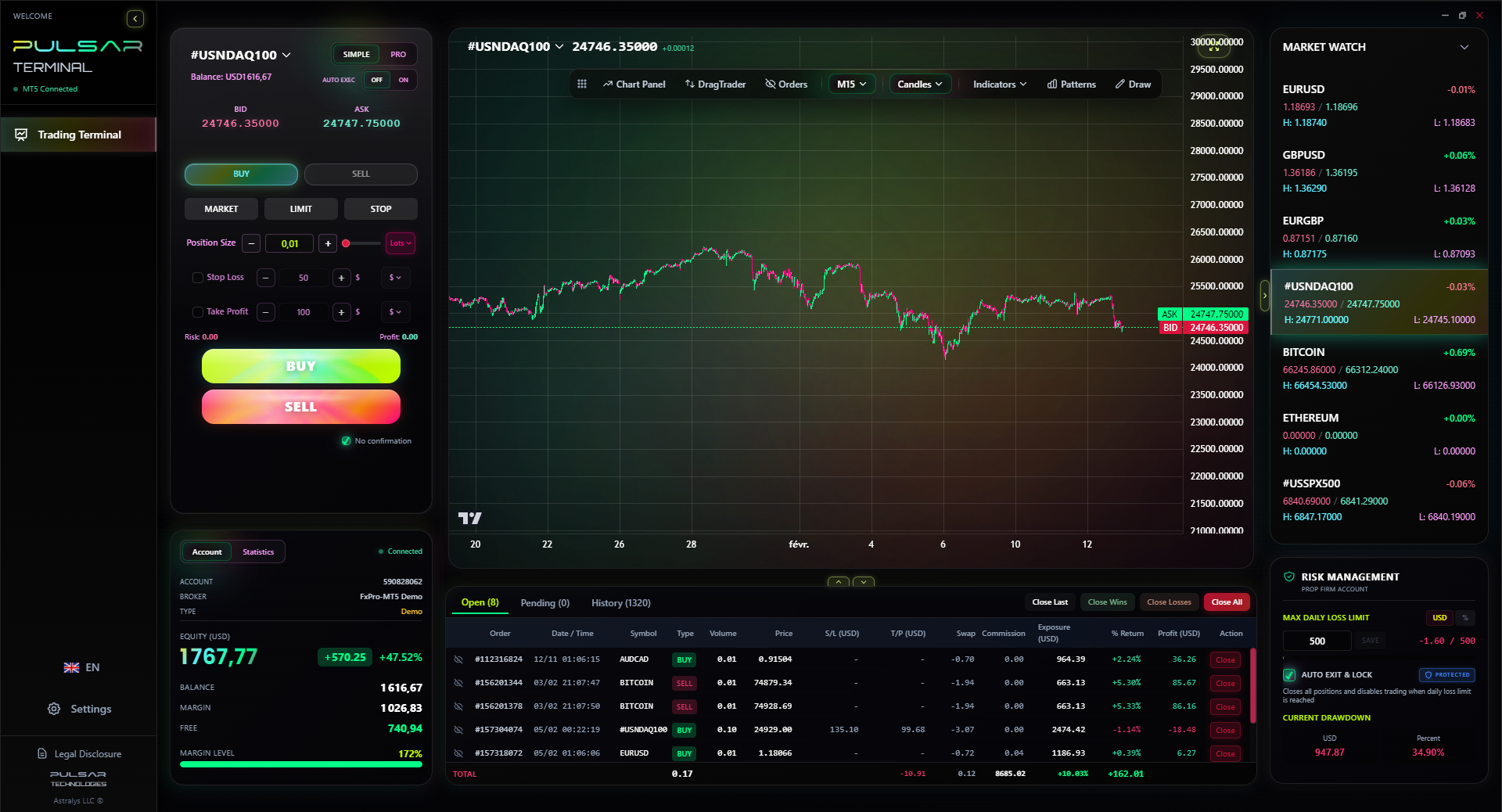
Managing multiple profit targets and moving stops to breakeven manually is stressful; Pulsar Terminal automates this entire process directly on your MT5 chart.
Pulsar Terminal
MT5オールインワンツール:ドラッグ&ドロップ注文、マルチTP/SL、トレーリングストップ、グリッドトレード、出来高プロファイル、プロップファーム保護。毎日1,000人以上のトレーダーが利用。
“A 50-pip loss on a highly leveraged trade can trigger a margin call faster than you can say 'volatility'.”
Let's walk through a hypothetical week with a R50,000 account, trading 1% risk per trade (R500).
Monday, 10:30 AM SAST: Gold (XAU/USD) has pulled back to $1,840 during the Asian session. This was a previous resistance level that now might act as support. The London session has just opened. The DXY is slightly down from its Friday high. Sentiment is neutral.
- Checklist: Price at level? YES. Good time? YES (London open). Sentiment? NEUTRAL (2 out of 3 is enough).
- Action: Place a BUY LIMIT order at $1,840.50. Stop Loss at $1,838.00 (25 pip risk). Take Profit 1 at $1,845.00 (22.5 pip profit, just under 1:1).
- Position Size: R500 risk / (25 pips * ~R0.55 per pip per 0.01 lot) = ~3.6 micro lots. We trade 0.03 lots.
- Result: Order fills. Price rises to TP1 by the afternoon. We close half (0.015 lots) for a R247 profit. Move stop on remaining half to breakeven.
Wednesday, 4:00 PM SAST (Overlap): Our remaining half position is still open. The US CPI data comes out hotter than expected. The dollar spikes, gold drops sharply. Our breakeven stop is triggered. We exit the second half at $1,840.50 for no gain/loss.
- Weekly Result: +R247 (0.49% account gain).
That's it. No home runs. Just consistent, managed trades. Maybe one or two more setups appear that week, maybe none. The goal isn't to trade every day; it's to be ready for the high-probability setups that match your rules. This discipline, applied over 100 trades, is what separates the professionals from the gamblers.
Your final step is choosing the right tool for the job. A good broker is essential. Read our detailed reviews to compare your options, like Exness review for low minimum deposits, IC Markets review for raw spreads, or XM review for their local presence. Find one that fits your version of this strategy.
FAQ
Q1What is the best time of day to trade gold in South Africa?
The most active and predictable times are between 10:00 AM and 11:00 PM SAST, covering the London and New York sessions. The peak volatility is during the London-New York overlap from 3:00 PM to 7:00 PM SAST. Avoid trading during Asian session lulls or on major international holidays when liquidity is thin.
Q2How much money do I need to start trading gold?
You can start with very little. Brokers like Exness and XM have minimum deposits of $10 (roughly R180). However, to trade properly with sensible risk management (e.g., risking 1% per trade), a starting capital of at least R10,000 is more realistic. This allows you to withstand normal losses without blowing your account.
Q3Why is the spread on gold so much higher than on EUR/USD?
Gold (XAU/USD) is a less liquid market than major forex pairs. There are fewer buyers and sellers at any given moment, so brokers widen the spread to protect themselves from the risk of rapid price gaps. The spread is your cost of doing business; you must choose a broker with competitive spreads and factor it into your profit targets.
Q4Should I use high use when trading gold?
Almost never. Gold is volatile. High use (like 1:500 or 1:1000) magnifies this volatility and can wipe out your account on a normal price swing. The FSCA caps use for retail clients at 1:200 for gold CFDs, and even that is very high. I recommend using use of 1:10 or 1:20 at most when starting out. It's about survival, not getting rich quick.
Q5What moves the price of gold the most?
The primary drivers are: 1) The strength of the US Dollar (inverse relationship), 2) US real interest rates (when yields fall, gold rises), 3) Geopolitical and economic uncertainty (gold is a safe-haven), and 4) Central bank demand. For South African traders, also watch USD/ZAR, as domestic factors can influence local gold sentiment.
Q6Is it better to scalp or swing trade gold?
For most retail traders, swing trading (holding trades for days) is more sustainable than scalping (holding for minutes). Scalping requires beating the high spread, perfect execution, and intense screen time. Swing trading allows you to capture larger moves that justify the spread cost and fits better with a full-time job. Choose the style that matches your personality and schedule.
Q7Are FSCA-regulated brokers safe for South Africans?
Yes, they are the safest option. FSCA regulation requires client fund segregation, regular audits, and compliance with financial standards. It also provides a local recourse if you have a dispute. While you can use offshore brokers, sticking with FSCA-regulated ones like those in our Pepperstone review or local brokers like Khwezi Trade offers significant protection.
ウィンストン教授のレッスン
重要ポイント:
- ✓Trade gold only during London/NY hours (10am-11pm SAST).
- ✓Never risk more than 1% of your account on a single XAU/USD trade.
- ✓Choose a broker with spreads under 10 pips for gold.
- ✓Your stop loss must be placed beyond the key level, not inside it.
この記事はどれくらい役に立ちましたか?
星をクリックして評価
週刊トレーディングインサイト
無料の週刊分析&戦略。スパムなし。
著者について
David van der Merwe
新興市場トレーダー
ヨハネスブルグ拠点で新興市場通貨11年のトレーダー。ZARペア、FSCA規制下の取引、南アフリカ市場分析を専門とする。
コメント
リスク警告
金融商品の取引には大きなリスクが伴い、すべての投資家に適しているわけではありません。過去の実績は将来の結果を保証するものではありません。本コンテンツは教育目的のみであり、投資助言として解釈すべきではありません。取引前に必ずご自身で調査を行ってください。
こちらもおすすめ

Cara Trading Forex Sukses: 7 Prinsip dari Trader Profesional
Cara trading forex sukses dengan 7 prinsip trader pro: manajemen modal, disiplin, journal trading, backtest. Data nyata, bukan janji profit palsu.
Jam Trading Forex Terbaik untuk Trader Indonesia: Panduan Lengkap dengan Tabel Waktu
Panduan jam trading forex untuk trader Indonesia. Tabel 4 sesi dunia, jam emas 20:00-00:00, sesi mana yang harus dihindari. Data akurat + tips dari trader berpengalaman.
Top 5 Sàn Forex Uy Tín Nhất 2026: Review Jujur dari Trader Indonesia
Top 5 sàn forex uy tín 2026 untuk trader Indonesia. Review jujur: spread, deposit, withdraw, dukungan lokal. Exness, XM, IC Markets & lebih.
