


If you've searched 'forex king shaka airport,' you might be mixing up two very different worlds.

David van der Merwe
新興市場トレーダー ·  South Africa
☕ 10 分で読める
学べること:
If you've searched 'forex king shaka airport,' you might be mixing up two very different worlds. One is the high-speed, screen-glued reality of trading the markets. The other is the airport bureau de change where you swap leftover rand for euros before a flight. Let's clear this up right now: you don't trade forex at an airport. But as a South African trader, understanding your local landscape - from the FSCA watchdog to the rand's wild swings - is what separates the pros from the punters. I'll walk you through the real setup, the costs, the brokers that actually work here, and yes, what that airport sign really means for your money.
Here's the first rule: only trade with an FSCA-licensed broker. The Financial Sector Conduct Authority isn't just some government office; it's your first line of defense. I learned this the hard way early on. A flashy international broker offered insane use and "guaranteed" signals. They weren't FSCA-regulated. When I tried to withdraw R15,000 in profits, it became a months-long nightmare of ignored emails. I never saw that money again.
An FSCA license means the broker has a physical presence here, follows strict capital rules, and keeps your funds in segregated accounts. It doesn't make them saints, but it gives you a real address to complain to. Check their license number on the FSCA's website - it takes two minutes. Brokers like IG, Plus500, and local favorite Khwezi Trade all operate under the FSCA's watch. This regulation is why our market, while volatile, isn't the Wild West.

Warning: If a broker's website is only in Russian or Chinese, with no clear FSCA details, run. They're targeting South Africans because they know we're hungry for opportunity, but they have zero accountability here.
“An FSCA license doesn't make a broker a saint, but it gives you a real address to complain to.”
Forget the 'from 0.0 pips' marketing. Let's talk about what you'll actually pay. Your total cost is the spread plus any commission, converted from dollars to rand. This conversion is a silent killer if you're not careful.
Spreads & Commissions
On a major pair like EUR/USD, you're looking at:
| Broker Type | Avg. Spread (EUR/USD) | Commission (per lot, round turn) | Effective Cost |
|---|---|---|---|
| Raw/ECN Account | 0.1 - 0.3 pips | $4 - $6 | ~0.7 - 0.9 pips |
| Standard Account | 1.2 - 1.8 pips | $0 | 1.2 - 1.8 pips |
That 'effective cost' is key. A broker advertising 0.1 pips but charging a $5 commission is often more expensive on a standard 1-lot trade than one with a 1.5-pip spread and no commission. Use a position size calculator that includes commission to see the true impact.
The ZAR Conversion Bite
This one hurts. Your broker might hold your account in USD. Every time you deposit Rands, they convert it. When you withdraw, they convert it back. Your bank might also charge an international payment fee. I once made a $300 profit (about R5,400 at the time), but after the broker's conversion spread and my bank's fee, I netted just R5,100. That's a R300 'tax' just for moving money.

Pro Tip: Look for brokers offering ZAR-denominated accounts, like some local options or FP Markets. You deposit and withdraw in Rand, avoiding the double conversion whammy. It simplifies your profit/loss calculations massively.

💡 ウィンストンのヒント
The spread at an airport forex counter is a tax on poor planning. The spread on your trading platform is the cost of doing business. Know which one you're paying, and why.
“Trading USD/ZAR is like trading with a live wire - the volatility is immense.”
You need a broker that understands our odd hours, our currency, and our preferred payment methods. Here’s the scoop on a few types.
The International Heavyweights: IG and Plus500 are huge here for a reason. They're FSCA-regulated, have slick platforms, and are generally reliable. IG's minimum deposit is steep (£250 or about R6,000), which keeps out the tourists. Plus500's zero-commission model is simple for beginners. Their customer support, however, can feel like you're talking to a global call center, not someone who knows what 'eWallet' is.
The Specialists: For raw pricing, Tickmill and FP Markets are top-tier. Their ECN accounts are where serious volume traders go. I've run my scalping strategy on FP Markets' raw account, and the execution is flawless. The 0.1 pip spread on EUR/USD with a $3 commission is the real deal.
The Local Champions: Khwezi Trade is a proudly South African FSCA ODP (Over-the-Counter Derivatives Provider). This is a big deal. Your money is held in segregated accounts at South African banks. Deposits via EFT clear in hours, not days. Their minimum deposit is R500, making it incredibly accessible. The spreads are competitive (from 0.4 pips), and you're supporting local expertise. Their platform might not have 1000 indicators, but for MT4/MT5 trading, it's solid.
Payment Methods That Actually Work:
- Instant EFT: This is king. It links directly to your SA online banking.
- Credit/Debit Card: Visa/Mastercard are universally accepted.
- Wire Transfer: Slow and often has bank fees, but used for large amounts.
- eWallets: Options like PayPal exist, but aren't as ubiquitous as in Europe.
Avoid brokers that only offer sketchy payment methods or cryptocurrencies as the primary deposit option.
“Trading USD/ZAR is like trading with a live wire - the volatility is immense.”
Trading USD/ZAR, EUR/ZAR, or GBP/ZAR is like trading with a live wire. The volatility is immense, which means opportunity and risk are both magnified. A 100-pip move on USD/ZAR is a regular Tuesday afternoon, whereas on EUR/USD, it's a notable event.
I got cocky with the ZAR once. In early 2025, USD/ZAR was around R18.90. I went short, expecting the rand to strengthen. I didn't account for a sudden hawkish comment from the Fed. The pair ripped to R19.40 in a day - a 500-pip move against me. My stop-loss was a pathetic 150 pips away. That trade cost me 3% of my account in hours. The lesson? With ZAR pairs, your stop-losses need to be wider, and your position size needs to be smaller. If you normally trade 1 lot on EUR/USD, consider 0.2 lots on USD/ZAR for the same risk.

Example: If your account is R20,000 and you risk 1% (R200) on a USD/ZAR trade with a 250-pip stop-loss, your position size is roughly R200 / (250 pips * R1.30 per pip*) ≈ 0.62 lots. (*Pip value varies with rate).
The rand is heavily influenced by local politics, commodity prices (gold, platinum), and global risk sentiment. Keep an eye on SA Reserve Bank announcements and the price of gold (XAU/USD). A rising gold price often supports the ZAR.
Using standard indicators like RSI or MACD on a ZAR chart requires adjusting the settings. The default 14-period RSI will be constantly in overbought/oversold territory. I use a 21 or even 28-period RSI on USD/ZAR to smooth out the noise.
💡 ウィンストンのヒント
If you wouldn't walk into the bank at King Shaka and ask for 100:1 use on a currency swap, don't do the digital equivalent on your phone. The principle is the same.
“The airport bureau is for converting holiday money. Your MT5 platform is for executing a disciplined plan.”
So, what about 'King Shaka Airport'? Let's be brutally honest. The forex counters at King Shaka International (or OR Tambo, or Cape Town) are for travelers, not traders. They provide a vital service: converting your physical rands to dollars or euros as you jet off, or vice versa when you land.
Here's what you need to know:
- The Rates Are Terrible: The buy/sell spread at an airport bureau de change can be 5% or more. If the interbank rate is R19/$1, they might buy your dollars at R17.50 and sell them at R20.50. It's a convenience fee, not a market.
- It's Physical Cash: This is about notes in your pocket, not digital entries on a trading platform. There are declaration limits (typically $10,000 equivalent) when traveling.
- It Has Nothing to Do With Your Trading Account: You cannot fund your Exness or IC Markets account at the airport kiosk. Funding is done electronically via the broker's portal.
The only connection between 'forex' and the airport is the basic function of currency exchange. For an active trader, it's irrelevant to your business. Thinking of the airport rate as a benchmark is like comparing the price of a single bottle of water at a stadium to the wholesale price of a pallet - they're fundamentally different markets.
“The airport bureau is for converting holiday money. Your MT5 platform is for executing a disciplined plan.”
Trading from SA comes with unique psychological challenges. The time zone means London opens at 10 am our time, and the US session kicks off at 3:30 pm. This is actually a perk - you can analyze the Asian session in the early morning, trade London, and catch the US open, all during a normal day.
But the big hurdle is the rand's depreciation over the long term. You're saving and trading in a currency that loses value against the dollar, euro, and pound. This creates a subtle pressure to 'perform' just to keep up. It can push you into overtrading.
My strategy? I measure my long-term performance in USD terms, not ZAR. My trading journal tracks the dollar value of my account. Why? Because my eventual goals - whether it's buying imported gear or traveling - are priced in hard currency. If my USD account is growing, I'm winning, regardless of the rand's daily drama. I only convert back to ZAR for living expenses.
Another key point: information overload. We have access to every global news source, plus our local noise. Filter out the local political chatter from your forex analysis. Unless it's a major budget speech or a SARB rate decision, it likely has a minimal direct impact on EUR/USD or even USD/ZAR in the short term. Focus on the big global drivers.
Finally, use tools that give you an edge and manage the psychological load. Setting multiple take-profit levels and trailing stops manually is stressful.
Pro Tip: This is where automation helps. Using a tool that lets you set a 3-tier take-profit and a trailing stop from the moment you enter the trade removes emotion. You plan the trade, set the rules, and the machine executes the plan, even if loadshedding hits.
💡 ウィンストンのヒント
Measure your success in a stable currency like USD. Let the rand's fluctuations be a footnote in your P&L, not the headline.
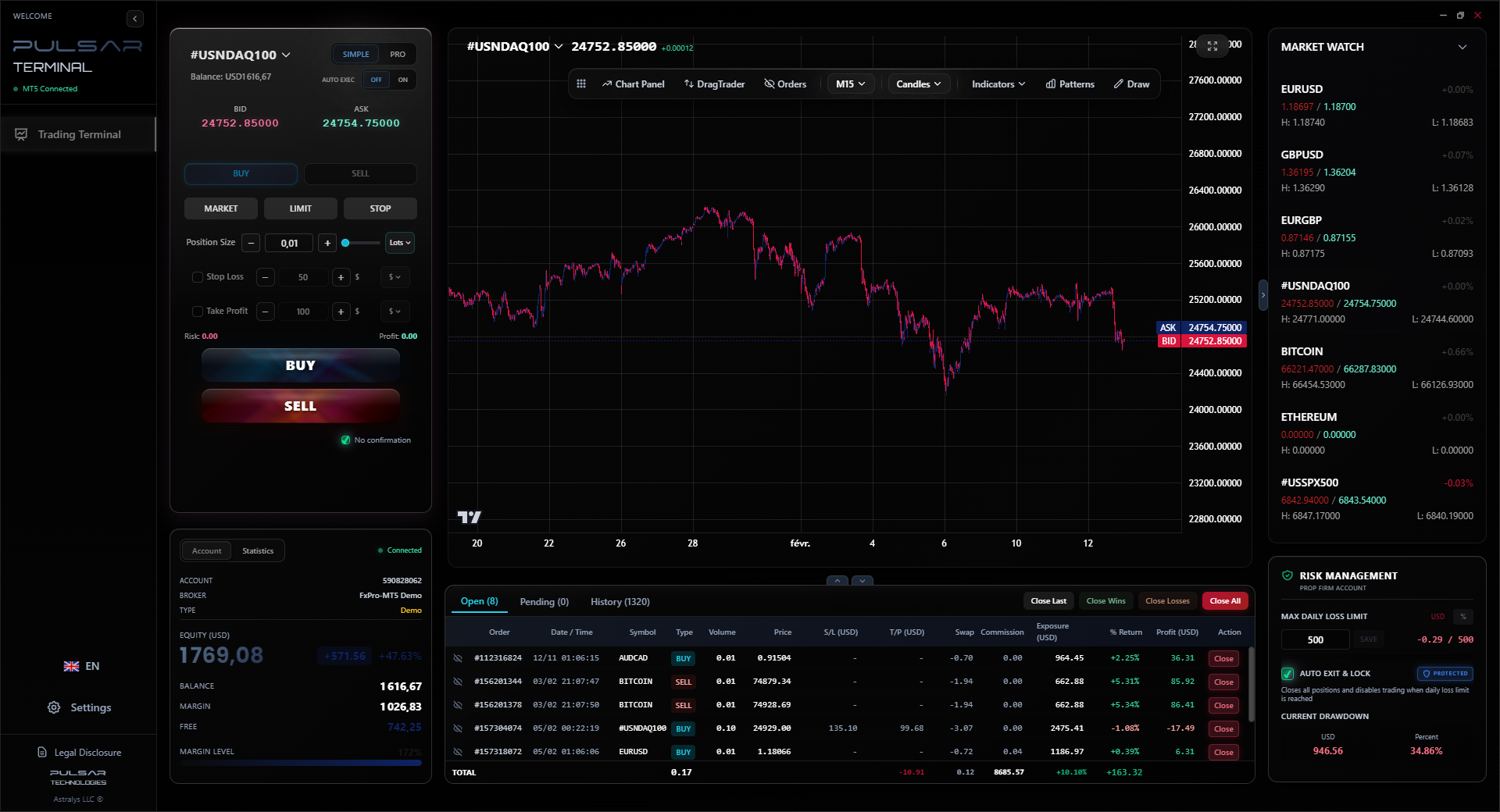
Managing complex trades on volatile pairs like USD/ZAR is stressful, but tools like Pulsar Terminal let you set multi-level take-profits and trailing stops automatically on MT5, so your plan executes perfectly even if the market gets wild.
Pulsar Terminal
MT5オールインワンツール:ドラッグ&ドロップ注文、マルチTP/SL、トレーリングストップ、グリッドトレード、出来高プロファイル、プロップファーム保護。毎日1,000人以上のトレーダーが利用。
“If you measure your performance in USD terms, the rand's daily drama becomes background noise.”
Let's wrap up with the classic mistakes I've made so you don't have to.
- Chasing 'ZAR-hedged' dreams: Don't trade just to 'beat the rand falling.' Trade because you have a valid edge on a chart. I once took awful USD/ZAR long trades for months because "the rand has to fall," ignoring clear technical breakdowns. It was expensive patriotism.
- Ignoring the true cost: That 'free deposit' might be eaten by a 3% conversion spread. Always calculate the total cost of a round-trip trade and a funding cycle.
- Using excessive use: With ZAR pairs already volatile, 500:1 use is a suicide pill. I keep mine below 30:1 for majors and 10:1 for ZAR crosses. A margin call can come frighteningly fast.
- Confusing investing with trading: The airport bureau is for converting holiday money. Your MT5 platform is for executing a disciplined swing trading plan. Never mix the two mindsets. One is a cost of living, the other is a business.
- Going it alone: The SA trading community is vibrant. Engage with serious traders on forums or local groups. The shared experience of trading through load-shedding or a rand flash crash is useful. Learning from others' mistakes is cheaper than making all your own.
FAQ
Q1Is forex trading legal in South Africa?
Yes, absolutely. It's regulated by the Financial Sector Conduct Authority (FSCA). The key is to use a broker that is licensed by the FSCA to ensure your funds are protected and you have legal recourse.
Q2What is the best forex broker for South Africans?
There's no single 'best' broker. It depends on your needs. For beginners, user-friendly platforms like Plus500 or IG are great. For low-cost, high-volume trading, look at Tickmill or FP Markets' ECN accounts. For fast local deposits and Rand accounts, a local broker like Khwezi Trade is an excellent choice.
Q3Can I trade forex at King Shaka International Airport?
No. The foreign exchange counters at the airport are for exchanging physical currency for travel purposes. They offer poor rates and have no connection to the leveraged spot forex market you trade online with a broker.
Q4Should I trade USD/ZAR?
Only if you understand its extreme volatility. It can move 300-500 pips in a single day. This requires much wider stop-losses and smaller position sizes compared to majors like EUR/USD. It's not for beginners.
Q5How do I avoid losing money on currency conversion?
Use a broker that offers a ZAR-denominated account. This allows you to deposit and withdraw in Rands directly. If your account is in USD, try to fund it with USD via a multi-currency account from your bank to avoid your bank's conversion fees.
Q6What is a good use level for a beginner in SA?
Start very low. I'd recommend no more than 10:1, even if your broker offers 500:1. This gives you room to be wrong without a single bad trade wiping you out. As you gain experience, you can adjust.
Q7What time are the best trading sessions for South Africa?
The London session (10:00 SAST - 19:00 SAST) offers the best liquidity and movement. The overlap with the US session (from 15:30 SAST) is often the most volatile and profitable period of the day.
ウィンストン教授のレッスン
重要ポイント:
- ✓Only use FSCA-regulated brokers for real protection.
- ✓Your total cost is spread + commission + conversion fees.
- ✓Trade ZAR pairs with 1/5th your normal position size.
- ✓Airport forex is for physical cash, not leveraged trading.
- ✓Measure your long-term performance in USD, not ZAR.
この記事はどれくらい役に立ちましたか?
星をクリックして評価
週刊トレーディングインサイト
無料の週刊分析&戦略。スパムなし。
著者について
David van der Merwe
新興市場トレーダー
ヨハネスブルグ拠点で新興市場通貨11年のトレーダー。ZARペア、FSCA規制下の取引、南アフリカ市場分析を専門とする。
コメント
リスク警告
金融商品の取引には大きなリスクが伴い、すべての投資家に適しているわけではありません。過去の実績は将来の結果を保証するものではありません。本コンテンツは教育目的のみであり、投資助言として解釈すべきではありません。取引前に必ずご自身で調査を行ってください。
こちらもおすすめ

Cara Trading Forex Sukses: 7 Prinsip dari Trader Profesional
Cara trading forex sukses dengan 7 prinsip trader pro: manajemen modal, disiplin, journal trading, backtest. Data nyata, bukan janji profit palsu.
Jam Trading Forex Terbaik untuk Trader Indonesia: Panduan Lengkap dengan Tabel Waktu
Panduan jam trading forex untuk trader Indonesia. Tabel 4 sesi dunia, jam emas 20:00-00:00, sesi mana yang harus dihindari. Data akurat + tips dari trader berpengalaman.
Top 5 Sàn Forex Uy Tín Nhất 2026: Review Jujur dari Trader Indonesia
Top 5 sàn forex uy tín 2026 untuk trader Indonesia. Review jujur: spread, deposit, withdraw, dukungan lokal. Exness, XM, IC Markets & lebih.
