


The biggest lie told to new traders in South Africa is that forex is a quick path to riches.

David van der Merwe
新興市場トレーダー ·  South Africa
☕ 9 分で読める
学べること:
- 1Lesson 1: Your First Loss is Your Best Teacher
- 2Lesson 2: Know the Local Playing Field (FSCA Rules & Costs)
- 3Lesson 3: Build a Trading Plan Before You Deposit a Cent
- 4Lesson 4: Taming the Local Beast – Trading USD/ZAR
- 5Lesson 5: Indicators Are Rear-View Mirrors, Not Crystal Balls
- 6Lesson 6: The Demo Account Lie & Making the Leap to Live
- 7Lesson 7: The Top 3 Beginner Mistakes (And How to Avoid Them)
The biggest lie told to new traders in South Africa is that forex is a quick path to riches. Social media gurus selling 'secret systems' and brokers flashing Lamborghinis have created a fantasy. The reality? Most beginners blow their first account within months. I did. I lost R15,000 in my first six months chasing 'sure things.' This guide isn't about getting rich quick. It's about surviving long enough to get good. I'll give you the real forex lessons for beginners that I wish someone had given me, tailored for our market, our rules, and our unique pitfalls.
Forget everything you think you know about trading from YouTube. Your first real, live trade will teach you more than 100 hours of theory. The psychology is different when it's your own money. Your heart races, you second-guess every tick, and fear becomes your worst enemy.
I remember my first 'big' trade back in 2014. I went long on EUR/USD at 1.3550 with R5,000, using way too much use. It moved against me by 20 pips. Instead of sticking to my planned stop loss, I moved it further away, convinced it would bounce. It didn't. I watched it drop another 50 pips before panic-selling. Loss: R1,200. That R1,200 bought me a crucial lesson: my plan was worthless if I didn't have the discipline to follow it. That's the core of all forex lessons for beginners. You will lose money. The goal is to lose small, learn fast, and never repeat the same mistake. Start by defining what a pip definition actually costs in your account. It makes the risk real.

💡 ウィンストンのヒント
Your first R10,000 in the market is tuition, not investment. Pay it willingly, but make sure you get the lesson.
“Your trading plan is worthless if you don't have the discipline to follow it.”
Trading from South Africa isn't the same as trading from London or New York. We have specific regulations and costs that directly impact your bottom line. Ignoring them is financial suicide.
The FSCA use Cap
Since 2021, the Financial Sector Conduct Authority (FSCA) has capped use for retail traders at 30:1. This is a good thing, honestly. It prevents you from blowing up your account in seconds. Before the cap, I saw brokers offering 1:500. At that level, a 20-pip move against you could wipe out your entire margin. 30:1 forces a bit more sanity. It means for every R1,000 in your account, you can control a position worth R30,000.
The Real Cost of Trading
Your broker isn't a charity. They make money from the spread definition, the difference between the buy and sell price. For a major pair like EUR/USD, a decent spread is 1-3 pips. On a standard lot (100,000 units), 1 pip is $10. So a 2-pip spread means you're down $20 the moment you enter the trade. It has to move in your favor just to break even. Some brokers like Tickmill or FP Markets offer 'raw' spreads near 0 pips but charge a commission (e.g., $3 per lot, per side). You need to do the math.

Warning: Always check for overnight financing fees (swap rates). Holding a trade overnight means you pay or receive interest. On some pairs, like USD/ZAR, these fees can be massive and eat into profits for swing trading positions.
Choosing a Broker: The FSCA is Your Friend
You can technically sign up with any international broker, but I strongly recommend using an FSCA-regulated one like those in our Exness review or XM review. Why? Protection. If there's a dispute, you have a local regulator to complain to. Deposits and withdrawals in ZAR are easier and cheaper. Your funds should be held in segregated accounts, meaning the broker can't use your money for their own bills.
“Demo accounts lie to you. Trading with pretend money doesn't replicate the gut-churn of risking your salary.”
A trading plan isn't a vague idea. It's a written contract with yourself that answers these questions:
- What do I trade? Don't say 'forex.' Be specific. Will you focus on majors like EUR/USD? The volatile USD/ZAR? Start with one or two pairs. Learn their personality.
- When do I enter? What specific condition triggers your trade? Is it a MACD indicator crossover? A price breaking a key level? It must be objective, not a 'feeling.'
- Where is my stop loss? This is non-negotiable. Before you click buy, you must know exactly where you'll get out if you're wrong. Use a position size calculator to ensure the loss is a small percentage of your account (1-2% is standard).
- Where is my take profit? What's your target? What's the reward relative to your risk (your Risk/Reward ratio)? Aim for at least 1:1.5.
- How much do I risk per trade? This is the golden rule. Risking 5% per trade means 5 consecutive losses wipe out 25% of your account. Risking 2% means you can withstand a bad streak.
I keep a trading journal. Every single trade gets logged: entry, exit, reason, screenshot, and my emotional state. Reviewing it monthly is how you spot your stupid patterns. My pattern was moving stop losses. The journal shamed me into stopping.
“Demo accounts lie to you. Trading with pretend money doesn't replicate the gut-churn of risking your salary.”
As a South African, USD/ZAR is tempting. You understand the news driving it (load-shedding, politics, commodity prices). But it's an exotic pair, and it will chew you up if you're not careful.
Why it's dangerous:
- High Volatility: It can move 200-300 pips in a day on major news. That's the equivalent of EUR/USD moving for a week.
- Wide Spreads: Expect spreads of 50-150 pips, sometimes more. Compare that to 1 pip on EUR/USD. You start every trade deep in the red.
- High Swap Fees: The interest rate differential between the US and SA can lead to huge overnight charges, especially if you're holding for weeks.
A painful lesson: In 2018, I shorted USD/ZAR at 13.80, betting on Rand strength. The spread was 80 pips. It immediately went against me. I held, thinking it was a retracement. A week later, it was at 14.50. My paper loss was huge, and the negative swap fees were adding up daily. I finally capitulated at 14.60. Total loss: over R8,000 on a single, poorly sized trade. I broke every rule in my plan.

Pro Tip: If you must trade USD/ZAR, treat it with extreme respect. Use much smaller position sizes. A 100-pip stop on USD/ZAR is tight; on EUR/USD it's wide. Your risk in Rands should be the same. Never trade it around major SA budget speeches or credit rating announcements unless you enjoy heart palpitations.
💡 ウィンストンのヒント
If you can't explain your trade in one simple sentence, you shouldn't be in it. Complexity is the enemy of execution.
“Overleveraging is the fastest way to turn a small account into no account.”
New traders load their charts with 10 different indicators, creating a mess of conflicting signals. The RSI indicator says overbought, but the moving average says buy. Then you freeze.
Here's the truth: most indicators are derived from price. They lag. Price moves first, the indicator follows. They help describe what has happened, not what will happen.
I used to hunt for the 'perfect' combination. I wasted years. My breakthrough came when I stripped everything back. Now, my main chart has just:
- Price Action: Support and resistance levels. Where has the price bounced or broken before?
- One Trend-Following Tool: A simple 20-period moving average to gauge the broader direction.
- One Momentum Tool: Usually the RSI, just to spot extreme conditions.
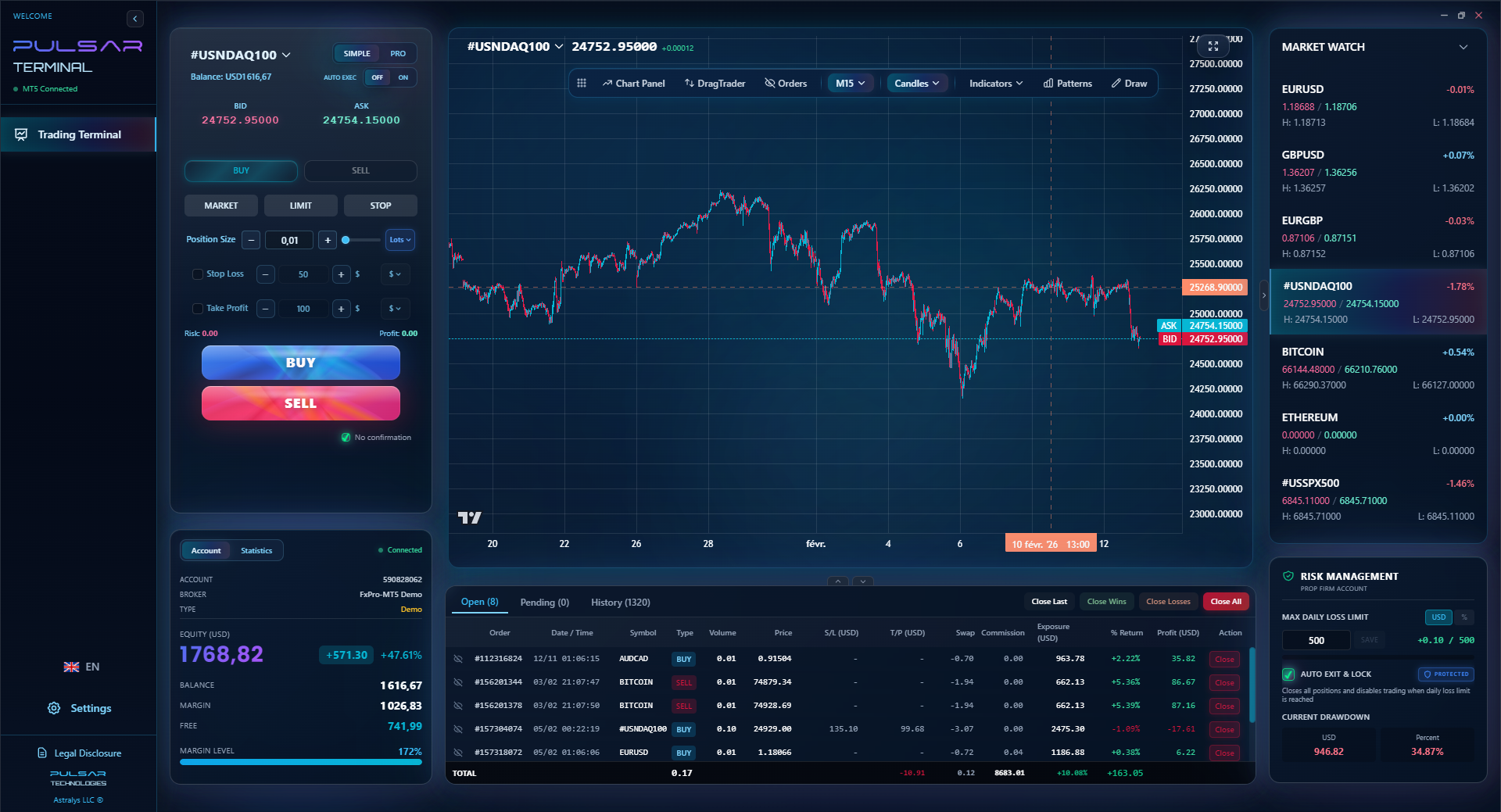
That's it. The cleaner your chart, the clearer your decision. A tool like Pulsar Terminal can help keep things organized with its clean layouts, but the principle is yours to follow. Don't let the tool think for you. Learn to read the raw price story first. All the fancy pattern recognition in the world won't save you if you don't understand basic supply and demand.
When you're trying to follow a clean trading plan, cluttered charts and manual order management are your enemy. A tool like Pulsar Terminal strips away the MT5 clutter, letting you focus on price action and execute your plan with one-click orders and automated risk management.
Pulsar Terminal
MT5オールインワンツール:ドラッグ&ドロップ注文、マルチTP/SL、トレーリングストップ、グリッドトレード、出来高プロファイル、プロップファーム保護。毎日1,000人以上のトレーダーが利用。
“Overleveraging is the fastest way to turn a small account into no account.”
Demo accounts are essential, but they lie to you. Trading with R500,000 of pretend money doesn't replicate the gut-churn of risking your hard-earned R5,000. The discipline you have on demo often evaporates on live.
How to use a demo properly:
- Trade your real strategy with your real planned risk percentages.
- Pretend the money is real. If you lose 10% of your demo capital, act as if you just lost real cash. Review what went wrong.
- Do it for at least 3 months of consistent, documented profitability. Not a lucky week, a consistent quarter.
Making the switch to live: This is the hardest part. The fear is real. Here's my method:
- Start absurdly small. Deposit the broker's minimum (e.g., R180 with some brokers). Your goal for the first month is not to make money. Your goal is to execute your plan perfectly for 20 trades. If you risk 2% of R180, that's R3.60 per trade. The monetary amount is irrelevant. You're paying for a psychology lesson.
- Only increase your deposit after a month of flawless plan execution, even if you lost money. If you followed your rules, you passed the test.
The moment you feel that fear on a live trade, you're learning the most important skill: emotional control. This is where most fail. They size up too fast, fear turns into panic, and they abandon their plan. Don't be that person. Graduate slowly.
💡 ウィンストンのヒント
The market doesn't care about your rent, your car payment, or your ego. Trade the price you see, not the price you need.
“USD/ZAR is an exotic pair that will chew you up if you're not careful. Respect it or avoid it.”
After mentoring dozens of new traders, I see the same errors on repeat. Let's kill them now.
Mistake 1: Overleveraging. The FSCA's 30:1 cap helps, but you can still overleverage yourself. Using 30:1 on your entire account is insane. Just because you can doesn't mean you should. I never use more than 10:1 effective use on my total account. Calculate your position size properly for every single trade.
Mistake 2: Revenge Trading. You take a loss. Anger and embarrassment kick in. You jump right back into another trade, twice the size, to 'make it back fast.' This is how accounts die in an afternoon. After a loss, walk away. Close the platform. Your job is to protect your capital, not your ego.
Mistake 3: Chasing the News. You see USD/ZAR spiking 100 pips on a news headline and FOMO (Fear Of Missing Out) in. You buy at the very top. The spike reverses, and you're left holding a massive loss. Major news events cause spreads to widen massively and prices to whipsaw. Unless you're an experienced scalping strategy pro, stay out for the first 15-30 minutes after major data releases like US Non-Farm Payrolls or our own SARB rate decisions.

Example: Your account is R10,000. You risk 2% per trade = R200 risk. On USD/ZAR, with a 100-pip stop loss, your position size should be calculated so that a 100-pip move loses you R200, not R2,000. This is where a calculator is essential.
FAQ
Q1What is the minimum amount I need to start forex trading in South Africa?
Technically, you can start with as little as R180 (about $10) with some brokers like Exness. But realistically, I'd recommend a minimum of R5,000. Why? With proper risk management (risking 1-2% per trade), a R5,000 account lets you risk R50-R100 per trade. This is enough to feel the psychological pressure of real trading without blowing up from a single small mistake. Starting with R180 often leads to taking insane risks just to see a meaningful profit in Rands.
Q2Are forex trading profits taxable in South Africa?
Yes. SARS considers profits from forex trading as taxable income. You must declare it on your annual tax return. Keep detailed records of all your trades, deposits, and withdrawals. Losses can be offset against other income, but the rules can be complex. It's worth consulting with a tax professional who understands trading income. Don't ignore this; it's part of treating trading like a real business.
Q3Is MetaTrader 4 or MetaTrader 5 better for beginners?
For a complete beginner, MT4 is simpler and has more than enough features. The community support, indicators, and expert advisors (EAs) are vast. MT5 is more powerful (more timeframes, more order types, built-in economic calendar) but can feel cluttered. Most South African brokers offer both. Start with MT4 on a demo account. Get comfortable with placing orders, setting stop losses, and reading charts. You can graduate to MT5 later if you need its specific features.
Q4What's the biggest difference between a demo and live account?
Psychology and execution. On demo, order fills are often instant and perfect. On a live account, especially during volatile news, you might get slippage (your order fills at a worse price than expected). But the main difference is you. The fear of loss and the greed for profit distort your judgment on a live account in a way demo trading can never simulate. That's why you must start live trading with tiny, almost meaningless amounts to acclimatize.
Q5How do I know if a broker is legitimately FSCA-regulated?
Don't just take their word for it. Go to the FSCA's official website (www.fsca.co.za) and use their 'Search for an authorised Financial Services Provider (FSP)' tool. Enter the broker's name or FSP number (which they should display clearly on their website). Verify the details match exactly. Also, check which entity is regulated. Sometimes a broker's parent company is regulated elsewhere, but their South African offering might not be. Look for the FSCA logo and a local ZAR bank account for deposits.
Q6Can I make a living from forex trading as a beginner?
Absolutely not. Anyone who tells you otherwise is selling you a dream. Treat your first two years as a paid education. Your goal should be to preserve capital and learn. The statistics are brutal: a very high percentage of retail traders lose money. The ones who eventually make consistent profits treat it like a skilled profession, not a lottery. They have a business plan, they keep records, and they manage risk above all else. Aim to be a consistent survivor first. The profits come later, if ever.
ウィンストン教授のレッスン
重要ポイント:
- ✓Risk a maximum of 2% of your account on any single trade.
- ✓Always know your stop loss before you enter a trade.
- ✓Trade your plan, not your emotions. Revenge trading kills accounts.
- ✓Verify your broker's FSCA registration directly on the regulator's website.
- ✓Treat your first R5,000 - R10,000 as tuition fees, not investment capital.
この記事はどれくらい役に立ちましたか?
星をクリックして評価
週刊トレーディングインサイト
無料の週刊分析&戦略。スパムなし。
著者について
David van der Merwe
新興市場トレーダー
ヨハネスブルグ拠点で新興市場通貨11年のトレーダー。ZARペア、FSCA規制下の取引、南アフリカ市場分析を専門とする。
コメント
リスク警告
金融商品の取引には大きなリスクが伴い、すべての投資家に適しているわけではありません。過去の実績は将来の結果を保証するものではありません。本コンテンツは教育目的のみであり、投資助言として解釈すべきではありません。取引前に必ずご自身で調査を行ってください。
こちらもおすすめ

Cara Trading Forex Sukses: 7 Prinsip dari Trader Profesional
Cara trading forex sukses dengan 7 prinsip trader pro: manajemen modal, disiplin, journal trading, backtest. Data nyata, bukan janji profit palsu.
Jam Trading Forex Terbaik untuk Trader Indonesia: Panduan Lengkap dengan Tabel Waktu
Panduan jam trading forex untuk trader Indonesia. Tabel 4 sesi dunia, jam emas 20:00-00:00, sesi mana yang harus dihindari. Data akurat + tips dari trader berpengalaman.
Top 5 Sàn Forex Uy Tín Nhất 2026: Review Jujur dari Trader Indonesia
Top 5 sàn forex uy tín 2026 untuk trader Indonesia. Review jujur: spread, deposit, withdraw, dukungan lokal. Exness, XM, IC Markets & lebih.
