


Here's the truth most trading 'gurus' won't tell you: obsessing over every forex news update is a fantastic way to lose money.

David van der Merwe
新興市場トレーダー ·  South Africa
☕ 11 分で読める
学べること:
- 1Why Most Forex News Updates Are a Waste of Your Time
- 2The South African News That Actually Moves the Market
- 3ZAR Pairs and How to Trade Them
- 4FSCA Rules and the Tax You Can't Ignore
- 5My Personal News Trading Routine (The 2025 Edition)
- 6Better Than a News Wire: The Tools You Actually Need
- 7Common Pitfalls and How to Avoid Them
Here's the truth most trading 'gurus' won't tell you: obsessing over every forex news update is a fantastic way to lose money. I've blown accounts doing it. In South Africa, with our unique market quirks and regulatory shifts, you need a smarter filter. This isn't about watching every headline; it's about knowing which ones actually move the ZAR and how to position yourself without the FSCA or SARS knocking. I'll show you the real numbers, the traps, and the few news events worth your attention.
When I started, I had Bloomberg on one screen and Reuters on the other, convinced I was a 'macro trader.' The result? I was overtrading, getting whipsawed by initial reactions, and completely missing the actual trend. The noise is overwhelming.
Most economic data releases are already priced in by the big banks. The initial spike you see? That's retail panic and algo reactions. The real move often happens 15-30 minutes later, once the institutional money has digested the details. Chasing the headline number is a mug's game.
In South Africa, this is even more pronounced. A huge 80% of ZAR trading happens offshore. By the time you read a local news update on your phone, the London or New York desks have already placed their bets. Your job isn't to be first; it's to be right about the sustained direction. I learned this the hard way in 2018, buying USD/ZAR on a slightly better-than-expected CPI print, only to watch it reverse and stop me out for a 45-pip loss within minutes. The news was 'good,' but the market had already moved.

Warning: Trading the immediate 5-second spike after a high-impact news release is pure gambling. The spreads widen, liquidity vanishes, and your stop-loss can get filled at a horrific price. Most reputable brokers like IC Markets or Pepperstone will warn you about this volatility.
Forget the minor data points. In South Africa, only a handful of events genuinely shift the needle for the Rand. You need to mark these on your calendar.
SARB Interest Rate Decisions: This is the big one. The South African Reserve Bank's Monetary Policy Committee (MPC) statements are everything. Don't just look at the rate change (or lack thereof). Scour the statement for hints about future policy (forward guidance) and their view on inflation and growth. A hawkish tone (hinting at future hikes) can boost the ZAR, even if they leave rates unchanged. I once caught a 220-pip move on USD/ZAR over two days because the SARB was unexpectedly concerned about currency depreciation.
National Budget Speech: The Finance Minister's budget speech outlines spending, debt, and tax plans. Markets hate uncertainty, and a budget perceived as fiscally irresponsible will hammer the Rand. Watch for reactions in bond yields – if they spike, the ZAR is usually in trouble.
Eskom and Load-Shedding Updates: This is uniquely South African. A major escalation in load-shedding stages or news of total grid collapse is a direct hit to economic growth forecasts. It's a negative ZAR event, full stop. I've shorted ZAR pairs against the USD and EUR on announcements of Stage 6 and higher.
Political Stability Headlines: This is less about scheduled news and more about monitoring the mood. Major cabinet reshuffles, corruption scandals that threaten governability, or widespread social unrest will cause foreign investment to flee and pressure the ZAR.
Global Risk Sentiment (The Big Driver): Let's be honest, the ZAR is a risk-sensitive, commodity currency. The most important forex news update for a South African trader often isn't local. It's US Federal Reserve announcements, major Chinese economic data (as a key commodity buyer), and broad market 'risk-on' or 'risk-off' moods. When global markets panic, traders sell emerging market currencies like the ZAR and buy the US dollar. It's that simple.

💡 ウィンストンのヒント
The market's reaction to news is more important than the news itself. A 'good' number that gets sold is actually bad news for buyers.
“Your job isn't to be first with the news; it's to be right about the sustained direction.”
USD/ZAR: The Main Event
This is the most liquid and widely followed pair, with a daily volume in the billions. It's your purest play on South African sentiment vs. the global reserve currency. Because of the ZAR's volatility, a standard lot (100,000 units) is massive risk. The average account here is under $1,000, so you must use a micro or cent account, or very small position sizes. A 50-pip move on USD/ZAR can be a much larger percentage move than on EUR/USD. Always, always use a position size calculator.
EUR/ZAR and GBP/ZAR
These pairs offer alternative plays. EUR/ZAR often correlates with global risk, similar to USD/ZAR, but can diverge on Eurozone-specific news. GBP/ZAR can be a wild ride, reacting sharply to both UK politics and SA news. The spreads on these pairs are wider, so they're less ideal for scalping strategies and better for swing trading over days or weeks.

Pro Tip: Don't fund your international broker account in ZAR if you can avoid it. With our currency's devaluation, you're taking an immediate hidden loss. Deposit USD or EUR if possible. If using a local FSCA broker with a ZAR account, this isn't an issue, but check their product offering.
The Practicalities of Trading ZAR
Volatility is your friend and enemy. A quiet day might see a 100-pip range; a news day can be 300-500 pips. This means your stop-loss placement is critical. Place it too tight, and you'll get taken out by noise. Too wide, and your risk per trade becomes insane. I use Average True Range (ATR) to gauge recent volatility and set stops at 1.5x the 14-period ATR, at a minimum.
Also, remember that about 71% of the domestic FX market is swaps (rollovers). If you're holding a ZAR trade overnight, the swap/rollover interest can be significant, especially if you're short the ZAR (funding a high-interest currency). Factor this into your trade plan for longer-term holds.
This is the boring but crucial part. Get it wrong, and your profits won't matter.
The 30:1 use Cap: Since 2021, the FSCA has capped use at 30:1 for retail traders. This is a good thing. It prevents you from blowing up your account in seconds. Anyone offering you more from a 'local' operation is likely unregulated or operating under a different license. Brokers like Exness or XM might offer higher use on their global entities, but if you're with their FSCA-regulated branch, it's 30:1 max.
The SARS Reality: Here's the kicker that catches everyone out. SARS wants its cut on your net forex trading profits. It doesn't matter if your broker is in Cyprus, the Seychelles, or Mars. If you're a South African tax resident, your worldwide income is taxable. You declare your net profit (total gains minus total losses, minus legitimate trading expenses like data subscriptions, internet costs, etc.) as part of your annual income.
I keep a simple spreadsheet: date, pair, P/L in ZAR. At the end of the tax year, I tally it up. If you're consistently profitable, set aside 25-30% of your profits for tax. Ignoring this is an audit waiting to happen. The FSCA's recent crackdown, with over R943 million in penalties last year, shows they're getting serious. While that's aimed at providers, it signals a stricter environment.
The COFI Bill Looming: The big forex news update on the regulatory front is the upcoming Conduct of Financial Institutions (COFI) Bill. It's aiming to simplify all financial conduct laws. For you, the trader, it likely means even clearer rules and consumer protections, but potentially more paperwork for brokers. It reinforces that the SA market is maturing and regulating.
“In South Africa, the most important forex news update for a trader often isn't local - it's whatever the US Federal Reserve just said.”
This is what I actually do, stripped of all the guru nonsense.
- The Calendar Scan (Sunday Night): I open my economic calendar. I highlight ONLY high-impact events for the USD, ZAR, EUR (if trading EUR pairs), and China. Medium-impact gets a glance. I ignore everything else.
- The Pre-News Setup (1 Hour Before): I do not have any open positions 1 hour before a high-impact event I care about. I'm flat. This removes emotion. I assess the market's expectation. What is the consensus forecast for the SARB rate? Is the market positioned for a hike or hold?
- The Reaction Window (15 Minutes After): I do NOT trade the news. I wait. Let the algos fight it out. I watch the price action and volume. Is there a sharp spike and immediate rejection? Or a breakout that holds for 15 minutes? I'm looking for the sustained move, not the first move. Tools like Volume Profile on a platform can help see where real trading is happening.
- The Trade Entry (After the Chaos): My entry is based on price action confirmation after the initial volatility settles. If USD/ZAR breaks above a key resistance level and holds there 20 minutes after the SARB announcement, that's a signal. I'll enter with a stop-loss below the pre-news consolidation range.
- The Management: This is where most fail. If the trade goes my way, I move my stop to breakeven as soon as possible to eliminate risk. Then, I might use a trailing stop to capture the trend. Managing this manually is stressful. This is where automation tools shine.

Example: Before the last MPC, USD/ZAR was trading at 18.50. Consensus was a 25bps hike. They hiked 25bps but gave dovish guidance. Price spiked down to 18.40 instantly (sell the rumor, buy the fact?), then reversed and rocketed to 18.80 over the next hour as the guidance was digested. Trading the initial spike would have been a loss. Trading the sustained breakout above 18.55 was the real play.
💡 ウィンストンのヒント
If you feel a rush of adrenaline and your heart pounding as a news release hits, you are gambling, not trading. Close the chart and come back in 30 minutes.
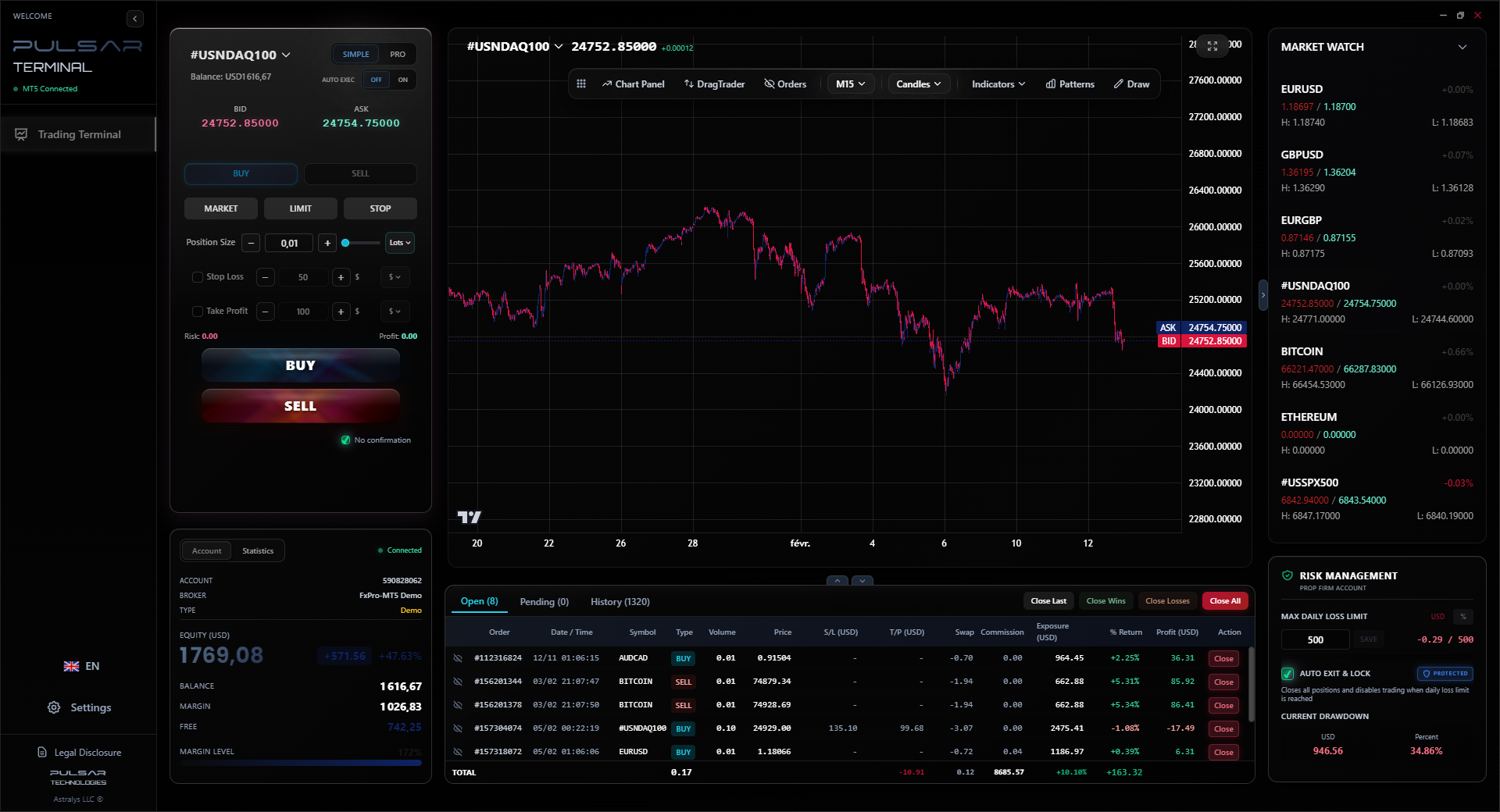
Managing trades around volatile news is stressful, but tools like Pulsar Terminal automate trailing stops and breakeven moves directly on your MT5 chart, so you can lock in profits without staring at the screen.
Pulsar Terminal
MT5オールインワンツール:ドラッグ&ドロップ注文、マルチTP/SL、トレーリングストップ、グリッドトレード、出来高プロファイル、プロップファーム保護。毎日1,000人以上のトレーダーが利用。
Forget subscribing to expensive news services. Here’s my toolkit:
- A Reliable Economic Calendar: Investing.com or Forex Factory’s free calendars are perfectly adequate. Filter for ‘High’ impact.
- Market Sentiment Gauge: I sometimes look at the US Dollar Index (DXY) and the S&P 500. If the DXY is soaring and stocks are tanking (risk-off), trying to buy EUR/ZAR is probably fighting the tide.
- Price Action & Volume: This is your primary tool. Candlestick patterns at key support/resistance levels tell you more than a journalist’s summary. Is the market absorbing selling pressure (bullish)? Is a rally failing on low volume (bearish)?
- Simple Indicators for Confirmation: I use the RSI indicator to spot overbought/oversold conditions within a trend, and the MACD indicator for trend momentum and potential crossovers. I never trade based solely on an indicator.
- A Trading Journal: This is non-negotiable. Record every trade, the news context, your reasoning, and the outcome. Review it monthly. My biggest improvements came from journaling, not from reading more news.
The goal is to move from being a passive consumer of news to an active interpreter of how the market reacts to that news. That’s the difference between losing and winning.
“A forex news update is just information. It's not a trading signal.”
I've stepped in every one of these traps, so you don't have to.
- Pitfall 1: Trading Too Big on News. The volatility will magnify your losses. Use half your normal position size, or less, around scheduled news.
- Pitfall 2: The 'This Time Is Different' Fallacy. The market has a long memory. Don't ignore key technical levels because a news headline seems super bullish or bearish. Price respects support and resistance until it doesn't.
- Pitfall 3: Revenge Trading After a News Loss. You get stopped out on a fake spike. You're furious. You jump right back in trying to get your money back. This is how you have a -50% day. After a bad news trade, walk away. Close the platform.
- Pitfall 4: Ignoring the Global Picture. Being hyper-focused on South African news while the US Fed is about to change policy is like worrying about a dripping tap while your house is on fire. Always know the global macro backdrop.
- Pitfall 5: Not Understanding Spreads and Slippage. During news, spreads can blow out from 2 pips to 20 pips or more on USD/ZAR. Your market order gets filled at a terrible price. Use limit orders to enter, not market orders, if you must trade around news.
The bottom line? A forex news update is just information. It's not a trading signal. Your edge comes from your disciplined process for interpreting and acting on that information, long after the headline-chasers have left the market.
FAQ
Q1Is forex trading legal in South Africa?
Yes, it's completely legal. It's regulated by the Financial Sector Conduct Authority (FSCA). You must trade with an FSCA-licensed broker for local protection, though you can also use international brokers at your own risk.
Q2How is forex trading taxed in South Africa?
SARS taxes your net profits (gains minus losses and related expenses) as part of your annual income. This applies even if your broker is offshore. Keep detailed records of all trades in ZAR.
Q3What is the use limit for retail traders in SA?
The FSCA caps use at 30:1 for retail clients. Any FSCA-regulated broker must adhere to this. It's a protective measure to limit risk.
Q4What is the most important news for the South African Rand (ZAR)?
The SARB interest rate decision and statement (MPC) is number one. Next is the National Budget Speech. Globally, US Federal Reserve policy and overall market risk sentiment are often more powerful drivers than local news.
Q5Should I trade the news as a beginner?
Absolutely not. It's the fastest way to lose money. Focus on learning price action, risk management, and trading in quiet market conditions first. News trading requires experience to handle the extreme volatility and emotional pressure.
Q6What is a good ZAR pair to start with?
USD/ZAR is the most liquid and has the most analysis available. However, due to its volatility, practice with tiny position sizes on a demo account or a cent account first to get a feel for its movements.
Q7What's the COFI Bill and how does it affect me?
The Conduct of Financial Institutions Bill is upcoming legislation to unify financial conduct laws. For traders, it should mean stronger consumer protections and a more stable, well-regulated trading environment with clearer rules for brokers.
ウィンストン教授のレッスン
重要ポイント:
- ✓Filter news: Only trade high-impact SARB, Budget, and global risk events.
- ✓Wait 15 mins after news for the real trend to establish.
- ✓Use max 30:1 use (FSCA rule) and half-size around news.
- ✓SARS taxes net profits; keep a ZAR trade journal.
- ✓USD/ZAR is volatile; a 50-pip move is a major swing.
この記事はどれくらい役に立ちましたか?
星をクリックして評価
週刊トレーディングインサイト
無料の週刊分析&戦略。スパムなし。
著者について
David van der Merwe
新興市場トレーダー
ヨハネスブルグ拠点で新興市場通貨11年のトレーダー。ZARペア、FSCA規制下の取引、南アフリカ市場分析を専門とする。
コメント
リスク警告
金融商品の取引には大きなリスクが伴い、すべての投資家に適しているわけではありません。過去の実績は将来の結果を保証するものではありません。本コンテンツは教育目的のみであり、投資助言として解釈すべきではありません。取引前に必ずご自身で調査を行ってください。
こちらもおすすめ

Cara Trading Forex Sukses: 7 Prinsip dari Trader Profesional
Cara trading forex sukses dengan 7 prinsip trader pro: manajemen modal, disiplin, journal trading, backtest. Data nyata, bukan janji profit palsu.
Jam Trading Forex Terbaik untuk Trader Indonesia: Panduan Lengkap dengan Tabel Waktu
Panduan jam trading forex untuk trader Indonesia. Tabel 4 sesi dunia, jam emas 20:00-00:00, sesi mana yang harus dihindari. Data akurat + tips dari trader berpengalaman.
Top 5 Sàn Forex Uy Tín Nhất 2026: Review Jujur dari Trader Indonesia
Top 5 sàn forex uy tín 2026 untuk trader Indonesia. Review jujur: spread, deposit, withdraw, dukungan lokal. Exness, XM, IC Markets & lebih.
