


Ever placed a trade on EUR/USD, watched it go 50 pips in your favor, and still had no real clue how much Naira you just made? You're not alone.

Olumide Adeyemi
西アフリカ・トレーディングの先駆者 ·  Nigeria
☕ 13 分で読める
学べること:
- 1What is a Pip, and Why Your Naira Mindset is Everything
- 2How Pip Value Works (It's Not the Same for Every Pair)
- 3Using the Calculator for Real Nigerian Risk Management
- 4Broker Specifics: Spreads, Commissions, and the Nigerian Reality
- 5A Step-by-Step Calculation: From Pips to Naira in Your Pocket
- 6Common Mistakes Nigerian Traders Make (And How to Avoid Them)
- 7Tools of the Trade: Recommended Calculators and Platforms
- 8Making It Routine: Integrating the Calculator Into Your Trading Plan

Ever placed a trade on EUR/USD, watched it go 50 pips in your favor, and still had no real clue how much Naira you just made? You're not alone. Most of us start out guessing, and that's a fast track to blowing an account. I did it myself. I remember a trade on GBP/JPY where I thought I'd made about ₦25,000, but after the spread and a weird conversion, my actual profit was closer to ₦18,500. That gap is where dreams and reality collide. This guide is about closing that gap for good. We're going to break down the forex pip profit calculator from a Nigerian perspective, so you know exactly what you're risking and what you stand to gain, in Naira, before you even click 'buy' or 'sell'.
Let's get the basics out of the way. A pip is usually the smallest price move a currency pair can make. For most pairs like EUR/USD or GBP/USD, it's 0.0001. So if EUR/USD moves from 1.0850 to 1.0851, that's one pip.
But here's where Nigerian traders get tripped up. We think in Naira, but the market doesn't. Your broker shows profit in USD, your brain converts it to Naira, and emotions get messy. A $50 loss might feel like 'just $50,' but that's over ₦70,000 at today's rate. That's a significant chunk of change. A forex pip profit calculator cuts through that mental fog. It translates pips directly into your account currency, which for most of us is USD, but the real goal is knowing what that means for your bottom line in Naira.

Warning: Never calculate your potential profit or loss based on the Central Bank of Nigeria (CBN) rate. Your broker converts your deposit and withdrawals at their rate, which is almost always the parallel market rate. That's the real value of your money.
I learned this the hard way early on. I funded my first live account with ₦100,000 when the official rate was around ₦410/$. I thought I had about $244. The broker's conversion gave me $217. That was my first real lesson in 'broker Naira' versus 'CBN Naira.' Always use the rate your broker gives you for honest calculations.
This is the core of the whole calculation. The value of a single pip depends on three things: the currency pair you're trading, the size of your trade (your lot size), and the current exchange rate.
The Standard Formula
For a standard lot (100,000 units), the pip value formula for a pair where USD is the quote currency (like EUR/USD) is straightforward:
Pip Value = (0.0001 / Exchange Rate) * Lot Size
If EUR/USD is at 1.0850 and you trade 1 standard lot, a pip is worth: (0.0001 / 1.0850) * 100,000 = $9.22.
The Nigerian Twist: USD/NGN and Exotic Pairs
Now, let's talk about something more local. If you ever look at USD/NGN, the calculation flips. Here, the Naira is the quote currency. A move from ₦1,450.00 to ₦1,450.50 is 50 pips (since it's usually quoted to two decimal places, the second decimal is the pip). The value of a pip in USD is different. This is where an online calculator saves you a massive headache. Trying to manually calculate pip value for GBP/JPY or USD/ZAR while also managing your trade is a recipe for a margin call.

Example: Let's say you're trading GBP/JPY, a common pair for volatility. You buy 0.5 lots (50,000 units) at 190.50. The pip value formula for cross pairs is more complex. A good forex pip profit calculator will instantly tell you that 1 pip on this trade is worth roughly $2.62. If you take 30 pips profit, that's about $78.60. At a parallel market rate of ₦1,450/$, that's roughly ₦113,970. Knowing that exact figure before you enter is power.
I once got caught in a USD/TRY (US Dollar/Turkish Lira) trade without checking the pip value. The pair was moving hundreds of pips a day, and I thought I'd hit a goldmine. I made 250 pips on a 0.2 lot trade and was ecstatic... until I realized the pip value was tiny due to the lira's low value. My 'massive' 250-pip win netted me less than $40. A calculator would have shown me that instantly.

💡 ウィンストンのヒント
A calculator tells you the 'what.' Your trading plan must tell you the 'why.' Never let a good number tempt you into a bad trade.

“Knowing the exact Naira value of a pip before you trade is what separates consistent traders from gamblers.”
This is where the tool stops being a nice-to-have and becomes non-negotiable. You shouldn't be figuring out your profit after the trade. You should know it before, as part of your risk calculation.
Here’s my exact pre-trade checklist:
- Determine Stop-Loss: I decide my stop-loss is 25 pips away from my entry based on my swing trading strategy.
- Use the Calculator: I plug in my pair (e.g., XAU/USD for Gold), my intended lot size (say, 0.1 lots), and my entry price. I look at the 'Pip Value' or 'Risk per Pip' output.
- Calculate Max Risk: If the calculator says 1 pip on this 0.1 lot gold trade is worth $1.00, then my 25-pip stop-loss equals a risk of $25.
- The Naira Check: Is $25 an acceptable loss? At ₦1,450/$, that's ₦36,250. Is that more than 1% of my trading account? If my account is $2,500, then 1% is $25. Perfect. If the math shows my risk is $50 (₦72,500), I immediately reduce my lot size to 0.05 to bring the risk back to my 1% rule.

Pro Tip: Always run the calculator for the specific lot size you intend to use. Don't just know that 1 pip on EUR/USD is ~$10 for a standard lot. For a 0.03 lot micro trade, it's $0.30. That detail changes everything for a scalping strategy where you're targeting 5-10 pips.
This process eliminates emotional, oversized trades. It forces discipline. I can't tell you how many times I've been tempted to double my position because a setup looked 'sure.' Running the numbers and seeing that it would break my risk rule has saved me thousands of dollars, which translates to millions of Naira over the years.
A pip profit calculator gives you the clean theoretical profit. But your net profit has costs deducted. For Nigerian traders, understanding these costs is critical because they eat directly into your Naira returns.
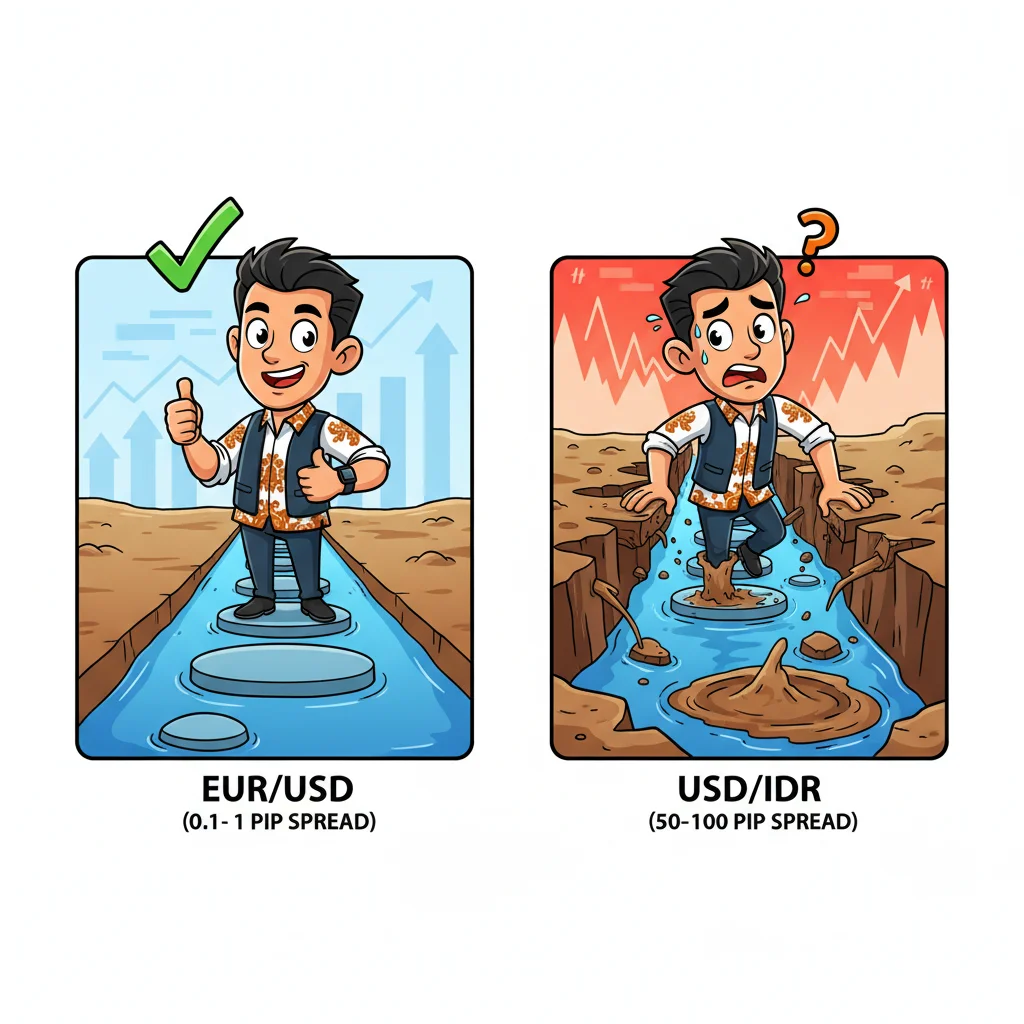
The Spread: This is the difference between the buy and sell price. If EUR/USD is quoted as 1.0850 / 1.0852, the spread is 2 pips. Your trade starts 2 pips in the red. A good calculator often has a field to input the spread to show your true break-even point.
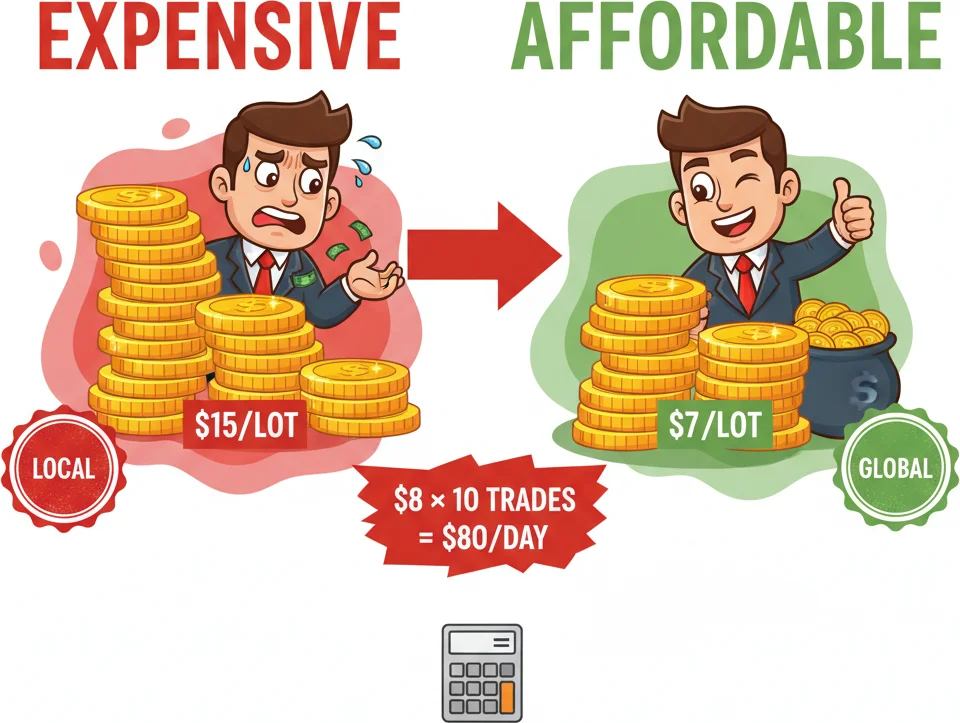
Commissions: Some brokers, like IC Markets or Pepperstone on their RAW accounts, charge a commission per lot instead of a wider spread. It might be $7 per round turn per standard lot. This must be factored in.
The Naira Conversion (Again): Remember, when you withdraw, your broker converts your USD profit to Naira. If you made $100, and their payout rate is ₦1,440/$, you get ₦144,000. If the parallel market rate that day is ₦1,460, you've effectively lost ₦2,000 in potential value. This isn't a broker fee, but it's a real cost of trading from Nigeria. Always check your broker's withdrawal rates and policies. Some international brokers are smoother than others for Nigerian clients; our Exness review and XM review cover some of these local nuances.
A complete profit calculation looks like this:
Net Profit (in USD) = (Pips Gained * Pip Value) - (Spread Cost in Pips * Pip Value) - Commission
Net Profit (in Naira) = Net Profit (USD) * Broker's Withdrawal Exchange Rate
Doing this manually is tedious. The best calculators let you input spread and commission to get a much clearer picture.
“Your real profit is (Exit Price - Entry Price) minus the spread. That detail changes everything.”
Let's walk through a full trade, soup to nuts, with real numbers. This is how I plan every single trade now.
Scenario: You're trading GBP/USD. You see a setup using the MACD indicator and support on the 4-hour chart.
- Trade Plan: You decide to buy at 1.2650. Your stop-loss is at 1.2625 (25 pips risk). Your take-profit target is at 1.2720 (70 pips potential reward).
- Account & Risk: You have a $5,000 account. Your risk-per-trade rule is 1.5%. That means you can afford to lose $75 on this trade max.
- Calculate Pip Value & Lot Size:
- You use a calculator. For GBP/USD at 1.2650, you find that 1 pip on a standard lot is worth $10.
- Your 25-pip stop-loss would risk $250 per standard lot. That's way over your $75 limit.
- So, you need a smaller lot size. $75 risk / 25 pips = $3 risk per pip.
- If 1 pip on a standard lot is $10, then to get $3 per pip, you need 0.3 lots (because $10 * 0.3 = $3).
- Final Check: You enter the trade with 0.3 lots. Your risk is 25 pips * $3/pip = $75 (✓ within your rule). Your potential reward is 70 pips * $3/pip = $210.
- The Outcome: The trade hits your take-profit at 1.2720.
- Gross Profit: $210.
- Your broker (IC Markets Raw Spread) had a 0.1 pip spread and a $7 commission per lot round turn.
- Spread Cost: 0.1 pips * $3/pip = $0.30 (negligible).
- Commission: $7 * 0.3 lots = $2.10.
- Net Profit (USD): $210 - $0.30 - $2.10 = $207.60.
- The Naira Payday: You withdraw. Your broker's payout rate is ₦1,442/$. You receive: $207.60 * 1,442 = ₦299,359.20.
See how the calculator was central to steps 3 and 4? Without it, determining that 0.3 lot size quickly and accurately is a struggle. This precision is what separates consistent traders from gamblers.
💡 ウィンストンのヒント
If you can't state your maximum loss in Naira before entering a trade, you have no business being in the trade. Period.

I've made most of these, so learn from my wasted Naira.
Mistake 1: Ignoring Lot Size. Thinking 'I made 100 pips!' is meaningless without the lot size. 100 pips on a 0.01 lot is $10. 100 pips on a 1.0 lot is $1,000. That's a life-changing difference. Always, always pair pips with position size. Use a position size calculator that's linked to your risk.
Mistake 2: Forgetting About Exotics. Trading USD/NGN, USD/ZAR, or USD/TRY? The pip value calculations are different. A 100-pip move in USD/TRY is not the same as in EUR/USD. Never assume. Always verify with a calculator that handles exotics.
Mistake 3: Pre-Calculating with the Wrong Rate. Don't use a static pip value. If you memorized that a pip on EUR/USD is $10, that's only true at an exchange rate of 1.0000. At 1.1000, it's about $9.09. Your calculator should use live or your entry price for accuracy.
Mistake 4: Not Accounting for the Full Cost. That exciting profit you see on your MT4 screen is usually the floating P&L. It doesn't automatically deduct the spread you paid to enter. Your real profit is (Exit Price - Entry Price) minus the spread. A good trade idea can be a loser if the spread is too wide. This is especially crucial for scalping, which is why choosing a low-spread broker is vital.
Mistake 5: Emotional Override. This is the big one. You've done the calculation. Your risk is set to 1%. The trade goes against you, and you think, 'Just this once, I'll move my stop-loss wider.' You've just invalidated your entire risk management plan. The calculator gave you a scientific number. Stick to it. The market doesn't care about your hope.
“It moves you from being reactive ('How much did I make?') to being proactive ('This is what I plan to make').”
You don't need to be a math whiz. You just need the right tools.
1. Built-in Calculator in Your Trading Platform: MT4 and MT5 have a built-in 'Trade' window that shows the estimated pip value and profit/loss as you set up an order. It's decent for a quick check, but it doesn't help with pre-trade risk planning on its own.
2. Dedicated Online Forex Calculators: These are the best for pre-trade planning. You'll find them on most major broker websites (like BabyPips or Myfxbook). Look for one that allows you to input:
- Currency Pair
- Account Currency (USD, EUR)
- Lot Size
- Entry & Exit Prices
- Spread Cost
- Commission
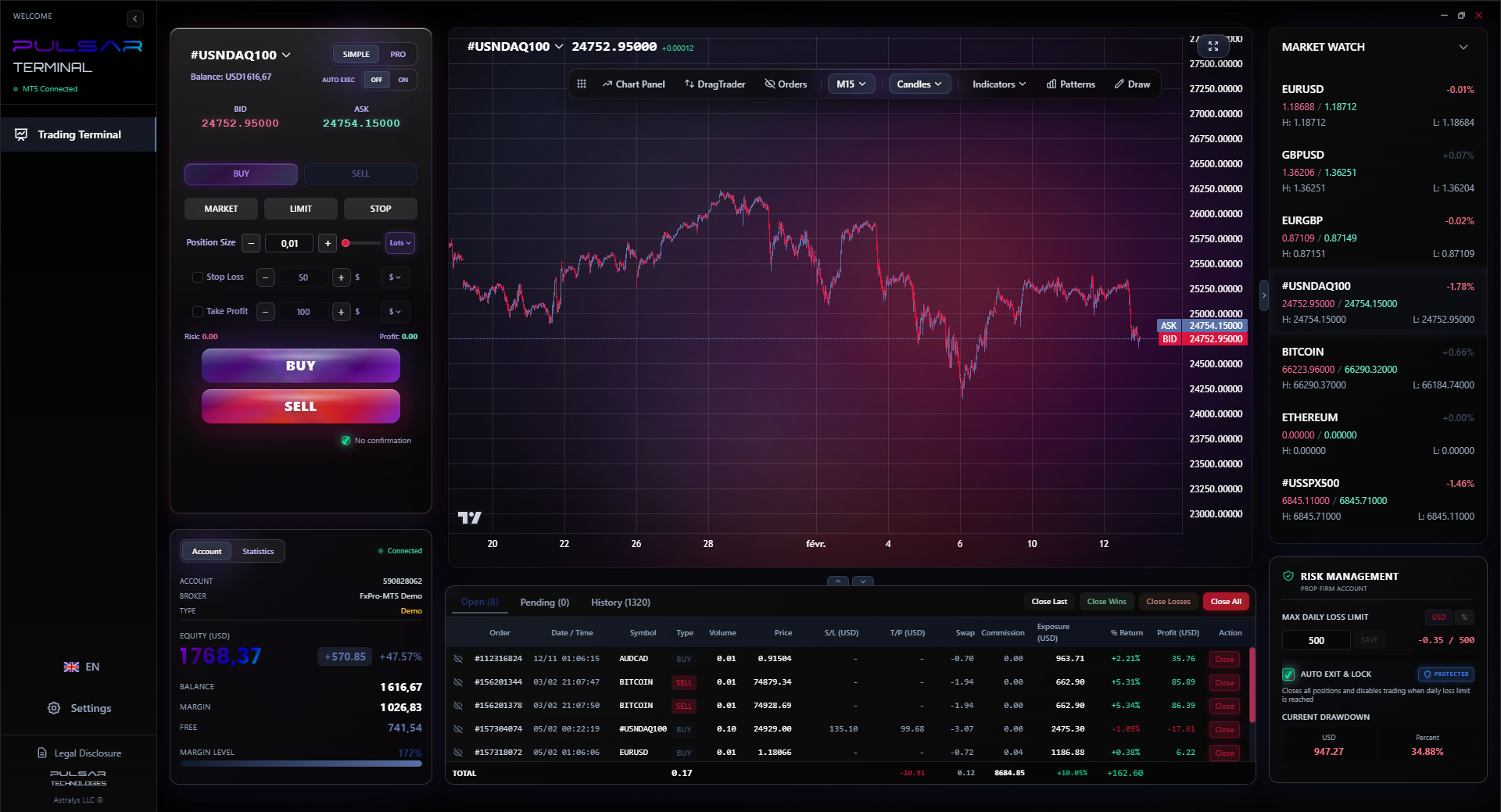
3. Advanced Trading Terminals: For the serious trader, platforms like Pulsar Terminal (which works with MT5) bake this functionality into the workflow. When you drag and drop an order onto the chart, it can instantly show you your risk in both pips and currency, your potential reward, and your risk-to-reward ratio right there on the screen. This seamless integration stops the back-and-forth between your chart and a web browser.
4. The Humble Spreadsheet: For ultimate control, I built a simple Excel sheet years ago. I input my account size, risk percentage, stop-loss in pips, and the pair. It uses live data feeds (with some work) to pull exchange rates and calculates my exact lot size. It's overkill for most, but it taught me the mechanics inside out.
My advice? Start with a reliable online calculator. Use it for every single trade plan for two weeks. It will become second nature. Then, as you grow, look into more integrated tools that simplify the process, so you can focus more on analysis and less on arithmetic.
Manually calculating risk for every trade setup is slow. Pulsar Terminal automates this by displaying your exact risk, reward, and R/R ratio directly on the MT5 chart as you set orders.
Pulsar Terminal
MT5オールインワンツール:ドラッグ&ドロップ注文、マルチTP/SL、トレーリングストップ、グリッドトレード、出来高プロファイル、プロップファーム保護。毎日1,000人以上のトレーダーが利用。
Knowing how to use a forex pip profit calculator is one thing. Making it an unbreakable part of your process is another. Here's how to bake it in.
Your New Trade Journal Entry: Every trade in your journal should start with the planned numbers, calculated before entry:
- Pair: EUR/USD
- Planned Entry: 1.0830
- Planned Stop-Loss: 1.0805 (25 pips)
- Planned Take-Profit: 1.0880 (50 pips)
- Calculated Pip Value (for X lots): $4.00
- Planned Risk: 25 pips * $4 = $100
- Planned Reward: 50 pips * $4 = $200
- Risk-to-Reward Ratio: 1:2
- Lot Size Used: 0.4 lots (derived from the $100 risk)
The Mental Shift: This practice does something powerful. It moves you from being reactive ('How much did I make?') to being proactive ('This is what I plan to make, and this is what I'm willing to lose to try'). It turns trading from a hopeful activity into a probabilistic business.
When I finally adopted this, my consistency improved dramatically. I was no longer chasing losses with bigger positions because my risk was capped and pre-defined. I was also able to calmly take profits at my target because I had already 'banked' that profit in my plan before the market even gave it to me. The calculator was the tool that enabled that psychological discipline.
, a forex pip profit calculator isn't just about numbers. It's the foundation of professional risk management. It's the difference between trading like a tourist in the market and trading like a local who knows the value of every single move. For us in Nigeria, where every Naira counts double, that knowledge isn't just power - it's profit.

FAQ
Q1Is there a simple formula to calculate pip value in my head for major pairs?
For pairs where USD is the quote currency (like EUR/USD, GBP/USD), a rough rule for a standard lot (100k units) is: Pip Value ≈ $10. But this is only perfectly accurate at an exchange rate of 1.0000. At 1.1000, it's about $9.09. For a mini lot (10k units), divide by 10 ($1). For a micro lot (1k units), divide by 100 ($0.10). It's a decent estimate, but always verify with a calculator for exact planning, especially when determining precise lot sizes for risk management.
Q2How do I calculate pip value for USD/NGN?
USD/NGN is usually quoted to two decimal places (e.g., ₦1,450.50). Here, a pip is typically a change of ₦0.01 (the second decimal place). For a standard lot (100,000 USD), a 1 pip move changes the value by 100,000 * 0.01 = ₦1,000. So, if you buy 1 standard lot of USD/NGN and it moves from ₦1,450.50 to ₦1,451.50 (a 100 pip move), your profit in Naira would be 100 pips * ₦1,000/pip = ₦100,000. Remember, your broker's profit/loss display will do this math, but knowing the underlying calculation helps you understand the massive use involved.
Q3My broker's profit/loss seems slightly off from my calculator. Why?
This is common and usually due to a few factors. First, check if your calculator is using the exact same entry price (including the spread). Second, brokers often use a more precise 'pipette' (1/10th of a pip) for internal calculations. Third, for cross currency pairs (like GBP/JPY), the calculation involves an extra step via the USD rate, and different sources might use slightly different rates. As long as the discrepancy is very small (a few cents), it's normal. If it's large, double-check your lot size and the pair's quote convention.
Q4Can I use a pip calculator for cryptocurrencies like Bitcoin?
Yes, but the concept changes. Cryptos are often quoted to two decimal places (e.g., BTC/USD at 65,432.10). The smallest move (0.01) is often called a 'point' or 'tick.' The value of that move depends entirely on your position size. A good crypto trading calculator will let you input your position size in units (e.g., 0.1 BTC) and will calculate the value of a 1-point move. The principle is identical: know the monetary value of the smallest price movement before you trade.
Q5As a Nigerian, should I look for a calculator that shows profits in Naira?
Not necessarily, and it might be misleading. Your international forex broker holds your account in USD (or EUR/GBP). All trading calculations happen in that account currency. A calculator showing Naira would have to use an assumed exchange rate, which likely won't match your broker's final conversion rate for withdrawals. It's more accurate to use a standard calculator to find your profit/loss in USD. Then, for a Naira estimate, simply multiply that USD amount by the current parallel market rate (or your broker's last known withdrawal rate). This two-step process gives you the clearest picture.
Q6Do I need a different calculator for calculating position size?
A pip profit calculator and a position size calculator are two sides of the same coin. A good, complete trading calculator will do both. You input your account balance, risk percentage, stop-loss in pips, and the pair. It will then output both the pip value and the exact lot size you should trade to adhere to your risk rule. Using a dedicated position size calculator that incorporates your stop-loss is the most professional way to approach every trade.
ウィンストン教授のレッスン
重要ポイント:
- ✓A pip's value changes with the pair, lot size, and price. Never assume.
- ✓Always calculate your max loss in Naira before entering any trade.
- ✓Factor in the spread and commission. They are real Naira costs.
- ✓Use the calculator to determine your lot size, not just your profit.
この記事はどれくらい役に立ちましたか?
星をクリックして評価
週刊トレーディングインサイト
無料の週刊分析&戦略。スパムなし。
著者について
Olumide Adeyemi
西アフリカ・トレーディングの先駆者
ナイジェリアで最もアクティブなFXトレーディング教育者の一人。ラゴスから8年のトレード経験。アフリカのトレーダー向けの少額資金戦略とプロップファームチャレンジを専門とする。
コメント
リスク警告
金融商品の取引には大きなリスクが伴い、すべての投資家に適しているわけではありません。過去の実績は将来の結果を保証するものではありません。本コンテンツは教育目的のみであり、投資助言として解釈すべきではありません。取引前に必ずご自身で調査を行ってください。
こちらもおすすめ

Cara Trading Forex Sukses: 7 Prinsip dari Trader Profesional
Cara trading forex sukses dengan 7 prinsip trader pro: manajemen modal, disiplin, journal trading, backtest. Data nyata, bukan janji profit palsu.
Jam Trading Forex Terbaik untuk Trader Indonesia: Panduan Lengkap dengan Tabel Waktu
Panduan jam trading forex untuk trader Indonesia. Tabel 4 sesi dunia, jam emas 20:00-00:00, sesi mana yang harus dihindari. Data akurat + tips dari trader berpengalaman.
Top 5 Sàn Forex Uy Tín Nhất 2026: Review Jujur dari Trader Indonesia
Top 5 sàn forex uy tín 2026 untuk trader Indonesia. Review jujur: spread, deposit, withdraw, dukungan lokal. Exness, XM, IC Markets & lebih.
