


How many times have you watched a trade go from a small loss to a margin call, wiping out a week's profits in minutes? If you're trading from Nigeria, with our unique market pressures and the Naira's wild swings, you know this feeling isn't just bad luck - it's a system failure.

Olumide Adeyemi
西アフリカ・トレーディングの先駆者 ·  Nigeria
☕ 9 分で読める
学べること:
How many times have you watched a trade go from a small loss to a margin call, wiping out a week's profits in minutes? If you're trading from Nigeria, with our unique market pressures and the Naira's wild swings, you know this feeling isn't just bad luck - it's a system failure. I've seen it destroy accounts, including my own early on. The truth is, without iron-clad forex risk management strategies, you're not a trader; you're a gambler donating your capital to the market. This guide isn't about fancy indicators. It's about building a survival kit for the Nigerian forex reality.
Let's cut the motivational talk. You need risk management because the Nigerian trading environment is stacked against the unprepared. The CBN itself has said the online retail space is "poorly regulated" and "may be subject to abuse." That's not a warning to ignore. It means when you sign up with some flashy broker promising 1:1000 use, you're largely on your own if things go south. There's no SEC safety net for retail forex CFDs here.
Then there's the Naira. Trading USD/NGN isn't for the faint-hearted. The volatility can make major pairs look sleepy. I remember a trade in 2023 where I was short USD/NGN. The spread widened from 50 pips to over 200 in seconds during a liquidity crunch. My stop-loss got skipped, and I took a loss 4 times bigger than I'd planned. That was a $1,200 lesson in market structure I'll never forget.

Warning: High use is a trap for beginners. A broker offering 1:1000 is giving you enough rope to hang yourself. With that use, a 0.1% move against you wipes out 100% of your margin. It's not a badge of honor; it's a risk multiplier.
The stats back this up. With over 500,000 active traders in Nigeria and daily volumes in the millions, the market is crowded. Most lose. The ones who last are the ones who treat capital preservation as their primary job. Profit is a secondary result. Your first goal every day is to not blow up your account.
“Without iron-clad forex risk management strategies, you're not a trader; you're a gambler donating your capital to the market.”
These aren't suggestions. They're the commandments. Break them, and you will pay.
The 1% Rule (Or Less)
This is the cornerstone. Never, ever risk more than 1% of your total trading capital on a single trade. For a $1,000 account, that's a $10 max risk. It sounds small, right? Good. It's supposed to. This rule forces you to survive a string of losses. Even 10 consecutive losses only cost you about 10% of your account. You live to fight another day. I use a simple position size calculator before every single trade. No guesswork.
Stop-Loss Orders: Your Life Insurance
Entering a trade without a stop-loss is criminal negligence. Your stop isn't a suggestion; it's a pre-planned exit. It should be based on technical levels, not on how much money you're willing to lose. If your analysis says the trade is invalidated if price moves 25 pips against you, your stop goes 25 pips away. Not 50 because you're "feeling" it.
Understanding use vs. Reality
Just because you can use 1:500 use doesn't mean you should. Let's get practical. Say you have a $500 account and you want to buy 1 standard lot of EUR/USD (a $100,000 position). At 1:500, your required margin is only $200. But that 1 lot move 10 pips is a $100 profit or loss. That's 20% of your account on a tiny move! That's insanity.
For beginners, I recommend capping use at 1:50 or even 1:30. It forces you to be more selective with your trades. A good broker like Pepperstone or IC Markets lets you adjust your use settings in your client area. Turn it down.

Example:
- Account: $1,000
- Risk per Trade: 1% = $10
- Trade Idea: Buy EUR/USD, Stop-Loss 20 pips away.
- Pip Value Calculation: $10 risk / 20 pips = $0.50 per pip.
- Position Size: On a standard lot (where 1 pip = $10), you need a position size of 0.05 lots to risk $0.50 per pip. That's your max. Not 0.1, not 0.07. 0.05.

💡 ウィンストンのヒント
If you can't state your exact maximum loss in Naira before you click 'buy,' you have no business being in the trade. Period.
“Entering a trade without a stop-loss is criminal negligence.”
Our market has quirks. Your strategy needs to adapt.
Dealing with Naira Pairs and Volatility
Trading USD/NGN or EUR/NGN? Your normal rules need tightening. Spreads can be enormous and liquidity can vanish. My rule for Naira pairs: I halve my normal position size and double my usual stop-loss distance in pips. This keeps my dollar risk the same but accounts for the pair's wilder nature. Also, avoid trading around major CBN announcements unless you're specifically scalping the volatility.
Choosing the Right Account Type
This is a hidden risk factor. Many Nigerian traders use standard accounts with wider spreads because they're "commission-free." But that wider spread is a cost you pay on every single trade. On a scalping strategy, it can kill your edge.
Compare a standard account with a 1.0 pip spread on EUR/USD to a raw spread account with a 0.1 pip spread + $3.50 commission per lot.
- Standard: You pay 1 pip on entry and exit. Total cost: 2 pips.
- Raw Spread: You pay 0.1 pip + $3.50 commission. The $3.50 commission is roughly 0.35 pips on a standard lot. Total cost: 0.1 + 0.35 + 0.1 + 0.35 = 0.9 pips.
The raw account is cheaper. Brokers like Exness and IC Markets offer these raw accounts. Do the math for your trading style.
The Prop Firm Trap
Prop firm challenges are huge here. Their number one killer? The daily loss limit. You might have a 10% max loss challenge, but a 5% daily loss limit. Blow that 5% in one bad morning, and you're out, even though you have 5% left in your overall drawdown. Your forex risk management strategies for prop firms must be extra conservative. Risk 0.5% per trade, not 1%. Your goal is to pass, not to get rich on the evaluation.
“Your first goal every day is to not blow up your account. Profit is a secondary result.”
Once you've mastered the 1% rule and strict stops, you can layer on these tactics.
Correlation and Diversification (The Right Way)
Diversifying doesn't mean opening 10 different trades. If you're long EUR/USD, long GBP/USD, and short USD/CHF, you're basically in the same "short USD" trade three times over. That's not diversification; it's concentration. You need to understand correlation. When one goes against you, they all likely will. True diversification might mean trading a forex pair, a commodity like gold (XAU/USD guide), and an index. They don't always move in lockstep.
Trailing Stop-Losses and Breakeven Moves
This is where you lock in profit and remove risk. When a trade moves in your favor by 1.5x to 2x your initial risk, move your stop-loss to breakeven. Now, the trade is risk-free. After that, you can trail your stop behind key support/resistance levels or use a fixed pip trail.
I got lazy with this on a long EUR/USD trade last year. I was up 80 pips and didn't trail my stop. A sudden news spike reversed it, and I ended up with a 5-pip profit instead of a 60-pip profit. Greed is expensive.
Hedging (It's Not What You Think)
Hedging within your retail account (e.g., buying and selling the same pair) is usually pointless. You just lock in a loss equal to the spread and pay swap fees. Real hedging is for businesses with physical currency exposure. For you, a hedge is simply closing the trade. Don't overcomplicate it.
💡 ウィンストンのヒント
The Naira's volatility isn't your enemy; it's a variable. Adjust your position size for it, don't ignore it. A smaller position with a wider stop is often smarter on USD/NGN.
“Your first goal every day is to not blow up your account. Profit is a secondary result.”
All the rules in the world won't save you from yourself. I've broken my own 1% rule. Everyone has. The market tests your discipline daily.
The most common psychological failures I see:
1. Moving Stop-Losses Further Away: "It'll come back." This is the account killer. Your stop is there because your analysis is wrong if price hits it. Moving it means you're now trading on hope, not analysis.
2. Revenge Trading: After a loss, you jump back in with a double-sized position to "make it back fast." This is how a $200 loss turns into a $1,000 loss in the next 10 minutes. When you take a loss, walk away. Close the platform. Your judgment is impaired.
3. Overtrading: Boredom is not a trading signal. Chasing every tiny move because you're "missing out" will grind your account down with spreads and commissions. Have a defined strategy, like swing trading specific sessions, and stick to it.

Pro Tip: Keep a trading journal. Not just "bought EUR/USD." Log your emotional state, your rationale, and what you did right or wrong. Review it weekly. Your biggest patterns of failure will become painfully obvious.
Managing multiple trades and moving stops to breakeven manually is stressful and error-prone; Pulsar Terminal automates these risk management tasks directly on your MT5 platform.
Pulsar Terminal
MT5オールインワンツール:ドラッグ&ドロップ注文、マルチTP/SL、トレーリングストップ、グリッドトレード、出来高プロファイル、プロップファーム保護。毎日1,000人以上のトレーダーが利用。
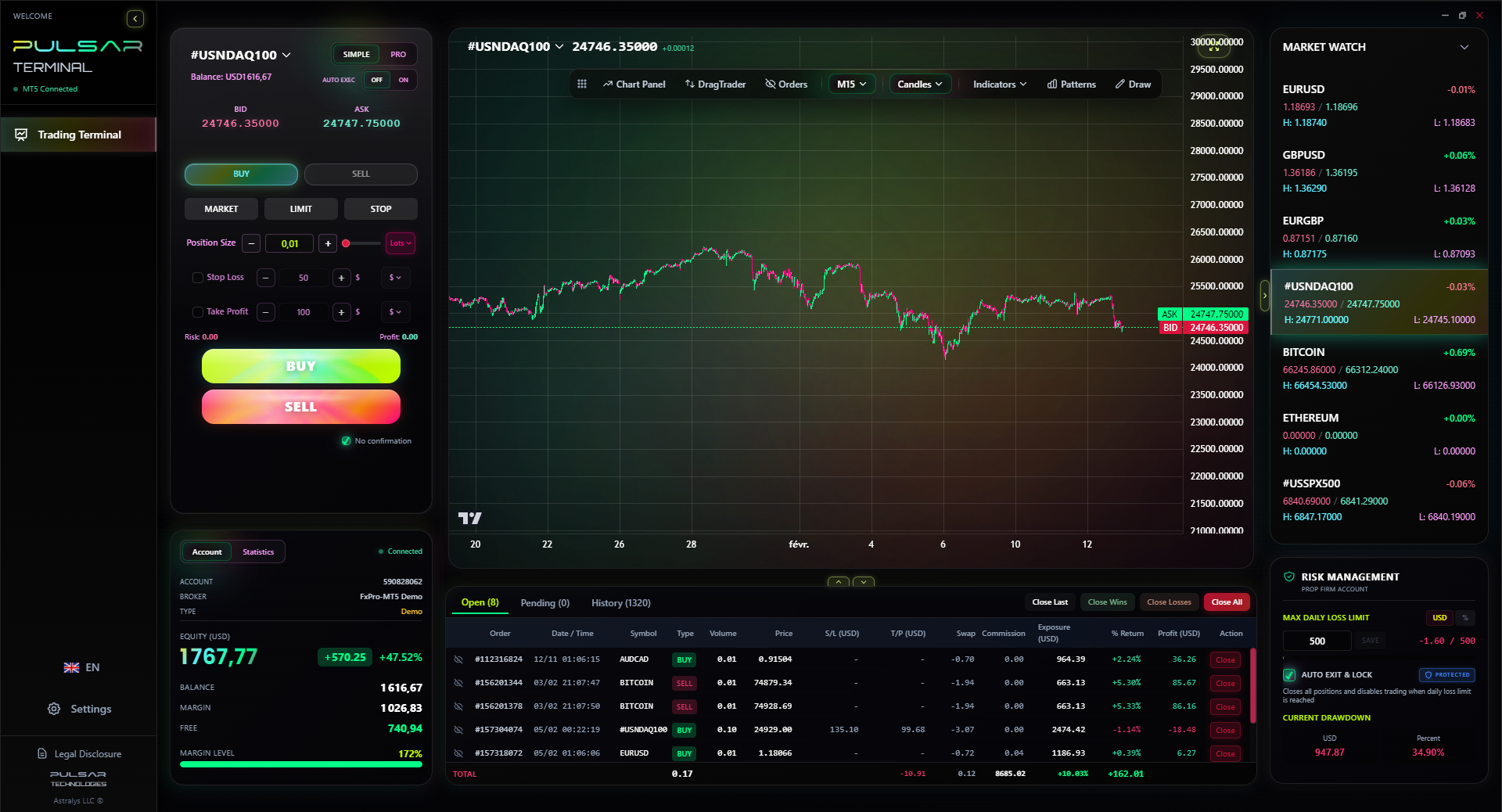
“The market tests your discipline daily. Your stop-loss is there because your analysis is wrong if price hits it.”
Here’s what a disciplined day looks like, factoring in our local context.
Pre-Market (Before 8 AM Lagos Time):
- Check economic calendar for high-impact news (especially CBN/FG announcements).
- Review your watchlist. Are spreads normal on your Naira pairs?
- Set your daily loss limit (e.g., 2-3% of account). If you hit it, you're done for the day.
Trade Execution:
- Identify a setup using your strategy (e.g., MACD indicator crossover at a key level).
- Determine your stop-loss level based on the chart, NOT your P&L.
- Use your position size calculator. Input: Account Balance, Risk %, Stop-Loss in pips. It gives you your lot size.
- Enter the trade WITH the stop-loss and take-profit orders attached immediately.
Trade Management:
- If trade goes your way 20 pips (or 1.5x your risk), consider moving stop to breakeven.
- Don't sit and stare. Set an alert and walk away.
- If stopped out, review. Was the setup valid? Was your stop placement wrong? Log it. Do NOT immediately re-enter.
Broker & Money Management:
- Withdraw profits regularly. Don't let your trading account balloon and become a casino chip stack. Take money out to enjoy or invest elsewhere.
- Re-evaluate your broker every 6 months. Are their withdrawals still fast? Have spreads deteriorated? There are great options like XM or HFM that cater well to Nigeria.
This routine is boring. It's mechanical. That's the point. You're removing emotion from the equation. Your job is to execute a plan, not to have an adrenaline rush.
💡 ウィンストンのヒント
Your first profit withdrawal is a more important milestone than your biggest winning trade. It proves you can get money out of the system.
FAQ
Q1Is 2% risk per trade okay for a beginner in Nigeria?
No, it's too high. Start with 0.5% to 1%. With 2%, just five losing trades in a row is a 10% account drawdown, which is psychologically devastating and hard to recover from. Start small to learn the market's rhythm without the constant pressure of large losses.
Q2How do I calculate my position size for USD/NGN?
The principle is the same, but you must know the pip value for USD/NGN, which is different from majors. On most platforms, if you put on a 1.00 lot trade, the platform will show you the approximate profit/loss per pip movement. Let's say it shows ₦100 per pip. If your account is $500 (≈₦700,000), and you want to risk 1% (₦7,000), with a 50-pip stop, your risk per pip is ₦7,000 / 50 = ₦140. Your position size would be 1.4 lots. Always use a calculator to confirm.
Q3What's the biggest risk management mistake Nigerian traders make?
Using excessive use because it's available. They see 1:1000, trade too large, and a minor move triggers a margin call. The second biggest mistake is trading USD/NGN without adjusting for its massive spreads and gaps. They use strategies designed for EUR/USD and get ripped apart by the execution costs.
Q4Should I hedge my Naira exposure by trading forex?
Not really. If you earn in Naira and are saving in USD, you're trying to protect purchasing power. Retail forex trading is speculative and high-risk - it's a terrible savings plan. A better 'hedge' might be buying stable assets (like actual USD) when the rate is favorable, not actively trading the pair with use.
Q5How do I know if my broker's spreads are fair for Nigeria?
Compare the live spreads on major pairs (EUR/USD, GBP/USD) during the London session between your broker and other reputable international brokers like Pepperstone or IC Markets. For Naira pairs, expect much wider spreads (50-100+ pips). The key is consistency. If the spread on USD/NGN suddenly doubles from its average when you try to trade, that's a bad sign.
Q6Can good risk management guarantee profits?
Absolutely not. It guarantees you'll survive long enough to find out if your trading strategy has an edge. It turns a potential disaster into a manageable loss. Profits come from your analysis and edge. Risk management just makes sure you're still in the game tomorrow to use that edge.
ウィンストン教授のレッスン
重要ポイント:
- ✓Never risk more than 1% of capital per trade.
- ✓Always use a stop-loss order before entering.
- ✓Cap use at 1:50 as a beginner.
- ✓Halve position size for volatile Naira pairs.
- ✓Close the platform after a loss to avoid revenge trading.
この記事はどれくらい役に立ちましたか?
星をクリックして評価
週刊トレーディングインサイト
無料の週刊分析&戦略。スパムなし。
著者について
Olumide Adeyemi
西アフリカ・トレーディングの先駆者
ナイジェリアで最もアクティブなFXトレーディング教育者の一人。ラゴスから8年のトレード経験。アフリカのトレーダー向けの少額資金戦略とプロップファームチャレンジを専門とする。
コメント
リスク警告
金融商品の取引には大きなリスクが伴い、すべての投資家に適しているわけではありません。過去の実績は将来の結果を保証するものではありません。本コンテンツは教育目的のみであり、投資助言として解釈すべきではありません。取引前に必ずご自身で調査を行ってください。
こちらもおすすめ

Cara Trading Forex Sukses: 7 Prinsip dari Trader Profesional
Cara trading forex sukses dengan 7 prinsip trader pro: manajemen modal, disiplin, journal trading, backtest. Data nyata, bukan janji profit palsu.
Jam Trading Forex Terbaik untuk Trader Indonesia: Panduan Lengkap dengan Tabel Waktu
Panduan jam trading forex untuk trader Indonesia. Tabel 4 sesi dunia, jam emas 20:00-00:00, sesi mana yang harus dihindari. Data akurat + tips dari trader berpengalaman.
Top 5 Sàn Forex Uy Tín Nhất 2026: Review Jujur dari Trader Indonesia
Top 5 sàn forex uy tín 2026 untuk trader Indonesia. Review jujur: spread, deposit, withdraw, dukungan lokal. Exness, XM, IC Markets & lebih.
