


Let's get one thing straight right now: the biggest lie sold to new traders in Nigeria is that a signal service will make you rich while you sleep.

Olumide Adeyemi
西アフリカ・トレーディングの先駆者 ·  Nigeria
☕ 9 分で読める
学べること:
- 1What You're Actually Buying (And It's Not Magic)
- 2The Nigerian Trader's Reality Check
- 3How to Vet a Signal Service (The Due Diligence Checklist)
- 4My Own Signal Service Experiment (The Numbers Don't Lie)
- 5The Right Way to Use Signals (As a Thinking Trader)
- 6Nigerian-Specific Red Flags and Scams
- 7The Real Alternative: Building Your Own Skill Set
Let's get one thing straight right now: the biggest lie sold to new traders in Nigeria is that a signal service will make you rich while you sleep. I've seen it a hundred times. A guy in Lagos pays 50,000 NGN a month for 'VIP signals,' blindly copies them for two weeks, makes a little, then gets one terrible call that wipes out three months of profits and his confidence. The problem isn't always the signal itself, it's how you use it. This guide isn't about finding the 'best' forex signal com. It's about tearing apart the business model, showing you the Nigerian-specific pitfalls (hello, 10% capital gains tax on gross profits), and teaching you how to vet and use these services so they don't use you.
A forex signal is just a suggestion. It's a piece of information telling you to buy or sell a currency pair at a specific price, with suggested stop-loss and take-profit levels. That's it. It's not a guarantee, it's not insider knowledge, and the provider has zero liability if you lose your shirt.
Most services operate on a subscription model. You pay weekly, monthly, or yearly. In Nigeria, I've seen everything from 5,000 NGN weekly WhatsApp groups to 'elite' services charging $200 (over 300,000 NGN) monthly. The price rarely correlates with quality. Often, you're just paying for the marketer's confidence, not their track record.

Warning: The moment a signal provider guarantees profits or shows you a screenshot of a massive trade without a verifiable, real-time track record, walk away. That's the oldest scam in the book.
The real product isn't the trade idea. It's the illusion of certainty. It's the feeling that someone smarter than you is doing the hard work. As a mentor, my first job is to break that illusion. The hard work - risk management, psychology, position sizing - is still yours. No signal can do that for you. If you don't have a solid position size calculator and understand what a margin call is, signals are just a faster way to lose money.
“The real product isn't the trade idea. It's the illusion of certainty.”
Trading in Nigeria isn't like trading in London or New York. You have unique hurdles, and ignoring them will sink you.
Taxes: The FIRS Will Find You
This is non-negotiable. The Federal Inland Revenue Service (FIRS) requires a 10% Capital Gains Tax on your gross forex trading profits. Gross means your total profits before subtracting losses. If you make 1,000,000 NGN in profit from signals over a year, you owe 100,000 NGN, even if you had losing trades along the way. A signal service won't mention this. It's your responsibility. I learned this the hard way early on, and let's just say the FIRS is very efficient at sending letters.
Broker Access and Costs
You're likely using an international broker like Exness, IC Markets, or XM. Signal providers often don't account for your specific broker's spreads or execution speed. A signal to buy EUR/USD at 1.0850 with a 5-pip stop might be invalid if your broker's spread is 3 pips wide during Lagos traffic hours. You're already 3 pips in the hole on entry. You must understand your own spread and how it interacts with signal parameters.
The Psychological Trap
The market here is young and hungry. With 93.7% of traders aged 18-35 (per that OctaFX survey), there's a rush for quick results. Signal services feed that impatience. But forex isn't a side hustle you check after your 9-5. It's a skilled profession. Relying on signals without understanding the 'why' behind them means you learn nothing. When the service eventually has a losing streak - and they all do - you'll have no framework to decide whether to stick with them or jump ship.

💡 ウィンストンのヒント
If you can't explain the reason for a signal in one sentence, you shouldn't take the trade. 'Because the guy said so' is not a reason.
“A signal service won't mention your 10% tax bill to the FIRS. It's your responsibility.”
Before you pay one kobo, do this. I don't care how flashy their Instagram is.
-
Demand a Verifiable Track Record: Not screenshots. A real, live myfxbook or FX Blue link that shows all trades, in real-time, with drawdown. Anyone can Photoshop a winning trade. A live account statement doesn't lie. Check the duration. A 3-month hot streak is luck. Look for 2+ years of consistent results.
-
Understand Their Strategy: Ask them: "What's your edge? Are you a scalping service or swing trading? What indicators do you base decisions on?" If they say "proprietary secret," that's nonsense. A real trader can explain their methodology in simple terms. If they trade based on RSI indicator divergences and news, they should say so.
-
Check for Nigerian Relevance: Do they understand local market hours? Do they send signals when you're actually able to trade (not just during London open)? Do they consider pairs popular here, or are they focused on exotic pairs you can't easily trade?
-
Calculate the Real Cost: Let's do math. If a service costs 30,000 NGN per month and you have a 100,000 NGN account, you need to make a 30% return just to break even on the fee. That's insane pressure and leads to terrible decisions. The fee should be a small fraction of your expected realistic returns.

Example: You have a 500,000 NGN account. A realistic, good return is 10% per month (50,000 NGN). Paying 15,000 NGN for signals is 30% of your profit. That's high, but maybe justifiable if they're stellar. Paying 50,000 NGN for signals means you need to make 100,000 NGN just to net 50,000 NGN after fees. The risk you'll take to achieve that will destroy you.
“A signal service won't mention your 10% tax bill to the FIRS. It's your responsibility.”
A few years back, I decided to test the hype. I subscribed to three popular 'forex signal com' style services for three months each. I traded them on a separate $2,000 account, following them to the letter.
- Service A (Swing Trading): Cost $99/month. Over 3 months: 42 signals. Net profit: +$287. After fees ($297), net loss: -$10. The killer? One massive losing trade wiped out 15 small winners. Their risk-reward was terrible.
- Service B (Gold Specialist): Cost $150/month. Focused on XAU/USD. 28 signals. Net profit: +$410. After fees ($450), net loss: -$40. They were aggressive, and spreads on gold ate into the profits.
- Service C ("AI-Powered"): Cost $250/month. A complete disaster. 20 signals. Net loss: -$780. Plus fees ($750). Total account drawdown: $1,530. They over-traded during high volatility and the 'AI' was just a fancy MACD indicator cross.
The lesson? Even the 'winning' services barely broke even after their high fees. The profit was not scalable. To make it worthwhile, I'd have needed a $50,000 account, which introduces a whole new level of psychological stress. It confirmed my belief: signals are a tool for idea generation, not a business model for the follower.
💡 ウィンストンのヒント
Treat signal fees like a business expense. If the expense isn't generating a net profit for the business (your trading), fire the supplier.
“Even the 'winning' services barely broke even after their high fees.”
Okay, so you've done your homework and found a service that seems legit. Here's how to use it without being a puppet.
Use Them as a Confluence Filter, Not a Holy Command. Don't just blindly enter. When you get a buy signal on EUR/USD, pull up your own chart. Does it align with your analysis? Is price at a key support level you already identified? Does the overall market sentiment agree? If two or three of your own factors align with the signal, it's stronger. If not, skip it. Your job is to be the final quality control.
Manage Your Own Risk. The service says "risk 2%." You must know what that means for your account. Use your own position size calculator. They don't know if you have other trades on. They don't know your total portfolio risk. You control the use, not them.
Journal Every Signal. Track the outcome, but more importantly, track why you took it or didn't. Did you skip a winner? Why? Did you take a loser? What was your confluence? This journal is how you transition from follower to independent trader. Over time, you'll start to see the provider's true win rate and, more importantly, you'll learn to spot the high-probability setups yourself.
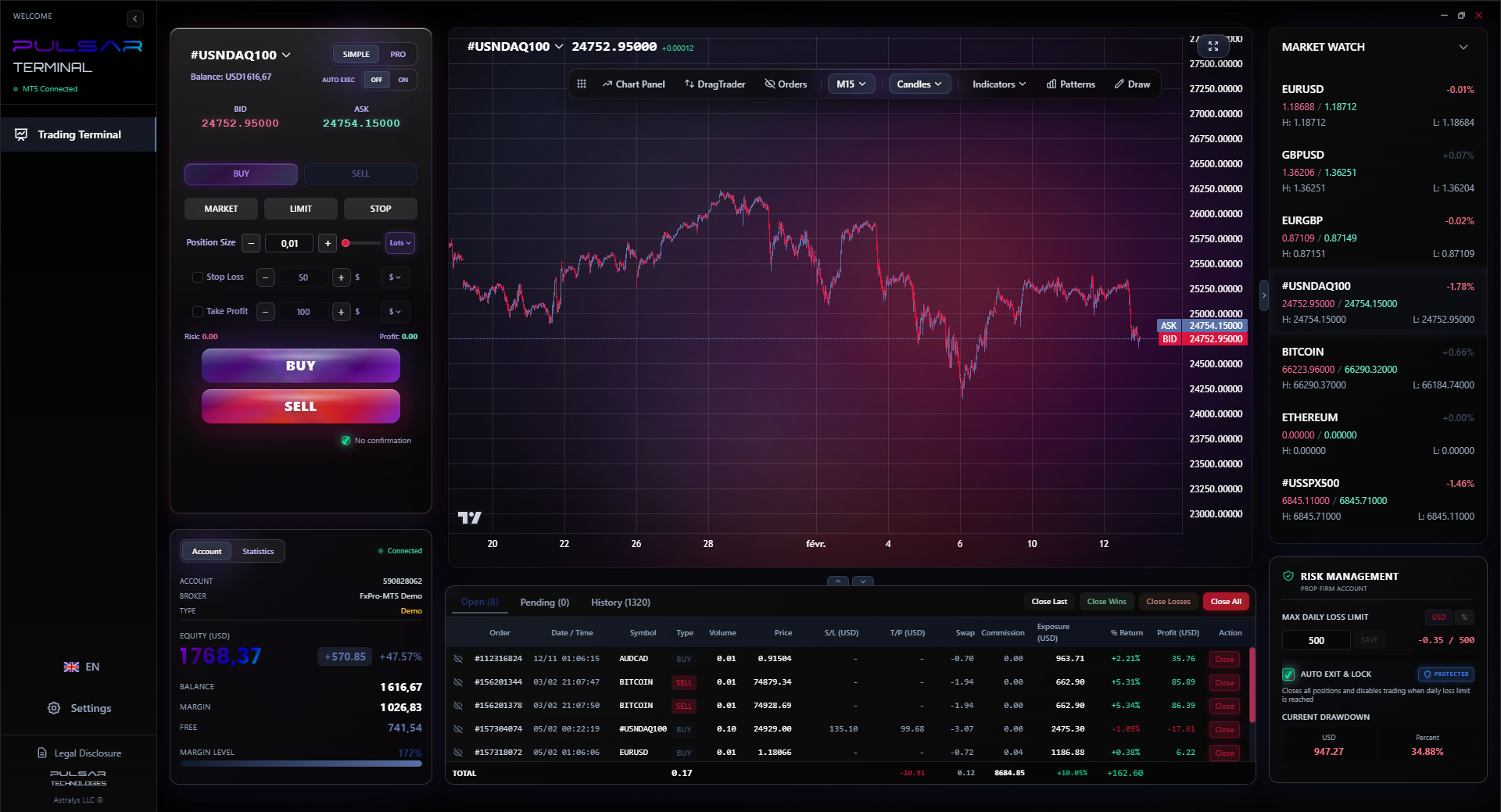
This is where a tool that gives you control is worth more than any signal. Manually moving stop-losses to breakeven or setting multiple take-profit levels is clunky on MT5. Having that automated based on your rules saves time and removes emotion.
Manually managing the complex risk from multiple signals is a headache; Pulsar Terminal automates trailing stops, breakeven moves, and multi-level take-profits directly on your MT5, so you can focus on analysis instead of order babysitting.
Pulsar Terminal
MT5オールインワンツール:ドラッグ&ドロップ注文、マルチTP/SL、トレーリングストップ、グリッドトレード、出来高プロファイル、プロップファーム保護。毎日1,000人以上のトレーダーが利用。
“Even the 'winning' services barely broke even after their high fees.”
Be extra vigilant for these local twists on the classic scam:
- The "Mentorship" Bundle: Pay 500,000 NGN for a 'signal package' that includes vague 'mentorship.' The mentorship is just pre-recorded videos from YouTube. The signals are copied from a free Telegram channel.
- The Naira-Denominated "Prop Firm" Front: A group sells signals and also 'funds' you with 'Naira-backed' accounts. It's just a Ponzi scheme. You're trading fake money, and when you want to withdraw 'profits,' they ask for more fees. Real prop firms are internationally regulated and use real capital. Their challenges require strict daily loss limits, something a good trading terminal can help you automate and manage.
- The WhatsApp Group Pressure: You're added to a broadcast group. You see 'live trades' popping in. They show profits. Then, the admin DMs you: "Sir, to continue receiving these golden signals, a small monthly contribution." The trades are often simulated or from a demo account. They create fear of missing out (FOMO) to get you to pay.
- The Fake CBN Endorsement: No, the Central Bank of Nigeria does not endorse, certify, or partner with any forex signal service. Anyone claiming otherwise is lying.
The rule is simple: if it sounds too good to be true, it is. No one with a truly profitable system needs to aggressively sell it for 10,000 NGN on Instagram. They'd be trading it with their own money.
💡 ウィンストンのヒント
The most valuable signal you'll ever get is the one you generate yourself from your own chart analysis. That's the only signal you'll truly trust during a drawdown.
“No one with a truly profitable system needs to aggressively sell it for 10,000 NGN on Instagram.”
This is the only path to long-term survival. Allocate the money you would spend on a year of signals (say, 360,000 NGN) differently.
- Education (30%): Buy two or three classic trading books. Take a reputable course that teaches chart reading, not just a specific 'guaranteed' strategy.
- Technology (30%): Invest in a reliable internet connection, a decent laptop, and consider tools that make your execution and analysis sharper. Your edge can come from better information and faster, more disciplined order management.
- Live Trading Capital (40%): Fund a small live account. Not to get rich, but to learn. Start with micro-lots. Your goal for the first year is not profit, it's education. Learn how your emotions react. Practice your risk management on every single trade.
I promise you, after one year of this self-directed approach, you will be lightyears ahead of the guy who spent the same amount blindly copying signals. You'll understand why a trade is placed. You'll be able to look at a chart and have an opinion. You might even start to see when your old signal provider is about to be wrong. That's true power.
FAQ
Q1Are forex signal services legal in Nigeria?
Yes, operating and subscribing to them is legal. However, they are largely unregulated. The legality of your trading depends on using a legitimate broker and declaring your profits for the 10% Capital Gains Tax to the FIRS. The service itself operates in a grey area with little consumer protection.
Q2What percentage of my profits should go to paying for signals?
As low as possible. A good rule of thumb is that the signal fee should not exceed 10-20% of your realistic average monthly trading profits. If your average profit is 50,000 NGN, don't pay more than 5,000-10,000 NGN. If the fee eats half your profit, the risk you need to take to make it worthwhile becomes dangerous.
Q3I'm new. Should I start with a signal service?
Absolutely not. It's the worst thing you can do. You'll develop zero skills and all the wrong habits. Start with a demo account, learn the basics of a pip, support/resistance, and risk management. After 3-6 months of consistent demo trading, then you might use a signal service as a learning tool to compare ideas, not as a crutch.
Q4How can I verify a signal provider's performance?
Demand a live, third-party verified track record like myfxbook or FX Blue. It should show several years of history, not just months. Check the maximum drawdown - if it's over 30%, be very wary. Also, look for consistency in lot size relative to account balance; sudden massive increases in risk are a red flag.
Q5Do signal providers account for Nigerian broker spreads and taxes?
Almost never. They provide generic entry/exit levels. It is 100% your responsibility to adjust for your broker's specific spread and to account for the 10% FIRS tax on your gross profits. A signal that works with a 0.1 pip spread on an ECN account might fail with a 3 pip spread on a standard account.
Q6What's better: free signals or paid signals?
Neither is inherently better. Free signals often have ulterior motives (to get you to deposit with a specific broker for their affiliate commission). Paid signals create an obligation to trade to 'get your money's worth,' which leads to overtrading. The best approach is to not rely on either as a primary strategy. Use them for research and idea generation only.
ウィンストン教授のレッスン
重要ポイント:
- ✓Signal fees must be less than 20% of your realistic profits.
- ✓Always verify with a live myfxbook track record, not screenshots.
- ✓You owe 10% Capital Gains Tax on gross profits to FIRS.
- ✓Use signals for confluence, not as blind orders.
この記事はどれくらい役に立ちましたか?
星をクリックして評価
週刊トレーディングインサイト
無料の週刊分析&戦略。スパムなし。
著者について
Olumide Adeyemi
西アフリカ・トレーディングの先駆者
ナイジェリアで最もアクティブなFXトレーディング教育者の一人。ラゴスから8年のトレード経験。アフリカのトレーダー向けの少額資金戦略とプロップファームチャレンジを専門とする。
コメント
リスク警告
金融商品の取引には大きなリスクが伴い、すべての投資家に適しているわけではありません。過去の実績は将来の結果を保証するものではありません。本コンテンツは教育目的のみであり、投資助言として解釈すべきではありません。取引前に必ずご自身で調査を行ってください。
こちらもおすすめ

Cara Trading Forex Sukses: 7 Prinsip dari Trader Profesional
Cara trading forex sukses dengan 7 prinsip trader pro: manajemen modal, disiplin, journal trading, backtest. Data nyata, bukan janji profit palsu.
Jam Trading Forex Terbaik untuk Trader Indonesia: Panduan Lengkap dengan Tabel Waktu
Panduan jam trading forex untuk trader Indonesia. Tabel 4 sesi dunia, jam emas 20:00-00:00, sesi mana yang harus dihindari. Data akurat + tips dari trader berpengalaman.
Top 5 Sàn Forex Uy Tín Nhất 2026: Review Jujur dari Trader Indonesia
Top 5 sàn forex uy tín 2026 untuk trader Indonesia. Review jujur: spread, deposit, withdraw, dukungan lokal. Exness, XM, IC Markets & lebih.
