


I remember staring at my screen in 2018, watching the USD/ZAR spike from R13.80 to R14.20 in a single session.

David van der Merwe
新興市場トレーダー ·  South Africa
☕ 13 分で読める
学べること:
- 1The Two Worlds of Forex 'Jobs' in SA
- 2The Modern Gateway: Prop Firm Challenges
- 3Real Salary Numbers: What Can You Actually Earn?
- 4The Skills You Actually Need (Not What You Think)
- 5The Fine Print: Costs, Taxes & South African Rules
- 6Your First Steps: A Realistic Action Plan
- 7Pitfalls & Scams: Protecting Your Capital & Your Career
I remember staring at my screen in 2018, watching the USD/ZAR spike from R13.80 to R14.20 in a single session. My phone was buzzing with messages from other traders, half celebrating, half panicking. That’s the life here – volatile, emotional, and full of opportunity if you know where to look. But when people ask me about forex trader jobs, they’re usually picturing a fancy office in Sandton, not someone like me trading from a home desk in Cape Town. The truth is, ‘forex trader jobs’ in South Africa isn’t one path. It’s a spectrum, from the salaried dealer at a bank to the independent retail trader, and now, the modern prop firm challenger. Let’s break down what each one really looks like, the numbers you can expect, and the harsh realities they don’t put in the job ad.
First, let's clear up the biggest confusion. When you hear 'forex trader job,' you're probably thinking of a formal, salaried position. That's one world. The other is being a self-employed retail trader. They're completely different careers.
The Salaried Trader (The 'Real' Job) This is your classic 9-to-5 (more like 7-to-7) role at a bank, asset manager, or corporate treasury. You're not trading your own money. You're executing trades for the institution's book, managing client portfolios, or hedging the company's currency exposure. Your performance is measured, but you get a salary, medical aid, and a bonus. The catch? Getting in is fiercely competitive. You typically need a finance degree, a strong academic record, and often to have come through a graduate program. The stress is institutional, but the paycheck is guaranteed.
The Independent Retail Trader (The 'Business') This is me, and likely why you're reading this. You're not an employee. You're a sole proprietor running a micro-trading business. There's no salary. Your income is 100% dependent on your trading profits, minus your losses and costs. You handle your own taxes, your own tech, and your own psychology. The freedom is incredible, but the responsibility is total. It's less of a 'job' and more of a entrepreneurial venture. According to FSCA warnings, most who try this lose money, especially at the start.

Warning: Don't confuse the two. Applying for a bank trader job with only retail trading experience on your CV often doesn't work. They see different skill sets. Retail trading teaches you self-reliance and risk management on a micro-scale. Institutional trading is about teamwork, process, and managing risk within strict compliance frameworks.
The landscape has evolved, though. A powerful hybrid has emerged: the proprietary trading firm, or 'prop firm.' This is where the lines between a job and independent trading blur, and it's become a major gateway for South Africans.

💡 ウィンストンのヒント
A trading plan you don't follow is just a piece of paper. The real skill is executing it when fear and greed are screaming in your ear.
“The salaried trader earns R812k even if the bank's forex desk has a flat year. The retail trader would need an 812% return to match that.”
This is the most relevant path for aspiring forex trader jobs in South Africa right now. You're not an employee, but you're trading the firm's capital. Pass their evaluation challenge (usually a two-phase test of profit targets and risk rules), and you get a funded account. You keep a large split of the profits (often 70-90%).
Why It's So Popular Here:
- Access to Capital: You don't need R500,000 of your own. You might pay a R2,000 fee for a R50,000 challenge account.
- Structured Learning: The challenge rules (like a 5% max daily loss, 10% max total loss) force discipline that many retail traders lack.
- Legitimacy: Passing a well-known firm's challenge is a credible achievement you can point to.
My Prop Firm Experience: I tested this path in 2023. I paid $299 (about R5,500 at the time) for a $100,000 challenge. My target was 10% profit ($10,000) with a max loss of 5% ($5,000). I used a conservative swing trading approach on XAU/USD. I hit the 8% profit target in Phase 1, but in Phase 2, I got greedy on a EUR/USD spike. I broke my own rule, over-leveraged, and hit the 5% daily loss limit in one bad trade. I blew the account. That R5,500 was gone. It was a brutal, expensive lesson in why the prop firm rules exist.
The Reality Check: Prop firms are not a charity. Their business model often relies on most challengers failing and forfeiting their fee. You must treat the challenge capital as if it's your own life savings. The risk rules are there for a reason. Using a tool that can automate these rules, like setting a hard stop on your daily loss, is not cheating. It's essential survival.

Example: Let's say you pass a challenge for a R200,000 account with an 80% profit split. You make a 10% profit (R20,000) in your first payout period. Your share is R16,000. That's a serious income boost, but remember, you're liable for tax on that as income.
“Prop firms are not a charity. Their business model often relies on most challengers failing and forfeiting their fee.”
Let's talk specifics. Vague promises are useless. Here are the numbers from the market right now.
Salaried Positions (Banks, Corporates): These figures are for employed foreign exchange dealers or analysts. They are gross annual salaries, before tax and including average bonuses.
| Position Level | Average Annual Salary (2026) | Key Notes |
|---|---|---|
| Entry-Level (1-3 yrs exp) | R570,990 | Often a graduate program output or junior dealer role. Bonus small. |
| Mid-Level / Average | R812,377 | The most commonly cited average. Includes avg bonus of ~R185k. |
| Senior Level (8+ yrs exp) | R934,914+ | Lead dealer, treasury manager. Bonuses can significantly exceed this. |
Another view puts the average monthly take-home for a Forex Trader role around R27,306 (roughly R327,672 per year). This wider range shows that titles vary, and compensation depends heavily on the institution (a major international bank vs. a local corporate).
Independent / Retail Trader Earnings: This is where it gets fuzzy and where most of the hype lives. There is no salary. Your earnings are your net profits.
- Beginner Reality: A beginner with a R10,000 account who's just becoming consistent might aim for 2-5% a month. That's R200-R500. Per month, not day. Many months will be negative. Anyone promising you guaranteed daily earnings is lying.
- Experienced Reality: A trader with a proven 3-year track record and a R100,000+ account might target 5-10% monthly. A 10% month is R10,000. On very good months or with higher risk, they might make R20,000-R30,000. On bad months, they lose. The annual net might average out to a 30-50% return on capital. So on R100k, that's R30k-R50k profit for the year. It's a business income, not a salary.
The key difference? The salaried trader earns R812k even if the bank's forex desk has a flat year. The retail trader with a R100k account would need a 812% return to match that. It puts the risk/reward in stark perspective.
“Prop firms are not a charity. Their business model often relies on most challengers failing and forfeiting their fee.”
Forget just reading charts. The skill set for salaried vs. independent roles diverges sharply after the basics.
For a Salaried Job (Bank/Corporate):
- Academic Credentials: A BCom in Finance, Investments, or Economics is almost mandatory. A CFA or similar postgraduate diploma is a huge advantage.
- Numerical & Analytical Rigor: You'll be building pricing models, analyzing macroeconomic reports, and preparing briefs for senior management. Excel is your best friend.
- Regulatory & Compliance Knowledge: Understanding the FAIS Act, FSCA conduct rules, and market abuse regulations is part of the job.
- Communication & Teamwork: You're presenting ideas to a committee, explaining hedges to clients, and working on a desk. Soft skills are critical.
For Independent / Prop Firm Success:
- Extreme Personal Discipline: This is the number one skill. It means following your trading plan when you're scared or greedy. It means logging every trade. I use a simple journal, but the act of reviewing why I took a losing trade on EUR/USD is what creates improvement.
- Risk Management Mastery: This isn't just a stop-loss. It's position sizing so that no single trade can blow you up. I never risk more than 1% of my account on a trade. Use a position size calculator every single time. It's boring, but it keeps you in the game.
- Psychological Resilience: You will have losing streaks. You will feel stupid. The ability to detach your self-worth from your P&L is a superpower. My worst drawdown was 8 consecutive losses. I felt physically sick. I had to step away for a week.
- Basic Technical & Fundamental Awareness: You don't need a PhD. You need to understand what drives the ZAR (commodity prices, SA politics, US interest rates) and be able to read basic support/resistance and perhaps one or two indicators like the RSI indicator or MACD indicator.

Pro Tip: If you want a salaried job, intern. Get any foot in the door at a financial institution. If you want to trade independently, treat your first year and at least R10,000 as tuition fees. Your goal isn't profit, it's survival and education. Paper trade until you have a written, tested plan.
💡 ウィンストンのヒント
Your first R10,000 in the market is tuition, not capital. If you expect to 'get rich,' you'll lose it. If you expect to 'learn,' you might keep it.
“Anyone guaranteeing profits, showing off luxury cars, and asking for a monthly fee is running a business. Their business is your subscription.”
This is the part that gets people into trouble. Ignorance isn't an excuse with SARS or the FSCA.
Key South African Regulations:
- No ZAR Speculation: You, as a South African resident, cannot legally speculate against the Rand (ZAR) with a local broker. This is why you'll trade USD/ZAR very rarely, if ever. Your focus will be on major pairs like EUR/USD, or commodities like gold (XAU/USD).
- use Cap: The FSCA caps use at 30:1 for major forex pairs for retail clients. This is a good thing. It prevents you from taking insane risks with 500:1 use that can wipe you out in minutes.
- Broker Choice: You can use a top-tier international broker like IC Markets or Pepperstone. Many are FSCA licensed as well. Avoid unregulated offshore bucket shops.
The Real Costs of Trading:
- Spread: The main cost. It's the difference between the buy and sell price. On EUR/USD, a good spread might be 0.1 pips. On exotic pairs, it can be 10x wider.
- Commission: Some brokers charge a commission per lot traded, plus a tiny spread.
- Swap/Overnight Fees: Holding a position past 5pm NY time incurs a finance charge. Can be positive or negative.
- Platform & Data Fees: Usually free, but advanced tools might cost.
- Prop Firm Challenges: Your 'entry fee' of R1,000 - R10,000, which is at risk.
Taxation (SARS): This is critical. Your trading profits are taxable income. If you trade frequently, it's likely considered revenue (normal income tax rates). If you hold for longer periods, you might argue for capital gains tax, but CGT also applies. You must keep impeccable records: all trade statements, bank deposits/withdrawals, and a P&L summary. I give my accountant a yearly spreadsheet. Expect to pay your marginal tax rate (up to 45%) on your net profits. Not declaring income from an offshore broker is tax evasion.
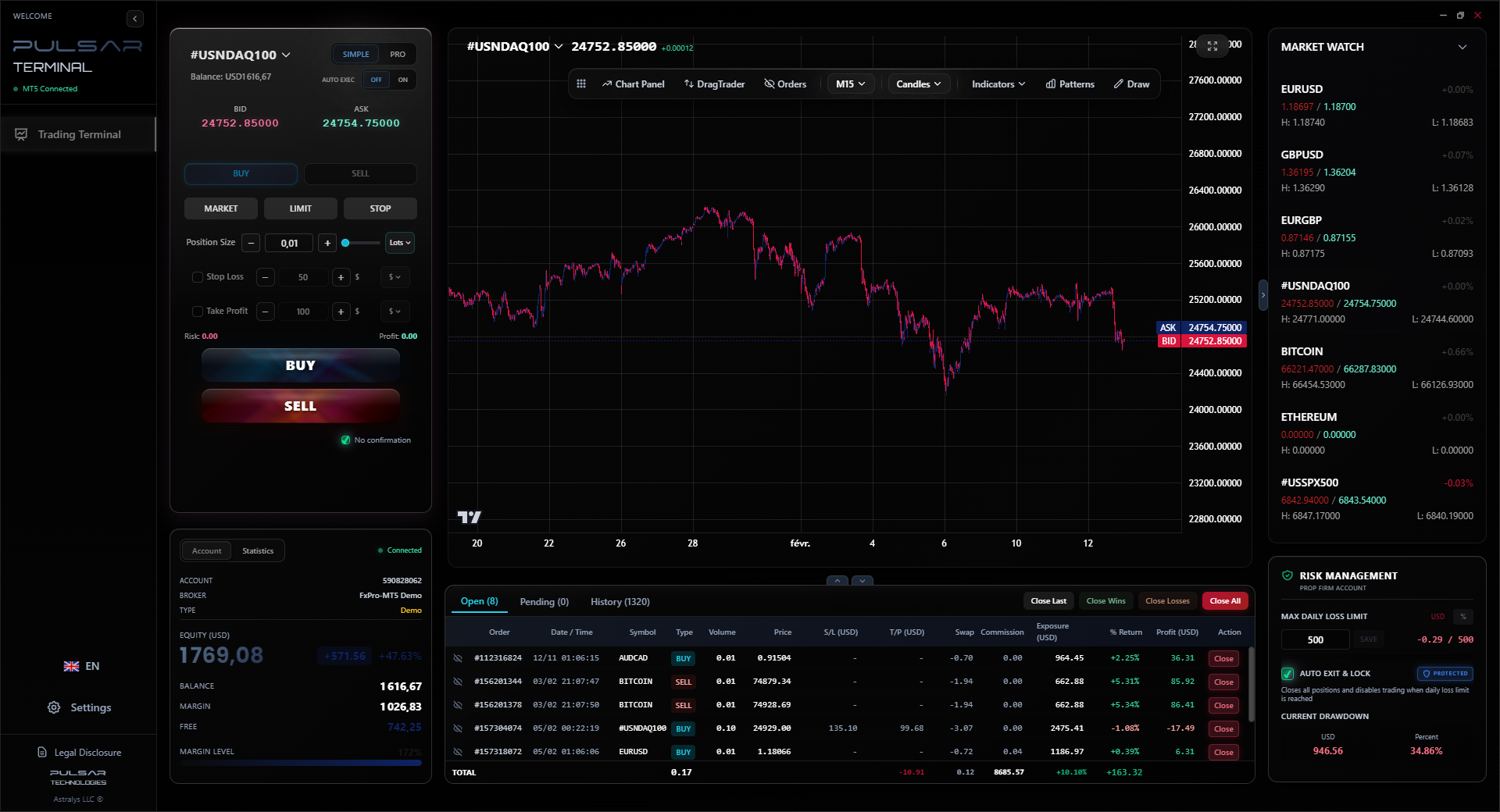
Managing the strict daily and total loss limits of a prop firm challenge is where most traders fail; Pulsar Terminal automates this protection directly on your MT5 chart, so you can't break your own rules in a moment of emotion.
Pulsar Terminal
MT5オールインワンツール:ドラッグ&ドロップ注文、マルチTP/SL、トレーリングストップ、グリッドトレード、出来高プロファイル、プロップファーム保護。毎日1,000人以上のトレーダーが利用。
“Anyone guaranteeing profits, showing off luxury cars, and asking for a monthly fee is running a business. Their business is your subscription.”
Okay, you're still interested. Here's a no-BS, step-by-step plan based on which path you're leaning toward.
If You Want a Salaried Trader Job:
- Education: Get the degree. Focus on finance, economics, math.
- Network: Join finance societies at university. Connect with alumni on LinkedIn who work in treasury or banks.
- Internships: Apply for every summer internship at investment banks, asset managers, or corporate treasuries. This is your #1 ticket.
- Demonstrate Interest: Have a simulated trading portfolio (even if it's just a spreadsheet) you can talk about intelligently in interviews. Understand what moved the USD/ZAR that week.
If You Want to Trade Independently or via a Prop Firm:
- Education with a Purpose: Don't just watch YouTube. Read 3 classic trading books. I recommend starting with Trading in the Zone by Mark Douglas for psychology.
- Paper Trade for 3-6 Months: Open a demo account with a broker like XM or Exness. Start with $10,000 virtual money. Your goal is not to double it. Your goal is to have 3 consecutive months of not losing it, following a simple plan.
- Develop a ONE-Page Trading Plan: It must include: What you trade (e.g., only EUR/USD and Gold), your time frame (e.g., 4-hour charts for swing trading), your entry/exit rules, and most importantly, your risk rules (e.g., 1% max risk per trade, stop-loss always set).
- Start Tiny with Real Money: Fund an account with money you can afford to lose completely. R2,000 is enough. The goal is to feel real emotion. Trade micro lots (0.01). Your mission is to preserve that R2,000 for 2 months.
- Consider a Prop Firm Challenge: Only after step 4. Start with their smallest, cheapest challenge. Treat it like a final exam for your trading plan.
Throughout this independent path, your best friend is a trading journal. Write down the reason for every trade, your emotional state, and the outcome. Review it weekly. This single habit separates the hobbyists from the professionals.
“Your trading profits are taxable income. Not declaring income from an offshore broker is tax evasion.”
The forex world, especially online, is full of people who want to separate you from your money. Here’s what to watch for.
1. The 'Sure Thing' Signal Seller or Guru: Anyone guaranteeing profits, showing off luxury cars, and asking for a monthly fee for signals is running a business. Their business is your subscription, not their trading. I paid R800/month for a signal service early on. Their calls were no better than a coin flip. I lost more following them than I ever did on my own.
2. The Unregulated 'Bucket Shop' Broker: If a broker offers 1000:1 use, promises bonuses for deposits, and has a shady-looking website, run. They may be dealing against you, manipulating prices, or making it impossible to withdraw. Stick to well-known, heavily regulated brokers. Check our Exness review and others for regulated options.
3. The Psychology of Revenge Trading: You take a loss. You feel angry and stupid. You jump right back in with a bigger position to 'make it back fast.' This is how a R1,000 loss becomes a R5,000 loss in an hour. It’s the fastest path to a margin call. When you lose, shut down the platform. Walk away. The market will be there tomorrow.
4. Over-Leveraging: The FSCA’s 30:1 limit helps, but you can still blow up an account with 30:1. Just because you can open a 5-lot position with a R10,000 account doesn't mean you should. A 10-pip move against you would be a catastrophe. Use a position size calculator religiously.
5. Neglecting Taxes: Thinking SARS won't find your offshore trading profits is a huge risk. They have data-sharing agreements. The penalty for tax evasion is severe. Plan for tax from day one. Set aside 25-30% of your net profits in a separate savings account immediately.
💡 ウィンストンのヒント
The market doesn't care about your rent, your ego, or your need to be right. Trade the price you see, not the price you hope for.
FAQ
Q1Do I need a license to be a forex trader in South Africa?
If you are trading your own money as an individual, no, you do not need a license. However, if you want to manage other people's money or give trading advice for a fee, you must be licensed as a Financial Services Provider (FSP) with the FSCA. For a salaried job at a bank, the institution holds the license, and you operate under it.
Q2What is the best broker for South African forex traders?
There's no single 'best.' Look for brokers that are regulated by reputable authorities (like the FSCA itself, ASIC, or CySEC), offer ZAR-based accounts for easy deposits/withdrawals, have competitive spreads on the pairs you trade, and provide a stable platform like MT4/MT5. International brokers like IC Markets and Pepperstone are popular choices among experienced South African traders.
Q3Can I make a full-time living from forex trading in SA?
Yes, it's possible, but it's statistically unlikely for most who try. It requires significant starting capital (well over R100,000 to generate a sustainable monthly income), years of disciplined practice, and a strong, proven trading system. Most successful full-time traders have gone through multiple periods of significant losses (drawdowns) first. It's wiser to start as a serious part-time endeavor while maintaining other income.
Q4How are prop firm payouts taxed in South Africa?
The profit share you receive from a prop firm is considered taxable income by SARS. It should be declared on your annual tax return (ITR12) under 'other income' or as business income if you trade regularly. You will pay income tax on the net amount you receive, at your marginal tax rate. Keep all payout statements and correspondence with the prop firm as proof.
Q5What's the main difference between a prop firm and a binary options/CFD broker?
A binary options broker is a betting platform, often unregulated, where you gamble on price direction. A CFD broker (like a standard forex broker) provides a platform for you to trade with your own capital. A prop firm provides you with their capital to trade after you pass an evaluation. You risk a one-time challenge fee, not your entire trading bankroll on each trade.
Q6Is scalping a good strategy for beginners in South Africa?
Generally, no. Scalping strategy requires lightning-fast execution, excellent platform reliability, and intense focus. Transaction costs (spreads) eat heavily into the small profits targeted. For beginners, the slower pace of swing or position trading allows more time for analysis and reduces the impact of emotional, knee-jerk decisions. Master the basics of reading the market first.
ウィンストン教授のレッスン
重要ポイント:
- ✓Salaried trader jobs average R812k/year but require a finance degree and are highly competitive.
- ✓Independent trading is a business, not a job; most beginners lose their initial capital.
- ✓Prop firms offer a capital gateway but have strict rules; most challengers fail.
- ✓South Africans cannot legally speculate against the ZAR; use is capped at 30:1.
- ✓All trading profits are taxable by SARS at your income tax rate.
この記事はどれくらい役に立ちましたか?
星をクリックして評価
週刊トレーディングインサイト
無料の週刊分析&戦略。スパムなし。
著者について
David van der Merwe
新興市場トレーダー
ヨハネスブルグ拠点で新興市場通貨11年のトレーダー。ZARペア、FSCA規制下の取引、南アフリカ市場分析を専門とする。
コメント
リスク警告
金融商品の取引には大きなリスクが伴い、すべての投資家に適しているわけではありません。過去の実績は将来の結果を保証するものではありません。本コンテンツは教育目的のみであり、投資助言として解釈すべきではありません。取引前に必ずご自身で調査を行ってください。
こちらもおすすめ

Cara Trading Forex Sukses: 7 Prinsip dari Trader Profesional
Cara trading forex sukses dengan 7 prinsip trader pro: manajemen modal, disiplin, journal trading, backtest. Data nyata, bukan janji profit palsu.
Jam Trading Forex Terbaik untuk Trader Indonesia: Panduan Lengkap dengan Tabel Waktu
Panduan jam trading forex untuk trader Indonesia. Tabel 4 sesi dunia, jam emas 20:00-00:00, sesi mana yang harus dihindari. Data akurat + tips dari trader berpengalaman.
Top 5 Sàn Forex Uy Tín Nhất 2026: Review Jujur dari Trader Indonesia
Top 5 sàn forex uy tín 2026 untuk trader Indonesia. Review jujur: spread, deposit, withdraw, dukungan lokal. Exness, XM, IC Markets & lebih.
