


I lost NGN 150,000 in my first three months.

Olumide Adeyemi
西アフリカ・トレーディングの先駆者 ·  Nigeria
☕ 10 分で読める
学べること:
- 1Forget the 'Gurus': Build Your Foundation First
- 2Crafting Your First Trading Plan (The Boring Stuff That Works)
- 3Analysis: Why Simple Beats Complex Every Time
- 4Brokers & Platforms: Navigating the Nigerian Reality
- 5The Psychology: Your Biggest Battle Isn't the Market
- 6Putting It All Together: Your 90-Day Action Plan

I lost NGN 150,000 in my first three months. I thought I was smart. I'd watched a few YouTube videos, downloaded a fancy indicator, and jumped right into EUR/USD. My first 'big' trade was a buy at 1.1250. It dropped to 1.1220, I panicked and sold. It then rocketed to 1.1300. That cycle of fear and greed repeated until my account was a ghost town. I was missing a real plan, a real education. This isn't about getting rich quick. This is the anti-guru guide, the foundational forex trading course for beginners I wish I'd had, written from Lagos, for Nigerians.
The first lesson is the hardest: unlearn everything the Instagram traders are selling. Your foundation isn't a secret signal. It's understanding the market's basic grammar.
The Absolute Basics You Must Master
You need to speak the language fluently. A pip isn't just a point; it's the measure of your profit and pain. If you don't know how to calculate the value of a pip for USD/NGN or GBP/USD, you're driving blind. Start with majors like EUR/USD - they're more liquid and have tighter spreads, which is kinder on a small account.
Then there's the spread. Buying a pair is like buying a car; you pay the ask price, and if you sold it immediately, you'd get the bid. That difference is the broker's fee. Trading a pair with a 3-pip spread means your trade is already 3 pips in the red the moment you click 'buy'. You need a 4-pip move just to be 1 pip in profit. This is why I always check the spread before entering, especially on exotics.

Warning: If a 'course' skips over pips, spreads, and lot sizes to show you a 'millionaire maker' indicator, run. You're being set up to fail. They profit from your confusion, not your success.
use is the ultimate double-edged sword. In Nigeria, you might see offers of 1:1000 or more. That means with NGN 50,000, you can control NGN 50,000,000 in the market. Sounds amazing, right? Here's the reality: a 0.1% move against you wipes out your entire NGN 50k. I learned this the hard way. I used 1:500 on a gold (XAU/USD) trade, got a margin call within hours, and watched my capital vanish. Start with 1:10 or 1:20 max while you're learning. It forces you to be patient and pick better entries.
This foundational knowledge is non-negotiable. It's the boring stuff that keeps you in the game. Once it's second nature, you can start looking at charts without immediately thinking about Lambos.
“A trading plan isn't a suggestion; it's the barrier between you and your own worst impulses.”
A trading plan is your constitution. It removes emotion. Mine fits on one page. Yours should too.
1. Your Market & Session: Don't trade everything. Pick one or two pairs. I started with just EUR/USD and the London/New York overlap (3 PM - 5 PM WAT). The liquidity is high, and the moves are clearer. Trying to track USD/JPY, GBP/AUD, and Gold all at once is a recipe for madness.
2. Your Strategy Rules: This is your 'how'. Will you trade breakouts? Bounces off support? Be specific. My early swing trading plan was simple: On the 4-hour chart, I'd only look for pullbacks to a key moving average when the trend on the daily chart was clear. I'd wait for price to touch it, then look for a bullish pin bar or a small consolidation. Entry, stop loss, and take profit were all defined before I entered.
3. Your Risk Management Rules: This is your 'how much'. This is the most important part of any forex trading course for beginners.
- Risk Per Trade: Never risk more than 1-2% of your account on a single trade. On a NGN 100,000 account, that's NGN 1,000-2,000 max. Use a position size calculator every single time. Don't guess.
- Stop Loss: Always have one. Place it at a level that, if hit, proves your trade idea was wrong. Not based on how much you can afford to lose.
- Daily/Weekly Loss Limit: If you lose 5% of your account in a day, stop. Close the platform. Go for a walk. This rule saved me from revenge trading more times than I can count.

Example: Account: NGN 200,000. Risk per trade: 1.5% = NGN 3,000. Trading EUR/USD. Stop Loss distance: 25 pips. Pip value for a mini lot (0.1): ~NGN 40. Position size = (NGN 3,000 risk) / (25 pips * NGN 40/pip) = 3.0 mini lots. So, you'd trade 0.3 standard lots. This math is mandatory.
4. Your Journal: After every trade, win or lose, write it down. Entry, exit, why you took it, how you felt. I reviewed my journal every Sunday. The pattern was glaring: my winning trades followed my plan. My losers were impulsive 'feelings' I had while watching the chart tick. The journal told the truth I didn't want to hear.

💡 ウィンストンのヒント
Your first NGN 100,000 profit is the most expensive you'll ever make. You'll pay for it in lessons, sleepless nights, and lost trades. The goal is to make that tuition fee as small as possible.
“The spread is the first enemy you must defeat before the market even notices you.”
Beginners overload their charts with 10 different indicators, all screaming different things. I did it. My chart looked like a rainbow vomited on it. Price action was buried. Here's a simpler, more powerful approach.
Start with Price Action & Support/Resistance: Draw horizontal lines where the price has reversed before. These are your battle lines. A swing trading approach often works well here: buying near support in an uptrend, selling near resistance in a downtrend. Don't overcomplicate it. A clean chart with a few key levels is worth more than a dozen lagging indicators.
Add ONE or TWO Indicators for Confirmation: That's it. I use two.
- Moving Averages: A simple 50 and 200-period Exponential Moving Average (EMA) on the daily chart tells me the trend. Price above both? Overall bias is up. Look for buys on lower timeframes.
- RSI: I use the RSI indicator to spot potential overbought or oversold conditions within a trend. In an uptrend, I look for the RSI to dip below 50 (but not into deep oversold) and then turn back up as a potential buy signal. It's a filter, not a signal generator.
I completely abandoned complex systems like Ichimoku or custom EAs early on. They gave me analysis paralysis. The goal isn't to predict the future with 100% accuracy. It's to find spots where the probability is in your favor, and your risk is tightly controlled. A clean 4-hour chart with a key support level and the 50 EMA nearby gave me that clarity. This is the core of a practical forex trading course for beginners: learning to see what the market is actually showing you, not what you hope to see.

“Ninety percent of your success will be determined by what you do after you click 'buy' or 'sell'.”
This is a minefield. You need a broker that accepts Nigerians, has reliable Naira deposit/withdrawal options, and is trustworthy.
Regulation is Key: Look for brokers regulated by top-tier authorities like the UK's FCA, Australia's ASIC, or Cyprus's CySEC. This offers a layer of protection. Many 'offshore' brokers target beginners with insane bonuses and use, but your funds are less secure. I started with an unregulated broker offering a 100% deposit bonus. Withdrawing my profits was a 3-month nightmare of 'verification' requests. Never again.
Deposits & Withdrawals: You'll likely use bank transfers, credit/debit cards, or maybe cryptocurrencies. Check the broker's specific channels for Nigeria. How long do withdrawals take? Are there fees? Read the fine print. A broker with slightly wider spreads but flawless, fast withdrawals is infinitely better than one with tight spreads that holds your money hostage.
The Platform: MetaTrader 4 or 5 is the industry standard in Nigeria for a reason. It's stable, everyone uses it, and there's a mountain of educational content for it. Before you choose a broker, make sure they offer MT4/5. Don't get seduced by a broker's proprietary platform unless you've done deep research.
My Experience: After my bad start, I moved to a well-regulated international broker like IC Markets or Pepperstone. Their raw spread accounts were a game-changer for my scalping strategy. Funding with my domiciliary account was smooth, and withdrawals hit my Nigerian bank account in 2-3 business days. The peace of mind was worth every pip.

Pro Tip: Open a demo account with 2-3 shortlisted brokers. Test their platform speed during the London open (when volatility is high), practice depositing and withdrawing a small amount of real money (like $50), and see how their customer support responds. This real-world test is better than any review.
💡 ウィンストンのヒント
The market is a mirror. If you see chaos, it's because your strategy is chaotic. If you see opportunity, your rules are clear. Clean your chart, clean your mind.
“Ninety percent of your success will be determined by what you do after you click 'buy' or 'sell'.”
You can have the best plan in the world, and your own brain will sabotage it. Here are the mental traps I fell into.
FOMO (Fear Of Missing Out): You see a pair shooting up, you jump in late near the top, and it reverses. My record? Jumping into GBP/JPY after a 150-pip rally, only to watch it retrace 80 pips immediately. The trade wasn't in my plan. I just couldn't stand watching 'money being made' without me. The cure? Have a checklist for every trade. If the current move doesn't fit your predefined setup, it doesn't exist. Turn off the screen.
Revenge Trading: You take a loss. Anger and embarrassment kick in. You immediately enter another trade, usually bigger, to 'make it back fast.' This is how you blow up an account. I did it. After a NGN 8,000 loss, I doubled my position size on the next trade, ignored my stop loss, and turned that NGN 8,000 loss into a NGN 25,000 disaster in under an hour. That's when I instituted my hard daily loss limit. Once hit, the trading terminal closes for the day.
Overconfidence After a Win: This is sneaky. You have three winning trades in a row. You start to feel invincible. You increase your position size beyond your 1% rule because 'you're on a hot streak.' The market humbles you quickly. Treat every trade as your first. Follow the plan, not your ego.
The market doesn't care about your rent, your dreams, or your ego. It's a chaotic, probabilistic environment. Your job is to manage your reactions to it. This mental discipline is the final, most advanced module of any true forex trading course for beginners. Without it, the first four modules are useless.
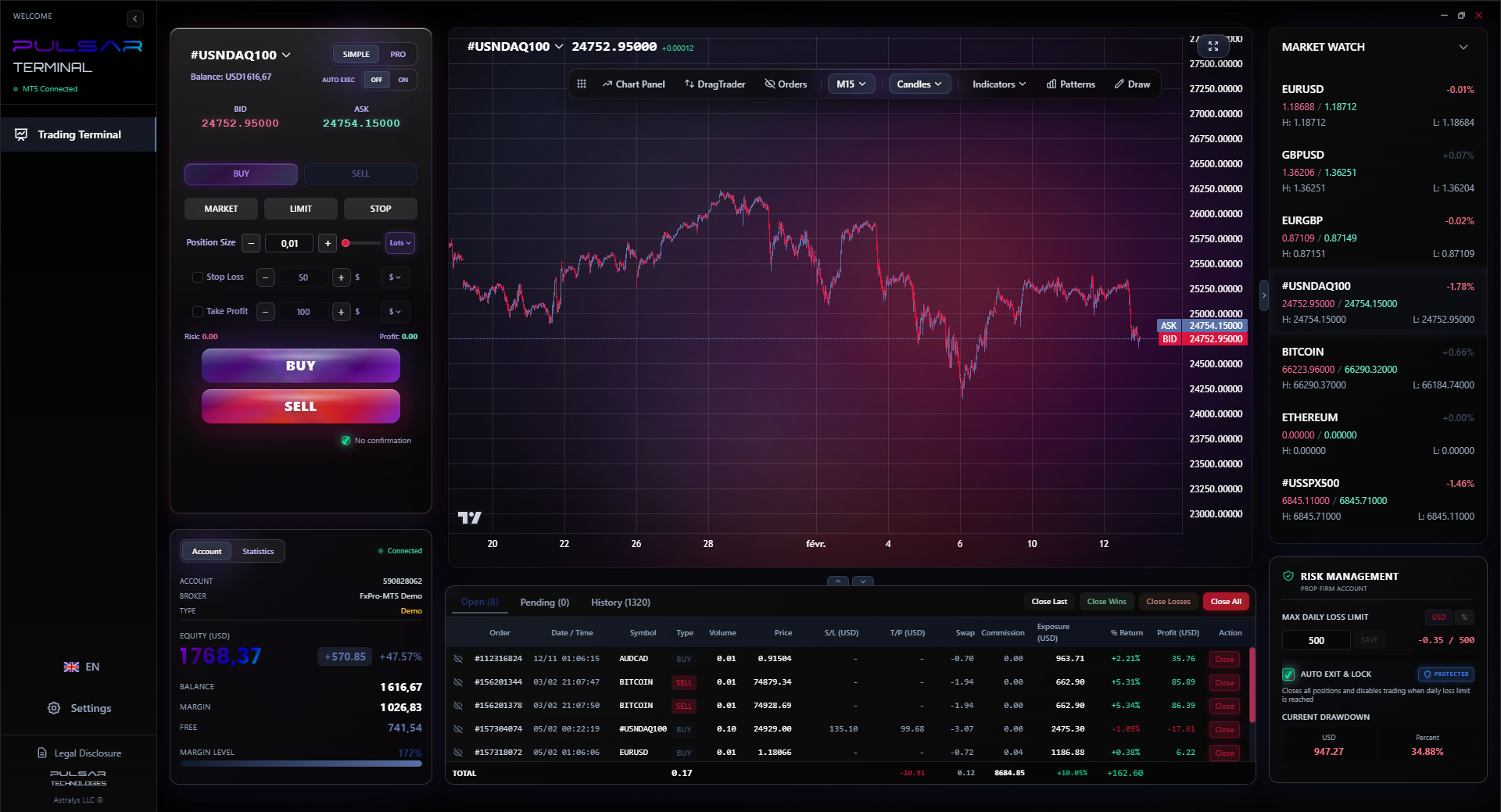
Managing the psychology of multiple trades is easier when your platform lets you set take-profit and stop-loss orders visually, directly on the chart, just like in Pulsar Terminal.
Pulsar Terminal
MT5オールインワンツール:ドラッグ&ドロップ注文、マルチTP/SL、トレーリングストップ、グリッドトレード、出来高プロファイル、プロップファーム保護。毎日1,000人以上のトレーダーが利用。
“Backtest your strategy in the past so you don't bankrupt it in the future.”
Here's how to structure your first 90 days. This is the syllabus.
Weeks 1-4: Education & Demo.
- Goal: Learn the mechanics. No real money.
- Action: Master pips, lots, use, margin. Read the broker's glossary. Open a demo account. Practice calculating position size for every simulated trade using your position size calculator. Trade one pair only. Write a one-page draft of your trading plan.
Weeks 5-8: Strategy & Backtesting.
- Goal: Find and test a simple strategy.
- Action: Pick one approach (e.g., price action with moving averages). Define clear entry, stop loss, and take profit rules. Go back on your demo chart for the last 6 months and 'paper trade' your strategy. Mark every setup you would have taken. How did it do? Tweak the rules. This is where you learn if your idea has an edge, without losing a kobo.
Weeks 9-12: Live Trading (Micro Account).
- Goal: Execute your plan with real money, focusing on process, not profit.
- Action: Fund a live account with the smallest amount possible. For many brokers, that's $50-$100 (NGN 40,000-80,000). Trade the smallest lot size (0.01 micro lots). Your goal is not to make money. Your goal is to take 20-30 trades that perfectly follow your plan. Did you place the stop loss correctly? Did you stick to your 1% risk? Did you journal? If you end this period break-even but with perfect discipline, you've succeeded more than 90% of beginners.
This 90-day plan forces patience. It builds muscle memory. The market will be here in 90 days. The question is, will you?
FAQ
Q1How much money do I need to start forex trading in Nigeria?
Technically, you can start a demo account with $0. For a live account, I recommend an absolute minimum of $100 (about NGN 120,000-150,000). This allows you to trade micro lots (0.01) and practice real risk management without the pressure of a tiny account. Many beginners fail because they start with $10, can only afford a few pips of movement, and get stopped out constantly. Start with an amount you can afford to lose completely while you learn.
Q2Are free online forex trading courses for beginners any good?
Some are excellent for the absolute basics (like explaining what a pip is). BabyPips.com is a classic, free starting point. However, be deeply skeptical of any 'free course' that ends with a sales pitch for a paid signals group or a 'robot.' The real value in a course is structure and mentorship, which is rarely free. The free content should give you the 'what,' but developing the 'how' and the discipline requires more dedicated study.
Q3What's the biggest mistake Nigerian beginners make?
Chasing high use and ignoring risk management. They see a broker offering 1:1000 use and think it's a shortcut. It's a shortcut to a margin call. They also often trade without a stop loss, hoping a losing trade will 'come back.' It usually doesn't. Start with low use (1:20 or less) and always, always use a stop loss. It's not a suggestion; it's your lifeline.
Q4Can I use my phone to trade forex?
Yes, you can, especially for monitoring and managing trades. MT4 and MT5 have good mobile apps. However, I strongly advise doing your main analysis and planning on a desktop or laptop computer. The bigger screen allows for better chart analysis and reduces the chance of costly input errors. Phone trading often leads to impulsive, emotional decisions.
Q5How long does it take to become profitable?
This is the hardest truth: it usually takes 1-2 years of consistent study, practice, and losing small amounts of money before you develop the skills and psychology for consistent profitability. If anyone tells you you'll be profitable in 30 days, they're lying. Treat the first year as a paid apprenticeship. Your goal is to learn and preserve capital, not to get rich.
Q6Is forex trading taxable in Nigeria?
The legal and tax landscape can change. Currently, the tax situation for individual retail forex traders in Nigeria is not always clearly defined or enforced. However, you should operate with the expectation that profits could be subject to tax in the future. It is crucial to keep detailed records of all your trades, deposits, and withdrawals for your own accounting and for any future regulatory requirements. Consult a Nigerian financial advisor for the most current advice.
ウィンストン教授のレッスン
重要ポイント:
- ✓Risk a maximum of 1-2% of your capital per trade.
- ✓use above 1:20 is a liability, not a tool.
- ✓A stop loss is non-negotiable. Always.
- ✓Master one pair and one timeframe before adding more.
- ✓Journal every trade. Your emotions are data.
この記事はどれくらい役に立ちましたか?
星をクリックして評価
週刊トレーディングインサイト
無料の週刊分析&戦略。スパムなし。
著者について
Olumide Adeyemi
西アフリカ・トレーディングの先駆者
ナイジェリアで最もアクティブなFXトレーディング教育者の一人。ラゴスから8年のトレード経験。アフリカのトレーダー向けの少額資金戦略とプロップファームチャレンジを専門とする。
コメント
リスク警告
金融商品の取引には大きなリスクが伴い、すべての投資家に適しているわけではありません。過去の実績は将来の結果を保証するものではありません。本コンテンツは教育目的のみであり、投資助言として解釈すべきではありません。取引前に必ずご自身で調査を行ってください。
こちらもおすすめ

Cara Trading Forex Sukses: 7 Prinsip dari Trader Profesional
Cara trading forex sukses dengan 7 prinsip trader pro: manajemen modal, disiplin, journal trading, backtest. Data nyata, bukan janji profit palsu.
Jam Trading Forex Terbaik untuk Trader Indonesia: Panduan Lengkap dengan Tabel Waktu
Panduan jam trading forex untuk trader Indonesia. Tabel 4 sesi dunia, jam emas 20:00-00:00, sesi mana yang harus dihindari. Data akurat + tips dari trader berpengalaman.
Top 5 Sàn Forex Uy Tín Nhất 2026: Review Jujur dari Trader Indonesia
Top 5 sàn forex uy tín 2026 untuk trader Indonesia. Review jujur: spread, deposit, withdraw, dukungan lokal. Exness, XM, IC Markets & lebih.
