


So you're hearing everyone talk about forex trading, but what does it actually mean for someone in Ghana? Is it just buying dollars at a forex bureau, or is there more to it? I remember asking myself the same questions when I started back in 2012, watching the cedi slide while feeling completely powerless.

Olumide Adeyemi
西アフリカ・トレーディングの先駆者
☕ 15 分で読める
学べること:
So you're hearing everyone talk about forex trading, but what does it actually mean for someone in Ghana? Is it just buying dollars at a forex bureau, or is there more to it? I remember asking myself the same questions when I started back in 2012, watching the cedi slide while feeling completely powerless. The real forex trading definition isn't just textbook stuff - it's about understanding how global currency movements affect your pocket, your business, and your opportunities right here in Accra, Kumasi, or Takoradi.
Let's cut through the noise. The basic forex trading definition is simple: you're buying one currency while selling another, hoping the exchange rate moves in your favor. That's it. But here's what most beginners miss - you're not buying physical cash. You're trading contracts for difference (CFDs) or spot contracts through a broker. When you 'buy' EUR/USD, you're speculating that the euro will strengthen against the US dollar. You never actually receive euros in your bank account.
I made this mistake early on. In 2013, I thought I was literally buying British pounds that would be delivered to me. I took a long position on GBP/USD at 1.5800 with $500, convinced the pound would rally. It did move to 1.5900, and I made about $63 profit. When I tried to withdraw 'my pounds,' my broker explained it was all settled in cash. That was my first real lesson in the forex trading definition - it's purely speculative price movement.
The market operates 24 hours a day from Monday to Friday, starting in Sydney, moving to Tokyo, then London, and finally New York. This means you can trade at 2 AM Ghana time if London is active, or during our afternoon when New York opens. The daily volume is insane - about $7.7 trillion. That's more than all the world's stock markets combined. For us in Ghana, this liquidity means we can enter and exit trades quickly, even with larger positions, without worrying about moving the market ourselves.

Warning: Many 'gurus' in Ghana sell courses claiming forex is a get-rich-quick scheme. It's not. The real forex trading definition includes words like 'risk,' 'probability,' and 'patience.' If someone promises you'll turn GHS 1,000 into GHS 100,000 in a month, walk away.
What forex trading isn't: It's not gambling (though beginners often treat it that way). It's not a salary replacement for most people. And it's definitely not the same as walking into a forex bureau on Ring Road to buy dollars for travel. That's currency exchange, not trading. The bureau gives you a fixed rate with a spread for their service. Trading involves analyzing charts, managing risk, and making decisions based on economic data - like the Bank of Ghana's interest rate announcements or our inflation reports.

💡 ウィンストンのヒント
The spread isn't just a cost, it's a signal. Wider than normal spreads often mean lower liquidity or upcoming news. If your usual EUR/USD spread jumps from 1 pip to 3, the market is telling you to be cautious.
“The real forex trading definition includes words like 'risk,' 'probability,' and 'patience.' If someone promises you'll turn GHS 1,000 into GHS 100,000 in a month, walk away.”
Here's where the global forex trading definition meets our local reality. As a Ghanaian trader, you're participating in an international market through brokers who aren't physically here. This creates both opportunities and complications you need to understand.
The Regulatory Gray Area
Forex trading is legal in Ghana, but there's no specific regulator overseeing online retail trading. The Bank of Ghana (BoG) regulates banks and forex bureaus, and the SEC handles securities. But when you open an account with Exness, XM, or Pepperstone, you're dealing with companies regulated offshore - by the FSCA in South Africa, ASIC in Australia, or CySEC in Cyprus. The BoG doesn't stop you from using these platforms, but they also can't help you if the broker disappears with your money. That protection gap is real.
I learned this the hard way in 2015. I deposited $1,000 with a broker that had flashy ads but questionable regulation. When I tried to withdraw $2,300 in profits, they delayed for months, then demanded 'verification fees.' I lost it all. Now I only use brokers with solid international regulation, and I keep records of every transaction for the Ghana Revenue Authority (GRA).
Trading the Cedi Itself
You can trade GHS pairs like USD/GHS or EUR/GHS, but not with most international brokers. You'll need a local platform or a broker with emerging market coverage. The volatility can be wild. Remember 2024 when the cedi was among the world's worst performers? Then 2025 happened - it gained nearly 30% against the dollar in six months. If you'd shorted USD/GHS at 15.56 in April and closed at 10.28 in June, you'd have made a 34% return on the currency move alone (not counting use).
Costs You Can't Avoid
Your trading costs come from spreads and sometimes commissions. A typical EUR/USD spread might be 0.8 to 1.2 pips on a standard account. But here's the Ghana-specific cost: when you withdraw profits to your bank, there's a 5% fee on foreign currency withdrawals from accounts funded electronically. If you withdraw $1,000, you pay $50 just in bank fees. I structure my withdrawals in larger, less frequent amounts to minimize this hit.

Pro Tip: Fund your trading account using mobile money if your broker supports it. MTN Mobile Money or Vodafone Cash often have lower fees than bank transfers, and the conversion happens at the broker's rate, not your bank's typically worse rate.
You'll also need to consider taxes. The GRA treats trading profits as income. Keep detailed records - I use a simple spreadsheet showing entry price, exit price, profit in USD, and the cedi equivalent using the exchange rate on the day I close the trade. When you're consistently profitable, talk to a tax advisor familiar with forex. I didn't declare my first two years of small profits, and when I finally got audited in 2018, the penalties hurt more than any losing trade.
“use is a tool, not a strategy. I once lost almost half my account in 20 minutes by overleveraging - less time than it takes to eat waakye.”
Understanding the forex trading definition requires mastering these building blocks. Get these wrong, and you'll join the 80% who blow their accounts within a year.
Currency Pairs: Every trade involves two currencies. Majors (like EUR/USD) have tight spreads. Minors (like EUR/GBP) are less liquid. Exotics (like USD/ZAR) have wider spreads but can offer big moves. As a Ghanaian, you might watch USD/GHS, but I'd stick to majors when starting - the spreads are cheaper, and information is plentiful.
Pips and Lots: A pip is the smallest price movement. For EUR/USD, moving from 1.0850 to 1.0851 is one pip. A standard lot is 100,000 units of the base currency. Most beginners should start with micro lots (1,000 units) or nano lots (100 units). When I started, I risked $5 per trade on micro lots. That slow grind taught me discipline.
use: This is borrowed money from your broker. If you have $100 and use 1:100 use, you control $10,000. It amplifies both profits and losses. Many brokers offer Ghanaians use up to 1:2000, but that's a trap. I once used 1:500 on a USD/JPY trade, put in $200, controlled $100,000, and lost $190 in 45 seconds when news hit. Now I rarely exceed 1:30, even on my main account.
Margin and Margin Calls: Margin is the collateral needed to open a leveraged position. If your losses eat into your margin too much, you get a margin call - either add funds or positions close automatically. Use a position size calculator religiously. My rule: never risk more than 1-2% of your account on a single trade.
Going Long vs. Short: Going long means buying the base currency, expecting it to rise. Going short means selling it, expecting it to fall. You can profit in both directions. In 2020, when oil crashed, I went long on USD/CAD (betting the US dollar would strengthen against the Canadian dollar) and made 220 pips in three days.
Bid/Ask Spread: The bid is what buyers will pay, the ask is what sellers want. The difference is the spread - your immediate cost. On a slow Sunday night, EUR/USD might have a 2-pip spread. During the London-New York overlap, it might be 0.8. Choose brokers with consistent spreads.
Here's a comparison of common pairs you'll encounter:
| Currency Pair | Typical Spread (pips) | Why Ghanaians Watch It |
|---|---|---|
| EUR/USD | 0.8 - 1.2 | Most liquid, lowest cost |
| GBP/USD | 1.2 - 1.8 | Volatile, good for swing trading |
| USD/JPY | 0.9 - 1.3 | Safe-haven flows during uncertainty |
| USD/GHS | 50 - 150 | Direct cedi exposure, very volatile |
| Gold (XAU/USD) | 25 - 50 | Hedge against inflation, popular here |

Example: You buy 1 micro lot (0.01) of EUR/USD at 1.0850. The spread is 1 pip, so your entry is effectively 1.0851. Price rises to 1.0901. You gain 50 pips. Since 1 pip on a micro lot = $0.10, your profit is $5.00. Minus the spread cost ($0.10), your net is $4.90.
“use is a tool, not a strategy. I once lost almost half my account in 20 minutes by overleveraging - less time than it takes to eat waakye.”
Ready to move from theory to practice? Here's exactly what I did when I started, adapted for today's environment.
1. Education Before Deposit Don't deposit a cedi yet. Spend two weeks learning. Read our EUR/USD guide to understand how the most traded pair behaves. Watch how economic calendars affect prices - when the US releases Non-Farm Payrolls or when the Bank of Ghana makes announcements. Use demo accounts aggressively. I traded on demo for four months before risking real money, and I still lost my first real account. The psychology is different.
2. Choosing Your Broker This is critical. Look for:
- Strong international regulation (FSCA, ASIC, CySEC)
- Low minimum deposit (Exness and XM offer $5-$10)
- Support for mobile money deposits/withdrawals
- MT4 or MT5 platform availability
I've used several over the years. Exness review shows why it's popular here - fast local payments. IC Markets review highlights raw spreads good for scalping strategy. XM review notes their $5 minimum helps beginners. Avoid brokers promising bonuses that require huge volume - they're designed to make you overtrade.
3. Funding Your Account Start small. Seriously. My first live deposit was $50 (about GHS 400 at the time). That forced me to trade micro lots and learn proper position size calculator use. Today, I'd recommend $100-$200 as a realistic starting point. Use mobile money if available - it's faster than bank transfers, which can take 3-5 business days.
4. Developing Your First Strategy Don't try to invent something new. Start with one simple strategy. Maybe price action around support/resistance, or combining RSI indicator with trend lines. I started with just moving averages and horizontal lines. Trade one pair consistently - EUR/USD is perfect. Journal every trade: why you entered, your emotion, the outcome. My 2014 journal shows 47 trades with a 38% win rate but positive expectancy because my winners were 3x larger than losers.
5. Navigating Taxes and Records Open a separate folder on your computer for:
- Deposit/withdrawal confirmations
- Monthly account statements from your broker
- A simple profit/loss spreadsheet When you withdraw, your bank will convert to cedis at their rate. Note that rate. The GRA wants cedi amounts for tax purposes. If you make significant profits (say, over GHS 10,000 per year), consult a tax professional. I didn't until 2019, and reconciling four years of trades was a nightmare.
💡 ウィンストンのヒント
Record the exact cedi exchange rate every time you deposit or withdraw. This isn't just for taxes - it shows you the true performance of your trading in your home currency, which is what actually pays your bills.
“Your account is in USD, but your expenses are in cedis. Sometimes, not converting profits immediately is part of the strategy.”
We learn more from losses than wins. Here are my most expensive lessons, translated into cedis so you feel the pain.
Overleveraging: In 2016, I had a $2,000 account. I saw a 'sure thing' on GBP/USD after Brexit news. Used 1:200 use, put on 2 mini lots (controlling $200,000). A 50-pip move against me would wipe my account. It moved 47 pips against me in 20 minutes. I lost $940 - almost half my account - in less time than it takes to eat waakye. use is a tool, not a strategy.
Chasing Losses: After that loss, I was angry. I deposited another $1,000 and traded aggressively to 'make it back.' Three trades later, I was down to $400. Emotional trading never works. Now, after two consecutive losses, I stop for the day. No exceptions.
Ignoring Economic Calendars: In January 2023, I was long on USD/JPY. The Bank of Japan was having a policy meeting, but I figured it wouldn't matter. They surprised everyone by adjusting yield curve control. USD/JPY dropped 280 pips in minutes. I lost $420. Now I never hold positions through major news unless I'm intentionally trading the news.
Poor Risk Management: Early on, I'd risk 5-10% per trade thinking 'this is the one.' That means 10 losing trades and you're done. Using proper position sizing changed everything. If your account is $500, risking 2% means $10 per trade. On EUR/USD, with a 1-pip spread and 20-pip stop loss, that means trading 0.05 lots maximum. The position size calculator does this math instantly.
Choosing the Wrong Broker: My first broker had 'zero spread' but huge commissions. My second had hidden fees on withdrawals. My third had terrible execution during news events. Read reviews like our Pepperstone review to understand execution quality. Test withdrawals with small amounts first.
Warning: The biggest mistake isn't a losing trade - it's not having a plan. Before you click 'buy' or 'sell,' know your entry, your stop loss, your take profit, and why you're in the trade. If you can't write it down in one sentence, don't take the trade.
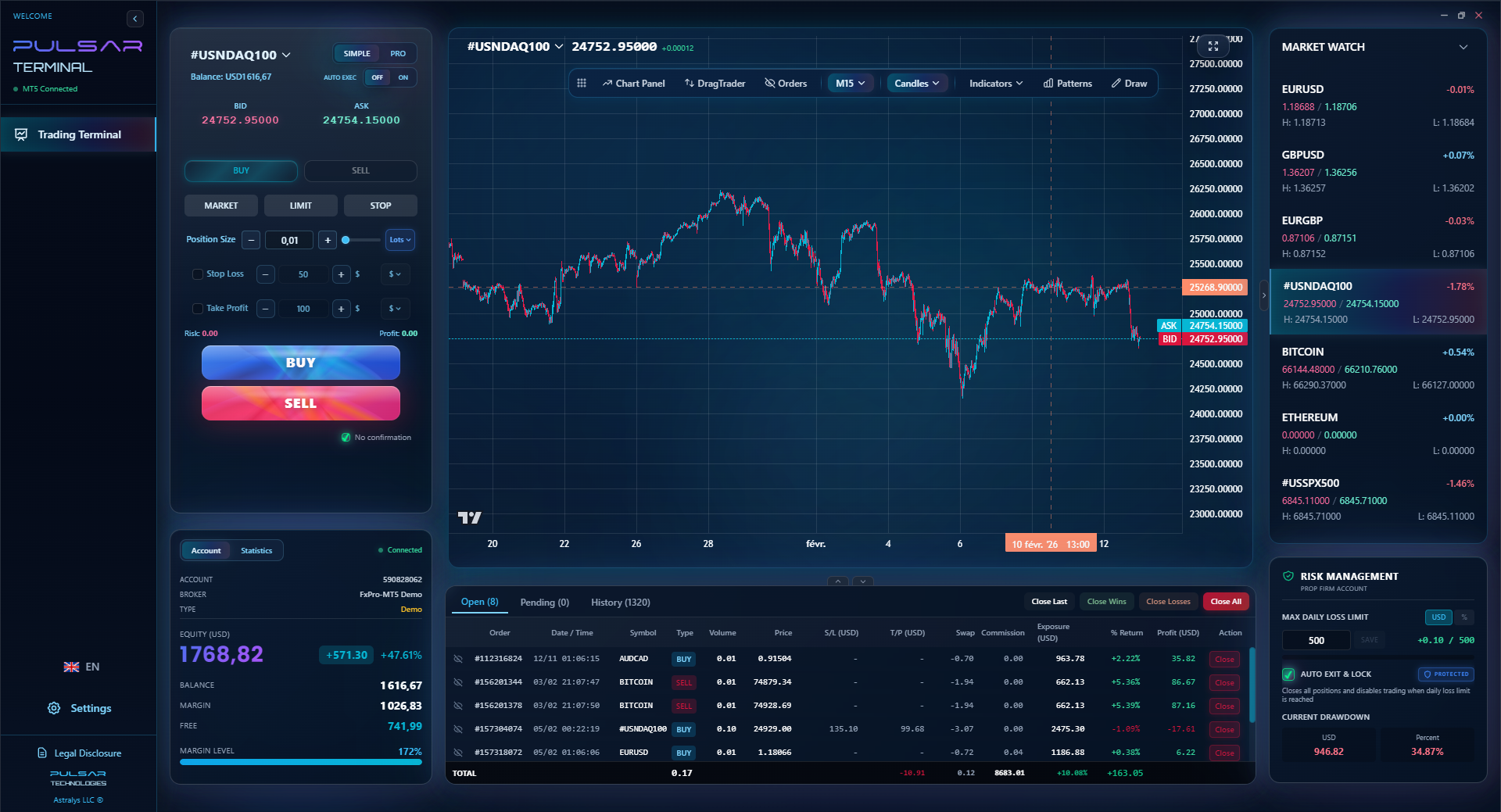
Managing multiple trades and protecting profits manually is exhausting; Pulsar Terminal automates trailing stops and partial closures directly on your MT5 charts.
Pulsar Terminal
MT5オールインワンツール:ドラッグ&ドロップ注文、マルチTP/SL、トレーリングストップ、グリッドトレード、出来高プロファイル、プロップファーム保護。毎日1,000人以上のトレーダーが利用。
“Your account is in USD, but your expenses are in cedis. Sometimes, not converting profits immediately is part of the strategy.”
Once you've survived six months and have consistent records, you can explore concepts that separate hobbyists from serious traders.
Correlation Trading: Some pairs move together (EUR/USD and GBP/USD are 80% correlated). Others move opposite (USD/JPY and Gold often inverse). In 2021, I noticed EUR/USD breaking down while USD/CHF was breaking up - both dollar pairs confirming strength. I went long USD/CHF with half my usual size since I was also in other dollar trades. Diversification matters.
Carry Trade: This involves buying a high-interest rate currency while selling a low-interest rate one, collecting the interest differential daily. With Ghana's policy rate at 29% in 2023 (now lower), theoretically you could have bought GHS against JPY (near 0%). But exotic pairs have huge spreads and political risk. I tried a mini carry trade with AUD/JPY once - made $12 in swap over two weeks, then lost $85 on price movement. Not worth it for retail traders.
Algorithmic Trading: This is using software (Expert Advisors on MT4) to trade automatically. I built a simple EA that traded based on MACD indicator crossovers. It made money in ranging markets but got slaughtered in trends. The key is rigorous backtesting. Don't buy 'winning' EAs from online marketers - if they worked, they wouldn't be selling them for $99.
Trading Psychology: This is 80% of long-term success. You need to manage fear, greed, and hope. I still get nervous before big trades. My solution: I reduce position size by 50% when I feel emotional. That way, even if I'm wrong, the loss won't hurt. Keep a trading journal that includes your emotional state. You'll see patterns - maybe you overtrade on Fridays, or you're afraid to pull the trigger after a big win.
Specializing: You can't master all pairs and all timeframes. I focus on EUR/USD and XAU/USD guide on the 4-hour and daily charts. Some traders excel at scalping strategy the 1-minute chart. Others are swing traders holding for weeks. Find what matches your personality and schedule. If you have a day job, don't try to scalp - you'll miss setups and hold losers too long.
“The biggest mistake isn't a losing trade - it's not having a plan. If you can't write your reason for trading in one sentence, don't take the trade.”
Trading from Ghana isn't the same as trading from London or New York. Our context shapes our opportunities and risks.
Power and Internet Stability: We have outages. I lost money in 2017 when my internet died during a trade. Now I have a backup USB modem and trade mostly on higher timeframes (4-hour+) so a 30-minute outage doesn't matter. Some brokers offer mobile apps with one-click close functionality - use it.
Currency Conversion Risk: Your account is in USD, but your expenses are in cedis. When the cedi strengthens, your dollar profits buy fewer cedis. In 2025, if you made $1,000 in June, it was worth about GHS 10,280. If you waited until December (when USD/GHS was around 11.5), that same $1,000 was worth GHS 11,500 - you gained 12% just from holding dollars. Sometimes, not converting immediately is part of the strategy.
Regulatory Changes Coming: The SEC Ghana is developing a framework for forex trading. This could mean local regulation of brokers, better consumer protection, but potentially restrictions on use or bonuses. Stay informed through official channels, not WhatsApp rumors.
Community and Scams: Ghana's trading community is growing, but so are scams. 'Fund managers' promising 10% monthly returns, fake investment schemes, and cloned broker websites. Verify everything. If an opportunity sounds too good, it is. Real traders share losses, not just screenshots of profits.
The Bottom Line for Ghanaians: Forex trading offers a way to participate in global markets from anywhere with internet. It can hedge against cedi depreciation (though trading GHS pairs directly is tricky). It requires discipline, continuous learning, and treating it as a business, not a casino. Start small, learn consistently, and focus on preserving capital before chasing profits. The market will be here tomorrow, next month, next year. Your job is to still be here with it.
Pro Tip: Connect your trading to the real economy. When you hear cocoa prices are up, think about how that affects Ghana's trade balance and potentially the cedi. When the Bank of Ghana intervenes in the forex market, understand what that means for USD/GHS. Context makes analysis richer.
💡 ウィンストンのヒント
Test your broker's withdrawal process with a small amount before you have large profits waiting. The ease of getting your money out is more important than any bonus or fancy platform feature.
FAQ
Q1Is forex trading legal in Ghana?
Yes, forex trading is legal for individuals in Ghana. However, there's currently no specific Ghanaian regulator overseeing online retail forex trading with international brokers. The Bank of Ghana regulates physical forex bureaus and banks, while the SEC regulates securities. Most Ghanaian traders use brokers regulated abroad (like FSCA, ASIC). The BoG doesn't prohibit this, but they also can't protect you if an offshore broker fails.
Q2What is the minimum amount needed to start forex trading in Ghana?
You can start with as little as $5 (about GHS 65) with brokers like XM or Exness that offer micro accounts. However, I realistically recommend $100-$200 (GHS 1,100-2,200) for proper risk management. With $50, you can only trade tiny positions, which limits learning. The minimum isn't about entering the market - it's about having enough to survive early mistakes without blowing your account.
Q3How do I withdraw my forex profits to my Ghanaian bank account?
You request a withdrawal through your broker's platform to the same method you deposited (usually bank transfer or mobile money). The broker sends USD (or another currency) to your bank. Your bank converts it to cedis at their exchange rate and credits your account. Be aware: as of 2025, banks charge a 5% fee on foreign currency withdrawals from accounts credited electronically. Withdraw larger amounts less frequently to minimize this fee impact.
Q4Do I pay taxes on forex trading profits in Ghana?
Yes. The Ghana Revenue Authority (GRA) treats trading profits as income, subject to personal income tax rates (0-35%). You must declare this income in your annual tax return. Keep detailed records of all trades, deposits, and withdrawals, including the cedi equivalent on the day you close trades. If trading through a registered company, corporate tax rates (around 25%) apply. Consult a tax professional once your profits become significant.
Q5Can I trade the Ghanaian cedi (GHS) on forex platforms?
Most major international brokers (Exness, XM, etc.) do not offer GHS pairs like USD/GHS. You would need a specialized broker or local platform that offers emerging market currencies. These pairs typically have very wide spreads (50-150 pips) and high volatility. As a beginner, I recommend focusing on major pairs like EUR/USD with tighter spreads and more predictable liquidity.
Q6What's the difference between a forex bureau and forex trading?
A forex bureau (like those in Accra Mall or airport) exchanges physical currency at a posted rate with a fixed margin for their service. You walk in with cedis, walk out with dollars. Forex trading is speculative: you're buying and selling currency contracts electronically, hoping the exchange rate moves in your favor. You never handle physical cash, and you can profit from rates going down (shorting) as well as up.
Q7How much use should a beginner in Ghana use?
As little as possible. Even though brokers might offer 1:500 or 1:1000 use to Ghanaian clients, that's dangerous. I recommend starting with no more than 1:10 to 1:30. With a $200 account at 1:30, you control $6,000 - enough to learn position sizing without wiping out on one bad trade. High use is the fastest way to lose everything. I learned this the hard way in 2016.
ウィンストン教授のレッスン
重要ポイント:
- ✓Start with ≤1:30 use, no matter what brokers offer
- ✓Risk only 1-2% of your account per trade
- ✓Keep detailed records for GRA from day one
- ✓Expect to lose your first account - it's tuition
- ✓Withdrawals cost 5% fee - plan accordingly
この記事はどれくらい役に立ちましたか?
星をクリックして評価
週刊トレーディングインサイト
無料の週刊分析&戦略。スパムなし。
著者について
Olumide Adeyemi
西アフリカ・トレーディングの先駆者
ナイジェリアで最もアクティブなFXトレーディング教育者の一人。ラゴスから8年のトレード経験。アフリカのトレーダー向けの少額資金戦略とプロップファームチャレンジを専門とする。
コメント
リスク警告
金融商品の取引には大きなリスクが伴い、すべての投資家に適しているわけではありません。過去の実績は将来の結果を保証するものではありません。本コンテンツは教育目的のみであり、投資助言として解釈すべきではありません。取引前に必ずご自身で調査を行ってください。
こちらもおすすめ

Cara Trading Forex Sukses: 7 Prinsip dari Trader Profesional
Cara trading forex sukses dengan 7 prinsip trader pro: manajemen modal, disiplin, journal trading, backtest. Data nyata, bukan janji profit palsu.
Jam Trading Forex Terbaik untuk Trader Indonesia: Panduan Lengkap dengan Tabel Waktu
Panduan jam trading forex untuk trader Indonesia. Tabel 4 sesi dunia, jam emas 20:00-00:00, sesi mana yang harus dihindari. Data akurat + tips dari trader berpengalaman.
Top 5 Sàn Forex Uy Tín Nhất 2026: Review Jujur dari Trader Indonesia
Top 5 sàn forex uy tín 2026 untuk trader Indonesia. Review jujur: spread, deposit, withdraw, dukungan lokal. Exness, XM, IC Markets & lebih.
